

Unbreakable? Researchers warn quantum computers have serious security flawsArtificial Intelligence News — ScienceDaily Quantum computers could revolutionize everything from drug discovery to business analytics—but their incredible power also makes them surprisingly vulnerable. New research from Penn State warns that today’s quantum machines are not just futuristic tools, but potential gold mines for hackers. The study reveals that weaknesses can exist not only in software, but deep within the physical hardware itself, where valuable algorithms and sensitive data may be exposed.
Quantum computers could revolutionize everything from drug discovery to business analytics—but their incredible power also makes them surprisingly vulnerable. New research from Penn State warns that today’s quantum machines are not just futuristic tools, but potential gold mines for hackers. The study reveals that weaknesses can exist not only in software, but deep within the physical hardware itself, where valuable algorithms and sensitive data may be exposed. Read More
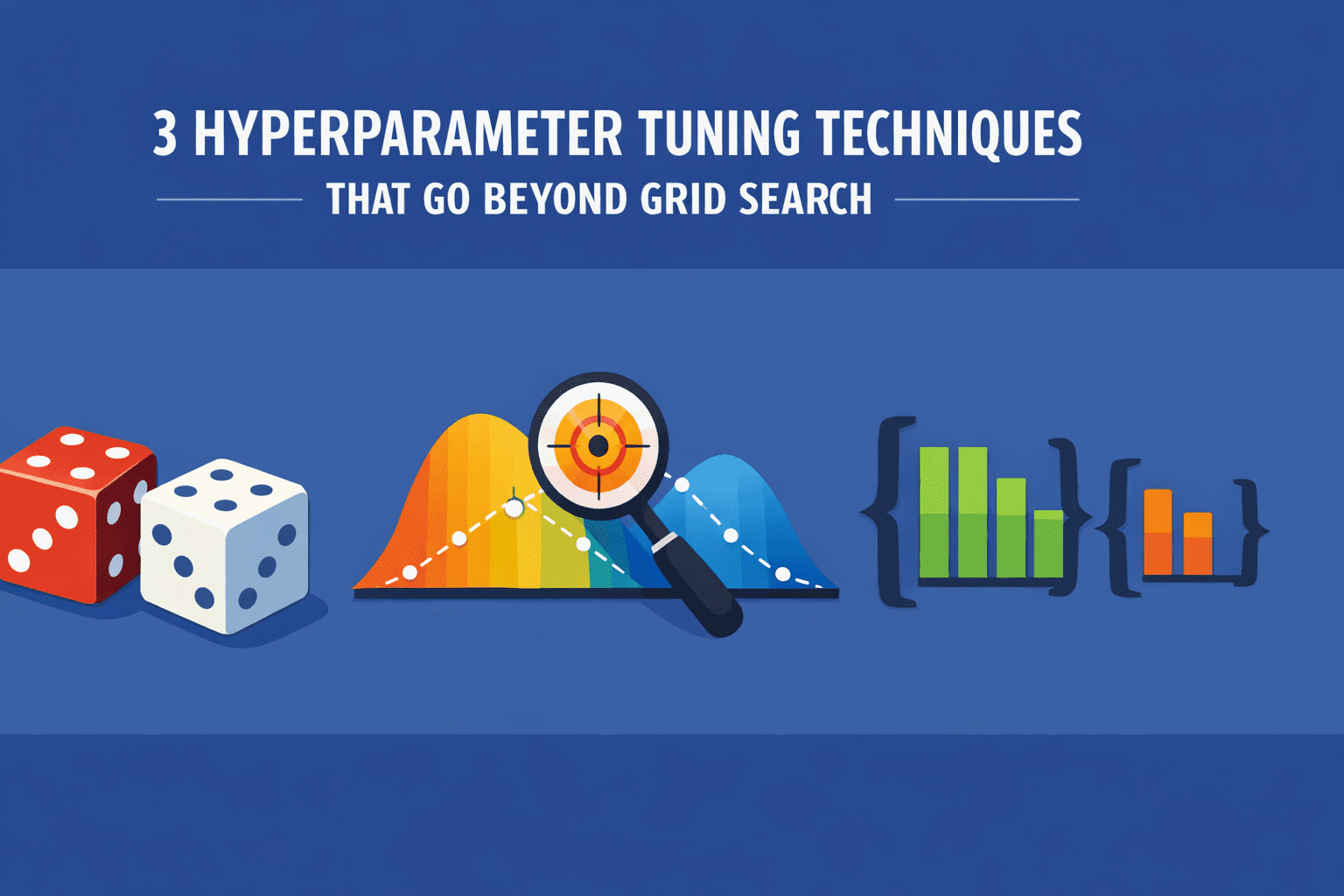
3 Hyperparameter Tuning Techniques That Go Beyond Grid SearchKDnuggets Uncover how advanced hyperparameter search methods in machine learning work, and why they can find optimal model configurations faster.
Uncover how advanced hyperparameter search methods in machine learning work, and why they can find optimal model configurations faster. Read More
Microsoft Research Releases OptiMind: A 20B Parameter Model that Turns Natural Language into Solver Ready Optimization ModelsMarkTechPost Microsoft Research has released OptiMind, an AI based system that converts natural language descriptions of complex decision problems into mathematical formulations that optimization solvers can execute. It targets a long standing bottleneck in operations research, where translating business intent into mixed integer linear programs usually needs expert modelers and days of work. What OptiMind Is
The post Microsoft Research Releases OptiMind: A 20B Parameter Model that Turns Natural Language into Solver Ready Optimization Models appeared first on MarkTechPost.
Microsoft Research has released OptiMind, an AI based system that converts natural language descriptions of complex decision problems into mathematical formulations that optimization solvers can execute. It targets a long standing bottleneck in operations research, where translating business intent into mixed integer linear programs usually needs expert modelers and days of work. What OptiMind Is
The post Microsoft Research Releases OptiMind: A 20B Parameter Model that Turns Natural Language into Solver Ready Optimization Models appeared first on MarkTechPost. Read More
How to Design a Fully Streaming Voice Agent with End-to-End Latency Budgets, Incremental ASR, LLM Streaming, and Real-Time TTSMarkTechPost In this tutorial, we build an end-to-end streaming voice agent that mirrors how modern low-latency conversational systems operate in real time. We simulate the complete pipeline, from chunked audio input and streaming speech recognition to incremental language model reasoning and streamed text-to-speech output, while explicitly tracking latency at every stage. By working with strict latency
The post How to Design a Fully Streaming Voice Agent with End-to-End Latency Budgets, Incremental ASR, LLM Streaming, and Real-Time TTS appeared first on MarkTechPost.
In this tutorial, we build an end-to-end streaming voice agent that mirrors how modern low-latency conversational systems operate in real time. We simulate the complete pipeline, from chunked audio input and streaming speech recognition to incremental language model reasoning and streamed text-to-speech output, while explicitly tracking latency at every stage. By working with strict latency
The post How to Design a Fully Streaming Voice Agent with End-to-End Latency Budgets, Incremental ASR, LLM Streaming, and Real-Time TTS appeared first on MarkTechPost. Read More
10 GitHub Repositories to Ace Any Tech InterviewKDnuggets The most trusted GitHub repositories to help you master coding interviews, system design, backend engineering, scalability, data structures and algorithms, and machine learning interviews with confidence.
The most trusted GitHub repositories to help you master coding interviews, system design, backend engineering, scalability, data structures and algorithms, and machine learning interviews with confidence. Read More
Why Package Installs Are Slow (And How to Fix It)Towards Data Science How sharded indexing patterns solve a scaling problem in package management
The post Why Package Installs Are Slow (And How to Fix It) appeared first on Towards Data Science.
How sharded indexing patterns solve a scaling problem in package management
The post Why Package Installs Are Slow (And How to Fix It) appeared first on Towards Data Science. Read More
Robot-R1: Reinforcement Learning for Enhanced Embodied Reasoning in Robotics AI updates on arXiv.org
Robot-R1: Reinforcement Learning for Enhanced Embodied Reasoning in Roboticscs.AI updates on arXiv.org arXiv:2506.00070v3 Announce Type: replace-cross
Abstract: Large Vision-Language Models (LVLMs) have recently shown great promise in advancing robotics by combining embodied reasoning with robot control. A common approach involves training on embodied reasoning tasks related to robot control using Supervised Fine-Tuning (SFT). However, SFT datasets are often heuristically constructed and not explicitly optimized for improving robot control. Furthermore, SFT often leads to issues such as catastrophic forgetting and reduced generalization performance. To address these limitations, we introduce Robot-R1, a novel framework that leverages reinforcement learning to enhance embodied reasoning specifically for robot control. Robot-R1 learns to predict the next keypoint state required for task completion, conditioned on the current scene image and environment metadata derived from expert demonstrations. Inspired by the DeepSeek-R1 learning approach, Robot-R1 samples reasoning-based responses and reinforces those that lead to more accurate predictions. To rigorously evaluate Robot-R1, we also introduce a new benchmark that demands the diverse embodied reasoning capabilities for the task. Our experiments show that models trained with Robot-R1 outperform SFT methods on embodied reasoning tasks. Despite having only 7B parameters, Robot-R1 even surpasses GPT-4o on reasoning tasks related to low-level action control, such as spatial and movement reasoning.
arXiv:2506.00070v3 Announce Type: replace-cross
Abstract: Large Vision-Language Models (LVLMs) have recently shown great promise in advancing robotics by combining embodied reasoning with robot control. A common approach involves training on embodied reasoning tasks related to robot control using Supervised Fine-Tuning (SFT). However, SFT datasets are often heuristically constructed and not explicitly optimized for improving robot control. Furthermore, SFT often leads to issues such as catastrophic forgetting and reduced generalization performance. To address these limitations, we introduce Robot-R1, a novel framework that leverages reinforcement learning to enhance embodied reasoning specifically for robot control. Robot-R1 learns to predict the next keypoint state required for task completion, conditioned on the current scene image and environment metadata derived from expert demonstrations. Inspired by the DeepSeek-R1 learning approach, Robot-R1 samples reasoning-based responses and reinforces those that lead to more accurate predictions. To rigorously evaluate Robot-R1, we also introduce a new benchmark that demands the diverse embodied reasoning capabilities for the task. Our experiments show that models trained with Robot-R1 outperform SFT methods on embodied reasoning tasks. Despite having only 7B parameters, Robot-R1 even surpasses GPT-4o on reasoning tasks related to low-level action control, such as spatial and movement reasoning. Read More
Panacea: Mitigating Harmful Fine-tuning for Large Language Models via Post-fine-tuning Perturbationcs.AI updates on arXiv.org arXiv:2501.18100v2 Announce Type: replace-cross
Abstract: Harmful fine-tuning attack introduces significant security risks to the fine-tuning services. Main-stream defenses aim to vaccinate the model such that the later harmful fine-tuning attack is less effective. However, our evaluation results show that such defenses are fragile–with a few fine-tuning steps, the model still can learn the harmful knowledge. To this end, we do further experiment and find that an embarrassingly simple solution–adding purely random perturbations to the fine-tuned model, can recover the model from harmful behaviors, though it leads to a degradation in the model’s fine-tuning performance. To address the degradation of fine-tuning performance, we further propose Panacea, which optimizes an adaptive perturbation that will be applied to the model after fine-tuning. Panacea maintains model’s safety alignment performance without compromising downstream fine-tuning performance. Comprehensive experiments are conducted on different harmful ratios, fine-tuning tasks and mainstream LLMs, where the average harmful scores are reduced by up-to 21.2%, while maintaining fine-tuning performance. As a by-product, we analyze the adaptive perturbation and show that different layers in various LLMs have distinct safety affinity, which coincide with finding from several previous study. Source code available at https://github.com/w-yibo/Panacea.
arXiv:2501.18100v2 Announce Type: replace-cross
Abstract: Harmful fine-tuning attack introduces significant security risks to the fine-tuning services. Main-stream defenses aim to vaccinate the model such that the later harmful fine-tuning attack is less effective. However, our evaluation results show that such defenses are fragile–with a few fine-tuning steps, the model still can learn the harmful knowledge. To this end, we do further experiment and find that an embarrassingly simple solution–adding purely random perturbations to the fine-tuned model, can recover the model from harmful behaviors, though it leads to a degradation in the model’s fine-tuning performance. To address the degradation of fine-tuning performance, we further propose Panacea, which optimizes an adaptive perturbation that will be applied to the model after fine-tuning. Panacea maintains model’s safety alignment performance without compromising downstream fine-tuning performance. Comprehensive experiments are conducted on different harmful ratios, fine-tuning tasks and mainstream LLMs, where the average harmful scores are reduced by up-to 21.2%, while maintaining fine-tuning performance. As a by-product, we analyze the adaptive perturbation and show that different layers in various LLMs have distinct safety affinity, which coincide with finding from several previous study. Source code available at https://github.com/w-yibo/Panacea. Read More

SAP and Fresenius to build sovereign AI backbone for healthcareAI News SAP and Fresenius are building a sovereign AI platform for healthcare that brings secure data processing to clinical settings. For data leaders in the medical sector, deploying AI requires strict governance that public cloud solutions often lack. This collaboration addresses that gap by creating a “controlled environment” where AI models can operate without compromising data
The post SAP and Fresenius to build sovereign AI backbone for healthcare appeared first on AI News.
SAP and Fresenius are building a sovereign AI platform for healthcare that brings secure data processing to clinical settings. For data leaders in the medical sector, deploying AI requires strict governance that public cloud solutions often lack. This collaboration addresses that gap by creating a “controlled environment” where AI models can operate without compromising data
The post SAP and Fresenius to build sovereign AI backbone for healthcare appeared first on AI News. Read More
Bridging the Gap Between Research and Readability with Marco Hening TallaricoTowards Data Science Diluting complex research, spotting silent data leaks, and why the best way to learn is often backwards.
The post Bridging the Gap Between Research and Readability with Marco Hening Tallarico appeared first on Towards Data Science.
Diluting complex research, spotting silent data leaks, and why the best way to learn is often backwards.
The post Bridging the Gap Between Research and Readability with Marco Hening Tallarico appeared first on Towards Data Science. Read More