

Red Hat unifies AI and tactical edge deployment for UK MODAI News The UK Ministry of Defence (MOD) has selected Red Hat to architect a unified AI and hybrid cloud backbone across its entire estate. Announced today, the agreement is designed to break down data silos and accelerate the deployment of AI models from the data centre to the tactical edge. For CIOs, it’s part of a
The post Red Hat unifies AI and tactical edge deployment for UK MOD appeared first on AI News.
The UK Ministry of Defence (MOD) has selected Red Hat to architect a unified AI and hybrid cloud backbone across its entire estate. Announced today, the agreement is designed to break down data silos and accelerate the deployment of AI models from the data centre to the tactical edge. For CIOs, it’s part of a
The post Red Hat unifies AI and tactical edge deployment for UK MOD appeared first on AI News. Read More

MACD: Model-Aware Contrastive Decoding via Counterfactual Datacs.AI updates on arXiv.org arXiv:2602.01740v2 Announce Type: replace
Abstract: Video language models (Video-LLMs) are prone to hallucinations, often generating plausible but ungrounded content when visual evidence is weak, ambiguous, or biased. Existing decoding methods, such as contrastive decoding (CD), rely on random perturbations to construct contrastive data for mitigating hallucination patterns. However, such a way is hard to control the visual cues that drive hallucination or well align with model weaknesses. We propose Model-aware Counterfactual Data based Contrastive Decoding (MACD), a new inference strategy that combines model-guided counterfactual construction with decoding. Our approach uses the Video-LLM’s own feedback to identify object regions most responsible for hallucination, generating targeted counterfactual inputs at the object level rather than arbitrary frame or temporal modifications. These model-aware counterfactual data is then integrated into CD to enforce evidence-grounded token selection during decoding. Experiments on EventHallusion, MVBench, Perception-test and Video-MME show that MACD consistently reduces hallucination while maintaining or improving task accuracy across diverse Video-LLMs, including Qwen and InternVL families. The method is especially effective in challenging scenarios involving small, occluded, or co-occurring objects. Our code and data will be publicly released.
arXiv:2602.01740v2 Announce Type: replace
Abstract: Video language models (Video-LLMs) are prone to hallucinations, often generating plausible but ungrounded content when visual evidence is weak, ambiguous, or biased. Existing decoding methods, such as contrastive decoding (CD), rely on random perturbations to construct contrastive data for mitigating hallucination patterns. However, such a way is hard to control the visual cues that drive hallucination or well align with model weaknesses. We propose Model-aware Counterfactual Data based Contrastive Decoding (MACD), a new inference strategy that combines model-guided counterfactual construction with decoding. Our approach uses the Video-LLM’s own feedback to identify object regions most responsible for hallucination, generating targeted counterfactual inputs at the object level rather than arbitrary frame or temporal modifications. These model-aware counterfactual data is then integrated into CD to enforce evidence-grounded token selection during decoding. Experiments on EventHallusion, MVBench, Perception-test and Video-MME show that MACD consistently reduces hallucination while maintaining or improving task accuracy across diverse Video-LLMs, including Qwen and InternVL families. The method is especially effective in challenging scenarios involving small, occluded, or co-occurring objects. Our code and data will be publicly released. Read More
Debugging code world modelscs.AI updates on arXiv.org arXiv:2602.07672v1 Announce Type: cross
Abstract: Code World Models (CWMs) are language models trained to simulate program execution by predicting explicit runtime state after every executed command. This execution-based world modeling enables internal verification within the model, offering an alternative to natural language chain-of-thought reasoning. However, the sources of errors and the nature of CWMs’ limitations remain poorly understood. We study CWMs from two complementary perspectives: local semantic execution and long-horizon state tracking. On real-code benchmarks, we identify two dominant failure regimes. First, dense runtime state reveals produce token-intensive execution traces, leading to token-budget exhaustion on programs with long execution histories. Second, failures disproportionately concentrate in string-valued state, which we attribute to limitations of subword tokenization rather than program structure. To study long-horizon behavior, we use a controlled permutation-tracking benchmark that isolates state propagation under action execution. We show that long-horizon degradation is driven primarily by incorrect action generation: when actions are replaced with ground-truth commands, a Transformer-based CWM propagates state accurately over long horizons, despite known limitations of Transformers in long-horizon state tracking. These findings suggest directions for more efficient supervision and state representations in CWMs that are better aligned with program execution and data types.
arXiv:2602.07672v1 Announce Type: cross
Abstract: Code World Models (CWMs) are language models trained to simulate program execution by predicting explicit runtime state after every executed command. This execution-based world modeling enables internal verification within the model, offering an alternative to natural language chain-of-thought reasoning. However, the sources of errors and the nature of CWMs’ limitations remain poorly understood. We study CWMs from two complementary perspectives: local semantic execution and long-horizon state tracking. On real-code benchmarks, we identify two dominant failure regimes. First, dense runtime state reveals produce token-intensive execution traces, leading to token-budget exhaustion on programs with long execution histories. Second, failures disproportionately concentrate in string-valued state, which we attribute to limitations of subword tokenization rather than program structure. To study long-horizon behavior, we use a controlled permutation-tracking benchmark that isolates state propagation under action execution. We show that long-horizon degradation is driven primarily by incorrect action generation: when actions are replaced with ground-truth commands, a Transformer-based CWM propagates state accurately over long horizons, despite known limitations of Transformers in long-horizon state tracking. These findings suggest directions for more efficient supervision and state representations in CWMs that are better aligned with program execution and data types. Read More
5 Useful Python Scripts to Automate Boring File TasksKDnuggets Tired of sifting through bloated folders, waiting on manual conversions, or not quite knowing what is on your drive? These Python scripts handle the file grunt work so you don’t have to.
Tired of sifting through bloated folders, waiting on manual conversions, or not quite knowing what is on your drive? These Python scripts handle the file grunt work so you don’t have to. Read More
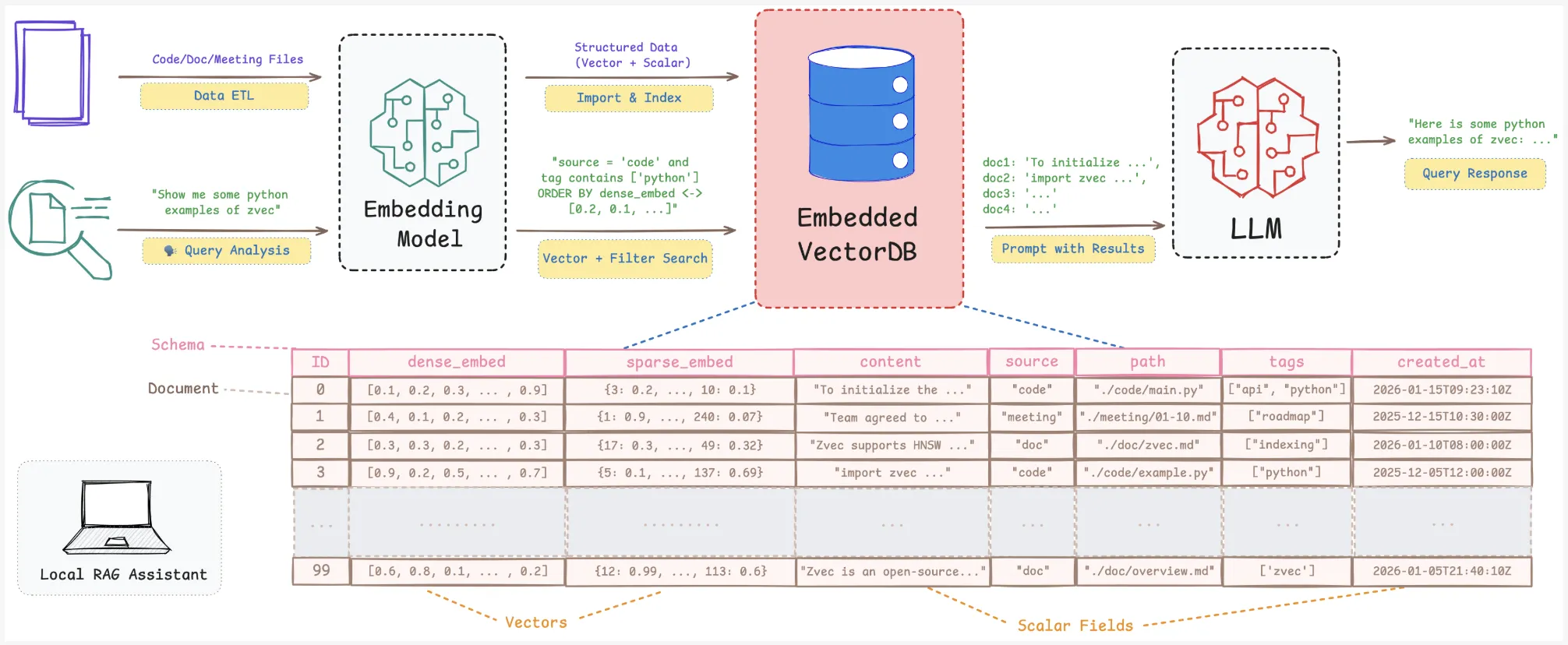
Alibaba Open-Sources Zvec: An Embedded Vector Database Bringing SQLite-like Simplicity and High-Performance On-Device RAG to Edge ApplicationsMarkTechPost Alibaba Tongyi Lab research team released ‘Zvec’, an open source, in-process vector database that targets edge and on-device retrieval workloads. It is positioned as ‘the SQLite of vector databases’ because it runs as a library inside your application and does not require any external service or daemon. It is designed for retrieval augmented generation (RAG),
The post Alibaba Open-Sources Zvec: An Embedded Vector Database Bringing SQLite-like Simplicity and High-Performance On-Device RAG to Edge Applications appeared first on MarkTechPost.
Alibaba Tongyi Lab research team released ‘Zvec’, an open source, in-process vector database that targets edge and on-device retrieval workloads. It is positioned as ‘the SQLite of vector databases’ because it runs as a library inside your application and does not require any external service or daemon. It is designed for retrieval augmented generation (RAG),
The post Alibaba Open-Sources Zvec: An Embedded Vector Database Bringing SQLite-like Simplicity and High-Performance On-Device RAG to Edge Applications appeared first on MarkTechPost. Read More
Building Your Modern Data Analytics Stack with Python, Parquet, and DuckDBKDnuggets Modern data analytics doesn’t have to be complex. Learn how Python, Parquet, and DuckDB work together in practice.
Modern data analytics doesn’t have to be complex. Learn how Python, Parquet, and DuckDB work together in practice. Read More
How to Model The Expected Value of Marketing CampaignsTowards Data Science The approach that takes companies to the next level of data maturity
The post How to Model The Expected Value of Marketing Campaigns appeared first on Towards Data Science.
The approach that takes companies to the next level of data maturity
The post How to Model The Expected Value of Marketing Campaigns appeared first on Towards Data Science. Read More
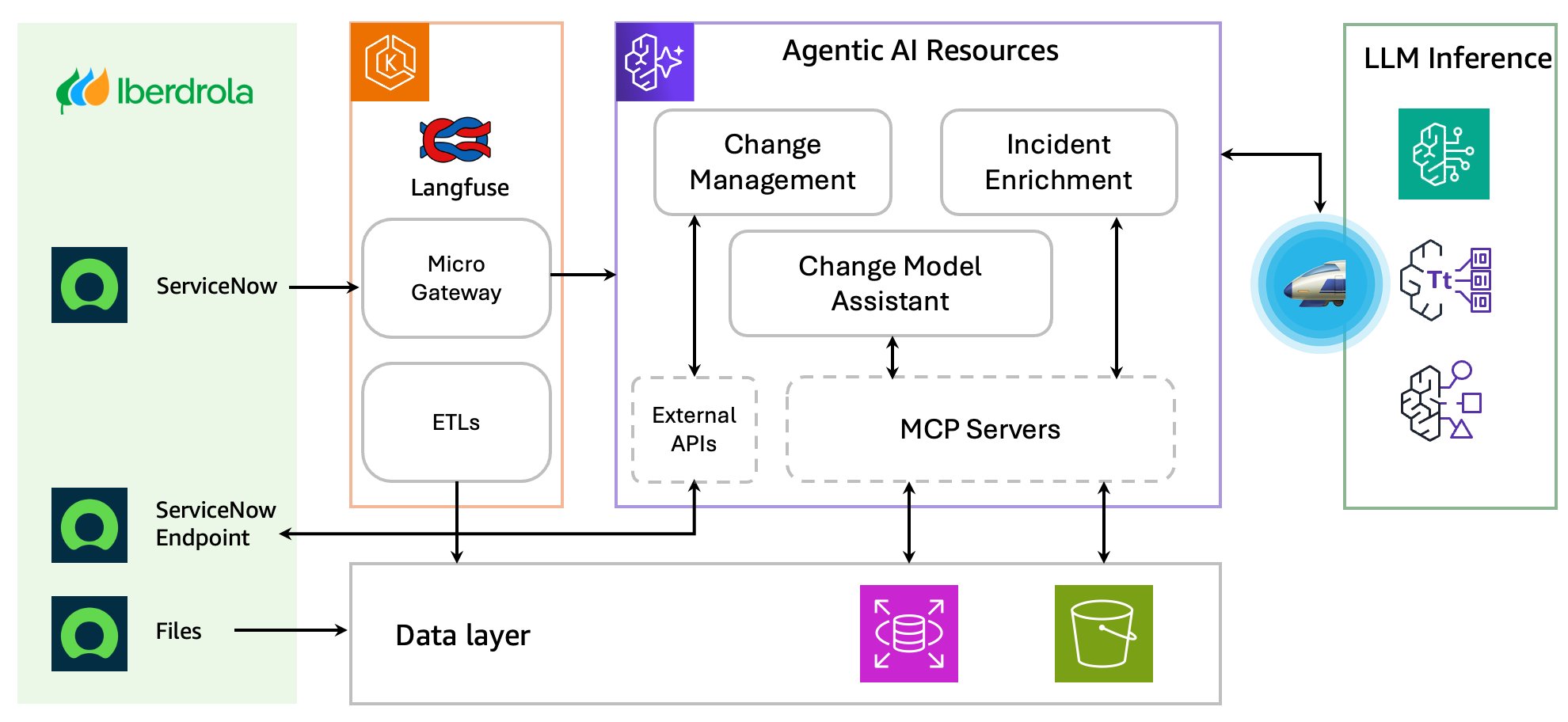
Iberdrola enhances IT operations using Amazon Bedrock AgentCoreArtificial Intelligence Iberdrola, one of the world’s largest utility companies, has embraced cutting-edge AI technology to revolutionize its IT operations in ServiceNow. Through its partnership with AWS, Iberdrola implemented different agentic architectures using Amazon Bedrock AgentCore, targeting three key areas: optimizing change request validation in the draft phase, enriching incident management with contextual intelligence, and simplifying change model selection using conversational AI. These innovations reduce bottlenecks, help teams accelerate ticket resolution, and deliver consistent and high-quality data handling throughout the organization.
Iberdrola, one of the world’s largest utility companies, has embraced cutting-edge AI technology to revolutionize its IT operations in ServiceNow. Through its partnership with AWS, Iberdrola implemented different agentic architectures using Amazon Bedrock AgentCore, targeting three key areas: optimizing change request validation in the draft phase, enriching incident management with contextual intelligence, and simplifying change model selection using conversational AI. These innovations reduce bottlenecks, help teams accelerate ticket resolution, and deliver consistent and high-quality data handling throughout the organization. Read More
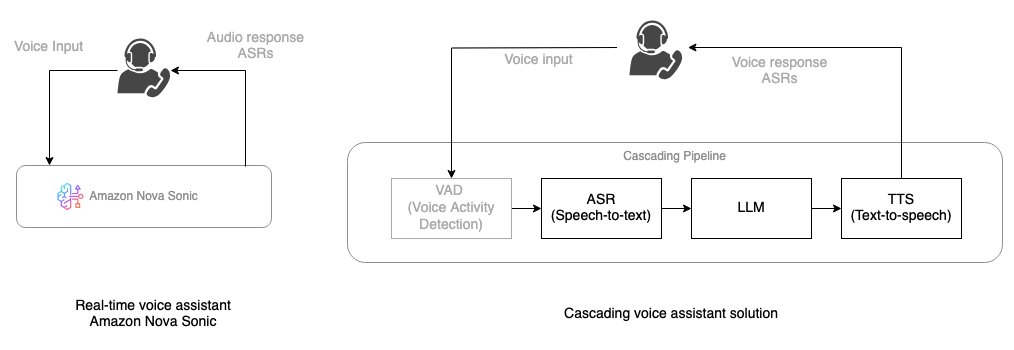
Building real-time voice assistants with Amazon Nova Sonic compared to cascading architecturesArtificial Intelligence Amazon Nova Sonic delivers real-time, human-like voice conversations through the bidirectional streaming interface. In this post, you learn how Amazon Nova Sonic can solve some of the challenges faced by cascaded approaches, simplify building voice AI agents, and provide natural conversational capabilities. We also provide guidance on when to choose each approach to help you make informed decisions for your voice AI projects.
Amazon Nova Sonic delivers real-time, human-like voice conversations through the bidirectional streaming interface. In this post, you learn how Amazon Nova Sonic can solve some of the challenges faced by cascaded approaches, simplify building voice AI agents, and provide natural conversational capabilities. We also provide guidance on when to choose each approach to help you make informed decisions for your voice AI projects. Read More

What Every Small Business Needs to Know About Agentic AIKDnuggets Generative AI, as experienced using traditional chat-style interfaces, has proven to be an incredibly useful tool. Still, it has a major limitation: it sits there and waits for you to type.
Generative AI, as experienced using traditional chat-style interfaces, has proven to be an incredibly useful tool. Still, it has a major limitation: it sits there and waits for you to type. Read More