

Google AI Introduces the WebMCP to Enable Direct and Structured Website Interactions for New AI AgentsMarkTechPost Google is officially turning Chrome into a playground for AI agents. For years, AI ‘browsers’ have relied on a messy process: taking screenshots of websites, running them through vision models, and guessing where to click. This method is slow, breaks easily, and consumes massive amounts of compute. Google has introduced a better way: the Web
The post Google AI Introduces the WebMCP to Enable Direct and Structured Website Interactions for New AI Agents appeared first on MarkTechPost.
Google is officially turning Chrome into a playground for AI agents. For years, AI ‘browsers’ have relied on a messy process: taking screenshots of websites, running them through vision models, and guessing where to click. This method is slow, breaks easily, and consumes massive amounts of compute. Google has introduced a better way: the Web
The post Google AI Introduces the WebMCP to Enable Direct and Structured Website Interactions for New AI Agents appeared first on MarkTechPost. Read More
Brain inspired machines are better at math than expected Artificial Intelligence News — ScienceDaily
Brain inspired machines are better at math than expectedArtificial Intelligence News — ScienceDaily Neuromorphic computers modeled after the human brain can now solve the complex equations behind physics simulations — something once thought possible only with energy-hungry supercomputers. The breakthrough could lead to powerful, low-energy supercomputers while revealing new secrets about how our brains process information.
Neuromorphic computers modeled after the human brain can now solve the complex equations behind physics simulations — something once thought possible only with energy-hungry supercomputers. The breakthrough could lead to powerful, low-energy supercomputers while revealing new secrets about how our brains process information. Read More
How to Build a Self-Organizing Agent Memory System for Long-Term AI Reasoning MarkTechPost In this tutorial, we build a self-organizing memory system for an agent that goes beyond storing raw conversation history and instead structures interactions into persistent, meaningful knowledge units. We design the system so that reasoning and memory management are clearly separated, allowing a dedicated component to extract, compress, and organize information. At the same time,
The post How to Build a Self-Organizing Agent Memory System for Long-Term AI Reasoning appeared first on MarkTechPost.
In this tutorial, we build a self-organizing memory system for an agent that goes beyond storing raw conversation history and instead structures interactions into persistent, meaningful knowledge units. We design the system so that reasoning and memory management are clearly separated, allowing a dedicated component to extract, compress, and organize information. At the same time,
The post How to Build a Self-Organizing Agent Memory System for Long-Term AI Reasoning appeared first on MarkTechPost. Read More
Your First 90 Days as a Data ScientistTowards Data Science A practical onboarding checklist for building trust, business fluency, and data intuition
The post Your First 90 Days as a Data Scientist appeared first on Towards Data Science.
A practical onboarding checklist for building trust, business fluency, and data intuition
The post Your First 90 Days as a Data Scientist appeared first on Towards Data Science. Read More

In January 2022, researchers at Google Brain published a paper that changed how people interact with AI. Jason Wei and colleagues demonstrated that adding intermediate reasoning steps to prompts (a method they called “chain-of-thought prompting”) improved large language model performance on arithmetic, commonsense, and symbolic reasoning tasks (Wei et al., 2022, arXiv:2201.11903). The technique was […]

AI forecasting model targets healthcare resource efficiencyAI News An operational AI forecasting model developed by Hertfordshire University researchers aims to improve resource efficiency within healthcare. Public sector organisations often hold large archives of historical data that do not inform forward-looking decisions. A partnership between the University of Hertfordshire and regional NHS health bodies addresses this issue by applying machine learning to operational planning.
The post AI forecasting model targets healthcare resource efficiency appeared first on AI News.
An operational AI forecasting model developed by Hertfordshire University researchers aims to improve resource efficiency within healthcare. Public sector organisations often hold large archives of historical data that do not inform forward-looking decisions. A partnership between the University of Hertfordshire and regional NHS health bodies addresses this issue by applying machine learning to operational planning.
The post AI forecasting model targets healthcare resource efficiency appeared first on AI News. Read More
GPT-5.2 derives a new result in theoretical physicsOpenAI News A new preprint shows GPT-5.2 proposing a new formula for a gluon amplitude, later formally proved and verified by OpenAI and academic collaborators.
A new preprint shows GPT-5.2 proposing a new formula for a gluon amplitude, later formally proved and verified by OpenAI and academic collaborators. Read More

Customize AI agent browsing with proxies, profiles, and extensions in Amazon Bedrock AgentCore BrowserArtificial Intelligence Today, we are announcing three new capabilities that address these requirements: proxy configuration, browser profiles, and browser extensions. Together, these features give you fine-grained control over how your AI agents interact with the web. This post will walk through each capability with configuration examples and practical use cases to help you get started.
Today, we are announcing three new capabilities that address these requirements: proxy configuration, browser profiles, and browser extensions. Together, these features give you fine-grained control over how your AI agents interact with the web. This post will walk through each capability with configuration examples and practical use cases to help you get started. Read More
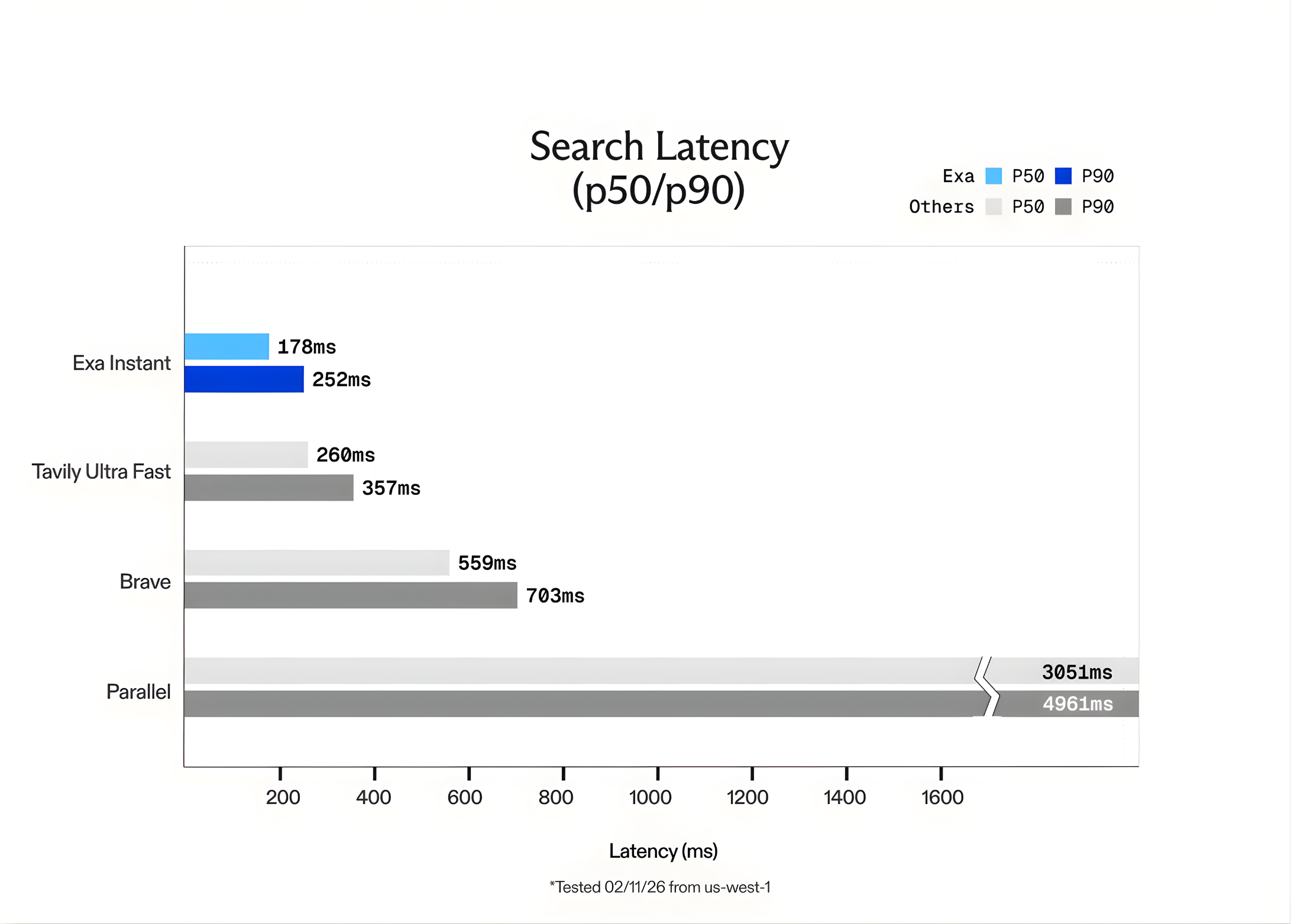
Exa AI Introduces Exa Instant: A Sub-200ms Neural Search Engine Designed to Eliminate Bottlenecks for Real-Time Agentic WorkflowsMarkTechPost In the world of Large Language Models (LLMs), speed is the only feature that matters once accuracy is solved. For a human, waiting 1 second for a search result is fine. For an AI agent performing 10 sequential searches to solve a complex task, a 1-second delay per search creates a 10-second lag. This latency
The post Exa AI Introduces Exa Instant: A Sub-200ms Neural Search Engine Designed to Eliminate Bottlenecks for Real-Time Agentic Workflows appeared first on MarkTechPost.
In the world of Large Language Models (LLMs), speed is the only feature that matters once accuracy is solved. For a human, waiting 1 second for a search result is fine. For an AI agent performing 10 sequential searches to solve a complex task, a 1-second delay per search creates a 10-second lag. This latency
The post Exa AI Introduces Exa Instant: A Sub-200ms Neural Search Engine Designed to Eliminate Bottlenecks for Real-Time Agentic Workflows appeared first on MarkTechPost. Read More
[In-Depth Guide] The Complete CTGAN + SDV Pipeline for High-Fidelity Synthetic DataMarkTechPost In this tutorial, we build a complete, production-grade synthetic data pipeline using CTGAN and the SDV ecosystem. We start from raw mixed-type tabular data and progressively move toward constrained generation, conditional sampling, statistical validation, and downstream utility testing. Rather than stopping at sample generation, we focus on understanding how well synthetic data preserves structure, distributions,
The post [In-Depth Guide] The Complete CTGAN + SDV Pipeline for High-Fidelity Synthetic Data appeared first on MarkTechPost.
In this tutorial, we build a complete, production-grade synthetic data pipeline using CTGAN and the SDV ecosystem. We start from raw mixed-type tabular data and progressively move toward constrained generation, conditional sampling, statistical validation, and downstream utility testing. Rather than stopping at sample generation, we focus on understanding how well synthetic data preserves structure, distributions,
The post [In-Depth Guide] The Complete CTGAN + SDV Pipeline for High-Fidelity Synthetic Data appeared first on MarkTechPost. Read More