

PodEval: A Multimodal Evaluation Framework for Podcast Audio Generationcs.AI updates on arXiv.org arXiv:2510.00485v1 Announce Type: cross
Abstract: Recently, an increasing number of multimodal (text and audio) benchmarks have emerged, primarily focusing on evaluating models’ understanding capability. However, exploration into assessing generative capabilities remains limited, especially for open-ended long-form content generation. Significant challenges lie in no reference standard answer, no unified evaluation metrics and uncontrollable human judgments. In this work, we take podcast-like audio generation as a starting point and propose PodEval, a comprehensive and well-designed open-source evaluation framework. In this framework: 1) We construct a real-world podcast dataset spanning diverse topics, serving as a reference for human-level creative quality. 2) We introduce a multimodal evaluation strategy and decompose the complex task into three dimensions: text, speech and audio, with different evaluation emphasis on “Content” and “Format”. 3) For each modality, we design corresponding evaluation methods, involving both objective metrics and subjective listening test. We leverage representative podcast generation systems (including open-source, close-source, and human-made) in our experiments. The results offer in-depth analysis and insights into podcast generation, demonstrating the effectiveness of PodEval in evaluating open-ended long-form audio. This project is open-source to facilitate public use: https://github.com/yujxx/PodEval.
arXiv:2510.00485v1 Announce Type: cross
Abstract: Recently, an increasing number of multimodal (text and audio) benchmarks have emerged, primarily focusing on evaluating models’ understanding capability. However, exploration into assessing generative capabilities remains limited, especially for open-ended long-form content generation. Significant challenges lie in no reference standard answer, no unified evaluation metrics and uncontrollable human judgments. In this work, we take podcast-like audio generation as a starting point and propose PodEval, a comprehensive and well-designed open-source evaluation framework. In this framework: 1) We construct a real-world podcast dataset spanning diverse topics, serving as a reference for human-level creative quality. 2) We introduce a multimodal evaluation strategy and decompose the complex task into three dimensions: text, speech and audio, with different evaluation emphasis on “Content” and “Format”. 3) For each modality, we design corresponding evaluation methods, involving both objective metrics and subjective listening test. We leverage representative podcast generation systems (including open-source, close-source, and human-made) in our experiments. The results offer in-depth analysis and insights into podcast generation, demonstrating the effectiveness of PodEval in evaluating open-ended long-form audio. This project is open-source to facilitate public use: https://github.com/yujxx/PodEval. Read More
Privacy-Preserving Learning-Augmented Data Structurescs.AI updates on arXiv.org arXiv:2510.00165v1 Announce Type: cross
Abstract: Learning-augmented data structures use predicted frequency estimates to retrieve frequently occurring database elements faster than standard data structures. Recent work has developed data structures that optimally exploit these frequency estimates while maintaining robustness to adversarial prediction errors. However, the privacy and security implications of this setting remain largely unexplored.
In the event of a security breach, data structures should reveal minimal information beyond their current contents. This is even more crucial for learning-augmented data structures, whose layout adapts to the data. A data structure is history independent if its memory representation reveals no information about past operations except what is inferred from its current contents. In this work, we take the first step towards privacy and security guarantees in this setting by proposing the first learning-augmented data structure that is strongly history independent, robust, and supports dynamic updates.
To achieve this, we introduce two techniques: thresholding, which automatically makes any learning-augmented data structure robust, and pairing, a simple technique that provides strong history independence in the dynamic setting. Our experimental results demonstrate a tradeoff between security and efficiency but are still competitive with the state of the art.
arXiv:2510.00165v1 Announce Type: cross
Abstract: Learning-augmented data structures use predicted frequency estimates to retrieve frequently occurring database elements faster than standard data structures. Recent work has developed data structures that optimally exploit these frequency estimates while maintaining robustness to adversarial prediction errors. However, the privacy and security implications of this setting remain largely unexplored.
In the event of a security breach, data structures should reveal minimal information beyond their current contents. This is even more crucial for learning-augmented data structures, whose layout adapts to the data. A data structure is history independent if its memory representation reveals no information about past operations except what is inferred from its current contents. In this work, we take the first step towards privacy and security guarantees in this setting by proposing the first learning-augmented data structure that is strongly history independent, robust, and supports dynamic updates.
To achieve this, we introduce two techniques: thresholding, which automatically makes any learning-augmented data structure robust, and pairing, a simple technique that provides strong history independence in the dynamic setting. Our experimental results demonstrate a tradeoff between security and efficiency but are still competitive with the state of the art. Read More
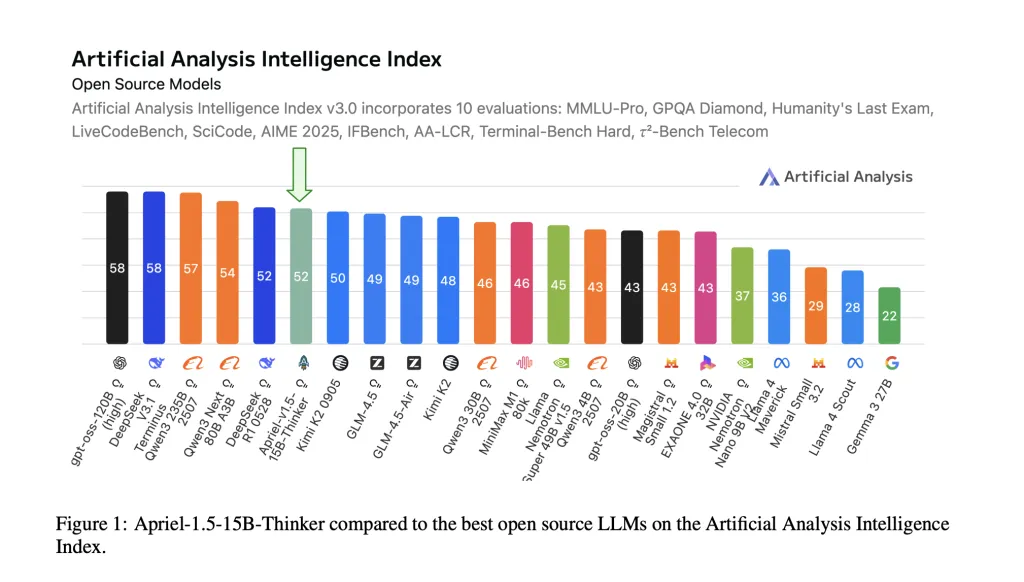
ServiceNow AI Releases Apriel-1.5-15B-Thinker: An Open-Weights Multimodal Reasoning Model that Hits Frontier-Level Performance on a Single-GPU BudgetMarkTechPost ServiceNow AI Research Lab has released Apriel-1.5-15B-Thinker, a 15-billion-parameter open-weights multimodal reasoning model trained with a data-centric mid-training recipe—continual pretraining followed by supervised fine-tuning—without reinforcement learning or preference optimization. The model attains an Artificial Analysis Intelligence Index score of 52 with 8x cost savings compared to SOTA. The checkpoint ships under an MIT license on
The post ServiceNow AI Releases Apriel-1.5-15B-Thinker: An Open-Weights Multimodal Reasoning Model that Hits Frontier-Level Performance on a Single-GPU Budget appeared first on MarkTechPost.
ServiceNow AI Research Lab has released Apriel-1.5-15B-Thinker, a 15-billion-parameter open-weights multimodal reasoning model trained with a data-centric mid-training recipe—continual pretraining followed by supervised fine-tuning—without reinforcement learning or preference optimization. The model attains an Artificial Analysis Intelligence Index score of 52 with 8x cost savings compared to SOTA. The checkpoint ships under an MIT license on
The post ServiceNow AI Releases Apriel-1.5-15B-Thinker: An Open-Weights Multimodal Reasoning Model that Hits Frontier-Level Performance on a Single-GPU Budget appeared first on MarkTechPost. Read More
TASER: Translation Assessment via Systematic Evaluation and Reasoningcs.AI updates on arXiv.org arXiv:2510.00255v1 Announce Type: cross
Abstract: We introduce TASER (Translation Assessment via Systematic Evaluation and Reasoning), a metric that uses Large Reasoning Models (LRMs) for automated translation quality assessment. TASER harnesses the explicit reasoning capabilities of LRMs to conduct systematic, step-by-step evaluation of translation quality. We evaluate TASER on the WMT24 Metrics Shared Task across both reference-based and reference-free scenarios, demonstrating state-of-the-art performance. In system-level evaluation, TASER achieves the highest soft pairwise accuracy in both reference-based and reference-free settings, outperforming all existing metrics. At the segment level, TASER maintains competitive performance with our reference-free variant ranking as the top-performing metric among all reference-free approaches. Our experiments reveal that structured prompting templates yield superior results with LRMs compared to the open-ended approaches that proved optimal for traditional LLMs. We evaluate o3, a large reasoning model from OpenAI, with varying reasoning efforts, providing insights into the relationship between reasoning depth and evaluation quality. The explicit reasoning process in LRMs offers interpretability and visibility, addressing a key limitation of existing automated metrics. Our results demonstrate that Large Reasoning Models show a measurable advancement in translation quality assessment, combining improved accuracy with transparent evaluation across diverse language pairs.
arXiv:2510.00255v1 Announce Type: cross
Abstract: We introduce TASER (Translation Assessment via Systematic Evaluation and Reasoning), a metric that uses Large Reasoning Models (LRMs) for automated translation quality assessment. TASER harnesses the explicit reasoning capabilities of LRMs to conduct systematic, step-by-step evaluation of translation quality. We evaluate TASER on the WMT24 Metrics Shared Task across both reference-based and reference-free scenarios, demonstrating state-of-the-art performance. In system-level evaluation, TASER achieves the highest soft pairwise accuracy in both reference-based and reference-free settings, outperforming all existing metrics. At the segment level, TASER maintains competitive performance with our reference-free variant ranking as the top-performing metric among all reference-free approaches. Our experiments reveal that structured prompting templates yield superior results with LRMs compared to the open-ended approaches that proved optimal for traditional LLMs. We evaluate o3, a large reasoning model from OpenAI, with varying reasoning efforts, providing insights into the relationship between reasoning depth and evaluation quality. The explicit reasoning process in LRMs offers interpretability and visibility, addressing a key limitation of existing automated metrics. Our results demonstrate that Large Reasoning Models show a measurable advancement in translation quality assessment, combining improved accuracy with transparent evaluation across diverse language pairs. Read More
Smarter, Not Harder: How AI’s Self-Doubt Unlocks Peak PerformanceTowards Data Science “Deep Think with Confidence,” a smarter way to scale reasoning tasks without wasting a massive amount of computation
The post Smarter, Not Harder: How AI’s Self-Doubt Unlocks Peak Performance appeared first on Towards Data Science.
“Deep Think with Confidence,” a smarter way to scale reasoning tasks without wasting a massive amount of computation
The post Smarter, Not Harder: How AI’s Self-Doubt Unlocks Peak Performance appeared first on Towards Data Science. Read More
How to Build an Advanced Agentic Retrieval-Augmented Generation (RAG) System with Dynamic Strategy and Smart Retrieval?MarkTechPoston October 1, 2025 at 4:11 am In this tutorial, we walk through the implementation of an Agentic Retrieval-Augmented Generation (RAG) system. We design it so that the agent does more than just retrieve documents; it actively decides when retrieval is needed, selects the best retrieval strategy, and synthesizes responses with contextual awareness. By combining embeddings, FAISS indexing, and a mock LLM,
The post How to Build an Advanced Agentic Retrieval-Augmented Generation (RAG) System with Dynamic Strategy and Smart Retrieval? appeared first on MarkTechPost.
In this tutorial, we walk through the implementation of an Agentic Retrieval-Augmented Generation (RAG) system. We design it so that the agent does more than just retrieve documents; it actively decides when retrieval is needed, selects the best retrieval strategy, and synthesizes responses with contextual awareness. By combining embeddings, FAISS indexing, and a mock LLM,
The post How to Build an Advanced Agentic Retrieval-Augmented Generation (RAG) System with Dynamic Strategy and Smart Retrieval? appeared first on MarkTechPost. Read More
Beyond ROC-AUC and KS: The Gini Coefficient, Explained SimplyTowards Data Scienceon September 30, 2025 at 3:30 pm Understanding Gini and Lorenz curves for smarter model evaluation
The post Beyond ROC-AUC and KS: The Gini Coefficient, Explained Simply appeared first on Towards Data Science.
Understanding Gini and Lorenz curves for smarter model evaluation
The post Beyond ROC-AUC and KS: The Gini Coefficient, Explained Simply appeared first on Towards Data Science. Read More

Why I Quit My 6 Figure Side Hustle for a Full-Time Data Science JobKDnuggetson September 30, 2025 at 2:40 pm Here’s why you should not quit your full-time data science job for high-paying side hustles.
Here’s why you should not quit your full-time data science job for high-paying side hustles. Read More
The 5 best AI AppSec tools in 2025AI Newson October 1, 2025 at 12:09 pm Guest author: Or Hillel, Green Lamp Applications have become the foundation of how organisations deliver services, connect with customers, and manage important operations. Every transaction, interaction, and workflow runs on a web app, mobile interface, or API. That central role has made applications one of the most attractive and frequently-targeted points of entry for attackers.
The post The 5 best AI AppSec tools in 2025 appeared first on AI News.
Guest author: Or Hillel, Green Lamp Applications have become the foundation of how organisations deliver services, connect with customers, and manage important operations. Every transaction, interaction, and workflow runs on a web app, mobile interface, or API. That central role has made applications one of the most attractive and frequently-targeted points of entry for attackers.
The post The 5 best AI AppSec tools in 2025 appeared first on AI News. Read More
The Role of Model Context Protocol (MCP) in Generative AI Security and Red TeamingMarkTechPoston October 1, 2025 at 9:07 am Overview Model Context Protocol (MCP) is an open, JSON-RPC–based standard that formalizes how AI clients (assistants, IDEs, web apps) connect to servers exposing three primitives—tools, resources, and prompts—over defined transports (primarily stdio for local and Streamable HTTP for remote). MCP’s value for security work is that it renders agent/tool interactions explicit and auditable, with normative
The post The Role of Model Context Protocol (MCP) in Generative AI Security and Red Teaming appeared first on MarkTechPost.
Overview Model Context Protocol (MCP) is an open, JSON-RPC–based standard that formalizes how AI clients (assistants, IDEs, web apps) connect to servers exposing three primitives—tools, resources, and prompts—over defined transports (primarily stdio for local and Streamable HTTP for remote). MCP’s value for security work is that it renders agent/tool interactions explicit and auditable, with normative
The post The Role of Model Context Protocol (MCP) in Generative AI Security and Red Teaming appeared first on MarkTechPost. Read More