

Data Visualization Explained (Part 3): The Role of ColorTowards Data Science A simple and powerful guide to using color for more impactful data stories.
The post Data Visualization Explained (Part 3): The Role of Color appeared first on Towards Data Science.
A simple and powerful guide to using color for more impactful data stories.
The post Data Visualization Explained (Part 3): The Role of Color appeared first on Towards Data Science. Read More
Introducing the Gemini 2.5 Computer Use modelGoogle DeepMind Blog Available in preview via the API, our Computer Use model is a specialized model built on Gemini 2.5 Pro’s capabilities to power agents that can interact with user interfaces.
Available in preview via the API, our Computer Use model is a specialized model built on Gemini 2.5 Pro’s capabilities to power agents that can interact with user interfaces. Read More
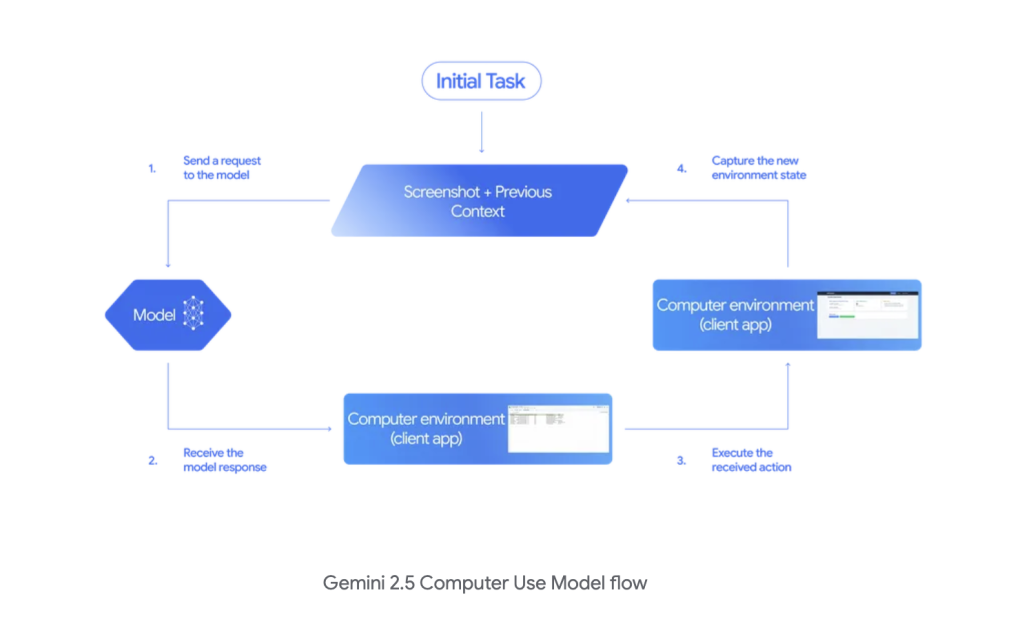
Google AI Introduces Gemini 2.5 ‘Computer Use’ (Preview): A Browser-Control Model to Power AI Agents to Interact with User InterfacesMarkTechPost Which of your browser workflows would you delegate today if an agent could plan and execute predefined UI actions? Google AI introduces Gemini 2.5 Computer Use, a specialized variant of Gemini 2.5 that plans and executes real UI actions in a live browser via a constrained action API. It’s available in public preview through Google
The post Google AI Introduces Gemini 2.5 ‘Computer Use’ (Preview): A Browser-Control Model to Power AI Agents to Interact with User Interfaces appeared first on MarkTechPost.
Which of your browser workflows would you delegate today if an agent could plan and execute predefined UI actions? Google AI introduces Gemini 2.5 Computer Use, a specialized variant of Gemini 2.5 that plans and executes real UI actions in a live browser via a constrained action API. It’s available in public preview through Google
The post Google AI Introduces Gemini 2.5 ‘Computer Use’ (Preview): A Browser-Control Model to Power AI Agents to Interact with User Interfaces appeared first on MarkTechPost. Read More

How AI is changing the way we travelAI News AI is reshaping how people plan and experience travel. From curated videos on Instagram Reels to booking engines that build entire itineraries in seconds, AI is becoming a powerful force in how journeys are imagined, booked, and lived. But this shift raises an important question: is AI giving travellers more freedom, or quietly steering their
The post How AI is changing the way we travel appeared first on AI News.
AI is reshaping how people plan and experience travel. From curated videos on Instagram Reels to booking engines that build entire itineraries in seconds, AI is becoming a powerful force in how journeys are imagined, booked, and lived. But this shift raises an important question: is AI giving travellers more freedom, or quietly steering their
The post How AI is changing the way we travel appeared first on AI News. Read More
Google DeepMind Introduces CodeMender: A New AI Agent that Uses Gemini Deep Think to Automatically Patch Critical Software VulnerabilitiesMarkTechPost What if an AI agent could localize a root cause, prove a candidate fix via automated analysis and testing, and proactively rewrite related code to eliminate the entire vulnerability class—then open an upstream patch for review? Google DeepMind introduces CodeMender, an AI agent that generates, validates, and upstreams fixes for real-world vulnerabilities using Gemini “Deep
The post Google DeepMind Introduces CodeMender: A New AI Agent that Uses Gemini Deep Think to Automatically Patch Critical Software Vulnerabilities appeared first on MarkTechPost.
What if an AI agent could localize a root cause, prove a candidate fix via automated analysis and testing, and proactively rewrite related code to eliminate the entire vulnerability class—then open an upstream patch for review? Google DeepMind introduces CodeMender, an AI agent that generates, validates, and upstreams fixes for real-world vulnerabilities using Gemini “Deep
The post Google DeepMind Introduces CodeMender: A New AI Agent that Uses Gemini Deep Think to Automatically Patch Critical Software Vulnerabilities appeared first on MarkTechPost. Read More
How to Perform Effective Agentic Context EngineeringTowards Data Science Learn how to optimize the context of your agents, for powerful agentic performance
The post How to Perform Effective Agentic Context Engineering appeared first on Towards Data Science.
Learn how to optimize the context of your agents, for powerful agentic performance
The post How to Perform Effective Agentic Context Engineering appeared first on Towards Data Science. Read More
Adversarial Agent Collaboration for C to Rust Translationcs.AI updates on arXiv.org arXiv:2510.03879v1 Announce Type: cross
Abstract: Translating C to memory-safe languages, like Rust, prevents critical memory safety vulnerabilities that are prevalent in legacy C software. Existing approaches for C to safe Rust translation, including LLM-assisted ones, do not generalize on larger (> 500 LoC) C codebases because they depend on complex program analyses that frequently break. In this work, we present ACToR (Adversarial C To Rust translator), a simple LLM agent-based approach. Inspired by GANs, ACToR pits a generator agent against a discriminator agent, which collaborate to iteratively generate a Rust translation. On each iteration, the translator agent synthesizes and refines a Rust translation to pass an existing suite of tests, and then the discriminator agent finds new failing tests. We demonstrate that ACToR translates all of the 63 real-world command line utilities considered in our benchmarks, which have an average size of 485 lines of code, and it achieves over 90% test pass rate with zero human intervention. To our knowledge, it is the first such system that reliably translates C programs of this scale. Furthermore, ACToR improves translation correctness by up to 18.9% compared to baseline, non-adversarial approaches.
arXiv:2510.03879v1 Announce Type: cross
Abstract: Translating C to memory-safe languages, like Rust, prevents critical memory safety vulnerabilities that are prevalent in legacy C software. Existing approaches for C to safe Rust translation, including LLM-assisted ones, do not generalize on larger (> 500 LoC) C codebases because they depend on complex program analyses that frequently break. In this work, we present ACToR (Adversarial C To Rust translator), a simple LLM agent-based approach. Inspired by GANs, ACToR pits a generator agent against a discriminator agent, which collaborate to iteratively generate a Rust translation. On each iteration, the translator agent synthesizes and refines a Rust translation to pass an existing suite of tests, and then the discriminator agent finds new failing tests. We demonstrate that ACToR translates all of the 63 real-world command line utilities considered in our benchmarks, which have an average size of 485 lines of code, and it achieves over 90% test pass rate with zero human intervention. To our knowledge, it is the first such system that reliably translates C programs of this scale. Furthermore, ACToR improves translation correctness by up to 18.9% compared to baseline, non-adversarial approaches. Read More

5 Signs Your Business Is a Prime Target for CyberattacksKDnuggets The good news is that recognizing these red flags early can cut your attack costs in half. Prevention beats recovery every time.
The good news is that recognizing these red flags early can cut your attack costs in half. Prevention beats recovery every time. Read More
Generalization of Graph Neural Network Models for Distribution Grid Fault Detectioncs.AI updates on arXiv.org arXiv:2510.03571v1 Announce Type: cross
Abstract: Fault detection in power distribution grids is critical for ensuring system reliability and preventing costly outages. Moreover, fault detection methodologies should remain robust to evolving grid topologies caused by factors such as reconfigurations, equipment failures, and Distributed Energy Resource (DER) integration. Current data-driven state-of-the-art methods use Recurrent Neural Networks (RNNs) for temporal modeling and Graph Neural Networks (GNNs) for spatial learning, in an RNN+GNN pipeline setting (RGNN in short). Specifically, for power system fault diagnosis, Graph Convolutional Networks (GCNs) have been adopted. Yet, various more advanced GNN architectures have been proposed and adopted in domains outside of power systems. In this paper, we set out to systematically and consistently benchmark various GNN architectures in an RNN+GNN pipeline model. Specifically, to the best of our knowledge, we are the first to (i) propose to use GraphSAGE and Graph Attention (GAT, GATv2) in an RGNN for fault diagnosis, and (ii) provide a comprehensive benchmark against earlier proposed RGNN solutions (RGCN) as well as pure RNN models (especially Gated Recurrent Unit (GRU)), particularly (iii) exploring their generalization potential for deployment in different settings than those used for training them. Our experimental results on the IEEE 123-node distribution network show that RGATv2 has superior generalization capabilities, maintaining high performance with an F1-score reduction of $sim$12% across different topology settings. In contrast, pure RNN models largely fail, experiencing an F1-score reduction of up to $sim$60%, while other RGNN variants also exhibit significant performance degradation, i.e., up to $sim$25% lower F1-scores.
arXiv:2510.03571v1 Announce Type: cross
Abstract: Fault detection in power distribution grids is critical for ensuring system reliability and preventing costly outages. Moreover, fault detection methodologies should remain robust to evolving grid topologies caused by factors such as reconfigurations, equipment failures, and Distributed Energy Resource (DER) integration. Current data-driven state-of-the-art methods use Recurrent Neural Networks (RNNs) for temporal modeling and Graph Neural Networks (GNNs) for spatial learning, in an RNN+GNN pipeline setting (RGNN in short). Specifically, for power system fault diagnosis, Graph Convolutional Networks (GCNs) have been adopted. Yet, various more advanced GNN architectures have been proposed and adopted in domains outside of power systems. In this paper, we set out to systematically and consistently benchmark various GNN architectures in an RNN+GNN pipeline model. Specifically, to the best of our knowledge, we are the first to (i) propose to use GraphSAGE and Graph Attention (GAT, GATv2) in an RGNN for fault diagnosis, and (ii) provide a comprehensive benchmark against earlier proposed RGNN solutions (RGCN) as well as pure RNN models (especially Gated Recurrent Unit (GRU)), particularly (iii) exploring their generalization potential for deployment in different settings than those used for training them. Our experimental results on the IEEE 123-node distribution network show that RGATv2 has superior generalization capabilities, maintaining high performance with an F1-score reduction of $sim$12% across different topology settings. In contrast, pure RNN models largely fail, experiencing an F1-score reduction of up to $sim$60%, while other RGNN variants also exhibit significant performance degradation, i.e., up to $sim$25% lower F1-scores. Read More
Improving Consistency in Retrieval-Augmented Systems with Group Similarity Rewardscs.AI updates on arXiv.org arXiv:2510.04392v1 Announce Type: cross
Abstract: RAG systems are increasingly deployed in high-stakes domains where users expect outputs to be consistent across semantically equivalent queries. However, existing systems often exhibit significant inconsistencies due to variability in both the retriever and generator (LLM), undermining trust and reliability. In this work, we focus on information consistency, i.e., the requirement that outputs convey the same core content across semantically equivalent inputs. We introduce a principled evaluation framework that decomposes RAG consistency into retriever-level, generator-level, and end-to-end components, helping identify inconsistency sources. To improve consistency, we propose Paraphrased Set Group Relative Policy Optimization (PS-GRPO), an RL approach that leverages multiple rollouts across paraphrased set to assign group similarity rewards. We leverage PS-GRPO to achieve Information Consistent RAG (Con-RAG), training the generator to produce consistent outputs across paraphrased queries and remain robust to retrieval-induced variability. Because exact reward computation over paraphrase sets is computationally expensive, we also introduce a scalable approximation method that retains effectiveness while enabling efficient, large-scale training. Empirical evaluations across short-form, multi-hop, and long-form QA benchmarks demonstrate that Con-RAG significantly improves both consistency and accuracy over strong baselines, even in the absence of explicit ground-truth supervision. Our work provides practical solutions for evaluating and building reliable RAG systems for safety-critical deployments.
arXiv:2510.04392v1 Announce Type: cross
Abstract: RAG systems are increasingly deployed in high-stakes domains where users expect outputs to be consistent across semantically equivalent queries. However, existing systems often exhibit significant inconsistencies due to variability in both the retriever and generator (LLM), undermining trust and reliability. In this work, we focus on information consistency, i.e., the requirement that outputs convey the same core content across semantically equivalent inputs. We introduce a principled evaluation framework that decomposes RAG consistency into retriever-level, generator-level, and end-to-end components, helping identify inconsistency sources. To improve consistency, we propose Paraphrased Set Group Relative Policy Optimization (PS-GRPO), an RL approach that leverages multiple rollouts across paraphrased set to assign group similarity rewards. We leverage PS-GRPO to achieve Information Consistent RAG (Con-RAG), training the generator to produce consistent outputs across paraphrased queries and remain robust to retrieval-induced variability. Because exact reward computation over paraphrase sets is computationally expensive, we also introduce a scalable approximation method that retains effectiveness while enabling efficient, large-scale training. Empirical evaluations across short-form, multi-hop, and long-form QA benchmarks demonstrate that Con-RAG significantly improves both consistency and accuracy over strong baselines, even in the absence of explicit ground-truth supervision. Our work provides practical solutions for evaluating and building reliable RAG systems for safety-critical deployments. Read More