

Past, Present, and Future of Bug Tracking in the Generative AI Eracs.AI updates on arXiv.org arXiv:2510.08005v1 Announce Type: cross
Abstract: Traditional bug tracking systems rely heavily on manual reporting, reproduction, triaging, and resolution, each carried out by different stakeholders such as end users, customer support, developers, and testers. This division of responsibilities requires significant coordination and widens the communication gap between non-technical users and technical teams, slowing the process from bug discovery to resolution. Moreover, current systems are highly asynchronous; users often wait hours or days for a first response, delaying fixes and contributing to frustration. This paper examines the evolution of bug tracking, from early paper-based reporting to today’s web-based and SaaS platforms. Building on this trajectory, we propose an AI-powered bug tracking framework that augments existing tools with intelligent, large language model (LLM)-driven automation. Our framework addresses two main challenges: reducing time-to-fix and minimizing human overhead. Users report issues in natural language, while AI agents refine reports, attempt reproduction, and request missing details. Reports are then classified, invalid ones resolved through no-code fixes, and valid ones localized and assigned to developers. LLMs also generate candidate patches, with human oversight ensuring correctness. By integrating automation into each phase, our framework accelerates response times, improves collaboration, and strengthens software maintenance practices for a more efficient, user-centric future.
arXiv:2510.08005v1 Announce Type: cross
Abstract: Traditional bug tracking systems rely heavily on manual reporting, reproduction, triaging, and resolution, each carried out by different stakeholders such as end users, customer support, developers, and testers. This division of responsibilities requires significant coordination and widens the communication gap between non-technical users and technical teams, slowing the process from bug discovery to resolution. Moreover, current systems are highly asynchronous; users often wait hours or days for a first response, delaying fixes and contributing to frustration. This paper examines the evolution of bug tracking, from early paper-based reporting to today’s web-based and SaaS platforms. Building on this trajectory, we propose an AI-powered bug tracking framework that augments existing tools with intelligent, large language model (LLM)-driven automation. Our framework addresses two main challenges: reducing time-to-fix and minimizing human overhead. Users report issues in natural language, while AI agents refine reports, attempt reproduction, and request missing details. Reports are then classified, invalid ones resolved through no-code fixes, and valid ones localized and assigned to developers. LLMs also generate candidate patches, with human oversight ensuring correctness. By integrating automation into each phase, our framework accelerates response times, improves collaboration, and strengthens software maintenance practices for a more efficient, user-centric future. Read More
Evaluation of LLMs for Process Model Analysis and Optimizationcs.AI updates on arXiv.org arXiv:2510.07489v1 Announce Type: new
Abstract: In this paper, we report our experience with several LLMs for their ability to understand a process model in an interactive, conversational style, find syntactical and logical errors in it, and reason with it in depth through a natural language (NL) interface. Our findings show that a vanilla, untrained LLM like ChatGPT (model o3) in a zero-shot setting is effective in understanding BPMN process models from images and answering queries about them intelligently at syntactic, logic, and semantic levels of depth. Further, different LLMs vary in performance in terms of their accuracy and effectiveness. Nevertheless, our empirical analysis shows that LLMs can play a valuable role as assistants for business process designers and users. We also study the LLM’s “thought process” and ability to perform deeper reasoning in the context of process analysis and optimization. We find that the LLMs seem to exhibit anthropomorphic properties.
arXiv:2510.07489v1 Announce Type: new
Abstract: In this paper, we report our experience with several LLMs for their ability to understand a process model in an interactive, conversational style, find syntactical and logical errors in it, and reason with it in depth through a natural language (NL) interface. Our findings show that a vanilla, untrained LLM like ChatGPT (model o3) in a zero-shot setting is effective in understanding BPMN process models from images and answering queries about them intelligently at syntactic, logic, and semantic levels of depth. Further, different LLMs vary in performance in terms of their accuracy and effectiveness. Nevertheless, our empirical analysis shows that LLMs can play a valuable role as assistants for business process designers and users. We also study the LLM’s “thought process” and ability to perform deeper reasoning in the context of process analysis and optimization. We find that the LLMs seem to exhibit anthropomorphic properties. Read More
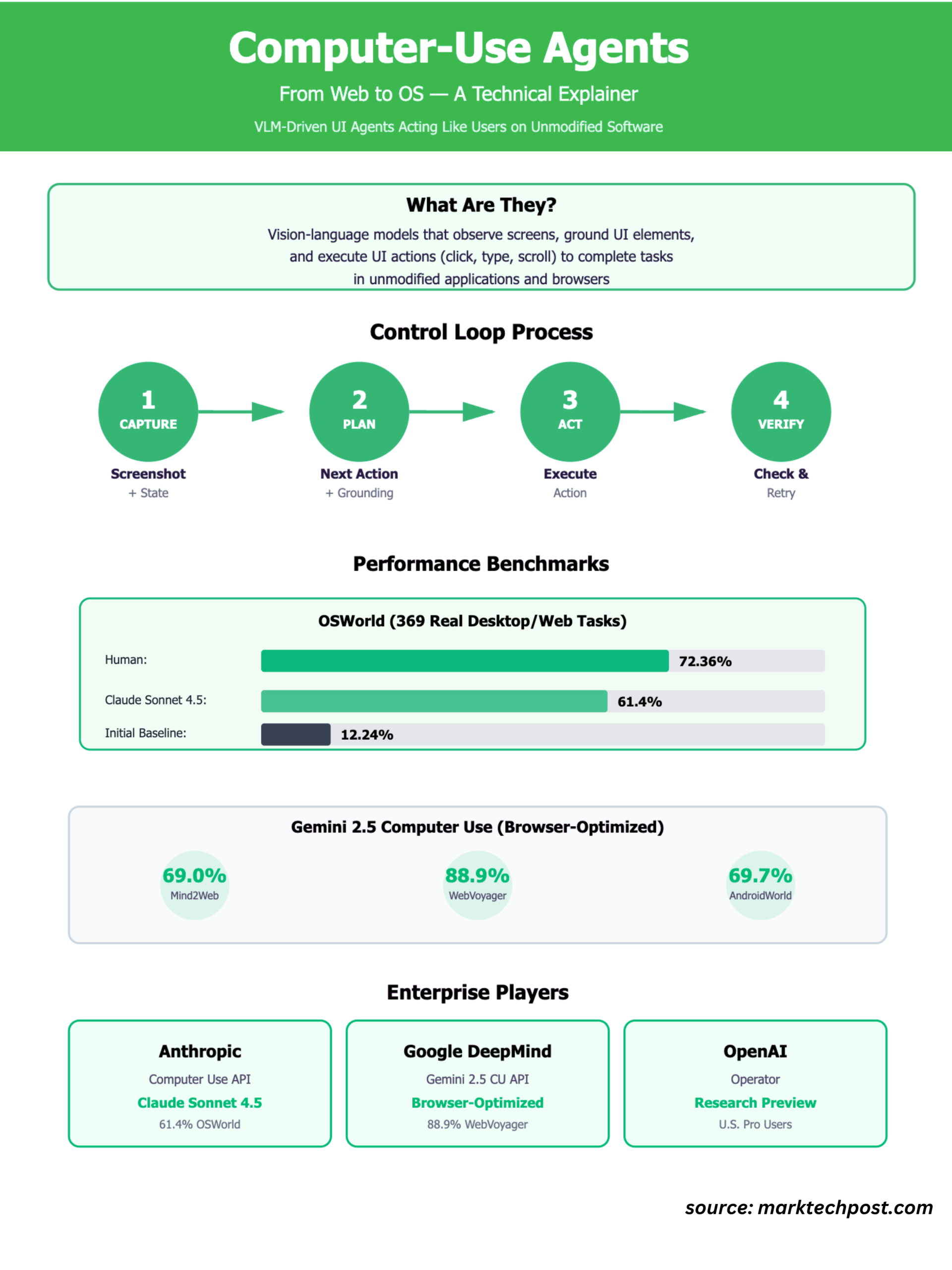
What are ‘Computer-Use Agents’? From Web to OS—A Technical ExplainerMarkTechPost TL;DR: Computer-use agents are VLM-driven UI agents that act like users on unmodified software. Baselines on OSWorld started at 12.24% (human 72.36%); Claude Sonnet 4.5 now reports 61.4%. Gemini 2.5 Computer Use leads several web benchmarks (Online-Mind2Web 69.0%, WebVoyager 88.9%) but is not yet OS-optimized. Next steps center on OS-level robustness, sub-second action loops, and
The post What are ‘Computer-Use Agents’? From Web to OS—A Technical Explainer appeared first on MarkTechPost.
TL;DR: Computer-use agents are VLM-driven UI agents that act like users on unmodified software. Baselines on OSWorld started at 12.24% (human 72.36%); Claude Sonnet 4.5 now reports 61.4%. Gemini 2.5 Computer Use leads several web benchmarks (Online-Mind2Web 69.0%, WebVoyager 88.9%) but is not yet OS-optimized. Next steps center on OS-level robustness, sub-second action loops, and
The post What are ‘Computer-Use Agents’? From Web to OS—A Technical Explainer appeared first on MarkTechPost. Read More
Self-Improving LLM Agents at Test-Timecs.AI updates on arXiv.org arXiv:2510.07841v1 Announce Type: cross
Abstract: One paradigm of language model (LM) fine-tuning relies on creating large training datasets, under the assumption that high quantity and diversity will enable models to generalize to novel tasks after post-training. In practice, gathering large sets of data is inefficient, and training on them is prohibitively expensive; worse, there is no guarantee that the resulting model will handle complex scenarios or generalize better. Moreover, existing techniques rarely assess whether a training sample provides novel information or is redundant with the knowledge already acquired by the model, resulting in unnecessary costs. In this work, we explore a new test-time self-improvement method to create more effective and generalizable agentic LMs on-the-fly. The proposed algorithm can be summarized in three steps: (i) first it identifies the samples that model struggles with (self-awareness), (ii) then generates similar examples from detected uncertain samples (self-data augmentation), and (iii) uses these newly generated samples at test-time fine-tuning (self-improvement). We study two variants of this approach: Test-Time Self-Improvement (TT-SI), where the same model generates additional training examples from its own uncertain cases and then learns from them, and contrast this approach with Test-Time Distillation (TT-D), where a stronger model generates similar examples for uncertain cases, enabling student to adapt using distilled supervision. Empirical evaluations across different agent benchmarks demonstrate that TT-SI improves the performance with +5.48% absolute accuracy gain on average across all benchmarks and surpasses other standard learning methods, yet using 68x less training samples. Our findings highlight the promise of TT-SI, demonstrating the potential of self-improvement algorithms at test-time as a new paradigm for building more capable agents toward self-evolution.
arXiv:2510.07841v1 Announce Type: cross
Abstract: One paradigm of language model (LM) fine-tuning relies on creating large training datasets, under the assumption that high quantity and diversity will enable models to generalize to novel tasks after post-training. In practice, gathering large sets of data is inefficient, and training on them is prohibitively expensive; worse, there is no guarantee that the resulting model will handle complex scenarios or generalize better. Moreover, existing techniques rarely assess whether a training sample provides novel information or is redundant with the knowledge already acquired by the model, resulting in unnecessary costs. In this work, we explore a new test-time self-improvement method to create more effective and generalizable agentic LMs on-the-fly. The proposed algorithm can be summarized in three steps: (i) first it identifies the samples that model struggles with (self-awareness), (ii) then generates similar examples from detected uncertain samples (self-data augmentation), and (iii) uses these newly generated samples at test-time fine-tuning (self-improvement). We study two variants of this approach: Test-Time Self-Improvement (TT-SI), where the same model generates additional training examples from its own uncertain cases and then learns from them, and contrast this approach with Test-Time Distillation (TT-D), where a stronger model generates similar examples for uncertain cases, enabling student to adapt using distilled supervision. Empirical evaluations across different agent benchmarks demonstrate that TT-SI improves the performance with +5.48% absolute accuracy gain on average across all benchmarks and surpasses other standard learning methods, yet using 68x less training samples. Our findings highlight the promise of TT-SI, demonstrating the potential of self-improvement algorithms at test-time as a new paradigm for building more capable agents toward self-evolution. Read More
Google Open-Sources an MCP Server for the Google Ads API, Bringing LLM-Native Access to Ads DataMarkTechPost Google has open-sourced a Model Context Protocol (MCP) server that exposes read-only access to the Google Ads API for agentic and LLM applications. The repository googleads/google-ads-mcp implements an MCP server in Python that surfaces two tools today: search (GAQL queries over Ads accounts) and list_accessible_customers (enumeration of customer resources). It includes setup via pipx, Google
The post Google Open-Sources an MCP Server for the Google Ads API, Bringing LLM-Native Access to Ads Data appeared first on MarkTechPost.
Google has open-sourced a Model Context Protocol (MCP) server that exposes read-only access to the Google Ads API for agentic and LLM applications. The repository googleads/google-ads-mcp implements an MCP server in Python that surfaces two tools today: search (GAQL queries over Ads accounts) and list_accessible_customers (enumeration of customer resources). It includes setup via pipx, Google
The post Google Open-Sources an MCP Server for the Google Ads API, Bringing LLM-Native Access to Ads Data appeared first on MarkTechPost. Read More
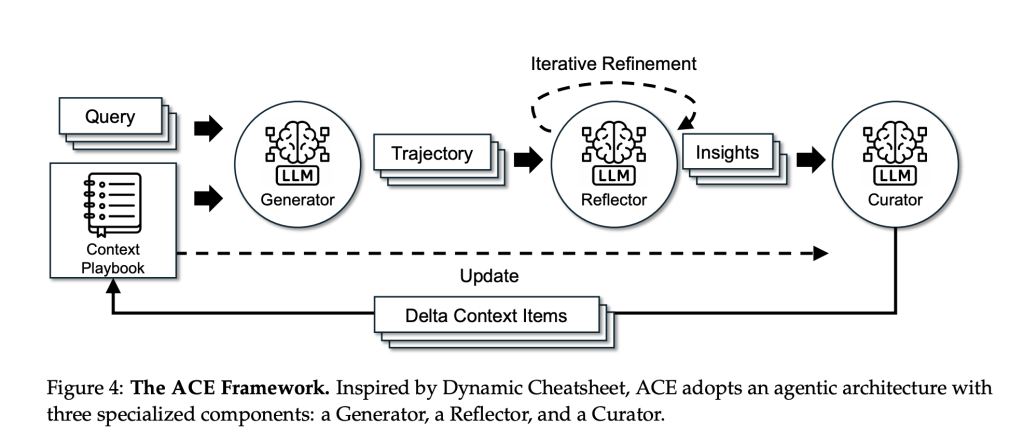
Agentic Context Engineering (ACE): Self-Improving LLMs via Evolving Contexts, Not Fine-TuningMarkTechPost TL;DR: A team of researchers from Stanford University, SambaNova Systems and UC Berkeley introduce ACE framework that improves LLM performance by editing and growing the input context instead of updating model weights. Context is treated as a living “playbook” maintained by three roles—Generator, Reflector, Curator—with small delta items merged incrementally to avoid brevity bias and
The post Agentic Context Engineering (ACE): Self-Improving LLMs via Evolving Contexts, Not Fine-Tuning appeared first on MarkTechPost.
TL;DR: A team of researchers from Stanford University, SambaNova Systems and UC Berkeley introduce ACE framework that improves LLM performance by editing and growing the input context instead of updating model weights. Context is treated as a living “playbook” maintained by three roles—Generator, Reflector, Curator—with small delta items merged incrementally to avoid brevity bias and
The post Agentic Context Engineering (ACE): Self-Improving LLMs via Evolving Contexts, Not Fine-Tuning appeared first on MarkTechPost. Read More

Gemini Enterprise: Google aims to put an AI agent on every deskAI News Google Cloud has launched Gemini Enterprise, a new platform it calls “the new front door for AI in the workplace”. Announced during a virtual press conference, the platform brings together Google’s Gemini models, first and third-party agents, and the core technology of what was formerly known as Google Agentspace to create a singular agentic platform.
The post Gemini Enterprise: Google aims to put an AI agent on every desk appeared first on AI News.
Google Cloud has launched Gemini Enterprise, a new platform it calls “the new front door for AI in the workplace”. Announced during a virtual press conference, the platform brings together Google’s Gemini models, first and third-party agents, and the core technology of what was formerly known as Google Agentspace to create a singular agentic platform.
The post Gemini Enterprise: Google aims to put an AI agent on every desk appeared first on AI News. Read More

AI value remains elusive despite soaring investmentAI News A new report from Red Hat finds that 89 percent of businesses are yet to see any customer value from their AI endeavours. However, organisations anticipate a 32 percent increase in AI investment by 2026. The survey finds that AI and security are the joint top IT priorities for UK organisations over the next 18
The post AI value remains elusive despite soaring investment appeared first on AI News.
A new report from Red Hat finds that 89 percent of businesses are yet to see any customer value from their AI endeavours. However, organisations anticipate a 32 percent increase in AI investment by 2026. The survey finds that AI and security are the joint top IT priorities for UK organisations over the next 18
The post AI value remains elusive despite soaring investment appeared first on AI News. Read More

10 Command-Line Tools Every Data Scientist Should KnowKDnuggets Get control of your data workflows with these essential CLI tools.
Get control of your data workflows with these essential CLI tools. Read More
Model Context Protocol (MCP) vs Function Calling vs OpenAPI Tools — When to Use Each?MarkTechPost Comparison Table Concern MCP Function Calling OpenAPI Tools Interface contract Protocol data model (tools/resources/prompts) Per-function JSON Schema OAS 3.1 document Discovery Dynamic via tools/list Static list provided to the model From OAS; catalogable Invocation tools/call over JSON-RPC session Model selects function; app executes HTTP request per OAS op Orchestration Host routes across many servers/tools App-local
The post Model Context Protocol (MCP) vs Function Calling vs OpenAPI Tools — When to Use Each? appeared first on MarkTechPost.
Comparison Table Concern MCP Function Calling OpenAPI Tools Interface contract Protocol data model (tools/resources/prompts) Per-function JSON Schema OAS 3.1 document Discovery Dynamic via tools/list Static list provided to the model From OAS; catalogable Invocation tools/call over JSON-RPC session Model selects function; app executes HTTP request per OAS op Orchestration Host routes across many servers/tools App-local
The post Model Context Protocol (MCP) vs Function Calling vs OpenAPI Tools — When to Use Each? appeared first on MarkTechPost. Read More