
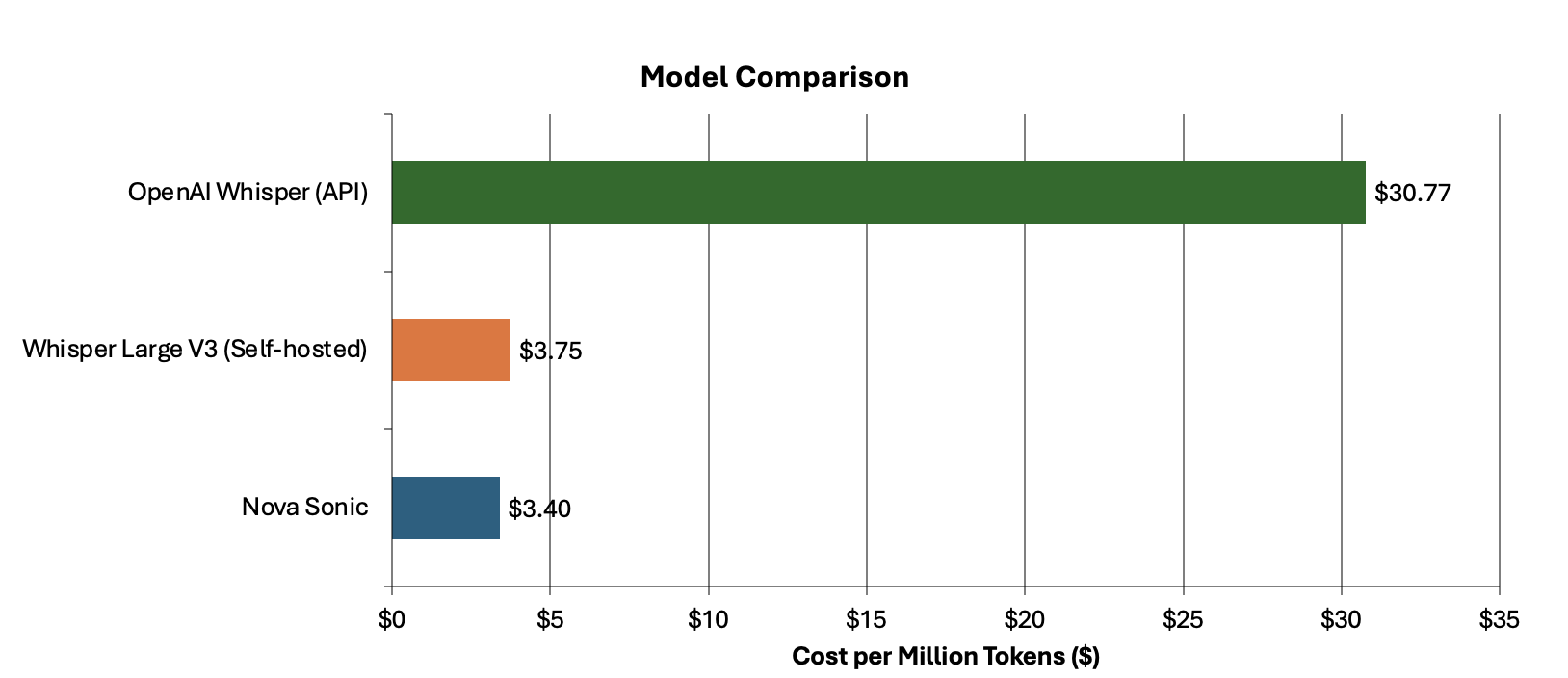
How Switchboard, MD automates real-time call transcription in clinical contact centers with Amazon Nova SonicArtificial Intelligence In this post, we examine the specific challenges Switchboard, MD faced with scaling transcription accuracy and cost-effectiveness in clinical environments, their evaluation process for selecting the right transcription solution, and the technical architecture they implemented using Amazon Connect and Amazon Kinesis Video Streams. This post details the impressive results achieved and demonstrates how they were able to use this foundation to automate EMR matching and give healthcare staff more time to focus on patient care.
In this post, we examine the specific challenges Switchboard, MD faced with scaling transcription accuracy and cost-effectiveness in clinical environments, their evaluation process for selecting the right transcription solution, and the technical architecture they implemented using Amazon Connect and Amazon Kinesis Video Streams. This post details the impressive results achieved and demonstrates how they were able to use this foundation to automate EMR matching and give healthcare staff more time to focus on patient care. Read More

What’s on My Bookmarks Bar: Data Science EditionKDnuggets Save time by keeping top resources and tools at your fingertips.
Save time by keeping top resources and tools at your fingertips. Read More

OpenAI spreads $600B cloud AI bet across AWS, Oracle, MicrosoftAI News OpenAI is on a spending spree to secure its AI compute supply chain, signing a new deal with AWS as part of its multi-cloud strategy. The company recently ended its exclusive cloud-computing partnership with Microsoft. It has since allocated a reported $250 billion back to Microsoft, $300 billion to Oracle, and now, $38 billion to
The post OpenAI spreads $600B cloud AI bet across AWS, Oracle, Microsoft appeared first on AI News.
OpenAI is on a spending spree to secure its AI compute supply chain, signing a new deal with AWS as part of its multi-cloud strategy. The company recently ended its exclusive cloud-computing partnership with Microsoft. It has since allocated a reported $250 billion back to Microsoft, $300 billion to Oracle, and now, $38 billion to
The post OpenAI spreads $600B cloud AI bet across AWS, Oracle, Microsoft appeared first on AI News. Read More

LLM Based Long Code Translation using Identifier Replacementcs.AI updates on arXiv.org arXiv:2510.09045v2 Announce Type: replace-cross
Abstract: In the domain of software development, LLMs have been utilized to automate tasks such as code translation, where source code from one programming language is translated to another while preserving its functionality. However, LLMs often struggle with long source codes that don’t fit into the context window, which produces inaccurate translations. To address this, we propose a novel zero-shot code translation method that incorporates identifier replacement. By substituting user-given long identifiers with generalized placeholders during translation, our method allows the LLM to focus on the logical structure of the code, by reducing token count and memory usage, which improves the efficiency and cost-effectiveness of long code translation. Our empirical results demonstrate that our approach preserves syntactical and hierarchical information and produces translation results with reduced tokens.
arXiv:2510.09045v2 Announce Type: replace-cross
Abstract: In the domain of software development, LLMs have been utilized to automate tasks such as code translation, where source code from one programming language is translated to another while preserving its functionality. However, LLMs often struggle with long source codes that don’t fit into the context window, which produces inaccurate translations. To address this, we propose a novel zero-shot code translation method that incorporates identifier replacement. By substituting user-given long identifiers with generalized placeholders during translation, our method allows the LLM to focus on the logical structure of the code, by reducing token count and memory usage, which improves the efficiency and cost-effectiveness of long code translation. Our empirical results demonstrate that our approach preserves syntactical and hierarchical information and produces translation results with reduced tokens. Read More
SUSTAINABLE Platform: Seamless Smart Farming Integration Towards Agronomy Automationcs.AI updates on arXiv.org arXiv:2510.26989v1 Announce Type: new
Abstract: The global agricultural sector is undergoing a transformative shift, driven by increasing food demands, climate variability and the need for sustainable practices. SUSTAINABLE is a smart farming platform designed to integrate IoT, AI, satellite imaging, and role-based task orchestration to enable efficient, traceable, and sustainable agriculture with a pilot usecase in viticulture. This paper explores current smart agriculture solutions, presents a comparative evaluation, and introduces SUSTAINABLE’s key features, including satellite index integration, real-time environmental data, and role-aware task management tailored to Mediterranean vineyards.
arXiv:2510.26989v1 Announce Type: new
Abstract: The global agricultural sector is undergoing a transformative shift, driven by increasing food demands, climate variability and the need for sustainable practices. SUSTAINABLE is a smart farming platform designed to integrate IoT, AI, satellite imaging, and role-based task orchestration to enable efficient, traceable, and sustainable agriculture with a pilot usecase in viticulture. This paper explores current smart agriculture solutions, presents a comparative evaluation, and introduces SUSTAINABLE’s key features, including satellite index integration, real-time environmental data, and role-aware task management tailored to Mediterranean vineyards. Read More
PoLAR: Polar-Decomposed Low-Rank Adapter Representationcs.AI updates on arXiv.org arXiv:2506.03133v2 Announce Type: replace-cross
Abstract: We show that low-rank adaptation of large-scale models suffers from a low stable rank that is well below the linear algebraic rank of the subspace, degrading fine-tuning performance. To mitigate the underutilization of the allocated subspace, we propose PoLAR, a parameterization inspired by the polar decomposition that factorizes the low-rank update into two direction matrices constrained to Stiefel manifolds and an unconstrained scale matrix. Our theory shows that PoLAR yields an exponentially faster convergence rate on a canonical low-rank adaptation problem. Pairing the parameterization with Riemannian optimization leads to consistent gains on three different benchmarks testing general language understanding, commonsense reasoning, and mathematical problem solving with base model sizes ranging from 350M to 27B.
arXiv:2506.03133v2 Announce Type: replace-cross
Abstract: We show that low-rank adaptation of large-scale models suffers from a low stable rank that is well below the linear algebraic rank of the subspace, degrading fine-tuning performance. To mitigate the underutilization of the allocated subspace, we propose PoLAR, a parameterization inspired by the polar decomposition that factorizes the low-rank update into two direction matrices constrained to Stiefel manifolds and an unconstrained scale matrix. Our theory shows that PoLAR yields an exponentially faster convergence rate on a canonical low-rank adaptation problem. Pairing the parameterization with Riemannian optimization leads to consistent gains on three different benchmarks testing general language understanding, commonsense reasoning, and mathematical problem solving with base model sizes ranging from 350M to 27B. Read More
A Framework for Objective-Driven Dynamical Stochastic Fieldscs.AI updates on arXiv.org arXiv:2504.16115v2 Announce Type: replace
Abstract: Fields offer a versatile approach for describing complex systems composed of interacting and dynamic components. In particular, some of these dynamical and stochastic systems may exhibit goal-directed behaviors aimed at achieving specific objectives, which we refer to as $textit{intelligent fields}$. However, due to their inherent complexity, it remains challenging to develop a formal theoretical description of such systems and to effectively translate these descriptions into practical applications. In this paper, we propose three fundamental principles to establish a theoretical framework for understanding intelligent fields: complete configuration, locality, and purposefulness. Moreover, we explore methodologies for designing such fields from the perspective of artificial intelligence applications. This initial investigation aims to lay the groundwork for future theoretical developments and practical advances in understanding and harnessing the potential of such objective-driven dynamical stochastic fields.
arXiv:2504.16115v2 Announce Type: replace
Abstract: Fields offer a versatile approach for describing complex systems composed of interacting and dynamic components. In particular, some of these dynamical and stochastic systems may exhibit goal-directed behaviors aimed at achieving specific objectives, which we refer to as $textit{intelligent fields}$. However, due to their inherent complexity, it remains challenging to develop a formal theoretical description of such systems and to effectively translate these descriptions into practical applications. In this paper, we propose three fundamental principles to establish a theoretical framework for understanding intelligent fields: complete configuration, locality, and purposefulness. Moreover, we explore methodologies for designing such fields from the perspective of artificial intelligence applications. This initial investigation aims to lay the groundwork for future theoretical developments and practical advances in understanding and harnessing the potential of such objective-driven dynamical stochastic fields. Read More
Aeolus: A Multi-structural Flight Delay Datasetcs.AI updates on arXiv.org arXiv:2510.26616v2 Announce Type: replace-cross
Abstract: We introduce Aeolus, a large-scale Multi-modal Flight Delay Dataset designed to advance research on flight delay prediction and support the development of foundation models for tabular data. Existing datasets in this domain are typically limited to flat tabular structures and fail to capture the spatiotemporal dynamics inherent in delay propagation. Aeolus addresses this limitation by providing three aligned modalities: (i) a tabular dataset with rich operational, meteorological, and airportlevel features for over 50 million flights; (ii) a flight chain module that models delay propagation along sequential flight legs, capturing upstream and downstream dependencies; and (iii) a flight network graph that encodes shared aircraft, crew, and airport resource connections, enabling cross-flight relational reasoning. The dataset is carefully constructed with temporal splits, comprehensive features, and strict leakage prevention to support realistic and reproducible machine learning evaluation. Aeolus supports a broad range of tasks, including regression, classification, temporal structure modeling, and graph learning, serving as a unified benchmark across tabular, sequential, and graph modalities. We release baseline experiments and preprocessing tools to facilitate adoption. Aeolus fills a key gap for both domain-specific modeling and general-purpose structured data research.Our source code and data can be accessed at https://github.com/Flnny/Delay-data
arXiv:2510.26616v2 Announce Type: replace-cross
Abstract: We introduce Aeolus, a large-scale Multi-modal Flight Delay Dataset designed to advance research on flight delay prediction and support the development of foundation models for tabular data. Existing datasets in this domain are typically limited to flat tabular structures and fail to capture the spatiotemporal dynamics inherent in delay propagation. Aeolus addresses this limitation by providing three aligned modalities: (i) a tabular dataset with rich operational, meteorological, and airportlevel features for over 50 million flights; (ii) a flight chain module that models delay propagation along sequential flight legs, capturing upstream and downstream dependencies; and (iii) a flight network graph that encodes shared aircraft, crew, and airport resource connections, enabling cross-flight relational reasoning. The dataset is carefully constructed with temporal splits, comprehensive features, and strict leakage prevention to support realistic and reproducible machine learning evaluation. Aeolus supports a broad range of tasks, including regression, classification, temporal structure modeling, and graph learning, serving as a unified benchmark across tabular, sequential, and graph modalities. We release baseline experiments and preprocessing tools to facilitate adoption. Aeolus fills a key gap for both domain-specific modeling and general-purpose structured data research.Our source code and data can be accessed at https://github.com/Flnny/Delay-data Read More

5 Fun Data Science Projects for Absolute BeginnersKDnuggets These beginner-friendly projects guide you through the full data science workflow so you can learn by building and experimenting.
These beginner-friendly projects guide you through the full data science workflow so you can learn by building and experimenting. Read More

NVIDIA and South Korea align on sovereign AI at APEC CEO SummitAI News At the APEC CEO Summit, NVIDIA said it is working with public agencies and private companies to build sovereign AI infrastructure across South Korea. The plan includes hundreds of thousands of NVIDIA GPUs across sovereign clouds and AI factories for areas like automotive, manufacturing and telecommunications. “Korea’s leadership in technology and manufacturing positions it at
The post NVIDIA and South Korea align on sovereign AI at APEC CEO Summit appeared first on AI News.
At the APEC CEO Summit, NVIDIA said it is working with public agencies and private companies to build sovereign AI infrastructure across South Korea. The plan includes hundreds of thousands of NVIDIA GPUs across sovereign clouds and AI factories for areas like automotive, manufacturing and telecommunications. “Korea’s leadership in technology and manufacturing positions it at
The post NVIDIA and South Korea align on sovereign AI at APEC CEO Summit appeared first on AI News. Read More