

Neural Networks Are Blurry, Symbolic Systems Are Fragmented. Sparse Autoencoders Help Us Combine Them.Towards Data Science Neural and symbolic models compress the world in fundamentally different ways, and Sparse Autoencoders (SAEs) offer a bridge to connect them.
The post Neural Networks Are Blurry, Symbolic Systems Are Fragmented. Sparse Autoencoders Help Us Combine Them. appeared first on Towards Data Science.
Neural and symbolic models compress the world in fundamentally different ways, and Sparse Autoencoders (SAEs) offer a bridge to connect them.
The post Neural Networks Are Blurry, Symbolic Systems Are Fragmented. Sparse Autoencoders Help Us Combine Them. appeared first on Towards Data Science. Read More
Semantic Anchors in In-Context Learning: Why Small LLMs Cannot Flip Their Labelscs.AI updates on arXiv.org arXiv:2511.21038v1 Announce Type: cross
Abstract: Can in-context learning (ICL) override pre-trained label semantics, or does it merely refine an existing semantic backbone? We address this question by treating LLMs as prompt-induced classifiers and contrasting their behavior under emph{natural} demonstrations (with correct labels) and emph{inverted} demonstrations (systematically flipping label meanings). We decompose ICL behavior into three alignment metrics (truth, prior, and prompt alignment) and introduce a semantic override rate, defined as correctness under flipped semantics. Across eight classification tasks and eight open-source LLMs (1–12B parameters), we find consistent evidence for a semantic anchor view. With natural demonstrations, ICL improves accuracy while maintaining strong prior alignment; most correct predictions coincide with zero-shot behavior, even when the prior is weak. With inverted demonstrations, models cannot learn coherent anti-semantic classifiers: prompt alignment increases only by sacrificing accuracy, and semantic override rates remain exactly zero in our few-shot 1–12B setting. Rather than flexibly remapping label meanings, ICL primarily adjusts how inputs project onto stable semantic directions learned during pre-training, clarifying fundamental limits of few-shot prompting and suggesting that overriding label semantics at these scales requires interventions beyond ICL. All code is available at: https://github.com/AnanthaPadmanaban-KrishnaKumar/semantic-anchors-icl.
arXiv:2511.21038v1 Announce Type: cross
Abstract: Can in-context learning (ICL) override pre-trained label semantics, or does it merely refine an existing semantic backbone? We address this question by treating LLMs as prompt-induced classifiers and contrasting their behavior under emph{natural} demonstrations (with correct labels) and emph{inverted} demonstrations (systematically flipping label meanings). We decompose ICL behavior into three alignment metrics (truth, prior, and prompt alignment) and introduce a semantic override rate, defined as correctness under flipped semantics. Across eight classification tasks and eight open-source LLMs (1–12B parameters), we find consistent evidence for a semantic anchor view. With natural demonstrations, ICL improves accuracy while maintaining strong prior alignment; most correct predictions coincide with zero-shot behavior, even when the prior is weak. With inverted demonstrations, models cannot learn coherent anti-semantic classifiers: prompt alignment increases only by sacrificing accuracy, and semantic override rates remain exactly zero in our few-shot 1–12B setting. Rather than flexibly remapping label meanings, ICL primarily adjusts how inputs project onto stable semantic directions learned during pre-training, clarifying fundamental limits of few-shot prompting and suggesting that overriding label semantics at these scales requires interventions beyond ICL. All code is available at: https://github.com/AnanthaPadmanaban-KrishnaKumar/semantic-anchors-icl. Read More
AI4X Roadmap: Artificial Intelligence for the advancement of scientific pursuit and its future directionscs.AI updates on arXiv.org arXiv:2511.20976v1 Announce Type: cross
Abstract: Artificial intelligence and machine learning are reshaping how we approach scientific discovery, not by replacing established methods but by extending what researchers can probe, predict, and design. In this roadmap we provide a forward-looking view of AI-enabled science across biology, chemistry, climate science, mathematics, materials science, physics, self-driving laboratories and unconventional computing. Several shared themes emerge: the need for diverse and trustworthy data, transferable electronic-structure and interatomic models, AI systems integrated into end-to-end scientific workflows that connect simulations to experiments and generative systems grounded in synthesisability rather than purely idealised phases. Across domains, we highlight how large foundation models, active learning and self-driving laboratories can close loops between prediction and validation while maintaining reproducibility and physical interpretability. Taken together, these perspectives outline where AI-enabled science stands today, identify bottlenecks in data, methods and infrastructure, and chart concrete directions for building AI systems that are not only more powerful but also more transparent and capable of accelerating discovery in complex real-world environments.
arXiv:2511.20976v1 Announce Type: cross
Abstract: Artificial intelligence and machine learning are reshaping how we approach scientific discovery, not by replacing established methods but by extending what researchers can probe, predict, and design. In this roadmap we provide a forward-looking view of AI-enabled science across biology, chemistry, climate science, mathematics, materials science, physics, self-driving laboratories and unconventional computing. Several shared themes emerge: the need for diverse and trustworthy data, transferable electronic-structure and interatomic models, AI systems integrated into end-to-end scientific workflows that connect simulations to experiments and generative systems grounded in synthesisability rather than purely idealised phases. Across domains, we highlight how large foundation models, active learning and self-driving laboratories can close loops between prediction and validation while maintaining reproducibility and physical interpretability. Taken together, these perspectives outline where AI-enabled science stands today, identify bottlenecks in data, methods and infrastructure, and chart concrete directions for building AI systems that are not only more powerful but also more transparent and capable of accelerating discovery in complex real-world environments. Read More
Implementing the Rock Paper Scissors Game in PythonTowards Data Science A beginner-friendly Python tutorial using conditionals and the random module
The post Implementing the Rock Paper Scissors Game in Python appeared first on Towards Data Science.
A beginner-friendly Python tutorial using conditionals and the random module
The post Implementing the Rock Paper Scissors Game in Python appeared first on Towards Data Science. Read More

Edge AI inside the human body: Cochlear’s machine learning implant breakthroughAI News The next frontier for edge AI medical devices isn’t wearables or bedside monitors—it’s inside the human body itself. Cochlear’s newly launched Nucleus Nexa System represents the first cochlear implant capable of running machine learning algorithms while managing extreme power constraints, storing personalised data on-device, and receiving over-the-air firmware updates to improve its AI models over time. For AI
The post Edge AI inside the human body: Cochlear’s machine learning implant breakthrough appeared first on AI News.
The next frontier for edge AI medical devices isn’t wearables or bedside monitors—it’s inside the human body itself. Cochlear’s newly launched Nucleus Nexa System represents the first cochlear implant capable of running machine learning algorithms while managing extreme power constraints, storing personalised data on-device, and receiving over-the-air firmware updates to improve its AI models over time. For AI
The post Edge AI inside the human body: Cochlear’s machine learning implant breakthrough appeared first on AI News. Read More
BotaCLIP: Contrastive Learning for Botany-Aware Representation of Earth Observation Datacs.AI updates on arXiv.org arXiv:2511.21194v1 Announce Type: cross
Abstract: Foundation models have demonstrated a remarkable ability to learn rich, transferable representations across diverse modalities such as images, text, and audio. In modern machine learning pipelines, these representations often replace raw data as the primary input for downstream tasks. In this paper, we address the challenge of adapting a pre-trained foundation model to inject domain-specific knowledge, without retraining from scratch or incurring significant computational costs. To this end, we introduce BotaCLIP, a lightweight multimodal contrastive framework that adapts a pre-trained Earth Observation foundation model (DOFA) by aligning high-resolution aerial imagery with botanical relev’es. Unlike generic embeddings, BotaCLIP internalizes ecological structure through contrastive learning with a regularization strategy that mitigates catastrophic forgetting. Once trained, the resulting embeddings serve as transferable representations for downstream predictors. Motivated by real-world applications in biodiversity modeling, we evaluated BotaCLIP representations in three ecological tasks: plant presence prediction, butterfly occurrence modeling, and soil trophic group abundance estimation. The results showed consistent improvements over those derived from DOFA and supervised baselines. More broadly, this work illustrates how domain-aware adaptation of foundation models can inject expert knowledge into data-scarce settings, enabling frugal representation learning.
arXiv:2511.21194v1 Announce Type: cross
Abstract: Foundation models have demonstrated a remarkable ability to learn rich, transferable representations across diverse modalities such as images, text, and audio. In modern machine learning pipelines, these representations often replace raw data as the primary input for downstream tasks. In this paper, we address the challenge of adapting a pre-trained foundation model to inject domain-specific knowledge, without retraining from scratch or incurring significant computational costs. To this end, we introduce BotaCLIP, a lightweight multimodal contrastive framework that adapts a pre-trained Earth Observation foundation model (DOFA) by aligning high-resolution aerial imagery with botanical relev’es. Unlike generic embeddings, BotaCLIP internalizes ecological structure through contrastive learning with a regularization strategy that mitigates catastrophic forgetting. Once trained, the resulting embeddings serve as transferable representations for downstream predictors. Motivated by real-world applications in biodiversity modeling, we evaluated BotaCLIP representations in three ecological tasks: plant presence prediction, butterfly occurrence modeling, and soil trophic group abundance estimation. The results showed consistent improvements over those derived from DOFA and supervised baselines. More broadly, this work illustrates how domain-aware adaptation of foundation models can inject expert knowledge into data-scarce settings, enabling frugal representation learning. Read More
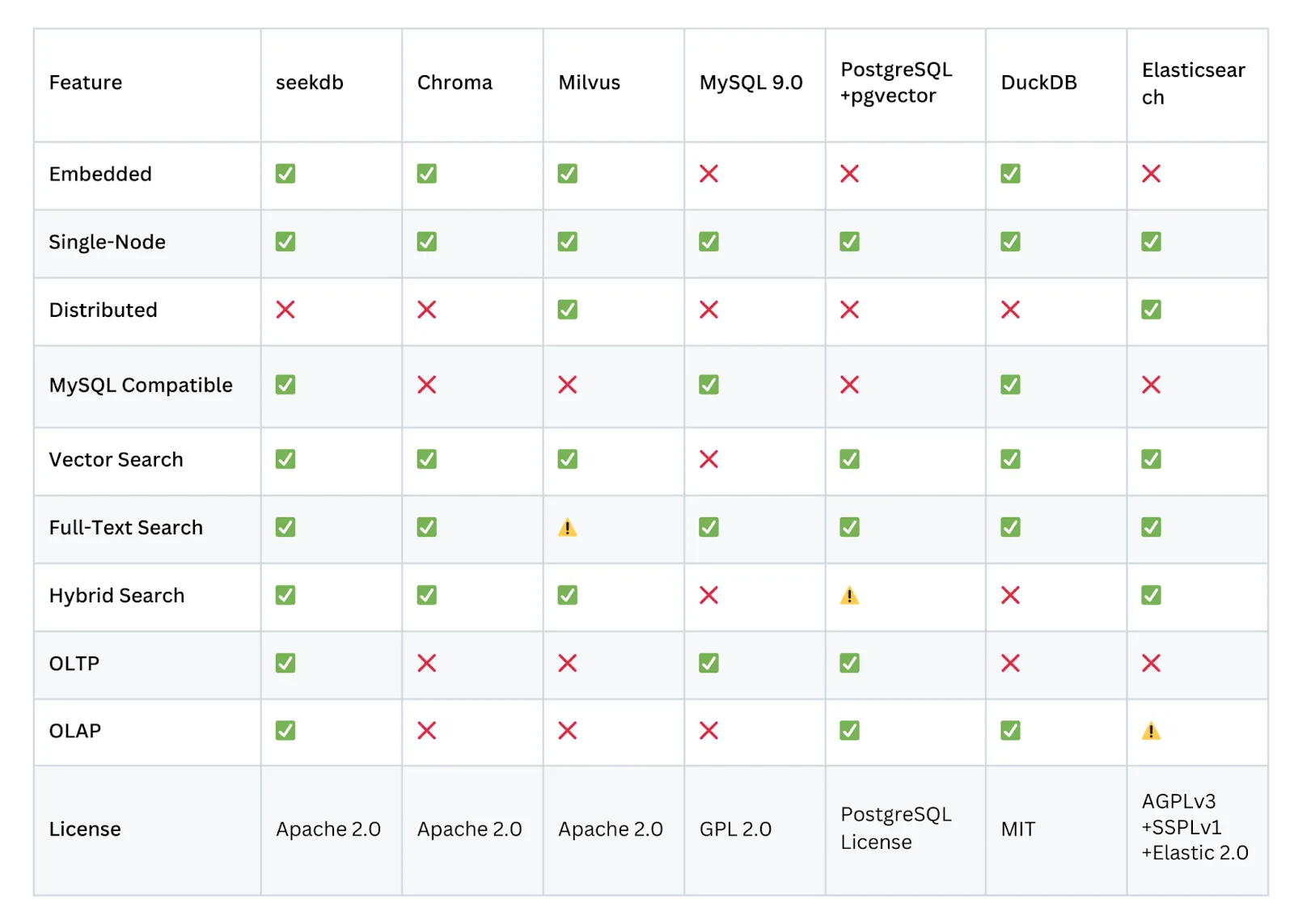
OceanBase Releases seekdb: An Open Source AI Native Hybrid Search Database for Multi-model RAG and AI AgentsMarkTechPost AI applications rarely deal with one clean table. They mix user profiles, chat logs, JSON metadata, embeddings, and sometimes spatial data. Most teams answer this with a patchwork of an OLTP database, a vector store, and a search engine. OceanBase released seekdb, an open source AI focused database (under the Apache 2.0 license). seekdb is
The post OceanBase Releases seekdb: An Open Source AI Native Hybrid Search Database for Multi-model RAG and AI Agents appeared first on MarkTechPost.
AI applications rarely deal with one clean table. They mix user profiles, chat logs, JSON metadata, embeddings, and sometimes spatial data. Most teams answer this with a patchwork of an OLTP database, a vector store, and a search engine. OceanBase released seekdb, an open source AI focused database (under the Apache 2.0 license). seekdb is
The post OceanBase Releases seekdb: An Open Source AI Native Hybrid Search Database for Multi-model RAG and AI Agents appeared first on MarkTechPost. Read More
SocialNav: Training Human-Inspired Foundation Model for Socially-Aware Embodied Navigationcs.AI updates on arXiv.org arXiv:2511.21135v1 Announce Type: cross
Abstract: Embodied navigation that adheres to social norms remains an open research challenge. Our textbf{SocialNav} is a foundational model for socially-aware navigation with a hierarchical “brain-action” architecture, capable of understanding high-level social norms and generating low-level, socially compliant trajectories. To enable such dual capabilities, we construct the SocNav Dataset, a large-scale collection of 7 million samples, comprising (1) a Cognitive Activation Dataset providing social reasoning signals such as chain-of-thought explanations and social traversability prediction, and (2) an Expert Trajectories Pyramid aggregating diverse navigation demonstrations from internet videos, simulated environments, and real-world robots. A multi-stage training pipeline is proposed to gradually inject and refine navigation intelligence: we first inject general navigation skills and social norms understanding into the model via imitation learning, and then refine such skills through a deliberately designed Socially-Aware Flow Exploration GRPO (SAFE-GRPO), the first flow-based reinforcement learning framework for embodied navigation that explicitly rewards socially compliant behaviors. SocialNav achieves +38% success rate and +46% social compliance rate compared to the state-of-the-art method, demonstrating strong gains in both navigation performance and social compliance. Our project page: https://amap-eai.github.io/SocialNav/
arXiv:2511.21135v1 Announce Type: cross
Abstract: Embodied navigation that adheres to social norms remains an open research challenge. Our textbf{SocialNav} is a foundational model for socially-aware navigation with a hierarchical “brain-action” architecture, capable of understanding high-level social norms and generating low-level, socially compliant trajectories. To enable such dual capabilities, we construct the SocNav Dataset, a large-scale collection of 7 million samples, comprising (1) a Cognitive Activation Dataset providing social reasoning signals such as chain-of-thought explanations and social traversability prediction, and (2) an Expert Trajectories Pyramid aggregating diverse navigation demonstrations from internet videos, simulated environments, and real-world robots. A multi-stage training pipeline is proposed to gradually inject and refine navigation intelligence: we first inject general navigation skills and social norms understanding into the model via imitation learning, and then refine such skills through a deliberately designed Socially-Aware Flow Exploration GRPO (SAFE-GRPO), the first flow-based reinforcement learning framework for embodied navigation that explicitly rewards socially compliant behaviors. SocialNav achieves +38% success rate and +46% social compliance rate compared to the state-of-the-art method, demonstrating strong gains in both navigation performance and social compliance. Our project page: https://amap-eai.github.io/SocialNav/ Read More
Dynamic Test-Time Compute Scaling in Control Policy: Difficulty-Aware Stochastic Interpolant Policycs.AI updates on arXiv.org arXiv:2511.20906v1 Announce Type: cross
Abstract: Diffusion- and flow-based policies deliver state-of-the-art performance on long-horizon robotic manipulation and imitation learning tasks. However, these controllers employ a fixed inference budget at every control step, regardless of task complexity, leading to computational inefficiency for simple subtasks while potentially underperforming on challenging ones. To address these issues, we introduce Difficulty-Aware Stochastic Interpolant Policy (DA-SIP), a framework that enables robotic controllers to adaptively adjust their integration horizon in real time based on task difficulty. Our approach employs a difficulty classifier that analyzes observations to dynamically select the step budget, the optimal solver variant, and ODE/SDE integration at each control cycle. DA-SIP builds upon the stochastic interpolant formulation to provide a unified framework that unlocks diverse training and inference configurations for diffusion- and flow-based policies. Through comprehensive benchmarks across diverse manipulation tasks, DA-SIP achieves 2.6-4.4x reduction in total computation time while maintaining task success rates comparable to fixed maximum-computation baselines. By implementing adaptive computation within this framework, DA-SIP transforms generative robot controllers into efficient, task-aware systems that intelligently allocate inference resources where they provide the greatest benefit.
arXiv:2511.20906v1 Announce Type: cross
Abstract: Diffusion- and flow-based policies deliver state-of-the-art performance on long-horizon robotic manipulation and imitation learning tasks. However, these controllers employ a fixed inference budget at every control step, regardless of task complexity, leading to computational inefficiency for simple subtasks while potentially underperforming on challenging ones. To address these issues, we introduce Difficulty-Aware Stochastic Interpolant Policy (DA-SIP), a framework that enables robotic controllers to adaptively adjust their integration horizon in real time based on task difficulty. Our approach employs a difficulty classifier that analyzes observations to dynamically select the step budget, the optimal solver variant, and ODE/SDE integration at each control cycle. DA-SIP builds upon the stochastic interpolant formulation to provide a unified framework that unlocks diverse training and inference configurations for diffusion- and flow-based policies. Through comprehensive benchmarks across diverse manipulation tasks, DA-SIP achieves 2.6-4.4x reduction in total computation time while maintaining task success rates comparable to fixed maximum-computation baselines. By implementing adaptive computation within this framework, DA-SIP transforms generative robot controllers into efficient, task-aware systems that intelligently allocate inference resources where they provide the greatest benefit. Read More
OpenApps: Simulating Environment Variations to Measure UI-Agent Reliabilitycs.AI updates on arXiv.org arXiv:2511.20766v1 Announce Type: new
Abstract: Reliability is key to realizing the promise of autonomous UI-Agents, multimodal agents that directly interact with apps in the same manner as humans, as users must be able to trust an agent to complete a given task. Current evaluations rely on fixed environments, often clones of existing apps, which are limited in that they can only shed light on whether or how often an agent can complete a task within a specific environment. When deployed however, agents are likely to encounter variations in app design and content that can affect an agent’s ability to complete a task. To address this blind spot of measuring agent reliability across app variations, we develop OpenApps, a light-weight open-source ecosystem with six apps (messenger, calendar, maps, etc.) that are configurable in appearance and content. OpenApps requires just a single CPU to run, enabling easy generation and deployment of thousands of versions of each app. Specifically, we run more than 10,000 independent evaluations to study reliability across seven leading multimodal agents. We find that while standard reliability within a fixed app is relatively stable, reliability can vary drastically when measured across app variations. Task success rates for many agents can fluctuate by more than $50%$ across app variations. For example, Kimi-VL-3B’s average success across all tasks fluctuates from $63%$ to just $4%$ across app versions. We also find agent behaviors such as looping or hallucinating actions can differ drastically depending on the environment configuration. These initial findings highlight the importance of measuring reliability along this new dimension of app variations. OpenApps is available at https://facebookresearch.github.io/OpenApps/
arXiv:2511.20766v1 Announce Type: new
Abstract: Reliability is key to realizing the promise of autonomous UI-Agents, multimodal agents that directly interact with apps in the same manner as humans, as users must be able to trust an agent to complete a given task. Current evaluations rely on fixed environments, often clones of existing apps, which are limited in that they can only shed light on whether or how often an agent can complete a task within a specific environment. When deployed however, agents are likely to encounter variations in app design and content that can affect an agent’s ability to complete a task. To address this blind spot of measuring agent reliability across app variations, we develop OpenApps, a light-weight open-source ecosystem with six apps (messenger, calendar, maps, etc.) that are configurable in appearance and content. OpenApps requires just a single CPU to run, enabling easy generation and deployment of thousands of versions of each app. Specifically, we run more than 10,000 independent evaluations to study reliability across seven leading multimodal agents. We find that while standard reliability within a fixed app is relatively stable, reliability can vary drastically when measured across app variations. Task success rates for many agents can fluctuate by more than $50%$ across app variations. For example, Kimi-VL-3B’s average success across all tasks fluctuates from $63%$ to just $4%$ across app versions. We also find agent behaviors such as looping or hallucinating actions can differ drastically depending on the environment configuration. These initial findings highlight the importance of measuring reliability along this new dimension of app variations. OpenApps is available at https://facebookresearch.github.io/OpenApps/ Read More