

On the Regulatory Potential of User Interfaces for AI Agent Governancecs.AI updates on arXiv.org arXiv:2512.00742v1 Announce Type: cross
Abstract: AI agents that take actions in their environment autonomously over extended time horizons require robust governance interventions to curb their potentially consequential risks. Prior proposals for governing AI agents primarily target system-level safeguards (e.g., prompt injection monitors) or agent infrastructure (e.g., agent IDs). In this work, we explore a complementary approach: regulating user interfaces of AI agents as a way of enforcing transparency and behavioral requirements that then demand changes at the system and/or infrastructure levels. Specifically, we analyze 22 existing agentic systems to identify UI elements that play key roles in human-agent interaction and communication. We then synthesize those elements into six high-level interaction design patterns that hold regulatory potential (e.g., requiring agent memory to be editable). We conclude with policy recommendations based on our analysis. Our work exposes a new surface for regulatory action that supplements previous proposals for practical AI agent governance.
arXiv:2512.00742v1 Announce Type: cross
Abstract: AI agents that take actions in their environment autonomously over extended time horizons require robust governance interventions to curb their potentially consequential risks. Prior proposals for governing AI agents primarily target system-level safeguards (e.g., prompt injection monitors) or agent infrastructure (e.g., agent IDs). In this work, we explore a complementary approach: regulating user interfaces of AI agents as a way of enforcing transparency and behavioral requirements that then demand changes at the system and/or infrastructure levels. Specifically, we analyze 22 existing agentic systems to identify UI elements that play key roles in human-agent interaction and communication. We then synthesize those elements into six high-level interaction design patterns that hold regulatory potential (e.g., requiring agent memory to be editable). We conclude with policy recommendations based on our analysis. Our work exposes a new surface for regulatory action that supplements previous proposals for practical AI agent governance. Read More
CogEvo-Edu: Cognitive Evolution Educational Multi-Agent Collaborative System AI updates on arXiv.org
CogEvo-Edu: Cognitive Evolution Educational Multi-Agent Collaborative Systemcs.AI updates on arXiv.org arXiv:2512.00331v1 Announce Type: new
Abstract: Large language models (LLMs) are increasingly deployed as conversational tutors in STEM education, yet most systems still rely on a single LLM with a static retrieval-augmented generation (RAG) pipeline over course materials. This design struggles in complex domains such as digital signal processing (DSP), where tutors must maintain coherent long-term student models, manage heterogeneous knowledge bases, and adapt teaching strategies over extended interactions. We argue that retrieval, memory, and control should be treated as a coupled cognitive evolution process. We instantiate this view in CogEvo-Edu, a hierarchical educational multi-agent system comprising a Cognitive Perception Layer (CPL), a Knowledge Evolution Layer (KEL), and a Meta-Control Layer (MCL). CPL maintains dual memories and performs confidence-weighted consolidation to build structured, self-correcting student profiles under limited context. KEL assigns each knowledge chunk a spatiotemporal value that drives activation, semantic compression, and forgetting. MCL formulates tutoring as hierarchical sequential decision making, orchestrating specialized agents and jointly adapting CPL/KEL hyperparameters via a dual inner–outer loop. To evaluate CogEvo-Edu, we construct DSP-EduBench, a vertical benchmark for DSP tutoring with heterogeneous resources, simulated student profiles, and long-horizon interaction scripts. Using a three-model LLM-as-a-Judge ensemble, CogEvo-Edu raises the overall score from 5.32 to 9.23 and improves all six indicators over static RAG, simple memory, and a single-agent variant, demonstrating the value of jointly evolving student profiles, knowledge bases, and teaching policies.
arXiv:2512.00331v1 Announce Type: new
Abstract: Large language models (LLMs) are increasingly deployed as conversational tutors in STEM education, yet most systems still rely on a single LLM with a static retrieval-augmented generation (RAG) pipeline over course materials. This design struggles in complex domains such as digital signal processing (DSP), where tutors must maintain coherent long-term student models, manage heterogeneous knowledge bases, and adapt teaching strategies over extended interactions. We argue that retrieval, memory, and control should be treated as a coupled cognitive evolution process. We instantiate this view in CogEvo-Edu, a hierarchical educational multi-agent system comprising a Cognitive Perception Layer (CPL), a Knowledge Evolution Layer (KEL), and a Meta-Control Layer (MCL). CPL maintains dual memories and performs confidence-weighted consolidation to build structured, self-correcting student profiles under limited context. KEL assigns each knowledge chunk a spatiotemporal value that drives activation, semantic compression, and forgetting. MCL formulates tutoring as hierarchical sequential decision making, orchestrating specialized agents and jointly adapting CPL/KEL hyperparameters via a dual inner–outer loop. To evaluate CogEvo-Edu, we construct DSP-EduBench, a vertical benchmark for DSP tutoring with heterogeneous resources, simulated student profiles, and long-horizon interaction scripts. Using a three-model LLM-as-a-Judge ensemble, CogEvo-Edu raises the overall score from 5.32 to 9.23 and improves all six indicators over static RAG, simple memory, and a single-agent variant, demonstrating the value of jointly evolving student profiles, knowledge bases, and teaching policies. Read More
Automatic Pith Detection in Tree Cross-Section Images Using Deep Learningcs.AI updates on arXiv.org arXiv:2512.00625v1 Announce Type: cross
Abstract: Pith detection in tree cross-sections is essential for forestry and wood quality analysis but remains a manual, error-prone task. This study evaluates deep learning models — YOLOv9, U-Net, Swin Transformer, DeepLabV3, and Mask R-CNN — to automate the process efficiently. A dataset of 582 labeled images was dynamically augmented to improve generalization. Swin Transformer achieved the highest accuracy (0.94), excelling in fine segmentation. YOLOv9 performed well for bounding box detection but struggled with boundary precision. U-Net was effective for structured patterns, while DeepLabV3 captured multi-scale features with slight boundary imprecision. Mask R-CNN initially underperformed due to overlapping detections, but applying Non-Maximum Suppression (NMS) improved its IoU from 0.45 to 0.80. Generalizability was next tested using an oak dataset of 11 images from Oregon State University’s Tree Ring Lab. Additionally, for exploratory analysis purposes, an additional dataset of 64 labeled tree cross-sections was used to train the worst-performing model to see if this would improve its performance generalizing to the unseen oak dataset. Key challenges included tensor mismatches and boundary inconsistencies, addressed through hyperparameter tuning and augmentation. Our results highlight deep learning’s potential for tree cross-section pith detection, with model choice depending on dataset characteristics and application needs.
arXiv:2512.00625v1 Announce Type: cross
Abstract: Pith detection in tree cross-sections is essential for forestry and wood quality analysis but remains a manual, error-prone task. This study evaluates deep learning models — YOLOv9, U-Net, Swin Transformer, DeepLabV3, and Mask R-CNN — to automate the process efficiently. A dataset of 582 labeled images was dynamically augmented to improve generalization. Swin Transformer achieved the highest accuracy (0.94), excelling in fine segmentation. YOLOv9 performed well for bounding box detection but struggled with boundary precision. U-Net was effective for structured patterns, while DeepLabV3 captured multi-scale features with slight boundary imprecision. Mask R-CNN initially underperformed due to overlapping detections, but applying Non-Maximum Suppression (NMS) improved its IoU from 0.45 to 0.80. Generalizability was next tested using an oak dataset of 11 images from Oregon State University’s Tree Ring Lab. Additionally, for exploratory analysis purposes, an additional dataset of 64 labeled tree cross-sections was used to train the worst-performing model to see if this would improve its performance generalizing to the unseen oak dataset. Key challenges included tensor mismatches and boundary inconsistencies, addressed through hyperparameter tuning and augmentation. Our results highlight deep learning’s potential for tree cross-section pith detection, with model choice depending on dataset characteristics and application needs. Read More
The Machine Learning “Advent Calendar” Day 1: k-NN Regressor in ExcelTowards Data Science This first day of the Advent Calendar introduces the k-NN regressor, the simplest distance-based model. Using Excel, we explore how predictions rely entirely on the closest observations, why feature scaling matters, and how heterogeneous variables can make distances meaningless. Through examples with continuous and categorical features, including the California Housing and Diamonds datasets, we see the strengths and limitations of k-NN, and why defining the right distance is essential to reflect real-world structure.
The post The Machine Learning “Advent Calendar” Day 1: k-NN Regressor in Excel appeared first on Towards Data Science.
This first day of the Advent Calendar introduces the k-NN regressor, the simplest distance-based model. Using Excel, we explore how predictions rely entirely on the closest observations, why feature scaling matters, and how heterogeneous variables can make distances meaningless. Through examples with continuous and categorical features, including the California Housing and Diamonds datasets, we see the strengths and limitations of k-NN, and why defining the right distance is essential to reflect real-world structure.
The post The Machine Learning “Advent Calendar” Day 1: k-NN Regressor in Excel appeared first on Towards Data Science. Read More
The Problem with AI Browsers: Security Flaws and the End of PrivacyTowards Data Science How Atlas and most current AI-powered browsers fail on three aspects: privacy, security, and censorship
The post The Problem with AI Browsers: Security Flaws and the End of Privacy appeared first on Towards Data Science.
How Atlas and most current AI-powered browsers fail on three aspects: privacy, security, and censorship
The post The Problem with AI Browsers: Security Flaws and the End of Privacy appeared first on Towards Data Science. Read More
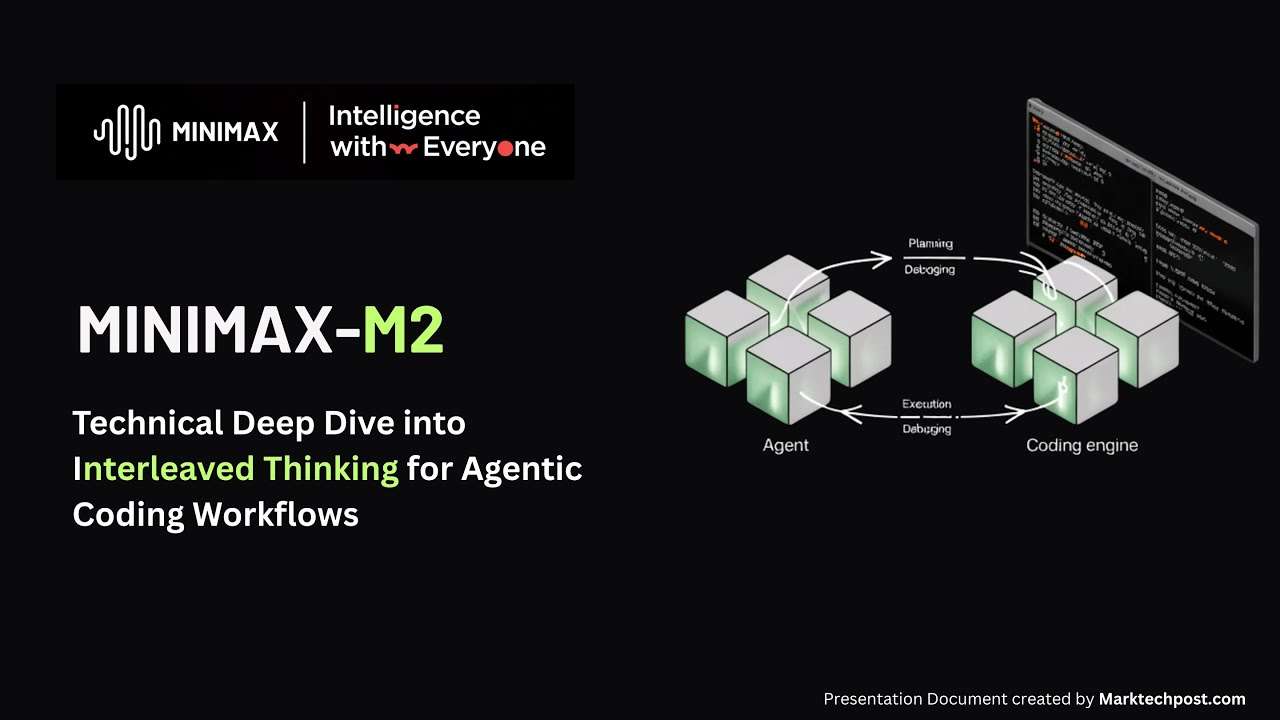
MiniMax-M2: Technical Deep Dive into Interleaved Thinking for Agentic Coding WorkflowsMarkTechPost The AI coding landscape just got a massive shake-up. If you’ve been relying on Claude 3.5 Sonnet or GPT-4o for your dev workflows, you know the pain: great performance often comes with a bill that makes your wallet weep, or latency that breaks your flow.This article provides a technical overview of MiniMax-M2, focusing on its
The post MiniMax-M2: Technical Deep Dive into Interleaved Thinking for Agentic Coding Workflows appeared first on MarkTechPost.
The AI coding landscape just got a massive shake-up. If you’ve been relying on Claude 3.5 Sonnet or GPT-4o for your dev workflows, you know the pain: great performance often comes with a bill that makes your wallet weep, or latency that breaks your flow.This article provides a technical overview of MiniMax-M2, focusing on its
The post MiniMax-M2: Technical Deep Dive into Interleaved Thinking for Agentic Coding Workflows appeared first on MarkTechPost. Read More

Building a Simple Data Quality DSL in PythonKDnuggets Build a lightweight Python DSL to define and check data quality rules in a clear, expressive way. Turn complex validation logic into simple, reusable configurations that anyone on your data team can understand.
Build a lightweight Python DSL to define and check data quality rules in a clear, expressive way. Turn complex validation logic into simple, reusable configurations that anyone on your data team can understand. Read More

Agentic AI autonomy grows in North American enterprisesAI News North American enterprises are now actively deploying agentic AI systems intended to reason, adapt, and act with complete autonomy. Data from Digitate’s three-year global programme indicates that, while adoption is universal across the board, regional maturity paths are diverging. North American firms are scaling toward full autonomy, whereas their European counterparts are prioritising governance frameworks
The post Agentic AI autonomy grows in North American enterprises appeared first on AI News.
North American enterprises are now actively deploying agentic AI systems intended to reason, adapt, and act with complete autonomy. Data from Digitate’s three-year global programme indicates that, while adoption is universal across the board, regional maturity paths are diverging. North American firms are scaling toward full autonomy, whereas their European counterparts are prioritising governance frameworks
The post Agentic AI autonomy grows in North American enterprises appeared first on AI News. Read More
Learning, Hacking, and Shipping MLTowards Data Science Vyacheslav Efimov on AI hackathons, data science roadmaps, and how AI meaningfully changed day-to-day ML Engineer work
The post Learning, Hacking, and Shipping ML appeared first on Towards Data Science.
Vyacheslav Efimov on AI hackathons, data science roadmaps, and how AI meaningfully changed day-to-day ML Engineer work
The post Learning, Hacking, and Shipping ML appeared first on Towards Data Science. Read More

Context Engineering is the New Prompt EngineeringKDnuggets It’s not about clever wording anymore. It’s about designing environments where AI can think with depth, consistency, and purpose.
It’s not about clever wording anymore. It’s about designing environments where AI can think with depth, consistency, and purpose. Read More