

The Machine Learning “Advent Calendar” Day 6: Decision Tree RegressorTowards Data Science During the first days of this Machine Learning Advent Calendar, we explored models based on distances. Today, we switch to a completely different way of learning: Decision Trees.
With a simple one-feature dataset, we can see how a tree chooses its first split. The idea is always the same: if humans can guess the split visually, then we can rebuild the logic step by step in Excel.
By listing all possible split values and computing the MSE for each one, we identify the split that reduces the error the most. This gives us a clear intuition of how a Decision Tree grows, how it makes predictions, and why the first split is such a crucial step.
The post The Machine Learning “Advent Calendar” Day 6: Decision Tree Regressor appeared first on Towards Data Science.
During the first days of this Machine Learning Advent Calendar, we explored models based on distances. Today, we switch to a completely different way of learning: Decision Trees.
With a simple one-feature dataset, we can see how a tree chooses its first split. The idea is always the same: if humans can guess the split visually, then we can rebuild the logic step by step in Excel.
By listing all possible split values and computing the MSE for each one, we identify the split that reduces the error the most. This gives us a clear intuition of how a Decision Tree grows, how it makes predictions, and why the first split is such a crucial step.
The post The Machine Learning “Advent Calendar” Day 6: Decision Tree Regressor appeared first on Towards Data Science. Read More
How We Are Testing Our Agents in DevTowards Data Science Testing that your AI agent is performing as expected is not easy. Here are a few strategies we learned the hard way.
The post How We Are Testing Our Agents in Dev appeared first on Towards Data Science.
Testing that your AI agent is performing as expected is not easy. Here are a few strategies we learned the hard way.
The post How We Are Testing Our Agents in Dev appeared first on Towards Data Science. Read More
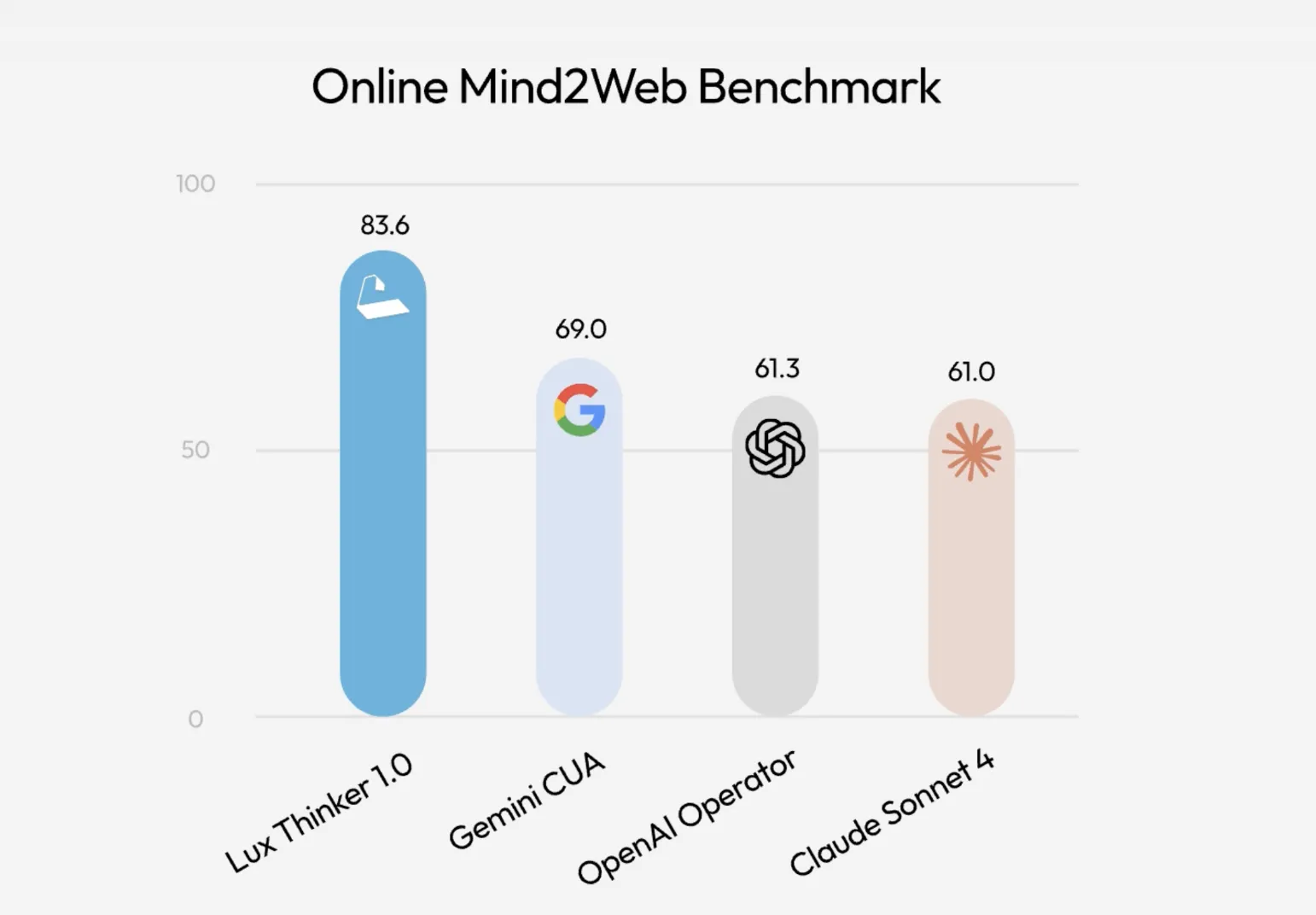
OpenAGI Foundation Launches Lux: A Foundation Computer Use Model that Tops Online Mind2Web with OSGym At ScaleMarkTechPost How do you turn slow, manual click work across browsers and desktops into a reliable, automated system that can actually use a computer for you at scale? Lux is the latest example of computer use agents moving from research demo to infrastructure. OpenAGI Foundation team has released Lux, a foundation model that operates real desktops
The post OpenAGI Foundation Launches Lux: A Foundation Computer Use Model that Tops Online Mind2Web with OSGym At Scale appeared first on MarkTechPost.
How do you turn slow, manual click work across browsers and desktops into a reliable, automated system that can actually use a computer for you at scale? Lux is the latest example of computer use agents moving from research demo to infrastructure. OpenAGI Foundation team has released Lux, a foundation model that operates real desktops
The post OpenAGI Foundation Launches Lux: A Foundation Computer Use Model that Tops Online Mind2Web with OSGym At Scale appeared first on MarkTechPost. Read More
On the Challenge of Converting TensorFlow Models to PyTorchTowards Data Science How to upgrade and optimize legacy AI/ML models
The post On the Challenge of Converting TensorFlow Models to PyTorch appeared first on Towards Data Science.
How to upgrade and optimize legacy AI/ML models
The post On the Challenge of Converting TensorFlow Models to PyTorch appeared first on Towards Data Science. Read More
The Machine Learning “Advent Calendar” Day 5: GMM in ExcelTowards Data Science This article introduces the Gaussian Mixture Model as a natural extension of k-Means, by improving how distance is measured through variances and the Mahalanobis distance. Instead of assigning points to clusters with hard boundaries, GMM uses probabilities learned through the Expectation–Maximization algorithm – the general form of Lloyd’s method.
Using simple Excel formulas, we implement EM step by step in 1D and 2D, and we visualise how the Gaussian curves or ellipses move during training. The means shift, the variances adjust, and the shapes gradually settle around the true structure of the data.
GMM provides a richer, more flexible way to model clusters, and becomes intuitive once the process is made visible in a spreadsheet.
The post The Machine Learning “Advent Calendar” Day 5: GMM in Excel appeared first on Towards Data Science.
This article introduces the Gaussian Mixture Model as a natural extension of k-Means, by improving how distance is measured through variances and the Mahalanobis distance. Instead of assigning points to clusters with hard boundaries, GMM uses probabilities learned through the Expectation–Maximization algorithm – the general form of Lloyd’s method.
Using simple Excel formulas, we implement EM step by step in 1D and 2D, and we visualise how the Gaussian curves or ellipses move during training. The means shift, the variances adjust, and the shapes gradually settle around the true structure of the data.
GMM provides a richer, more flexible way to model clusters, and becomes intuitive once the process is made visible in a spreadsheet.
The post The Machine Learning “Advent Calendar” Day 5: GMM in Excel appeared first on Towards Data Science. Read More
YOLOv1 Paper Walkthrough: The Day YOLO First Saw the WorldTowards Data Science A detailed walkthrough of the YOLOv1 architecture and its PyTorch implementation from scratch
The post YOLOv1 Paper Walkthrough: The Day YOLO First Saw the World appeared first on Towards Data Science.
A detailed walkthrough of the YOLOv1 architecture and its PyTorch implementation from scratch
The post YOLOv1 Paper Walkthrough: The Day YOLO First Saw the World appeared first on Towards Data Science. Read More

Top 5 Small AI Coding Models That You Can Run LocallyKDnuggets This article is for vibe coders and developers seeking private, fast, and affordable AI coding solutions.
This article is for vibe coders and developers seeking private, fast, and affordable AI coding solutions. Read More

UK and Germany plan to commercialise quantum supercomputingAI News The UK and Germany plan to integrate their science sectors to accelerate the commercialisation of quantum supercomputing technology. Announced on the final day of the German president’s state visit, these joint commitments target the gap between R&D and enterprise application in computing, sensing, and timing. The partnership involves specific funding to fast-track product development and
The post UK and Germany plan to commercialise quantum supercomputing appeared first on AI News.
The UK and Germany plan to integrate their science sectors to accelerate the commercialisation of quantum supercomputing technology. Announced on the final day of the German president’s state visit, these joint commitments target the gap between R&D and enterprise application in computing, sensing, and timing. The partnership involves specific funding to fast-track product development and
The post UK and Germany plan to commercialise quantum supercomputing appeared first on AI News. Read More

Aluminium OS is the AI-powered successor to ChromeOSAI News The convergence of mobile and desktop operating systems is a goal that has remained elusive for big tech firms since the early days of the smartphone. Microsoft’s attempt in the form of Windows Mobile was reaching the end of its road by 2010, and despite Apple’s iOS/iPadOS and macOS moving very slowly towards one another
The post Aluminium OS is the AI-powered successor to ChromeOS appeared first on AI News.
The convergence of mobile and desktop operating systems is a goal that has remained elusive for big tech firms since the early days of the smartphone. Microsoft’s attempt in the form of Windows Mobile was reaching the end of its road by 2010, and despite Apple’s iOS/iPadOS and macOS moving very slowly towards one another
The post Aluminium OS is the AI-powered successor to ChromeOS appeared first on AI News. Read More
Single-Round Scalable Analytic Federated Learningcs.AI updates on arXiv.org arXiv:2512.03336v1 Announce Type: cross
Abstract: Federated Learning (FL) is plagued by two key challenges: high communication overhead and performance collapse on heterogeneous (non-IID) data. Analytic FL (AFL) provides a single-round, data distribution invariant solution, but is limited to linear models. Subsequent non-linear approaches, like DeepAFL, regain accuracy but sacrifice the single-round benefit. In this work, we break this trade-off. We propose SAFLe, a framework that achieves scalable non-linear expressivity by introducing a structured head of bucketed features and sparse, grouped embeddings. We prove this non-linear architecture is mathematically equivalent to a high-dimensional linear regression. This key equivalence allows SAFLe to be solved with AFL’s single-shot, invariant aggregation law. Empirically, SAFLe establishes a new state-of-the-art for analytic FL, significantly outperforming both linear AFL and multi-round DeepAFL in accuracy across all benchmarks, demonstrating a highly efficient and scalable solution for federated vision.
arXiv:2512.03336v1 Announce Type: cross
Abstract: Federated Learning (FL) is plagued by two key challenges: high communication overhead and performance collapse on heterogeneous (non-IID) data. Analytic FL (AFL) provides a single-round, data distribution invariant solution, but is limited to linear models. Subsequent non-linear approaches, like DeepAFL, regain accuracy but sacrifice the single-round benefit. In this work, we break this trade-off. We propose SAFLe, a framework that achieves scalable non-linear expressivity by introducing a structured head of bucketed features and sparse, grouped embeddings. We prove this non-linear architecture is mathematically equivalent to a high-dimensional linear regression. This key equivalence allows SAFLe to be solved with AFL’s single-shot, invariant aggregation law. Empirically, SAFLe establishes a new state-of-the-art for analytic FL, significantly outperforming both linear AFL and multi-round DeepAFL in accuracy across all benchmarks, demonstrating a highly efficient and scalable solution for federated vision. Read More