
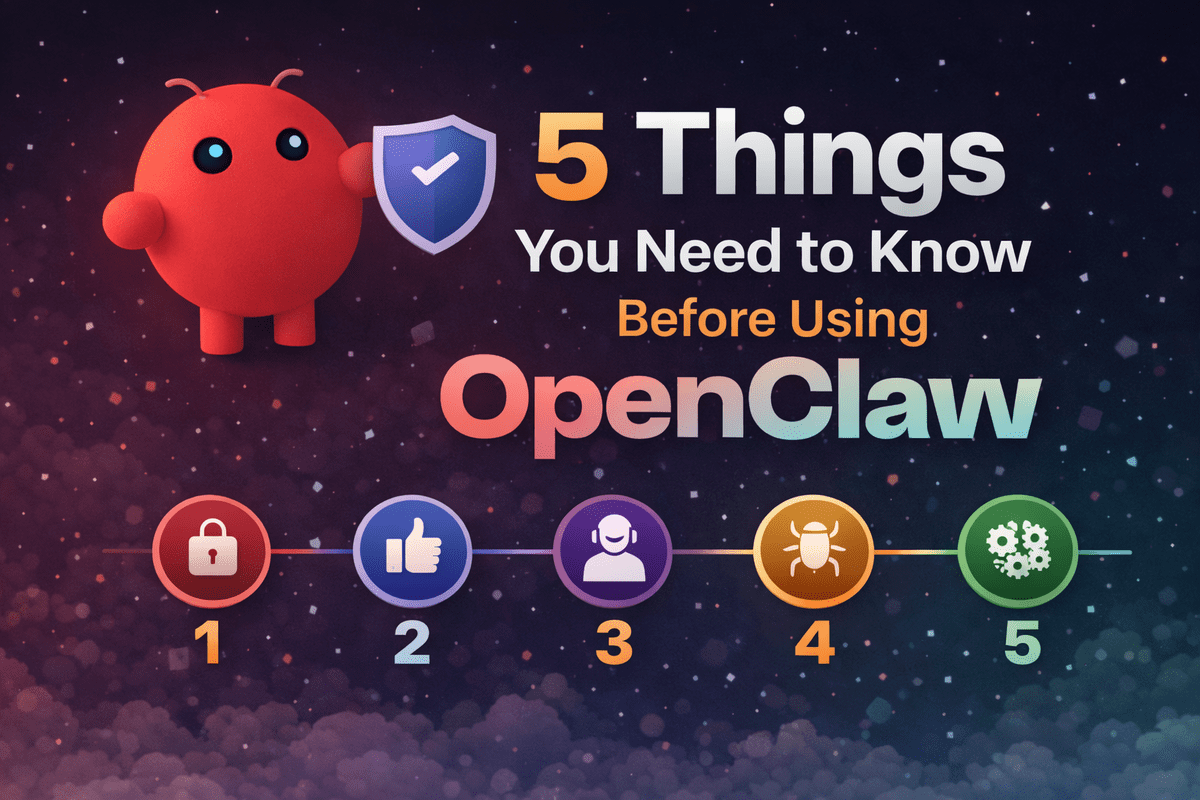
5 Things You Need to Know Before Using OpenClawKDnuggets OpenClaw is incredibly powerful, but if you install it without understanding these five things, you could expose far more than you expect.
OpenClaw is incredibly powerful, but if you install it without understanding these five things, you could expose far more than you expect. Read More

Poor implementation of AI may be behind workforce reductionAI News Many organisations are eroding the foundations of business – productivity, competitiveness, and efficiency. This is happening due to poor implementation of human-AI collaboration, according to cloud data and AI consultancy, Datatonic. The company says in the next phase of enterprise AI, success will come from carefully-governed and designed AI that works alongside humans in “human-in-the-loop
The post Poor implementation of AI may be behind workforce reduction appeared first on AI News.
Many organisations are eroding the foundations of business – productivity, competitiveness, and efficiency. This is happening due to poor implementation of human-AI collaboration, according to cloud data and AI consultancy, Datatonic. The company says in the next phase of enterprise AI, success will come from carefully-governed and designed AI that works alongside humans in “human-in-the-loop
The post Poor implementation of AI may be behind workforce reduction appeared first on AI News. Read More

The Gap Between Junior and Senior Data Scientists Isn’t CodeTowards Data Science Why my obsession with complex algorithms was actually holding my career back.
The post The Gap Between Junior and Senior Data Scientists Isn’t Code appeared first on Towards Data Science.
Why my obsession with complex algorithms was actually holding my career back.
The post The Gap Between Junior and Senior Data Scientists Isn’t Code appeared first on Towards Data Science. Read More
Goldman Sachs and Deutsche Bank test agentic AI for trade surveillanceAI News Banks are testing a new type of artificial intelligence, like agentic AI, that does more than scan for keywords or follow preset rules. Instead of relying only on static alerts, some trading desks are beginning to use systems designed to reason through patterns in real time and flag conduct that may need human review. Bloomberg
The post Goldman Sachs and Deutsche Bank test agentic AI for trade surveillance appeared first on AI News.
Banks are testing a new type of artificial intelligence, like agentic AI, that does more than scan for keywords or follow preset rules. Instead of relying only on static alerts, some trading desks are beginning to use systems designed to reason through patterns in real time and flag conduct that may need human review. Bloomberg
The post Goldman Sachs and Deutsche Bank test agentic AI for trade surveillance appeared first on AI News. Read More
From Shallow Bayesian Neural Networks to Gaussian Processes: General Convergence, Identifiability and Scalable Inferencecs.AI updates on arXiv.org arXiv:2602.22492v1 Announce Type: cross
Abstract: In this work, we study scaling limits of shallow Bayesian neural networks (BNNs) via their connection to Gaussian processes (GPs), with an emphasis on statistical modeling, identifiability, and scalable inference. We first establish a general convergence result from BNNs to GPs by relaxing assumptions used in prior formulations, and we compare alternative parameterizations of the limiting GP model. Building on this theory, we propose a new covariance function defined as a convex mixture of components induced by four widely used activation functions, and we characterize key properties including positive definiteness and both strict and practical identifiability under different input designs. For computation, we develop a scalable maximum a posterior (MAP) training and prediction procedure using a Nystr”om approximation, and we show how the Nystr”om rank and anchor selection control the cost-accuracy trade-off. Experiments on controlled simulations and real-world tabular datasets demonstrate stable hyperparameter estimates and competitive predictive performance at realistic computational cost.
arXiv:2602.22492v1 Announce Type: cross
Abstract: In this work, we study scaling limits of shallow Bayesian neural networks (BNNs) via their connection to Gaussian processes (GPs), with an emphasis on statistical modeling, identifiability, and scalable inference. We first establish a general convergence result from BNNs to GPs by relaxing assumptions used in prior formulations, and we compare alternative parameterizations of the limiting GP model. Building on this theory, we propose a new covariance function defined as a convex mixture of components induced by four widely used activation functions, and we characterize key properties including positive definiteness and both strict and practical identifiability under different input designs. For computation, we develop a scalable maximum a posterior (MAP) training and prediction procedure using a Nystr”om approximation, and we show how the Nystr”om rank and anchor selection control the cost-accuracy trade-off. Experiments on controlled simulations and real-world tabular datasets demonstrate stable hyperparameter estimates and competitive predictive performance at realistic computational cost. Read More
Early Risk Stratification of Dosing Errors in Clinical Trials Using Machine Learningcs.AI updates on arXiv.org arXiv:2602.22285v1 Announce Type: cross
Abstract: Objective: The objective of this study is to develop a machine learning (ML)-based framework for early risk stratification of clinical trials (CTs) according to their likelihood of exhibiting a high rate of dosing errors, using information available prior to trial initiation. Materials and Methods: We constructed a dataset from ClinicalTrials.gov comprising 42,112 CTs. Structured, semi-structured trial data, and unstructured protocol-related free-text data were extracted. CTs were assigned binary labels indicating elevated dosing error rate, derived from adverse event reports, MedDRA terminology, and Wilson confidence intervals. We evaluated an XGBoost model trained on structured features, a ClinicalModernBERT model using textual data, and a simple late-fusion model combining both modalities. Post-hoc probability calibration was applied to enable interpretable, trial-level risk stratification. Results: The late-fusion model achieved the highest AUC-ROC (0.862). Beyond discrimination, calibrated outputs enabled robust stratification of CTs into predefined risk categories. The proportion of trials labeled as having an excessively high dosing error rate increased monotonically across higher predicted risk groups and aligned with the corresponding predicted probability ranges. Discussion: These findings indicate that dosing error risk can be anticipated at the trial level using pre-initiation information. Probability calibration was essential for translating model outputs into reliable and interpretable risk categories, while simple multimodal integration yielded performance gains without requiring complex architectures. Conclusion: This study introduces a reproducible and scalable ML framework for early, trial-level risk stratification of CTs at risk of high dosing error rates, supporting proactive, risk-based quality management in clinical research.
arXiv:2602.22285v1 Announce Type: cross
Abstract: Objective: The objective of this study is to develop a machine learning (ML)-based framework for early risk stratification of clinical trials (CTs) according to their likelihood of exhibiting a high rate of dosing errors, using information available prior to trial initiation. Materials and Methods: We constructed a dataset from ClinicalTrials.gov comprising 42,112 CTs. Structured, semi-structured trial data, and unstructured protocol-related free-text data were extracted. CTs were assigned binary labels indicating elevated dosing error rate, derived from adverse event reports, MedDRA terminology, and Wilson confidence intervals. We evaluated an XGBoost model trained on structured features, a ClinicalModernBERT model using textual data, and a simple late-fusion model combining both modalities. Post-hoc probability calibration was applied to enable interpretable, trial-level risk stratification. Results: The late-fusion model achieved the highest AUC-ROC (0.862). Beyond discrimination, calibrated outputs enabled robust stratification of CTs into predefined risk categories. The proportion of trials labeled as having an excessively high dosing error rate increased monotonically across higher predicted risk groups and aligned with the corresponding predicted probability ranges. Discussion: These findings indicate that dosing error risk can be anticipated at the trial level using pre-initiation information. Probability calibration was essential for translating model outputs into reliable and interpretable risk categories, while simple multimodal integration yielded performance gains without requiring complex architectures. Conclusion: This study introduces a reproducible and scalable ML framework for early, trial-level risk stratification of CTs at risk of high dosing error rates, supporting proactive, risk-based quality management in clinical research. Read More
Enhancing Renal Tumor Malignancy Prediction: Deep Learning with Automatic 3D CT Organ Focused Attentioncs.AI updates on arXiv.org arXiv:2602.22381v1 Announce Type: cross
Abstract: Accurate prediction of malignancy in renal tumors is crucial for informing clinical decisions and optimizing treatment strategies. However, existing imaging modalities lack the necessary accuracy to reliably predict malignancy before surgical intervention. While deep learning has shown promise in malignancy prediction using 3D CT images, traditional approaches often rely on manual segmentation to isolate the tumor region and reduce noise, which enhances predictive performance. Manual segmentation, however, is labor-intensive, costly, and dependent on expert knowledge. In this study, a deep learning framework was developed utilizing an Organ Focused Attention (OFA) loss function to modify the attention of image patches so that organ patches attend only to other organ patches. Hence, no segmentation of 3D renal CT images is required at deployment time for malignancy prediction. The proposed framework achieved an AUC of 0.685 and an F1-score of 0.872 on a private dataset from the UF Integrated Data Repository (IDR), and an AUC of 0.760 and an F1-score of 0.852 on the publicly available KiTS21 dataset. These results surpass the performance of conventional models that rely on segmentation-based cropping for noise reduction, demonstrating the frameworks ability to enhance predictive accuracy without explicit segmentation input. The findings suggest that this approach offers a more efficient and reliable method for malignancy prediction, thereby enhancing clinical decision-making in renal cancer diagnosis.
arXiv:2602.22381v1 Announce Type: cross
Abstract: Accurate prediction of malignancy in renal tumors is crucial for informing clinical decisions and optimizing treatment strategies. However, existing imaging modalities lack the necessary accuracy to reliably predict malignancy before surgical intervention. While deep learning has shown promise in malignancy prediction using 3D CT images, traditional approaches often rely on manual segmentation to isolate the tumor region and reduce noise, which enhances predictive performance. Manual segmentation, however, is labor-intensive, costly, and dependent on expert knowledge. In this study, a deep learning framework was developed utilizing an Organ Focused Attention (OFA) loss function to modify the attention of image patches so that organ patches attend only to other organ patches. Hence, no segmentation of 3D renal CT images is required at deployment time for malignancy prediction. The proposed framework achieved an AUC of 0.685 and an F1-score of 0.872 on a private dataset from the UF Integrated Data Repository (IDR), and an AUC of 0.760 and an F1-score of 0.852 on the publicly available KiTS21 dataset. These results surpass the performance of conventional models that rely on segmentation-based cropping for noise reduction, demonstrating the frameworks ability to enhance predictive accuracy without explicit segmentation input. The findings suggest that this approach offers a more efficient and reliable method for malignancy prediction, thereby enhancing clinical decision-making in renal cancer diagnosis. Read More
ASML’s high-NA EUV tools clear the runway for next-gen AI chipsAI News The machine that will make tomorrow’s AI chips possible has just been declared ready for mass production–and the clock for the industry’s next leap has officially started. ASML, the Dutch company that holds a global monopoly on commercial extreme ultraviolet lithography equipment, confirmed this week that its High-NA EUV tools have crossed the threshold from
The post ASML’s high-NA EUV tools clear the runway for next-gen AI chips appeared first on AI News.
The machine that will make tomorrow’s AI chips possible has just been declared ready for mass production–and the clock for the industry’s next leap has officially started. ASML, the Dutch company that holds a global monopoly on commercial extreme ultraviolet lithography equipment, confirmed this week that its High-NA EUV tools have crossed the threshold from
The post ASML’s high-NA EUV tools clear the runway for next-gen AI chips appeared first on AI News. Read More

Role Intelligence AI Red Teamer — At a Glance Glassdoor Feb 2026 ZipRecruiter Feb 2026 Mercor/Remotive Listings WEF AI Security Talent 2025 AI Red Teamer ● Moderate Demand AI Red Teamers proactively test AI systems—especially LLMs and generative AI—for security vulnerabilities, safety risks, biases, and failure modes through adversarial simulation. The newest role in AI […]
Role Intelligence AI Product Manager — At a Glance IAPP Salary Survey 2025–26 Glassdoor AI PM Compensation ZipRecruiter AI PM Salaries Product School PM Compensation AI Product Manager ▲ HIGH DEMAND Bridges product strategy, AI/ML technology, and responsible AI practices. Translates regulatory requirements into product features, defines no-go deployment thresholds, designs bias detection dashboards, and […]