What Is Microsoft Copilot? Every Version Explained, Pricing & Limitations (2026)
Microsoft has put the word "Copilot" on at least six different products, and none of them do the same thing. There is a free chatbot, a $20/month personal upgrade, a $30/month enterprise add-on, a coding assistant, a cybersecurity tool, and a platform for building your own AI agents. If you have ever Googled "what is Microsoft Copilot" and left more confused than when you started, this article untangles the mess.
What Is Microsoft Copilot?
Microsoft Copilot is a family of AI-powered assistants developed by Microsoft that uses large language models (LLMs) like OpenAI's GPT-5.4 and Claude, an AI assistant made by Anthropic, to help people write, analyze data, generate code, and automate tasks across Microsoft 365 apps, Windows, GitHub, and security operations.
Think of Copilot less like a single product and more like a brand name Microsoft applies to AI features everywhere. The way Google puts "Gemini" on everything from its chatbot to its developer API, Microsoft puts "Copilot" on everything from a free chat window to a $39/seat enterprise coding tool. The original version launched as Bing Chat on February 7, 2023, was rebranded to Microsoft Copilot on November 15, 2023, and has since expanded into an ecosystem spanning consumer, enterprise, developer, and security products (Wikipedia).
As of March 2026, Copilot has surpassed 100 million monthly active users across commercial and consumer tiers (Microsoft 2025 Annual Report, October 2025). Microsoft does not publicly define what "monthly active" means in this context -- it likely includes any user who interacted with any Copilot surface (including Bing sidebar and Windows taskbar) at least once in a calendar month, not sustained daily usage.
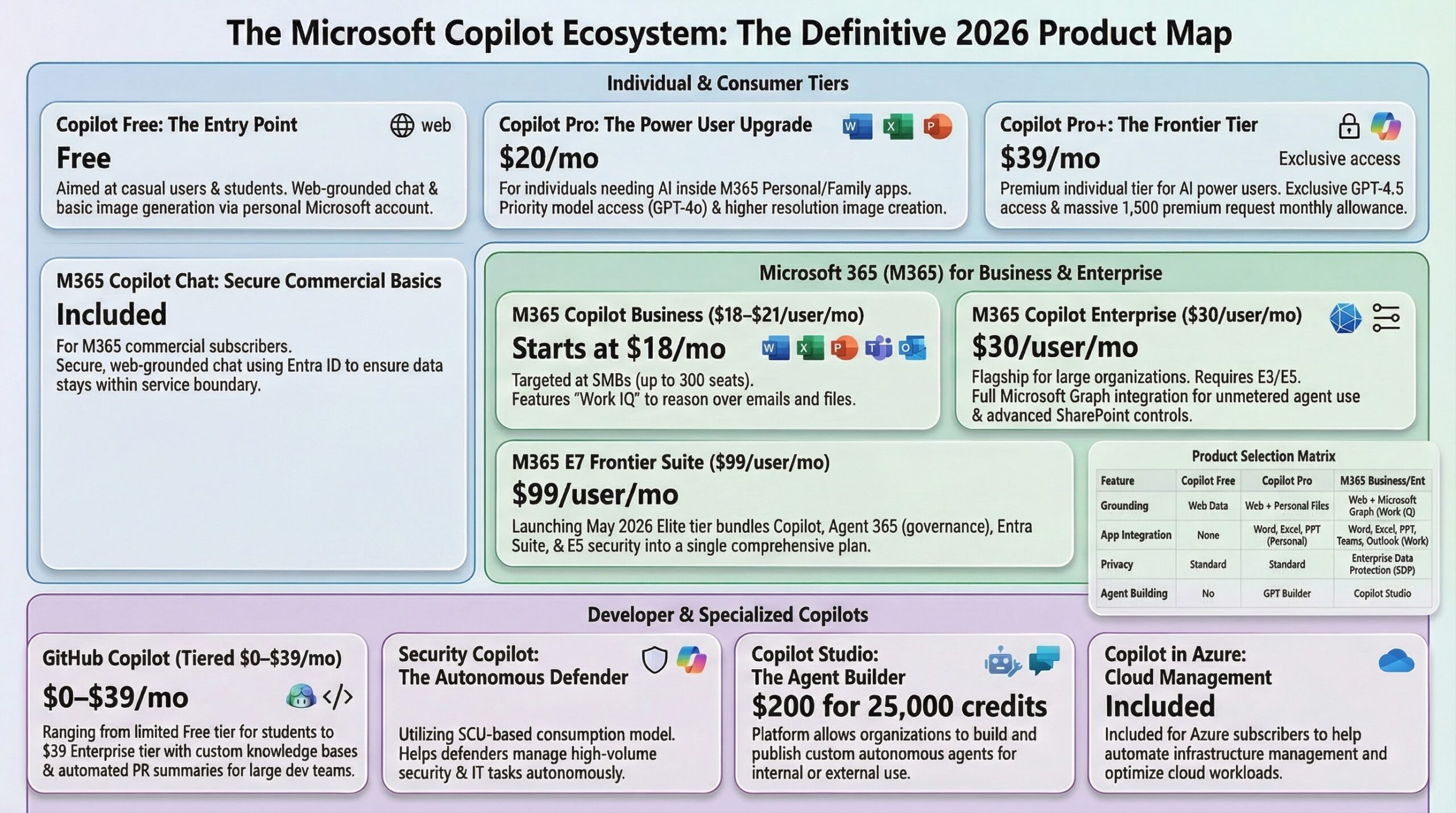
The Microsoft Copilot Ecosystem — Pricing verified March 2026. Copilot products are powered by GPT-5.4 as the primary reasoning engine. E7 Frontier Suite pricing is announced, not yet confirmed.
Who Uses Microsoft Copilot — and Why It Matters?
85%
of Fortune 500 companies use Microsoft AI platforms, including Copilot, Azure AI, and Fabric. (Microsoft 2025 Annual Report)
Copilot is not a standalone chatbot competing for browser tabs. Its power comes from being embedded inside tools that billions of people already use. Here is where it lives:
Microsoft 365
Word, Excel, PowerPoint, Outlook, and Teams with Microsoft Graph grounding across your organization's data.
Windows & Edge
Taskbar integration, browser sidebar, and Copilot+ PCs with on-device AI processing via NPU chips.
GitHub
VS Code, JetBrains, Neovim integration with multi-model support (GPT-5.4, Claude 4.6, Gemini) and coding agents in GitHub Actions.
Azure & Security
AI agents in Defender, Sentinel, Intune, Entra (Microsoft's identity and access management platform), and Purview (Microsoft's data governance and compliance platform) for phishing triage, malware analysis, and incident response.
That embedded presence is what separates Copilot from competitors. ChatGPT holds 64-68% of the standalone chatbot market, and Copilot only holds about 4.5% of that standalone share (Statcounter/Similarweb, January 2026). But standalone share misses the point. By Q1 2026, Microsoft reported 15 million paid Microsoft 365 Copilot seats across more than 100 countries -- a 160% year-over-year growth (Directions on Microsoft). GitHub Copilot (a separate product from Microsoft Copilot/M365 Copilot, focused on software development) has over 1.3 million developers on paid plans spanning more than 50,000 organizations (Worklytics). Its primary competitor in the coding space is Claude Code, Anthropic's terminal-native coding agent, which leads on SWE-bench Verified (80.8%) and specializes in repository-scale refactoring. Many developers now use both: GitHub Copilot for inline autocomplete and Claude Code for deep architectural work. The value is not in the chat window. It is in the Office ribbon, the IDE sidebar, and the security console.
ROI projection: A Microsoft-commissioned Forrester study projected over 100% ROI for Microsoft 365 Copilot deployments, with a potential 10-month payback period and estimated time savings of 8+ hours per user per month (Microsoft 365 Copilot Pricing Page). Worth noting who paid for the study.
The adoption gap nobody talks about: 79% of surveyed enterprises report deploying Copilot, but only 3.3% of all eligible M365 users have actually purchased the paid add-on (Windows Central, Q1 2026). That gap between organizational deployment and individual seat adoption means most enterprises have Copilot on paper, not in practice. For a full breakdown of costs, total cost of ownership including training and change management, and break-even math at realistic adoption rates, see the Microsoft Copilot Pricing Guide.
IT Administrator
Manages Copilot rollout through Microsoft Admin Console, configures access policies per organizational unit, monitors adoption through Copilot Analytics. Explore tech career paths in this evolving space.
Knowledge Worker
Uses Copilot inside Word, Excel, PowerPoint, and Outlook to draft documents, summarize email threads, and build presentations from meeting notes. The prompt engineering gap between useful and hallucinated output is real.
Software Developer
Runs GitHub Copilot in VS Code or JetBrains for real-time code completion, chat-based debugging, and autonomous coding agents in GitHub Actions.
Security Analyst
Deploys Security Copilot agents in Defender and Sentinel to triage phishing alerts, reverse-engineer malware scripts, and generate incident response reports. SOC analysts found malicious emails up to 550% faster using the Phishing Triage Agent. See the cybersecurity hub.
How Does Microsoft Copilot Perform?
Benchmarks are snapshots, not the full story. They measure specific tasks under controlled conditions, and real-world performance depends on your prompt quality, the complexity of your data, and which Copilot surface you are using. That said, benchmarks reveal where the underlying models excel and where they fall short.
Microsoft Copilot's flagship model is OpenAI's GPT-5.4 (released March 5, 2026). Here is how it stacks up against Claude Opus 4.6, the latest flagship model from Anthropic (which powers some Copilot features through the Anthropic partnership), and Google Gemini 3.1 Pro:
SWE-bench Verified
Real GitHub Issue Resolution -- a test that measures how well AI can fix real bugs from GitHub repositories, using a human-verified subset of issues
Claude Opus 4.6
80.8%
Gemini 3.1 Pro
80.6%
GPT-5.4
80.0%
All three models are within 1% of each other. The harness and prompt engineering matter more than the model at this level. Data integrity warning: OpenAI has stopped reporting SWE-bench Verified scores due to training data contamination concerns across all frontier models -- models may have been trained on the same repositories used in testing, which inflates scores. Treat these numbers as directional, not definitive. The sub-1% spread between models is within noise range.
SWE-bench Pro
Advanced Software Engineering -- a harder version of SWE-bench with less risk of data contamination, testing AI on more complex software engineering tasks
GPT-5.4
57.7%
Gemini 3.1 Pro
54.2%
Claude Opus 4.5
45.89%
SWE-bench Pro is considered a more reliable software engineering benchmark than SWE-bench Verified (less contamination risk). GPT-5.4 leads decisively here, giving Copilot a genuine edge for complex coding workflows.
Terminal-Bench 2.0
DevOps & CLI Workflows -- a test that measures how well AI can perform real system administration and command-line tasks like managing servers and debugging deployments
GPT-5.4
75.1%
Gemini 3.1 Pro
68.5%
Claude Opus 4.6
65.4%
GPT-5.4 dominates terminal operations. If your workflow is heavy on system administration, git, and CI/CD debugging, this is Copilot's strongest benchmark.
Humanity's Last Exam
Deep Reasoning & Knowledge -- a crowd-sourced test of expert-level questions across dozens of academic disciplines, designed to be the hardest AI reasoning benchmark
Gemini 3 Pro Prev.
37.52%
Claude Opus 4.6
34.44%
GPT-5 Pro
31.64%
GPT-5.2
27.80%
Gemini 3 Pro Preview leads the hardest reasoning benchmark, followed by Claude Opus 4.6. GPT-5.4 has not been tested on HLE -- the GPT-5 Pro and GPT-5.2 scores shown above are from earlier GPT-5 family models, not the GPT-5.4 that currently powers Copilot. Do not assume GPT-5.4 would score similarly; it may score higher or lower. Copilot's underlying GPT-5.2 scores 27.80%.
The honest summary: GPT-5.4 wins on speed, terminal execution, and SWE-bench Pro. Gemini 3 Pro Preview leads on deep reasoning (HLE). Claude Opus 4.6 wins on SWE-bench Verified and intent understanding. Gemini 3.1 Pro wins on price-to-performance. No single model dominates every dimension, which is exactly why Microsoft now offers multiple models inside Copilot rather than locking users into one.
How Does Microsoft Copilot Work?
If you are wondering what happens between typing a question and getting an answer, here is the short version: Copilot is not just a "wrapper" around ChatGPT. It is an orchestration engine -- think of it like an air traffic controller that coordinates between you, the AI model, and your organization's data.
The system has three layers. First, the user interface -- this is wherever you are typing (Word, Teams, Edge, the Copilot app). Second, the LLM -- currently GPT-5.4 by default, with Claude and other models available in certain surfaces. Third, the Microsoft Graph -- the data layer that connects your emails, files, chats, and calendar across M365 apps. It acts as a secure index of your organization's emails, documents, calendar events, Teams chats, and SharePoint files (Microsoft Learn).
When you submit a prompt, Copilot does not just send your words to the AI model. The orchestration engine first runs responsible AI checks and security validation. Then it queries the Microsoft Graph to pull in your relevant data -- the email thread you are referencing, the document you have open, the meeting notes from yesterday. This process is called "grounding," and it is what makes Copilot different from a generic chatbot. The AI answers using your data, not just its training data (Microsoft Learn - Copilot Architecture). The Prometheus model, Microsoft's proprietary connective layer, iteratively generates search queries that combine the Bing index with the LLM to keep outputs accurate and current.
Copilot Orchestration
Your PromptOrchestration EngineMS GraphLLM (GPT-5.4)Grounded Response
Copilot inherits your existing access permissions. If you cannot see a file in SharePoint, Copilot cannot see it either.
A key concept: Copilot inherits your existing access permissions. If you cannot see a file in SharePoint, Copilot cannot see it either. It respects role-based access controls through Microsoft Purview (Microsoft's data governance and compliance platform that manages data classification, sensitivity labels, and data loss prevention policies) and Entra ID.
The Product Tiers
This is where the naming confusion peaks. Here is every product Microsoft calls "Copilot," what it costs, and who it is for:
FREE
Microsoft Copilot
Personal use, casual AI chat
Price$0
AccountMicrosoft Acct
Web-grounded AI chat, voice interaction, image generation via Designer (DALL-E 3, OpenAI's AI image generator), cross-conversation memory. No M365 app integration, Microsoft Graph grounding, or Enterprise Data Protection (EDP -- Microsoft's guarantee that your organizational data is not used to train AI models).
$20/MO
Copilot Pro
Power users who need AI inside Office apps
Price$20/user/mo
RequiresM365 Personal+
Priority access to GPT-5 Pro and newer models, Copilot in Word/Excel/PPT/Outlook, nearly unlimited image generation, Copilot Labs (Think Deeper, Copilot Vision). No Microsoft Graph grounding or enterprise data protection. Requires separate M365 Personal ($9.99/mo), Family ($12.99/mo), or Premium ($19.99/mo) subscription.
$39/MO
Copilot Pro+
AI power users needing higher limits
Price$39/user/mo
RequiresM365 Personal+
Everything in Copilot Pro + significantly higher usage limits for premium AI models, expanded access to advanced reasoning and generation capabilities. Copilot Pro+ launched in early 2026. Verify current pricing and availability at microsoft.com/copilot as tier details may change.
$18-21/MO
M365 Copilot Business
SMBs already on Microsoft 365
Price$21/user/mo*
AccountEntra ID
Work IQ (Graph grounding), Copilot in Teams/Outlook/Word/Excel/PPT, Copilot Studio for internal agents, enterprise data protection. *Promo: $18/user/mo for new customers, first year (expires Jun 30, 2026). Monthly: $25.20. Account: Microsoft Entra ID (Microsoft's identity and login system for businesses -- if your company uses Microsoft 365, Entra ID is what manages your work account).
$30/MO
M365 Copilot Enterprise
Large orgs, advanced security & analytics
Price$30/user/mo
RequiresM365 E3/E5
Everything in Business + Copilot Control System, SharePoint Advanced Management, Copilot Analytics, deep reasoning models (Claude Opus 4.5, Anthropic's previous flagship, for select features), Copilot Tuning. Also in M365 E7 bundle ($99/user/mo, GA May 1, 2026).
$0-39/MO
GitHub Copilot
Software developers (a separate product from M365 Copilot)
Free2,000 comp/mo
Enterprise$39/seat/mo
Free (2K completions/mo) | Pro $10/mo | Business $19/seat/mo | Enterprise $39/seat/mo. Multi-model support: GPT-5.4, Claude Sonnet 4.6, Gemini. Coding agents in GitHub Actions. Enterprise: custom knowledge bases, PR summaries, SAML SSO, SCIM.
PAY-AS-YOU-GO
Security Copilot
Security & IT teams
PricingMetered SCUs (Security Compute Units -- billing units that measure how much processing power your security AI tasks consume)
M365 E5400 SCUs/mo incl.
AI agents in Defender, Sentinel, Intune, Entra, and Purview. Phishing triage, malware analysis, conditional access optimization, incident response automation. SOC analysts found malicious emails up to 550% faster.
Copilot Studio deserves a separate mention. It is not a Copilot you use -- it is a platform for building your own AI agents. Think of it as a low-code workshop where you can create custom AI workflows that connect to your internal systems. If you have an M365 Copilot license, building internal agents is included. For standalone agents or external publishing, pricing starts at $200/month for 25,000 Copilot Credits, or pay-as-you-go (Microsoft Copilot Studio Pricing).
What Are the Limitations of Microsoft Copilot?
No puff piece here. Copilot has real problems you should understand before committing your budget -- or your trust.
The Name Itself Is the First Problem
Microsoft applies the "Copilot" label to at least six distinct products with different capabilities, different pricing, and different license requirements. In January 2026, renaming the classic Office web hub to "Microsoft 365 Copilot app" triggered viral misinformation that Word and Excel were being replaced. Internal employees have described the branding push as excessive. When users hear "Copilot," they cannot know which product you mean without asking. (The Verge, January 2026)
You Need an M365 License to Get the Best Features
Microsoft 365 Copilot is an add-on, not a standalone product. You must already pay for a qualifying base license (M365 E3/E5 or Business Standard/Premium), then add $30/user/month on top. For a 500-person organization, that is $15,000/month before you even count the base subscription. The free version is just a chatbot with no access to your organization's data. (Microsoft 365 Copilot Pricing, March 2026)
Limited Cross-Conversation Memory
Copilot has introduced limited memory features -- the free tier added "Memory for personalization" in April 2025 (storing preferences, facts, and routines), and enterprise users have Work IQ Copilot Memory that implicitly learns work style and habits via Microsoft Graph. Voice chats in the M365 Copilot app also reference stored memories as of January 2026. However, this is not equivalent to ChatGPT's robust cross-conversation memory system. Copilot's memory is narrower in scope, less user-configurable, and does not carry full conversational context between sessions the way ChatGPT does. (Microsoft Learn, Copilot feature updates April 2025 / January 2026)
Variable Quality Across Apps
Copilot is excellent for quick formatting, charting, and email summarization. It struggles with complex reasoning. In Excel, it frequently fails to grasp overarching structural logic on multi-sheet workbooks, crashes on memory-heavy files, and can silently break cross-sheet dependencies. Performance quality varies significantly between Word (strong), PowerPoint (moderate), and Excel (inconsistent on complex tasks). (Independent testing, March 2026)
Data Residency Gaps with Claude Integration
When Copilot routes queries to Anthropic's Claude models (used for Researcher, Cowork, and some Excel Agent Mode features), data is transferred to AWS or GCP data centers in the United States. This breaks strict Azure data residency guarantees required by many EU, UK, and AU/NZ organizations. Anthropic became a Microsoft sub-processor in January 2026, bound by Microsoft's DPA, but the physical data transfer remains a compliance concern for regulated industries. (Practical365, March 2026)
Permission Debt Becomes a Security Risk
Copilot is extremely good at finding data. If your SharePoint permissions are messy -- and most organizations' permissions are messy -- Copilot will surface sensitive files (salary data, HR records, financial projections) to anyone authorized to ask. In a typical organization, Copilot can access an average of three million sensitive records. Microsoft offers Restricted SharePoint Search (RSS) as a mitigation, but fixing legacy permissions is the real solution. See AI governance for policy frameworks. (Microsoft Security Documentation, 2026)
What Is the Latest Microsoft Copilot?
The pace of change is aggressive. Here is what has shipped and what is coming:
March 9, 2026
Copilot Cowork (Research Preview)
The centerpiece of Wave 3. Powered by Anthropic's Claude, Cowork takes a high-level goal and autonomously plans, executes, and delivers multi-step tasks across Outlook, Teams, Excel, PowerPoint, and SharePoint in the background. Unlike standard Copilot, it runs for hours on long-running projects. Broader availability through Microsoft's Frontier program expected late March. (Microsoft Blog, March 2026)
March 2026
Claude Models in M365 Copilot
Anthropic's Claude Sonnet 4.5 and Opus 4.5 are now available inside Microsoft 365 Copilot Chat, Excel Agent Mode, and Copilot Studio. Users can choose Claude for deep reasoning tasks where it outperforms GPT on specific benchmarks. Claude is also powering new Anthropic Office agents for Excel, PowerPoint, and Word (available via Frontier program). (Practical365, March 2026)
March 15-16, 2026
Windows 11 Copilot Integrations Cancelled
Microsoft cancelled planned Copilot integrations in Windows 11 Notifications, Settings, and File Explorer -- features originally announced in 2024 that never shipped. Separately, existing Copilot integrations in Snipping Tool, Photos, Widgets, and Notepad were scaled back or deprioritized. Microsoft cited the need to remove "unnecessary Copilot entry points" in response to user criticism over "AI bloat." Note: cancelled plans and scaled-back existing features are distinct actions. (gHacks / WindowsCentral, March 2026)
Expanding
MCP (Model Context Protocol) Support in Copilot Studio
Copilot Studio now supports MCP (Model Context Protocol) -- an open standard created by Anthropic that acts as a universal interface for connecting AI models to external tools and data sources. Instead of building custom integrations per AI platform, developers build one MCP server that works across Claude, ChatGPT, and Copilot. This positions Copilot Studio as a multi-provider orchestration platform.
Preview
BYOM (Bring Your Own Model)
Copilot Studio now supports BYOM -- routing tasks to non-OpenAI models from the Azure AI Foundry catalog, including Meta Llama, Mistral, Cohere, and Microsoft's own Phi-3.5 family. Organizations can align model selection with workload requirements, governance policies, and cost constraints.
May 1, 2026
Microsoft 365 E7 Frontier Suite
The first new enterprise license tier in a decade. Priced at $99/user/month, E7 bundles M365 E5, M365 Copilot, Agent 365 (a new control plane for governing AI agents), and the Microsoft Entra Suite into a single plan. Designed to simplify licensing for organizations going all-in on Copilot.
You are here: What Is Microsoft Copilot (the overview)
→ Next: Microsoft Copilot Pricing Guide (understand costs)
→ Then: How to Use Copilot in Microsoft 365 (hands-on guide)
→ Choose: Copilot vs ChatGPT or a deep-dive article based on your role.
Microsoft Copilot Pricing Guide: Every Tier Explained
Complete pricing comparison across all Copilot products with license requirement matrix.
Coming Soon
Copilot vs ChatGPT: Which AI Assistant Wins for Work?
Head-to-head comparison across productivity, coding, and enterprise deployment scenarios.
Data verified: 2026-03-27
Data verified: 2026-03-27. Microsoft Copilot is a trademark of Microsoft Corporation. OpenAI, GPT-5.4, and DALL-E are trademarks of OpenAI. Claude is a trademark of Anthropic. Google Gemini is a trademark of Google LLC.
Before You Use AI
Your Privacy
Microsoft 365 Copilot inherits your existing Microsoft 365 security and compliance policies. Data processed through Copilot is not used to train foundation models. However, queries routed through Anthropic's Claude models are processed on AWS/GCP infrastructure in the United States under Microsoft's DPA. Enterprise tenants can configure data residency through Microsoft Purview. The free consumer Copilot processes data under Microsoft's standard consumer privacy terms. Review your organization's data classification policies before using Copilot with sensitive information.
AI assistants can increase productivity, but over-reliance on AI-generated outputs without critical review creates dependency risks. If you or someone you know is experiencing a mental health crisis:
988 Suicide & Crisis Lifeline -- Call or text 988 (US)
Under GDPR and CCPA, you have the right to access, correct, and delete your personal data. TechJack Solutions maintains editorial independence from all vendors, including Microsoft. This article was not sponsored, reviewed, or approved by Microsoft. We do not receive affiliate commissions from Microsoft Copilot licenses. Our evaluations are based on primary documentation, independent benchmarks, and verified adoption data.