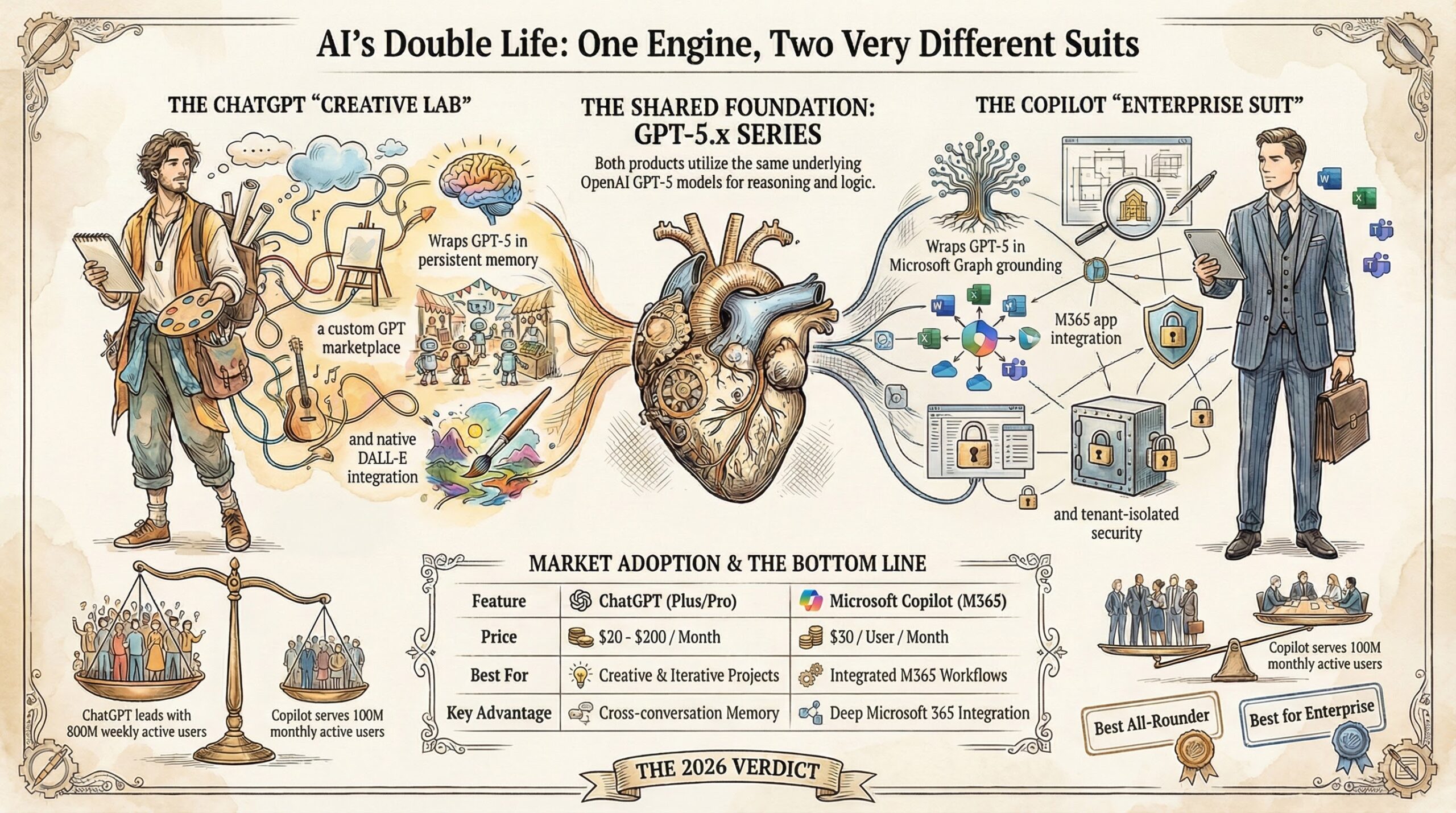
Microsoft Copilot vs ChatGPT: Same Engine, Different Wrapper
Here is the most absurd fact in enterprise AI right now: the two products people spend the most time comparing run on the same large language model. Microsoft Copilot and ChatGPT both use OpenAI's GPT-5 series. Same weights. Same training data. Same reasoning architecture. So every benchmark comparison between "Copilot's AI" and "ChatGPT's AI" is, at some level, comparing a thing to itself.
The question was never "which AI is smarter." It is "which wrapper gives you more value for the way you actually work." We tested both across six dimensions that determine real-world usefulness -- enterprise integration, standalone chat quality, coding, privacy, pricing, and multimodal capabilities -- to find where each earns its price tag and where each falls short.
Important Context
Microsoft 365 Copilot now runs GPT-5.4 Thinking and GPT-5.3 Instant as of March 2026. ChatGPT Plus runs GPT-5.4. Copilot has also expanded to include non-OpenAI models (Claude Opus 4.6 and Claude Sonnet 4.5 from Anthropic, the AI safety company behind the Claude family of models) in Copilot Studio, with Gemini 2.5 Pro available in GitHub Copilot. This comparison covers the default consumer and enterprise experiences. Pricing and features change frequently; verify at microsoft.com/copilot and chatgpt.com/pricing.
ChatGPT wins standalone. Copilot wins embedded in M365. Same engine, different value propositions -- the real decision is how you work, not which AI is smarter.
Verdict: ChatGPT is the better standalone AI tool for most individuals. Copilot is the better embedded AI tool for Microsoft 365 organizations. Neither is universally "better" -- they solve fundamentally different problems with the same underlying engine.
If your company already runs Microsoft 365 and you need AI that knows your emails, documents, and meetings, Copilot wins. If you want the most capable AI chat interface with cross-conversation memory, custom agents, and a mature plugin ecosystem, ChatGPT wins.
The evidence follows.
What to Tell Your Boss (30-Second Version)
Copilot and ChatGPT run the same GPT-5 models -- the AI itself is not the differentiator
Copilot's value is enterprise integration: it reads your Microsoft Graph data (emails, files, Teams chats) and respects your existing access controls
ChatGPT's value is standalone power: cross-conversation memory, custom GPTs, agent mode, and a broader plugin ecosystem
At enterprise scale, Copilot costs $21-30/user/mo on top of your existing M365 license; ChatGPT Teams costs $25-30/user/mo as a separate line item
The real decision: embedded AI inside your existing tools (Copilot) vs. the best standalone AI workspace (ChatGPT)
An orchestration engine, not a chatbot. The Prometheus orchestrator intercepts your prompt, queries Microsoft Graph -- the master index of everything your organization stores in Microsoft 365 -- for relevant context (the window of information, measured in tokens (chunks of text the model processes), that the AI can "see" at once) including emails, documents, and Teams chats, sends the grounded prompt to GPT-5.4 via Azure OpenAI, then post-processes for Responsible AI compliance. 100M+ MAU with 15M paid M365 Copilot seats (Microsoft FY26 Q2, January 2026).
Pricing: Free Chat (web-grounded). Copilot Pro $20/mo (requires M365). M365 Copilot Business $21/mo/user ($18 promo through June 2026). Enterprise $30/user/mo. Checked: March 27, 2026.
A standalone AI workspace. GPT-5.4 for Plus/Pro users, GPT-4o mini on free. Persistent cross-conversation memory, custom GPTs, agent mode, Advanced Data Analysis, DALL-E 4, and Sora 2. Market share: 64-68% of standalone AI chatbots as of January 2026 (StatCounter).
Pricing: Free (GPT-4o mini). Go $8/mo (verify tier name at chatgpt.com/pricing). Plus $20/mo. Pro $200/mo. Teams $25/user/mo. Enterprise: custom. Checked: March 27, 2026.
This is the most Googled question in this comparison, and the answer requires more nuance than a yes or no.
Yes, Copilot uses OpenAI's GPT models. Microsoft 365 Copilot runs GPT-5.4 Thinking and GPT-5.3 Instant as its default engines, with GPT-5.2 deeply integrated for everyday tasks (Microsoft 365 Blog, March 2026).
No, Copilot does not use ChatGPT the product. Copilot accesses the models through Azure OpenAI Service -- a Microsoft-hosted, enterprise-isolated instance that is completely separate from OpenAI's consumer infrastructure. Your data never touches OpenAI's public servers (Microsoft Learn).
How the Same Engine Powers Two Different Products
OpenAI GPT-5.4
Same weights, same training
→
Azure OpenAI Service
Microsoft-hosted, isolated
→
Microsoft Copilot
+ Prometheus + Graph + RAI
OpenAI GPT-5.4
Same weights, same training
→
OpenAI Servers
OpenAI-hosted, consumer infra
→
ChatGPT
+ Memory + GPTs + Plugins
The deeper truth: Copilot is no longer just an OpenAI wrapper. Microsoft has evolved it into a multi-model platform. Within Copilot Studio, enterprise users can select Anthropic's Claude Opus 4.6 and Claude Sonnet 4.5 for heavy reasoning tasks, plus bring-your-own models (Phi, Llama, Mistral, Cohere). GitHub Copilot separately offers Gemini 2.5 Pro for coding contexts (Microsoft Copilot Blog, 2025-2026). Microsoft is also developing proprietary MAI models (MAI-1, MAI-Voice-1, MAI-Image-1) to reduce single-vendor dependency on OpenAI.
So is Microsoft Copilot the same as ChatGPT? Same engine, different car. One is a sedan built for the open road. The other is a company shuttle that knows every route in your building.
Both products are powered by the GPT-5.x model family (GPT-5.4 as of March 2026). Copilot 100M MAU per Microsoft earnings; ChatGPT usage per OpenAI press materials.
Round 1 -- Enterprise Integration
Enterprise Integration
This is where the comparison actually matters. Raw AI capability is identical -- they run the same model. What differs is how that capability connects to your work.
Copilot's case
Copilot lives inside Word, Excel, PowerPoint, Outlook, Teams, and SharePoint. It drafts documents, summarizes meetings, builds Excel models from plain English, and generates presentations -- all grounded in Microsoft Graph data (Microsoft Learn). Microsoft reports 73% faster Word drafting, 59% faster Excel analysis, and 43% Teams efficiency gain. Telemetry from 50,000 Word users showed 7 minutes saved per accepted output (Microsoft Research, 2026). Enterprise users project 8+ hours saved per month (Forrester study commissioned by Microsoft -- worth noting that Microsoft funded this study; independent telemetry shows 7-10 minutes per accepted output, which is more conservative).
VS
ChatGPT's case
ChatGPT is ecosystem-agnostic. It does not integrate into your Office apps, but it does not require you to be on any specific platform either. You can upload files, run Python code, build custom GPTs, and use agent mode -- all from one interface. For teams not on Microsoft 365, or teams using a mix of platforms, ChatGPT requires zero ecosystem commitment. An MIT study found ChatGPT reduced writing task time by 40% while increasing output quality by 18% (MIT Working Paper).
DependsIf your organization runs M365, Copilot wins -- embedded integration compounds value that ChatGPT cannot replicate. If you are not on M365, ChatGPT's standalone flexibility wins.
Round 2 -- Standalone Chat
Standalone AI Chat Quality
Strip away the enterprise integration. Which product gives you a better AI conversation?
Copilot's case
Copilot Chat (free for M365 users) offers Think Deeper (o1 reasoning), Copilot Vision, and voice. Microsoft recently introduced Work IQ with Copilot Memory, but it is newer and enterprise-only (Microsoft 365 Blog, March 2026). At 4.5% standalone market share versus ChatGPT's 64-68%, the experience gap is real. (That 4.5% measures standalone chatbot usage only and does not capture Copilot's embedded M365 usage across 15 million paid seats -- Copilot's value proposition is integration, not standalone chat.)
VS
ChatGPT's case
Persistent memory across sessions, custom GPTs without code, 150+ vetted third-party integrations (via the GPT Store ecosystem, which replaced the earlier plugin store in 2024 -- the broader GPT Store has thousands of community-built GPTs, but roughly 150 are officially vetted integrations), agent mode, and Canvas for iterative writing/coding (OpenAI). No other chatbot matches this standalone feature set.
Winner: ChatGPTNot close on standalone chat quality. Memory, custom GPTs, agent mode, and ecosystem maturity put ChatGPT in a different league as a self-contained AI workspace.
Round 3 -- Coding
Coding Assistance
Both platforms offer coding capabilities, but they target different workflows. Important distinction: GitHub Copilot is a standalone developer product with its own pricing and licensing -- it is not part of the Microsoft 365 Copilot license discussed elsewhere in this article.
GitHub Copilot (separate product, not included in M365 Copilot)
Embedded directly in VS Code, JetBrains, and Visual Studio. Default model GPT-4.1, with multi-model selection (GPT-5.4, Claude Sonnet 4.5, Gemini 2.5 Pro). 55% faster task completion, 30% code acceptance rate, 20M+ users (GitHub Blog, 2026). On Terminal-Bench 2.0 (measures how well AI completes real programming tasks in a command-line terminal), GPT-5.3 Codex scores 79.3% -- highest of any model (LM Council, March 2026).
VS
ChatGPT for coding
Conversational coding partner. Paste code, describe problems, iterate in Canvas editor. Advanced Data Analysis runs Python directly. On SWE-bench Pro (tests whether AI can fix real software bugs in real open-source repositories -- the hardest coding evaluation available) -- GPT-5.4 leads at 57.7% (SWE-bench, March 2026).
The Third Option
Claude Code, Anthropic's terminal-native coding agent, leads SWE-bench Verified at 80.8% and specializes in repository-scale refactoring with a 1M-token context window. If your primary use case is deep code architecture work, Claude Code is the strongest option. See our Copilot vs Claude comparison for the full breakdown.
Winner: TieDifferent tools for different workflows. GitHub Copilot for in-IDE autocomplete. ChatGPT for conversational debugging. Claude Code for deep architectural reasoning and multi-file refactoring. Many developers use two or all three. Note: GitHub Copilot Enterprise costs $39/user/mo on top of GitHub -- not included in M365 Copilot.
SWE-bench Contamination Caveat
Caveat: SWE-bench scores across all vendors carry training data contamination concerns -- models may have been trained on the same repositories used in testing, which inflates scores. OpenAI stopped reporting on SWE-bench Verified for this reason. Treat these numbers as directional, not definitive.
Round 4 -- Privacy & Data
Privacy and Data Handling
This is where the architectural difference between "same engine" and "different wrapper" matters most.
Copilot's case
All processing stays within the M365 service boundary via a Microsoft-exclusive Azure OpenAI instance -- your data never reaches OpenAI's public infrastructure. Respects Microsoft Graph access controls and integrates with Purview for DLP and sensitivity labels. Compliance: SOC 2, HIPAA, GDPR, ISO 27001, FedRAMP (Microsoft Learn).
VS
ChatGPT's case
ChatGPT Enterprise encrypts data at rest (AES-256) and in transit (TLS 1.2+). OpenAI guarantees no model training on Enterprise/Teams data. But data leaves your organizational perimeter to be processed on OpenAI's servers. Zero visibility into your internal access controls (OpenAI Enterprise Privacy).
Permission Debt Warning
Copilot is a magnifying glass for permission debt. If your SharePoint permissions are messy -- and they usually are -- Copilot will happily surface sensitive documents to anyone who technically has access. Cybersecurity teams should audit SharePoint and OneDrive permissions before enabling Copilot organization-wide.
Winner: CopilotData-stays-in-your-tenant architecture and ACL-aware retrieval are genuine advantages for regulated industries. For AI governance frameworks, this distinction matters.
The pricing trap most comparisons miss: Copilot's enterprise pricing looks comparable to ChatGPT Teams ($21-30 vs $25-30 per user per month). But Copilot requires an existing M365 E3 or E5 subscription. If your organization already pays for M365, the incremental cost is just the Copilot add-on. If you are not on M365, the total cost of ownership is significantly higher. ChatGPT Teams is a standalone product -- no platform prerequisite.
54 min
Break-even threshold. Microsoft estimates M365 Copilot hits break-even at just 54 minutes saved monthly per employee (assuming $70K average salary). A Forrester study commissioned by Microsoft projected 100%+ ROI with payback in 10 months. Take vendor-commissioned ROI studies with appropriate skepticism -- but 54 minutes per month is a low bar.
Promotional Pricing
Microsoft is running a $18/user/mo promotional rate for new M365 Copilot Business customers through June 30, 2026. That undercuts ChatGPT Teams by $7/user/mo -- but promotional pricing is temporary. Make decisions based on list price.
Round 5 -- Multimodal
Multimodal Capabilities
Both platforms now offer text, image, video, and voice. The difference is context. Copilot manipulates your actual Office documents -- building Excel models, designing PowerPoint decks, editing Word drafts -- from inside the apps. ChatGPT processes uploaded files in isolation.
Copilot's case
Native structured document manipulation -- Word, Excel, PowerPoint from inside the apps. DALL-E 3 (via Designer), Sora 2 (Frontier program), Copilot Voice (GPT-4o). Work IQ memory is new and enterprise-only.
VS
ChatGPT's case
DALL-E 4 (one generation ahead), Sora 2, Advanced Voice Mode, Operator (computer use beta), persistent cross-conversation memory on all paid tiers. Upload/download only for document handling, but the standalone creative toolset is more mature.
Winner: ChatGPTChatGPT leads on standalone multimodal breadth -- DALL-E 4 vs 3, computer use, and memory maturity. Copilot wins on structured document manipulation within M365.
Best For
Which AI Should You Pick?
Question 1 of 5
Do you already pay for Microsoft 365?
Existing M365 licenses change the cost calculus -- Copilot is an add-on, not a standalone purchase
Question 2 of 5
What is your primary work environment?
Pick the one closest to your daily work
Question 3 of 5
What do you need AI for most?
Question 4 of 5
How important is enterprise data security?
Question 5 of 5
Do you need AI that remembers context across conversations?
Our recommendation for you
Copilot
Microsoft 365 power users
If you spend your day in Outlook, Teams, Word, and Excel, Copilot eliminates context-switching and grounds AI outputs in your actual work data. The value compounds with the number of M365 apps you use daily.
ChatGPT
Solo professionals and freelancers
No ecosystem prerequisite, persistent memory across projects, custom GPTs for specialized workflows, and the Go tier at $8/mo is the cheapest paid AI on the market.
Both
Developers
GitHub Copilot for in-IDE suggestions (55% faster task completion). ChatGPT for conversational debugging and code explanation. They are complementary, not competitive.
Copilot
Enterprise security and compliance teams
Data stays within the M365 boundary, ACL-aware retrieval prevents unauthorized data surfacing, and Purview DLP integration is automatic. But audit your SharePoint permissions first. Explore the full AI tools landscape to see how these tools fit into broader enterprise strategies.
ChatGPT
People evaluating AI for the first time
The free tier is functional, the interface is intuitive, and you do not need an M365 subscription to try it.
ChatGPT
Mixed-ecosystem organizations
If your company uses Google Workspace for email but Microsoft for some apps, ChatGPT's ecosystem-agnostic approach avoids vendor lock-in. Compare with Gemini vs ChatGPT if Google Workspace is your primary platform.
Edge Cases: When the Wrong Choice Wins
You need AI that remembers you across months
ChatGPT
Pick ChatGPT, even if you are a heavy M365 user. ChatGPT's persistent memory is mature and works across all paid tiers. Copilot's Work IQ memory is new, enterprise-only, and still proving itself.
You want to build no-code AI agents
Copilot
Pick Copilot Studio. Microsoft's agent-building platform integrates with Power Platform connectors (Salesforce, ServiceNow, Azure SQL) and respects your security boundary.
FedRAMP certification, HIPAA compliance, in-boundary data processing, and ACL-aware retrieval are compliance advantages that ChatGPT Enterprise cannot match architecturally.
Students and individual learners
ChatGPT
The free tier is more capable standalone, Plus at $20/mo requires no separate M365 subscription, and the broader plugin ecosystem gives more tools to explore.
You work across multiple AI models
Copilot
Surprisingly, pick Copilot Studio. Access Claude Opus 4.6, Claude Sonnet 4.5, and GPT-5.4 from a single interface, plus BYOM (Phi, Llama, Mistral, Cohere) -- something ChatGPT does not offer.
Freshness notice: AI models and pricing change rapidly. This comparison reflects data available as of March 27, 2026. Microsoft's $18/mo promotional pricing expires June 30, 2026. If you are reading this more than 90 days after the verification date, key features and pricing may have shifted. Check our AI Tools Hub for the latest updates.
Microsoft, Microsoft 365, Copilot, Azure, Teams, Word, Excel, PowerPoint, Outlook, SharePoint, and GitHub are trademarks of Microsoft Corporation. OpenAI, ChatGPT, and GPT are trademarks of OpenAI, Inc.
Before You Use AI
Your Privacy
Microsoft Copilot processes data within the M365 service boundary using Azure OpenAI Service; your data does not flow to OpenAI's public infrastructure. ChatGPT Enterprise encrypts data and commits to not training on your inputs, but data is processed on OpenAI's servers outside your organizational perimeter. On free/consumer tiers for both platforms, your prompts may be used for model improvement -- review each vendor's data practices before entering sensitive information.
AI assistants are productivity tools, not substitutes for human judgment, professional advice, or emotional support. If you or someone you know is in crisis:
988 Suicide & Crisis Lifeline -- Call or text 988 (US)
Under GDPR and CCPA, you have the right to access, correct, and delete your personal data processed by AI systems. This article was researched and written with AI assistance, verified against primary sources, and edited by humans.
TechJack Solutions maintains editorial independence from all vendors discussed. We may earn commissions from affiliate links; this does not influence our verdicts or recommendations.