Microsoft Copilot Agents and Azure AI: The Enterprise Agent Ecosystem Explained
In 2025, agents moved from experiment to expectation. Microsoft reported that 85% of Fortune 500 companies now use some form of Microsoft AI across Copilots, Fabric, and Azure AI (Microsoft Cloud Blog, July 2025). But adoption is not the hard part anymore. The hard part is figuring out which of Microsoft's four agent-building surfaces to use, when to use each one, and how to govern them all without losing velocity. This article maps that ecosystem using Microsoft's own framework so IT leaders can plan an agent roadmap, not just pilot individual tools.
What Are AI Agents, Anyway?
An AI agent is software that can take actions on its own — not just answer questions, but actually do things like send emails, update spreadsheets, or file tickets. Think of it as an AI assistant that doesn't just suggest what to do, but does it for you.
Most AI chatbots wait for you to type a prompt and then respond. An agent goes further: you give it a goal, and it figures out the steps, uses the tools available to it, and carries out the work. That is the shift Microsoft is building its entire enterprise AI strategy around.
What Are Microsoft Copilot Agents?
Microsoft Copilot agents are AI programs that can do tasks for you automatically inside Microsoft 365 and Azure. They interpret goals, execute multi-step workflows, coordinate with other agents, and take action across enterprise systems on behalf of users — all while staying within IT-defined governance boundaries.
Microsoft introduced the agent framework in late 2024 and expanded it through 2025 with four distinct building surfaces: Copilot Studio (low-code), Azure AI Foundry — Microsoft's cloud platform where developers can access 11,000+ AI models and build custom AI applications — (pro-code), Security Copilot (security operations), and the M365 Agent Builder (business user). As of March 2026, the Agent Store offers 70+ pre-built agents with multi-agent orchestration via the Agent2Agent (A2A) protocol, a standard that lets separate AI agents talk to each other and divide up work automatically (Microsoft Copilot Blog). The ecosystem supports models from OpenAI, Anthropic (the company behind Claude, an AI assistant similar to ChatGPT), Meta, Mistral, DeepSeek, and Cohere through a catalog of over 11,000 options in Azure AI Foundry. That 11,000 figure includes every fine-tuned variant, community upload, and experimental checkpoint -- the number of models suitable for production agentic workflows is significantly smaller (likely under 100 when filtered for GA status, enterprise SLAs, and agentic task support) (Microsoft Annual Report 2025).
of Fortune 500 companies use some form of Microsoft AI, including Copilots, Fabric, and Azure AI. (Microsoft Cloud Blog, July 2025)
The agent ecosystem is fragmented by design. Microsoft built four surfaces because enterprises have four distinct builder personas. Understanding which surface serves which team is the first strategic decision.
Copilot Studio
Low-code SaaS platform for business users and IT. Build agents with natural language, add enterprise knowledge, create agentic workflows.
$200/mo capacity pack (25,000 credits)
Azure AI Foundry
Pro-code platform for developers. 11,000+ models, custom agent design, full API access. 80% of Fortune 500 use Foundry for AI workloads.
Included w/ M365 E5 (400 Security Compute Units/mo)
M365 Agent Builder
In-product agent creation inside Microsoft 365 Copilot Chat. Natural language interface for business users who need agents without leaving their workflow.
Included w/ M365 Copilot license
The adoption numbers tell a clear story about where enterprise AI investment is heading. 80% of the Fortune 500 use Azure AI Foundry for their AI workloads. Security Copilot's Phishing Triage Agent helps SOC (Security Operations Center) analysts find malicious emails up to 550% faster. The Conditional Access Optimization Agent found 204% more missing zero-trust policies in early deployments (Microsoft Security Copilot).
IT Operations Lead
Governs agent sprawl across M365 tenant. Uses Agent 365 control plane to track which agents are active, who built them, and what they cost. Primary concern: visibility without blocking innovation.
Security Analyst
Runs Security Operations Center (SOC) operations with Security Copilot agents embedded in Defender and Sentinel. Agents autonomously triage phishing alerts, reverse-engineer malware scripts, and translate natural language into KQL queries. See the cybersecurity hub.
Business Process Owner
Uses Copilot Studio or Agent Builder to automate expense workflows, onboarding sequences, and approval chains. No code required. IT retains governance oversight.
Platform Engineer
Builds custom agents on Azure AI Foundry with multi-model selection. Designs multi-agent architectures using the Agent2Agent (A2A) protocol. Handles Model Context Protocol (MCP) integration for cross-system action.
How Do Copilot Agents Compare to Other Agent Platforms?
Microsoft's agent approach differs from competitors at the framework level, not just the model level. The strategic question is not which LLM is best but which orchestration philosophy matches your organizational structure. Microsoft's key advantage is Microsoft Graph — a unified API (Application Programming Interface) that connects all your organization's Microsoft 365 data (emails, calendars, files, org charts, Teams messages) into one searchable layer that agents can act on.
Dimension
Microsoft Copilot Agents
LangChain / CrewAI
Anthropic Claude (API + MCP + Claude Code)
Google Vertex AI Agents
Builder audience
Business users to platform engineers
Developers only
Developers and power users (note: Anthropic does not have a formalized "Claude Agents" product -- agent capabilities come from Claude's API with tool use, Claude Code for developer workflows, and MCP integration for connecting to external tools)
Developers and GCP admins
Agent creation
Natural language + low-code + pro-code
Code-only (Python)
Code + Claude desktop tools
Code + Vertex console
Enterprise data
Microsoft Graph + 1,400 connectors
Custom integrations
MCP servers + custom
Google Workspace + BigQuery
Multi-agent
A2A protocol (March 2026)
CrewAI orchestration
Multi-agent via MCP
Agent-to-agent in preview*
Model flexibility
11,000+ models (BYOM)
Any model via API
Anthropic models primary
Google + partner models
Governance
Agent 365 + Copilot Studio lifecycle
DIY governance
Admin controls + SSO
IAM + Vertex controls
Lock-in risk
High (M365/Azure ecosystem)
Low (open source)
Low-Medium (MCP is open standard)
High (GCP ecosystem)
*Google Vertex AI Agents data in this table is based on general industry reporting, not notebook-verified primary sources. Treat the Vertex column as directional rather than definitive. If this comparison is material to your procurement decision, verify directly with Google Cloud documentation.
Key tradeoff: Microsoft offers the broadest builder audience and deepest enterprise integration but carries the highest vendor lock-in risk. Open-source frameworks like LangChain offer flexibility at the cost of building your own governance layer. If your organization is already on M365 E3/E5, the integration advantage is substantial. If you are multi-cloud, evaluate MCP-based approaches that work across providers.
How Does the Microsoft Agent Ecosystem Work?
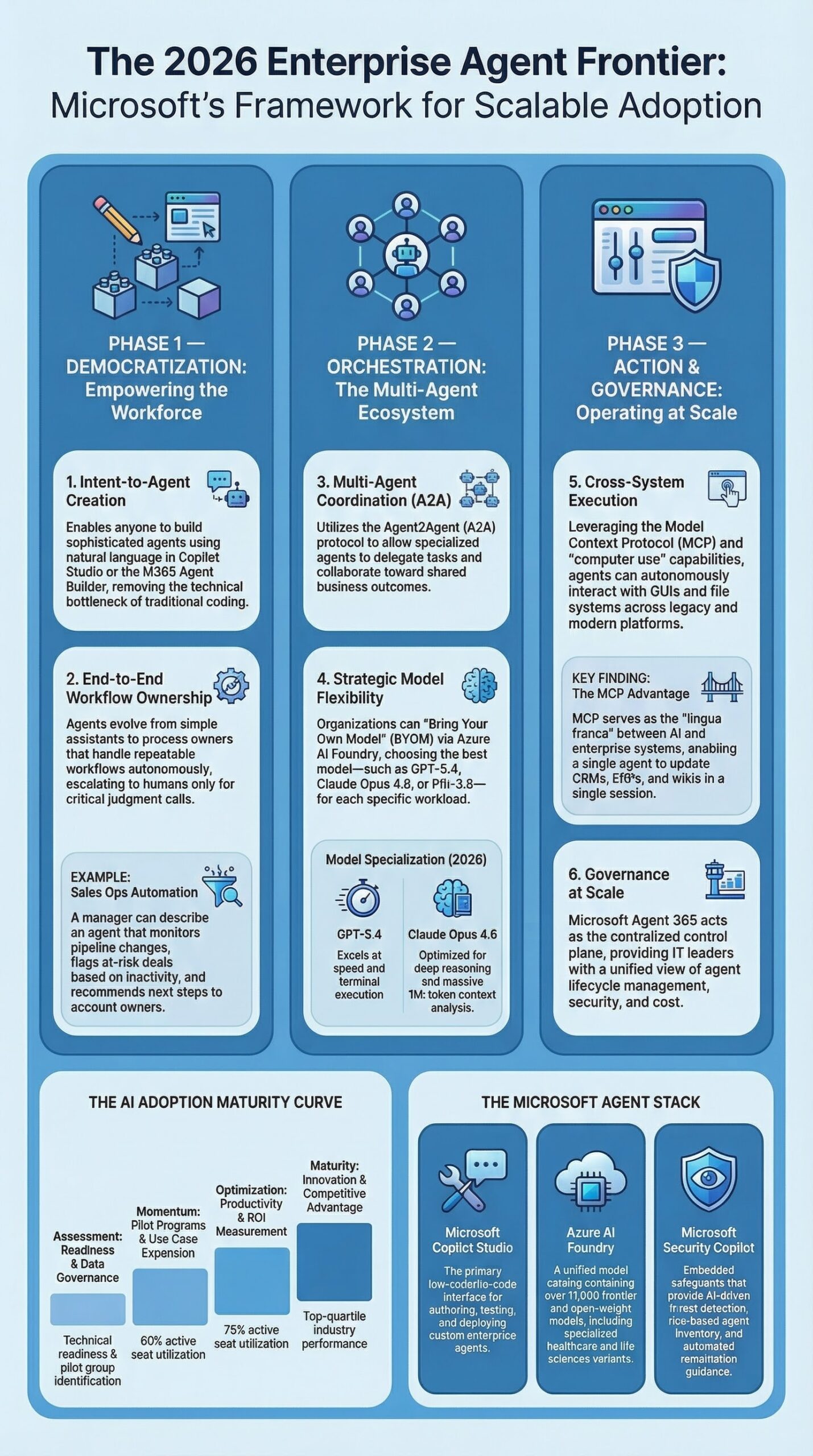
Microsoft organizes its agent platform around six core capabilities that define what scalable agent adoption requires. Each capability maps to specific tools. Together, they form the architecture that IT leaders need to evaluate.
Microsoft's 6 Core Capabilities Framework for Enterprise Agent Adoption. Current models: GPT-5.4, Claude Opus 4.6, Claude Sonnet 4.5 (March 2026). Maturity level assessment is a TJS editorial judgment.
1
Anyone Can Build Agents
No coding required — describe what you need in plain English
Building an agent no longer requires translating business intent into technical code. Sales leaders, operations managers, and HR officials describe what they want done using natural language to create an agent. IT teams retain the ability to review, refine, and govern the underlying logic.
Copilot StudioM365 Agent BuilderNatural Language
Ready when: 10+ repeatable processes with manual handoffs between SaaS tools
2
Agents Own Workflows End-to-End
The AI handles the entire process, not just one step
Agents crossed the threshold from assisting with tasks to owning them. With agent flows and the Workflows Agent, agents automatically advance work, validate submissions against company policies, route requests across SaaS tools, and escalate to humans only when judgment is required.
Agent FlowsWorkflows AgentCopilot Studio
Ready when: 3+ processes where cycle time is dominated by waiting, not working
3
Multi-Agent Coordination
Multiple AI agents working together like a team
Meaningful business outcomes rarely happen in a single step or system. The Agent2Agent (A2A) protocol, rolling out in March 2026, allows agents to specialize, delegate, and collaborate toward shared goals. One agent monitors signals, another validates data, a third takes action. A coordinating agent routes questions to the right specialist behind the scenes. Concrete example: Agent A monitors your inbox for support tickets, Agent B looks up the customer's history in your CRM, Agent C drafts a response using your company's knowledge base — all coordinating automatically through A2A without anyone manually handing off between systems. In manufacturing, one agent grounds in safety documentation, another handles equipment manuals, a third connects to supplier expertise, and an orchestrator routes questions automatically.
A2A ProtocolOrchestrator AgentAgent Store
4
Model Flexibility
Pick the best AI brain for each job, not one model for everything
Different tasks require different model strengths. Copilot Studio now supports Anthropic Claude models, reasoning-specific models, BYOM (Bring Your Own Model — connecting any AI model your team prefers) options, and access to thousands of models through Microsoft Foundry. An organization in a regulated field might use one model optimized for complex policy interpretation and another tuned for cost efficiency in high-volume requests, with central governance ensuring each model is applied appropriately.
Azure AI FoundryBYOM11,000+ Models
5
Cross-System Action via MCP
Agents reach into other apps and actually click buttons for you
The Model Context Protocol (MCP) — an open standard that lets AI agents connect to and take actions inside external software tools — and computer use capabilities let agents navigate interfaces, fill out form fields, and take action across external tools rather than just making recommendations. An operations agent can autonomously identify a supply issue, update the system of record, file a remediation ticket, and notify stakeholders with context and next steps. This addresses the biggest gap in early AI adoption: reducing the manual handoffs that slow work between tools and teams.
MCPComputer Use1,400 Connectors
6
Governance at Scale
One dashboard to see, control, and budget every agent in your organization
Agent 365 launches May 1, 2026 as part of the M365 E7 bundle ($99/user/month) and is not yet available as of this writing (March 2026). Until Agent 365 ships, organizations deploying agents must rely on Copilot Studio's existing lifecycle management and manual governance processes. Once launched, Agent 365 provides a unified control plane. IT leaders can see which agents are in use, how they perform, and what they cost across environments. Copilot Studio adds lifecycle management, agent evaluations, and enterprise controls.
Agent 365M365 E7Copilot Studio Lifecycle
Ready when: 5+ agents in production with no centralized view of performance or cost
What Are the Risks of Enterprise Agents?
No strategic assessment is complete without honest risk analysis. These are the constraints IT leaders should plan for, not discover in production.
Oversharing via Microsoft Graph
Copilot functions as a magnifying glass for legacy permission debt. If SharePoint permissions are messy, Copilot will surface sensitive data to any user who asks. Microsoft introduced Restricted SharePoint Search (RSS) to limit AI access to curated sites, but the underlying permission architecture is the organization's responsibility to fix. (Microsoft Learn - Data Privacy)
Autonomous Action Failures
AI "workslop," content that appears useful but is incomplete or inaccurate, undermines productivity by forcing recipients to redo the work. In a 2025 survey of 1,150 U.S. employees, 40% received AI-generated workslop in the past month, estimated at 15% of content. In technical environments, agents can introduce hardcoded secrets or permissive infrastructure configurations if human review gates are skipped. (Microsoft New Future of Work Report 2025)
Cost Unpredictability
Copilot Studio uses Copilot Credits ($200/month for 25,000 credits) with variable consumption per action. Security Copilot uses SCUs (Security Compute Units — a metered billing unit where each agent action consumes a set number of units). Premium model multipliers (using Anthropic Claude models burns credits at 3x the standard rate) make forecasting difficult. Based on early deployment patterns, plan for metered consumption to exceed initial estimates by 40-60% during the first quarter of deployment. (Microsoft Copilot Studio Pricing)
Governance Complexity
Copilot Cowork executes actions using the identity of the user who delegated the task, creating ambiguity in audit trails. Existing compliance frameworks that assume a direct link between a user identity and a system action may not capture accountability for autonomous agent actions.
Vendor Lock-In
M365 Copilot requires an E3/E5 base license ($52-87/user/month total with Copilot). Proprietary Microsoft Graph connectors can trap an organization within the ecosystem. Mitigation: leverage MCP-based integrations where possible, as the open standard works across Anthropic, OpenAI, and Google, giving you portability if you need to shift providers.
Is Your Organization Ready for AI Agents?
Not every organization is ready for autonomous agents. Before investing in Copilot agents, run through this quick maturity checklist:
Do you have Microsoft 365 Copilot deployed? Agents build on the Copilot foundation. Without Copilot licenses in place, agents have no platform to run on.
Have you identified 3-5 specific workflows to automate? Successful agent pilots start with concrete, repeatable processes (e.g., expense approvals, IT ticket routing, onboarding checklists) — not vague mandates to "use AI."
Is your IT governance ready for autonomous actions? Agents act on behalf of users. You need clear policies for what agents can and cannot do, who approves agent creation, and how you audit agent actions.
Are your SharePoint/M365 permissions clean? Agents inherit user permissions via Microsoft Graph. If your permission architecture is messy, agents will surface data they shouldn't.
Do you have budget visibility for consumption-based pricing? Agent costs are metered, not flat-rate. Finance and IT need to agree on monitoring thresholds before the first agent goes live.
If you checked fewer than 3 boxes, start with Microsoft 365 Copilot deployment and permission hygiene before pursuing agents.
What Is Microsoft's Agent Roadmap?
2025 Foundations
Agent Platform Established
Copilot Studio expanded with natural language agent creation, model flexibility, and enterprise controls. Security Copilot embedded in Defender, Sentinel, Entra, Intune, Purview.
Feb-Mar 2026
Wave 3 and Agent Mode
Agent Mode rolls out in Word, Excel, PowerPoint. Copilot Cowork (powered by Anthropic Claude) enters Research Preview. Multi-agent coordination via A2A launches March 2026. (Microsoft 365 Roadmap)
Apr 2026
New Agents Go Live
Project Manager Agent and Community Agents roll out worldwide. Copilot Studio 2026 Release Wave 1 begins (April-September). New knowledge types, evaluation tools, and out-of-the-box workflow actions. (Microsoft Learn)
Expect vertical agent templates for healthcare, financial services, and manufacturing. Deeper MCP ecosystem with third-party tool integrations. Note: This is an editorial projection based on market trajectory, not a confirmed Microsoft roadmap item.
The question for 2026 is not whether agents will be deployed but how deliberately they will be operationalized. Organizations that have all six capabilities in place are not just experimenting with agents. They are turning curiosity into confidence and innovation into sustained business value.
Suggested Reading Order
This article is the most advanced in the Microsoft Copilot series. If you landed here first, consider reading in this order for a smoother learning curve:
Data verified: 2026-03-27. Microsoft, Copilot, Azure, Azure AI Foundry, Microsoft 365, and Security Copilot are trademarks of Microsoft Corporation.
Before You Use AI
Your Privacy
Microsoft 365 Copilot processes data within your M365 tenant boundary. Microsoft states it does not train foundation models on customer data. However, Copilot Cowork routes requests through Anthropic's Claude models, and data residency for Australian/NZ users is explicitly excluded from local commitments for Claude-powered features. Review your tenant's data processing addendum and configure Restricted SharePoint Search before enabling agent features.
AI agents that autonomously execute tasks can create unhealthy dependency patterns and reduce critical thinking skills over time. If you or someone you know is experiencing a mental health crisis:
988 Suicide & Crisis Lifeline -- Call or text 988 (US)
Under GDPR Article 22 and CCPA, you have the right to understand and contest automated decisions that affect you. Microsoft provides data subject request tools in the M365 compliance center. TechJack Solutions maintains editorial independence from all vendors discussed. We do not accept payment for coverage. Microsoft, Copilot, Azure, and related marks are trademarks of Microsoft Corporation.