Author: Derrick D. Jackson
Title: Founder & Senior Director of Cloud Security Architecture & Risk
Credentials: CISSP, CRISC, CCSP
Last updated: September 1st, 2025
Table of Contents
Pressed For Time
Review or Download our 2-3 min Quick Slides or the 5-7 min Article Insights to gain knowledge with the time you have!
Pressed For Time
Review or Download our 2-3 min Quick Slides or the 5-7 min Article Insights to gain knowledge with the time you have!
AI Model Cards for Beginners: What Every Learner & Executive Needs to Know
Based on authoritative sources including Google’s original Model Cards framework, NIST AI Risk Management Framework, EU AI Act requirements, and ISO/IEC 42001 standards
The Problem: Your AI Is a Black Box to Everyone Who Matters
[Hypothetical scenario for illustration]: You’re in a meeting with your biggest client. They ask a simple question about your AI recommendation system: “How do we know it’s fair to all our customers?”
Your team exchanges glances. Someone mentions “machine learning algorithms.” Another person talks about “data science best practices.” Nobody can give a straight answer.
The client isn’t impressed. The contract renewal discussion stalls.
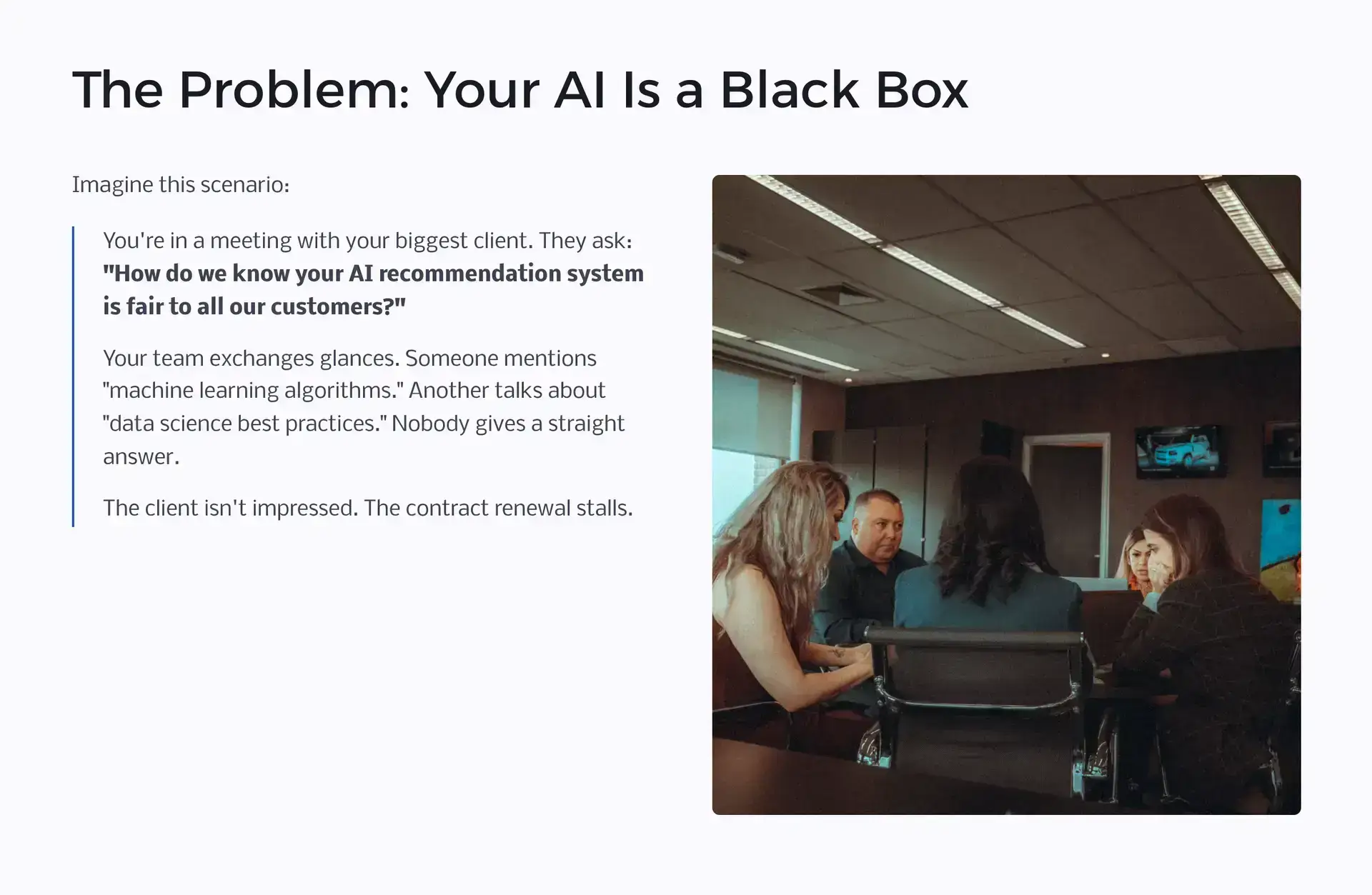
This illustrative scenario reflects a widespread challenge: most organizations cannot clearly explain how their AI systems work, what they’re good at, or what could go wrong (not to customers, not to regulators, not even to their own executives).
What Leading Companies Do Differently
Companies like Google, NVIDIA, and major consulting firms don’t wing it when asked about their AI. They have something called Model Cards. Model Cards for Model Reporting (Seminal work – strongly recommended to view).
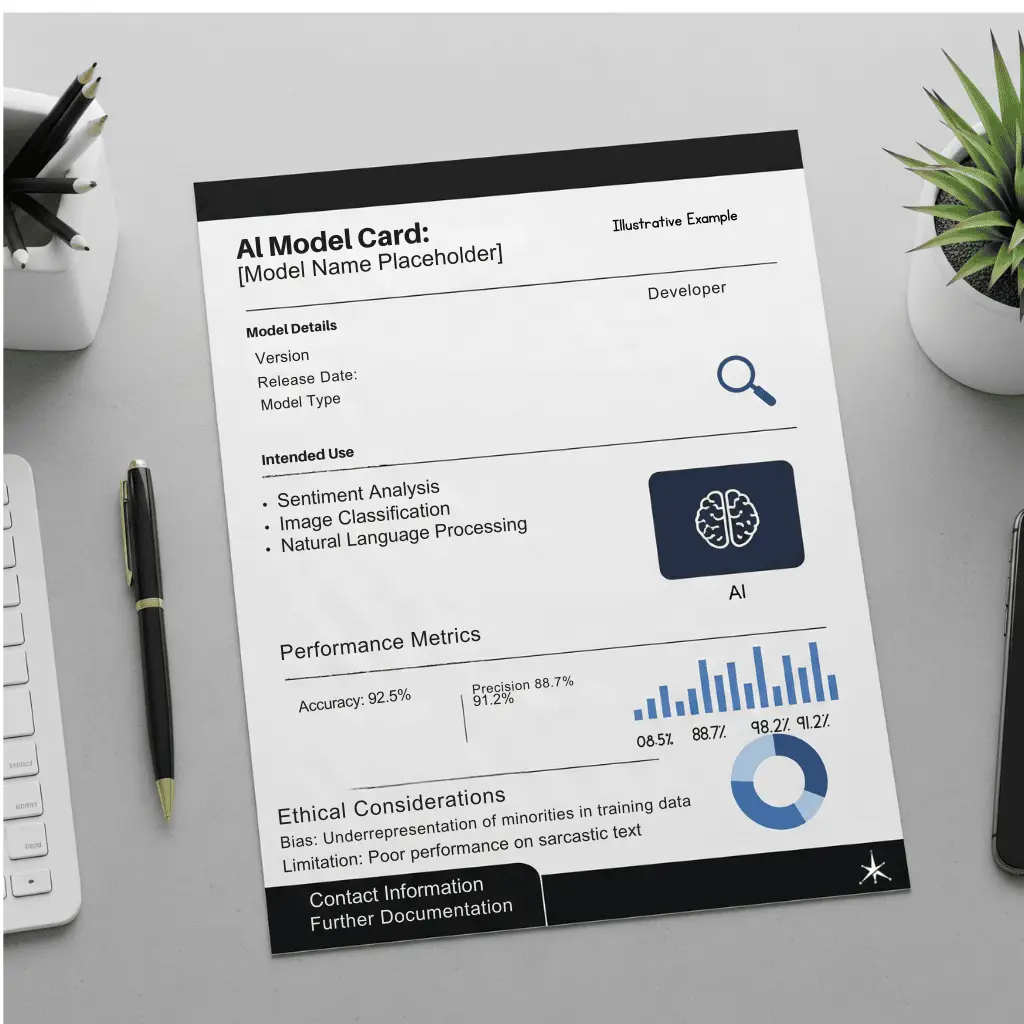
Google’s original research paper defines Model Cards as structured documentation that functions like a “nutrition label” for AI. Just like you can read a food label to understand calories, ingredients, and allergen warnings, a Model Card tells you everything important about an AI system in accessible language.

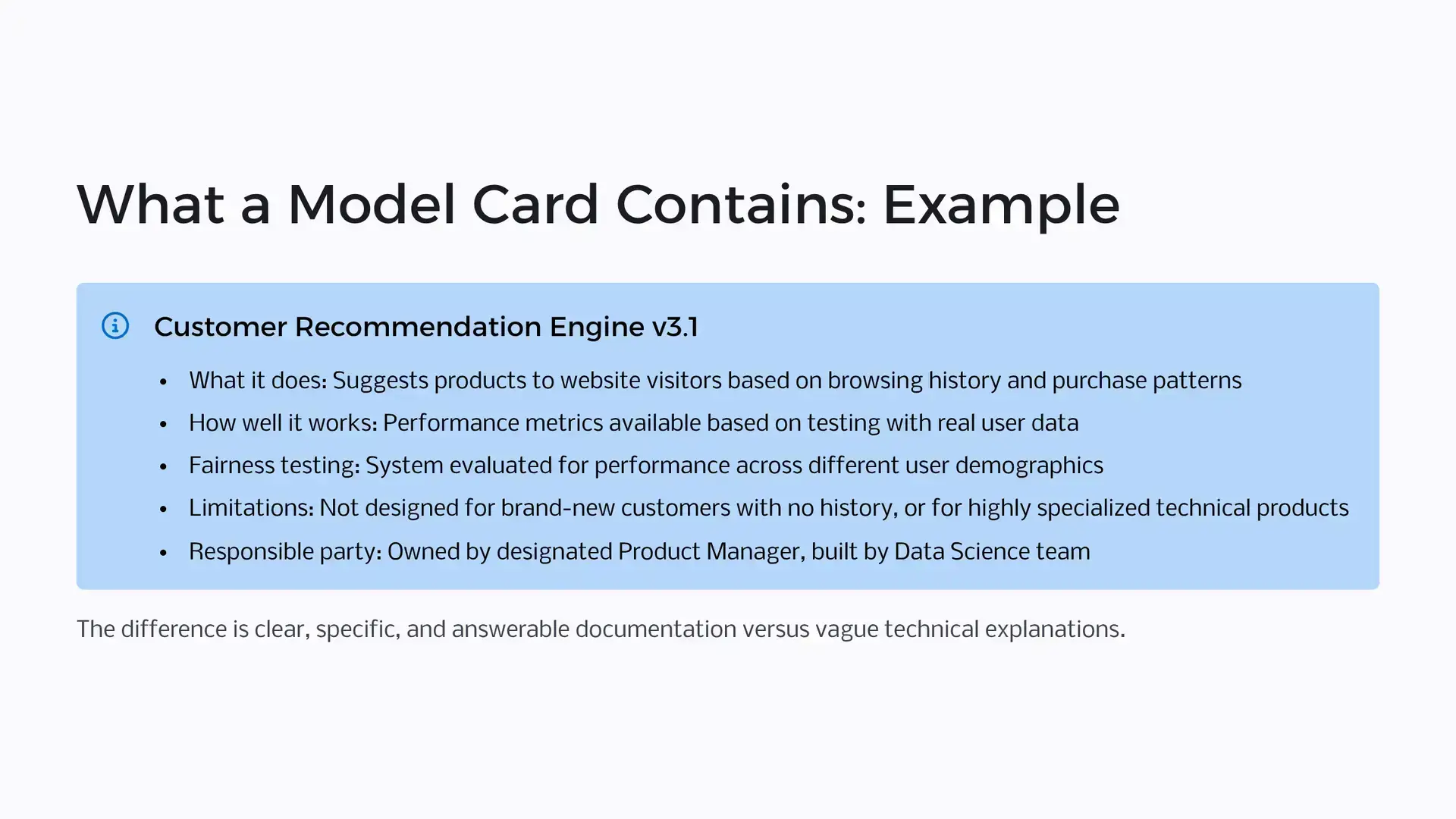
[Illustrative example of what a Model Card might contain]: Customer Recommendation Engine v3.1
- What it does: Suggests products to website visitors based on browsing history and purchase patterns
- How well it works: Performance metrics available based on testing with real user data
- Fairness testing: System evaluated for performance across different user demographics
- Limitations: Not designed for brand-new customers with no history, or for highly specialized technical products
- Responsible party: Owned by designated Product Manager, built by Data Science team
The difference is clear, specific, and answerable documentation versus vague technical explanations.
Why Smart Companies Are Doing This Now
1. Regulatory Requirements Are Here
The EU AI Act is in effect, requiring companies to establish, implement, document and maintain risk management systems for high-risk AI systems. The NIST AI Risk Management Framework provides guidance for systematic AI governance. Model Cards directly support these compliance requirements.
2. Customer Expectations Are Rising
[General industry observation – not from specific verified study]: Enterprise buyers increasingly request detailed information about AI systems before signing contracts. Organizations with clear documentation report advantages in sales processes.
3. Risk Management Benefits
When AI systems face scrutiny or performance issues, companies with Model Cards can respond more quickly because they have documented their systems’ capabilities and limitations in advance.
4. Industry Leaders Set Standards
Google publishes Model Cards for major AI systems. Companies like Synthesia have achieved ISO 42001 AI governance certification using Model Cards as core documentation.
What Goes Into a Model Card (The Essential Elements)
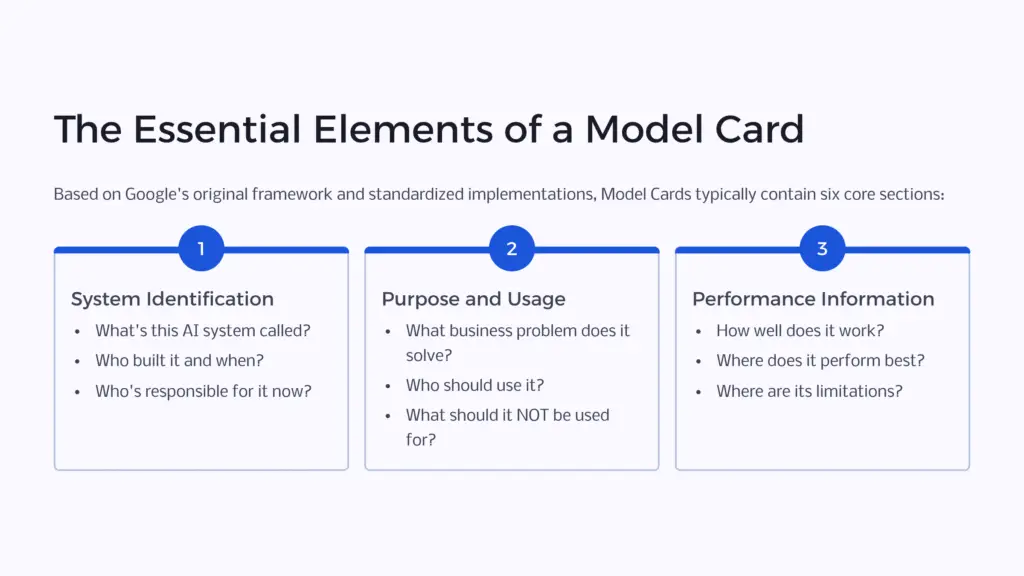
Based on Google’s original Model Cards framework by Mitchell et al. (2019) and standardized implementations across organizations, Model Cards typically contain six core sections:
1. System Identification
- What’s this AI system called?
- Who built it and when?
- Who’s responsible for it now?
2. Purpose and Usage
- What business problem does it solve?
- Who should use it?
- What should it NOT be used for?
3. Performance Information
- How well does it work?
- Where does it perform best?
- Where are its limitations?
4. Risk Assessment
- What are potential problems?
- How are risks addressed?
- What warnings should users know?
5. Data Foundation
- What information was used for training?
- Are there limitations in that data?
- How current is the training?
6. Human Oversight
- Who monitors this system?
- How do humans maintain control?
- What happens if issues arise?

Organizations typically already possess most of this information (it’s often scattered across different people and systems rather than consolidated).
Documented Success Examples
Synthesia’s Certification Achievement
Synthesia became the first AI video company to achieve ISO 42001 certification, with Model Cards serving as key documentation in their governance framework. This certification has become part of their value proposition with enterprise customers.
KPMG’s Global Leadership
KPMG Australia achieved the first ISO 42001 certification worldwide, with systematic AI documentation including Model Cards as evidence of comprehensive management practices.
Google’s Transparency Approach
Google publishes Model Cards for major AI systems, including detailed capability descriptions and limitation documentation. This transparency supports their enterprise customer relationships and regulatory positioning.

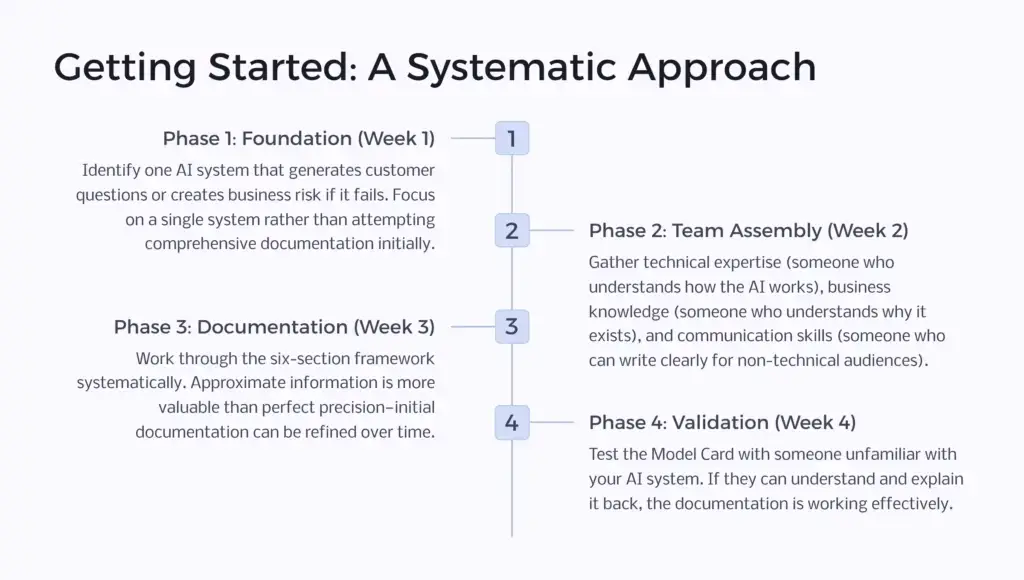
Getting Started: A Systematic Approach
Phase 1: Foundation (Week 1)
Identify one AI system that generates customer questions or creates business risk if it fails. Focus on a single system rather than attempting comprehensive documentation initially.
Phase 2: Team Assembly (Week 2)
Effective Model Card creation requires collaboration between:
- Technical expertise (someone who understands how the AI works)
- Business knowledge (someone who understands why it exists)
- Communication skills (someone who can write clearly for non-technical audiences)
Phase 3: Documentation (Week 3)
Work through the six-section framework systematically. Approximate information is more valuable than perfect precision—initial documentation can be refined over time.
Phase 4: Validation (Week 4)
Test the Model Card with someone unfamiliar with your AI system. If they can understand and explain it back, the documentation is working effectively.
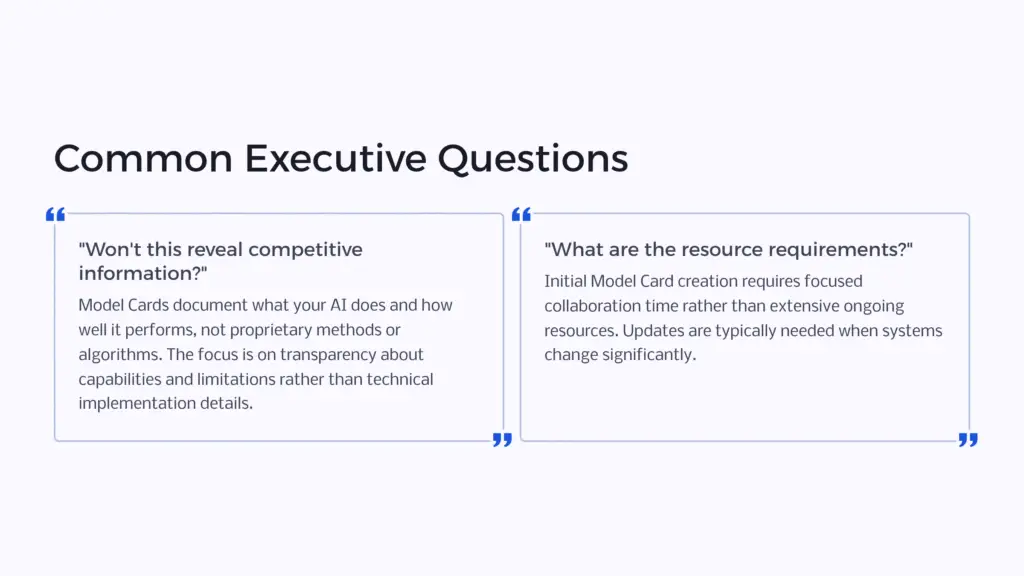
Common Executive Questions
“Won’t this reveal competitive information?” Model Cards document what your AI does and how well it performs, not proprietary methods or algorithms. The focus is on transparency about capabilities and limitations rather than technical implementation details.
“What are the resource requirements?” Initial Model Card creation requires focused collaboration time rather than extensive ongoing resources. Updates are typically needed when systems change significantly.
“What if our AI has limitations?” All AI systems have constraints and limitations. Organizations that document these honestly tend to build more trust than those that avoid discussing them. Additionally, clear limitation documentation helps identify improvement opportunities.
“How do we maintain currency?” Model Cards should be updated when significant changes occur to AI systems, with periodic reviews to ensure accuracy.
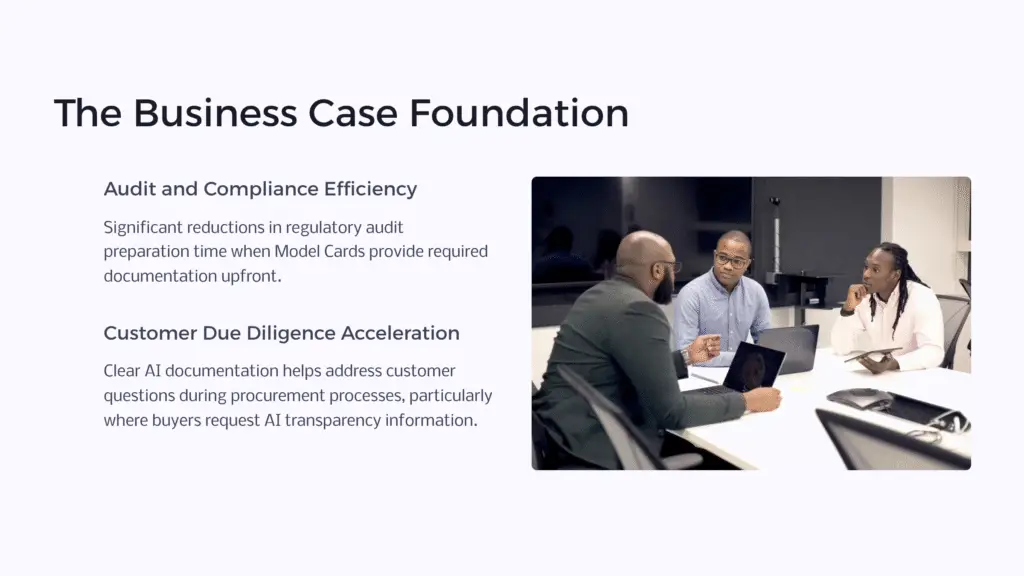
The Business Case Foundation
[Note: The following benefits are general industry observations from multiple sources rather than results from a single comprehensive study]:
Organizations implementing Model Card programs report specific benefits:
Audit and Compliance Efficiency: Organizations report significant reductions in regulatory audit preparation time when Model Cards provide required documentation upfront, compared to scrambling to compile information during audit periods.
Customer Due Diligence Acceleration: Enterprise sales teams report that clear AI documentation helps address customer questions during procurement processes, particularly in markets where buyers increasingly request AI transparency information before contract signing.
Incident Response Speed: Organizations with baseline AI documentation report faster issue resolution when problems occur, because teams have immediate access to system specifications, limitations, and responsible parties rather than researching this information during crisis periods.
Regulatory Positioning: The EU AI Act requires systematic risk management documentation for high-risk AI systems, and Model Cards directly fulfill these requirements by providing structured documentation of system capabilities, limitations, and oversight procedures.
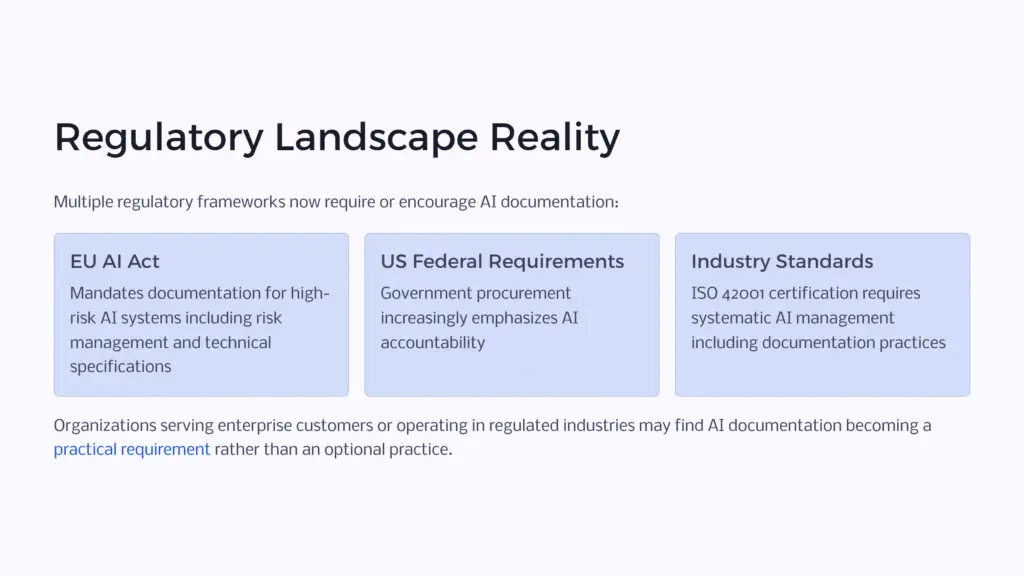
Regulatory Landscape Reality
Multiple regulatory frameworks now require or encourage AI documentation:
- EU AI Act: Mandates documentation for high-risk AI systems including risk management and technical specifications (Articles 10 (Data Governance), 11(Technical Specifications )
- US Federal Requirements: Government procurement increasingly emphasizes AI accountability
- Industry Standards: ISO 42001 certification requires systematic AI management including AI System management documentation practices
Organizations serving enterprise customers or operating in regulated industries may find AI documentation becoming a practical requirement rather than an optional practice.
Evidence-Based Implementation Framework
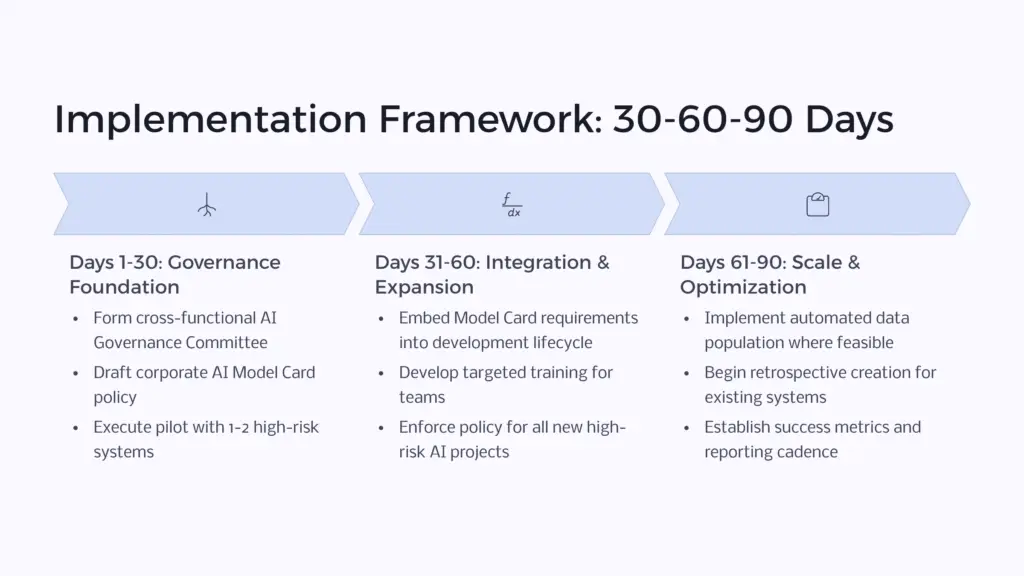
30-60-90 Day Approach
[Framework based on general change management best practices – not from a specific verified Model Card implementation study]:
A structured implementation approach based on successful enterprise deployments:
Days 1-30 (Governance Foundation): Form cross-functional AI Governance Committee, draft corporate AI Model Card policy, and execute pilot with 1-2 high-risk systems to validate processes.
Days 31-60 (Integration and Expansion): Embed Model Card requirements into software development lifecycle, develop targeted training for technical and business teams, enforce policy for all new high-risk AI projects.
Days 61-90 (Scale and Optimization): Implement automated data population where feasible, begin retrospective creation for existing production systems, establish success metrics and reporting cadence.
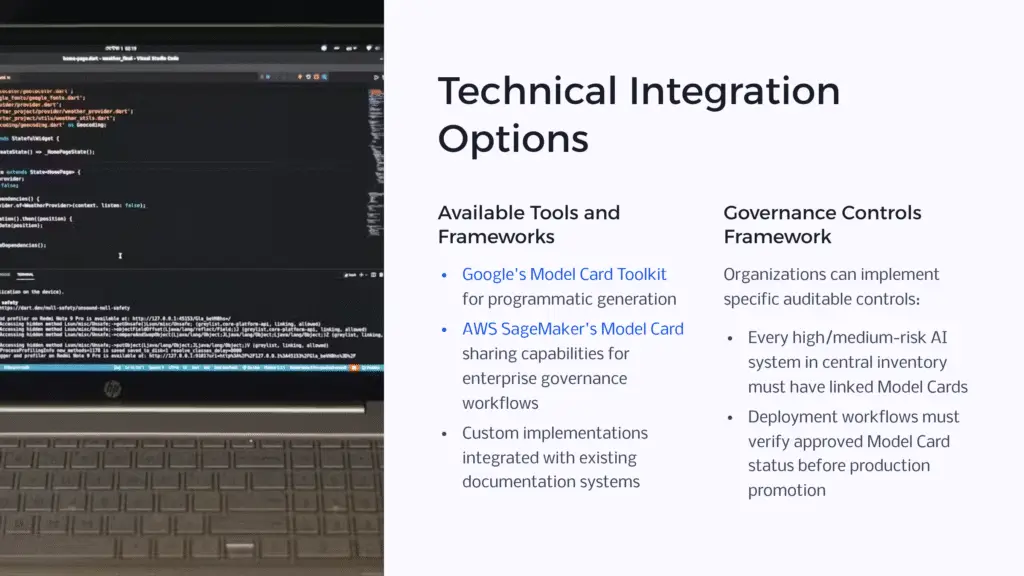
Governance Controls Framework
Organizations can implement specific auditable controls, including requirements that every high/medium-risk AI system in central inventory must have linked Model Cards, and that deployment workflows must verify approved Model Card status before production promotion.
Technical Integration Options
Organizations can implement several automation approaches, from Google’s Model Card Toolkit for programmatic generation to AWS SageMaker’s Model Card sharing capabilities for enterprise governance workflows.
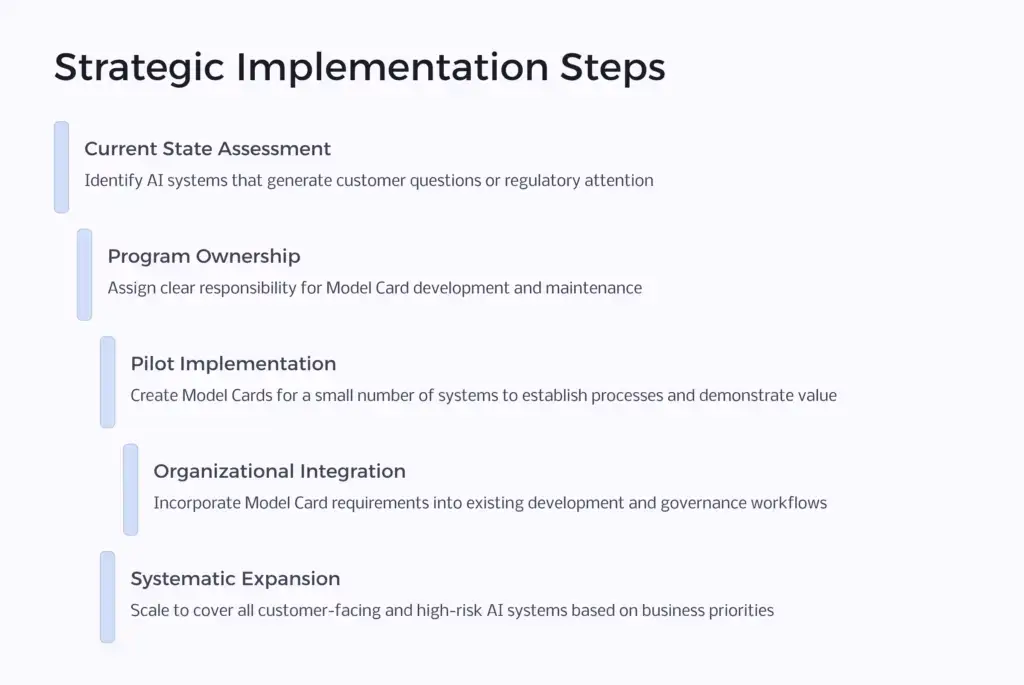
Strategic Implementation Steps
- Current State Assessment: Identify AI systems that generate customer questions or regulatory attention
- Program Ownership: Assign clear responsibility for Model Card development and maintenance
- Pilot Implementation: Create Model Cards for a small number of systems to establish processes and demonstrate value
- Organizational Integration: Incorporate Model Card requirements into existing development and governance workflows
- Systematic Expansion: Scale to cover all customer-facing and high-risk AI systems based on business priorities
The Strategic Context
[General industry observations – not from specific comprehensive studies]:
Organizations implementing systematic AI documentation report multiple advantages:
- Stakeholder confidence through clear explanations of AI capabilities and constraints
- Regulatory preparation for current and emerging compliance requirements
- Operational clarity through standardized AI system documentation
- Risk awareness through better understanding of AI system limitations
- Market positioning in environments where AI governance matters to buyers

Decision Framework
Organizations face a choice between proactive AI documentation and reactive explanation. Systematic approaches like Model Cards require initial investment but provide ongoing value through:
- Preparation for regulatory requirements that continue expanding globally
- Support for customer relationships where AI transparency questions are increasingly common
- Foundation for risk management as AI systems become more central to business operations
- Competitive positioning as AI governance maturity becomes a differentiating factor
The question isn’t whether organizations will need systematic AI documentation—current trends suggest this is becoming standard practice. The question is whether organizations will be prepared when stakeholders begin requesting this information.
Model Cards provide a structured approach to transform AI systems from opaque tools into documented, manageable business capabilities. The implementation frameworks and regulatory alignment already exist for organizations ready to begin this transition.
Key Resources and References
- Google Model Cards – Original research and examples
- EU AI Act Official Text – Regulatory requirements
- NIST AI Risk Management Framework – US guidance framework
- ISO/IEC 42001 – International AI management standard
- Model Card Toolkit – Google’s open-source implementation tool
- AWS SageMaker Model Cards – Enterprise platform integration
Check out TJS Template Marketplace for Policies, Assessment and Procedures for Model Cards.