Over 10 years we help companies reach their financial and branding goals. Engitech is a values-driven technology agency dedicated.

Gallery

Contacts

411 University St, Seattle, USA

engitech@oceanthemes.net

+1 -800-456-478-23

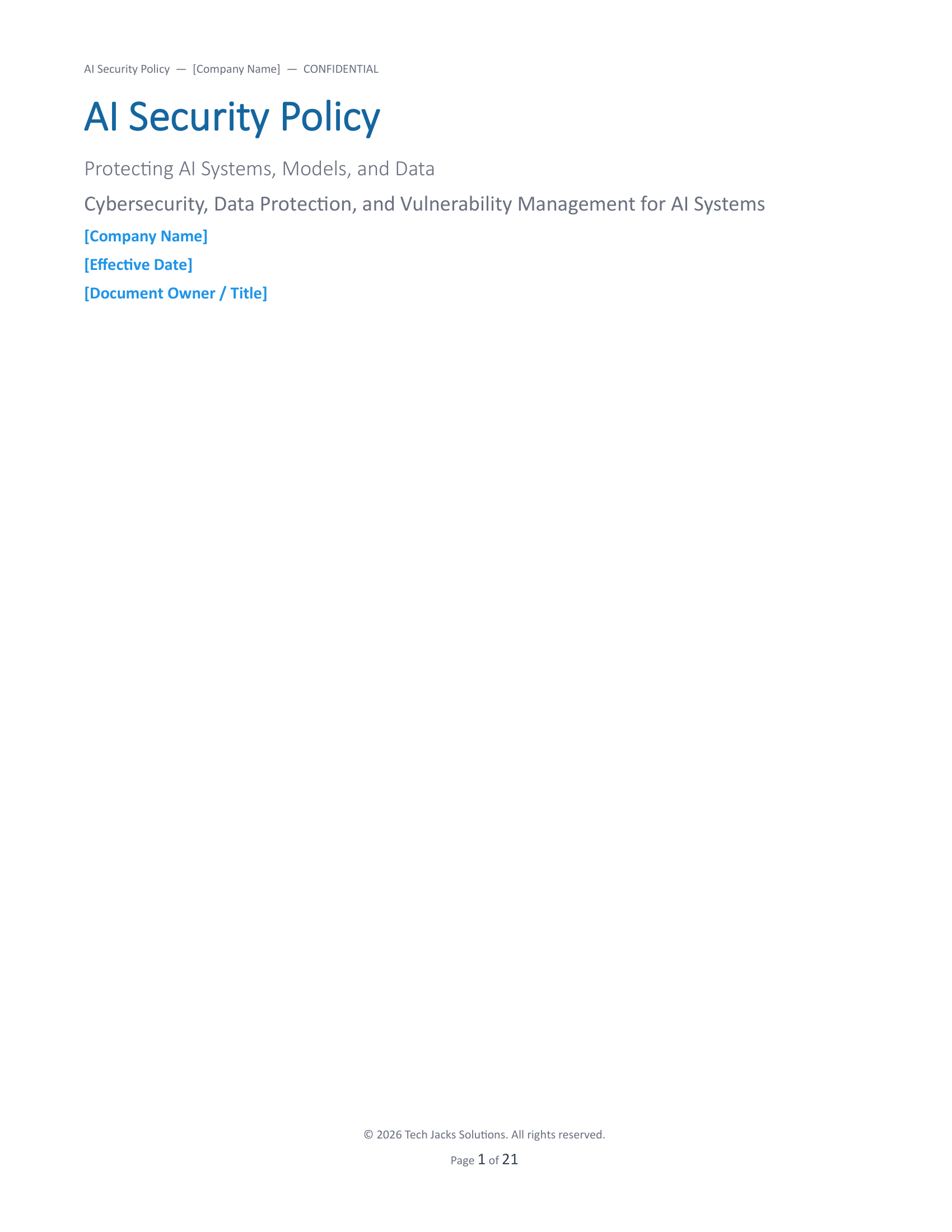
AI Security Policy Template

AI Security Policy Template

Establish a structured framework for secure, responsible AI system governance aligned with leading regulatory and industry standards.

[Download Now]


This AI Security Policy template offers a structured starting point for organizations developing comprehensive AI governance documentation. The template includes 18 defined sections covering purpose and scope, governance structures, risk management systems, technical requirements, and incident management protocols. Organizations will need to customize placeholder content (marked in brackets), adapt role definitions to their organizational structure, and tailor examples to match their specific regulatory requirements and operational environment. Using this template as a foundation may reduce the time spent developing baseline policy documentation from scratch.

Key Benefits

  • Provides a governance framework with defined board, risk management office, and ethics committee structures including suggested responsibilities and KPIs
  • Includes risk classification guidance aligned with EU AI Act Annex II and III high-risk categories
  • Contains technical requirement sections covering data governance, model security, adversarial resilience, and infrastructure security
  • Offers human oversight level definitions (Monitoring, Intervention, Control) with competency requirements
  • Includes incident classification and response procedures with severity levels and regulatory reporting timelines
  • Provides documentation retention guidance with suggested periods for technical documentation, audit records, and incident reports

Who Uses This?

This template is designed for:

  • Information Security Officers and CISOs establishing AI security programs
  • AI Risk Managers developing governance documentation
  • Compliance Officers addressing AI regulatory requirements
  • IT Directors overseeing AI system deployments
  • Legal and Risk Management teams evaluating AI governance frameworks

Preview: What’s Included

The template contains editable sections for:

  • Purpose, scope, and policy statement definitions
  • AI Governance Board and Risk Management Office role descriptions
  • Risk identification and classification matrices based on EU AI Act categories
  • Technical requirements for data governance, model security, and infrastructure
  • Transparency, explainability, and logging requirements
  • Human oversight levels and competency training frameworks
  • Testing and validation procedures including pre-deployment and continuous testing
  • Incident management classification and response timelines
  • Third-party vendor assessment and contractual requirement guidance
  • Compliance monitoring and audit frequency recommendations
  • Record keeping retention periods and storage requirements
  • Version history and approval tracking tables

Why This Matters

Organizations deploying AI systems face increasing pressure to demonstrate responsible governance practices. The EU AI Act introduces binding requirements for high-risk AI systems, including mandatory risk assessments, human oversight mechanisms, and incident reporting obligations. In the United States, the NIST AI Risk Management Framework provides voluntary guidance that many enterprises now expect from their vendors and partners.

Developing AI security policies from scratch requires significant time investment and expertise across multiple regulatory frameworks. Many organizations struggle to translate abstract framework requirements into practical policy documentation that their teams can implement. Without structured governance documentation, organizations may face challenges demonstrating compliance readiness during audits, customer security reviews, or regulatory inquiries.

This template provides a structured starting point that organizations can adapt to their specific context. It does not guarantee compliance with any regulation (professional review is recommended), but it may help reduce the effort required to develop baseline governance documentation.

Framework Alignment

This template references and is structured to support alignment with:

  • EU AI Act (Artificial Intelligence Act): Risk classification categories from Annex II and III, conformity assessment requirements, CE marking provisions, incident reporting timelines (72-hour initial notification, 15-day follow-up), and human oversight mandates
  • NIST AI Risk Management Framework (AI RMF 1.0): Structured approach to AI risk identification, assessment, and mitigation throughout the system lifecycle
  • ISO/IEC 42001:2023: Requirements for establishing, implementing, and maintaining AI management systems
  • General Data Protection Regulation (GDPR): Data protection provisions applicable to AI systems processing personal data

Key Features

Based on the template’s table of contents and content structure:

  1. Governance Structure Documentation: Defines AI Governance Board, AI Risk Management Office, and AI Ethics Committee with suggested composition, responsibilities, and KPIs
  2. Risk Classification Framework: Includes EU AI Act high-risk categories (biometric identification, critical infrastructure, employment, law enforcement, etc.) and criteria for general-purpose AI models with systemic risk
  3. Technical Requirements Sections: Covers data quality standards, bias detection and mitigation, data protection, model security, adversarial resilience testing, and infrastructure security controls
  4. Human Oversight Provisions: Three-level oversight framework (Monitoring, Intervention, Control) with competency training requirements and authority matrix guidance
  5. Incident Management Protocols: Severity classification (Critical, High, Medium, Low), response procedures with defined timelines, and regulatory reporting requirements
  6. Third-Party Management Framework: Vendor due diligence checklist, contractual requirement guidance, and ongoing monitoring procedures
  7. Performance Metrics Table: Pre-defined KPIs including risk assessment timeliness, control implementation rate, training completion, and incident response time targets
  8. Record Retention Guidance: Suggested retention periods (technical documentation: system lifetime + 10 years; audit records: 7 years; incident reports: 5 years)

Comparison Table: Starting from Scratch vs. Using This Template

AspectStarting from ScratchUsing This Template
Initial structure developmentMust create document hierarchy and section organizationPre-defined 18-section structure with logical flow
Framework alignment researchRequires research across EU AI Act, NIST AI RMF, ISO 42001Framework references integrated throughout with section mapping
Risk classification categoriesMust compile and organize risk categories from regulationsEU AI Act Annex II/III categories pre-organized with definitions
Governance role definitionsMust develop role descriptions and responsibilitiesSample board, committee, and office structures with suggested KPIs
Technical control sectionsMust identify and organize technical requirement areasPre-structured sections for data governance, model security, infrastructure
Incident response timelinesMust research regulatory reporting requirementsEU AI Act notification timelines (72 hours, 15 days) pre-documented
KPI frameworkMust develop performance metrics from scratchPre-defined metrics table with targets and measurement frequencies
Customization effortN/A (building new)Replace placeholders, adapt examples, tailor to organizational context

FAQ Section

What format is the template provided in? The template is provided as a Microsoft Word document (.docx) to ensure proper formatting, collaborative editing capabilities, and compatibility with standard document management workflows.

How much customization is required? The template includes placeholder text marked with brackets (e.g., [Organization Name], [Company], [Product]) that must be replaced with your specific information. Blue italicized sections contain examples that should be customized to match your environment, regulatory requirements, and organizational structure. Role definitions in Section 3 should be updated to align with your governance structure.

Does this template guarantee compliance with the EU AI Act or other regulations? No. This template provides a structured framework designed to support compliance efforts, but it does not guarantee compliance with any regulation. Organizations should engage qualified legal and compliance professionals to review and adapt the documentation to their specific circumstances and regulatory obligations.

What regulatory frameworks does this template reference? The template explicitly references the EU AI Act (including Annex II and III risk categories), NIST AI Risk Management Framework (AI RMF 1.0), ISO/IEC 42001:2023, and GDPR. These references are documented in Section 15 of the template.

What sections are included in the template? The template contains 18 main sections: Purpose and Scope, Policy Statement, Governance Structure, Risk Management System, Technical Requirements, Transparency and Explainability, Human Oversight, Testing and Validation, Incident Management, Third-Party Management, Compliance and Audit, Record Keeping, Policy Enforcement, Related Documents, References, Definitions, Version History, and Approvers.

Is this template suitable for organizations outside the EU? Yes. While the template includes EU AI Act requirements, it also incorporates NIST AI RMF guidance relevant to U.S. organizations and ISO 42001 standards with international applicability. Organizations can adapt the template to emphasize the frameworks most relevant to their regulatory context.

Ideal For

  • Organizations beginning to formalize AI governance programs
  • Companies preparing for EU AI Act compliance requirements
  • Security and compliance teams developing AI-specific policy documentation
  • Risk management professionals establishing AI oversight frameworks
  • Enterprises requiring vendor AI security policy documentation
  • Organizations undergoing customer security assessments involving AI systems

    Pricing Strategy Options

    Single Template Contact for pricing based on organizational requirements and customization needs.

    Bundle Option May be combined with additional AI governance templates (such as AI Ethics Guidelines, AI Risk Assessment Framework, or Model Card Template) depending on organizational compliance scope.

    Enterprise Option Available as part of comprehensive AI governance documentation suites for organizations requiring multiple policy templates and supporting documentation.


    Differentiator

    This AI Security Policy template consolidates requirements from multiple leading frameworks (EU AI Act, NIST AI RMF, ISO 42001, GDPR) into a single structured document with pre-defined governance structures, risk classification guidance, and performance metrics. The template includes practical elements often missing from generic policy templates: three-level human oversight definitions with competency requirements, incident severity classifications with specific regulatory reporting timelines, and a complete KPI framework with suggested targets and measurement frequencies. Rather than requiring organizations to research and compile requirements from multiple framework documents, this template provides an integrated starting point designed to support adaptation to specific organizational contexts.


    Documents are optimized for Microsoft Word to ensure proper formatting and collaborative editing capabilities. Professional legal and compliance review is recommended before implementation.

    Author

    Tech Jacks Solutions