Why professionals trust our templates
- 270+ downloads by governance & compliance teams
- Built by AI governance practitioners, not generic template mills
- 14-day money-back guarantee • Instant download • Secure checkout via Stripe
AI Conformity Assessment & Certification Policy
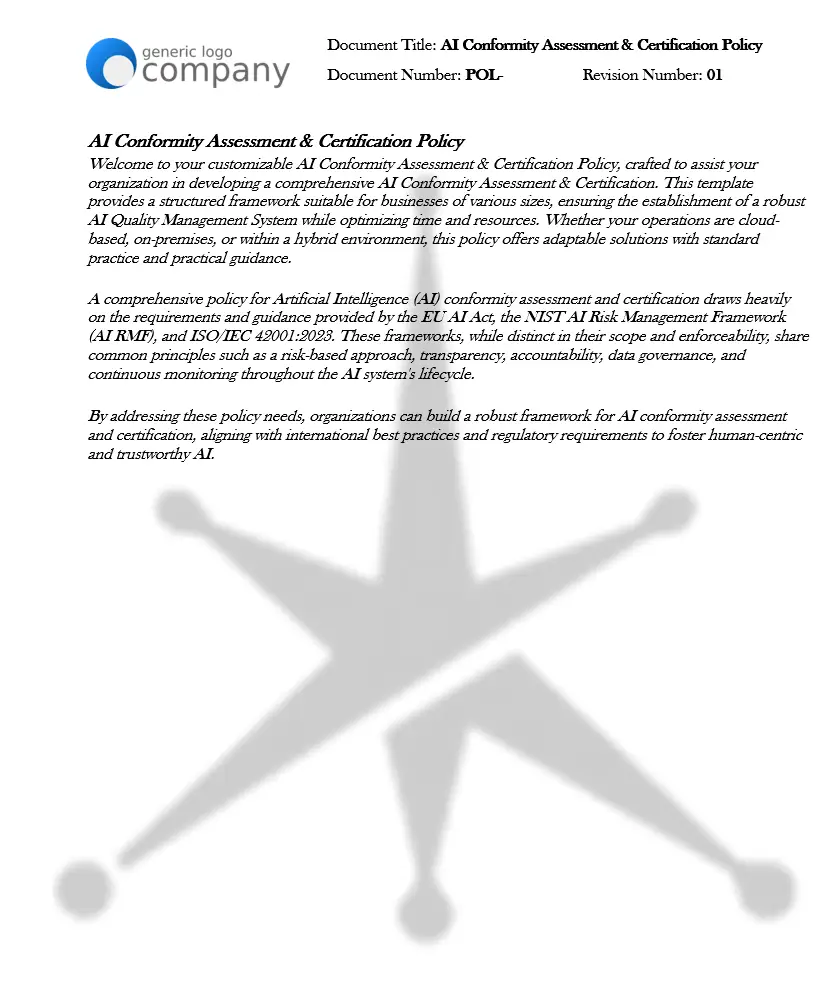
Subtitle: A structured policy framework designed to support organizations in developing comprehensive AI conformity assessment and certification processes aligned with EU AI Act, NIST AI RMF, and ISO/IEC 42001:2023 requirements.
[Download Now]
This AI Conformity Assessment & Certification Policy provides a structured framework for organizations seeking to establish governance over AI systems across various operational environments (cloud-based, on-premises, or hybrid). The template requires organizational customization to reflect your specific technologies, processes, and risk profile. By providing pre-drafted policy sections covering foundational governance, high-risk system requirements, and AI management system components, this template can reduce the time required to develop AI conformity documentation from scratch while providing a structured starting point for compliance efforts.
Key Benefits
✓ Provides framework for multi-regulatory alignment — Includes structured sections referencing EU AI Act, NIST AI RMF, and ISO/IEC 42001:2023 requirements
✓ Includes guidance on high-risk AI classification — Contains procedures for classifying AI systems based on EU AI Act Annex III criteria
✓ Supports AI lifecycle management documentation — Covers requirements from design through deployment, operation, and monitoring
✓ Contains 27 defined key terms — Includes comprehensive definitions section for consistent terminology use
✓ Includes GPAIM provider obligations framework — Addresses General Purpose AI Model requirements including systemic risk classifications
✓ Provides RACI-ready structure — Includes sections for roles, responsibilities, and accountability assignment
Who Uses This?
Designed for:
- AI Governance Officers and Compliance Teams
- Chief Information Security Officers (CISOs)
- Risk Management Professionals
- Legal and Regulatory Affairs Teams
- Organizations developing or deploying AI systems in regulated environments
- Entities subject to EU AI Act requirements
What’s included in this template:
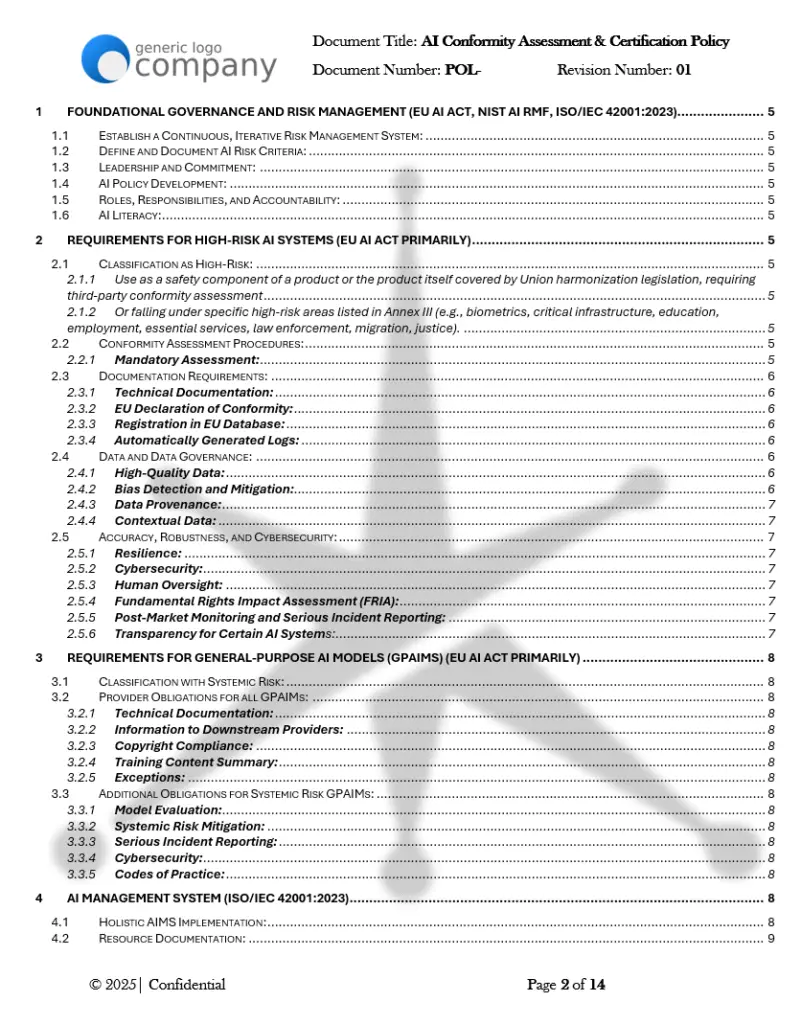
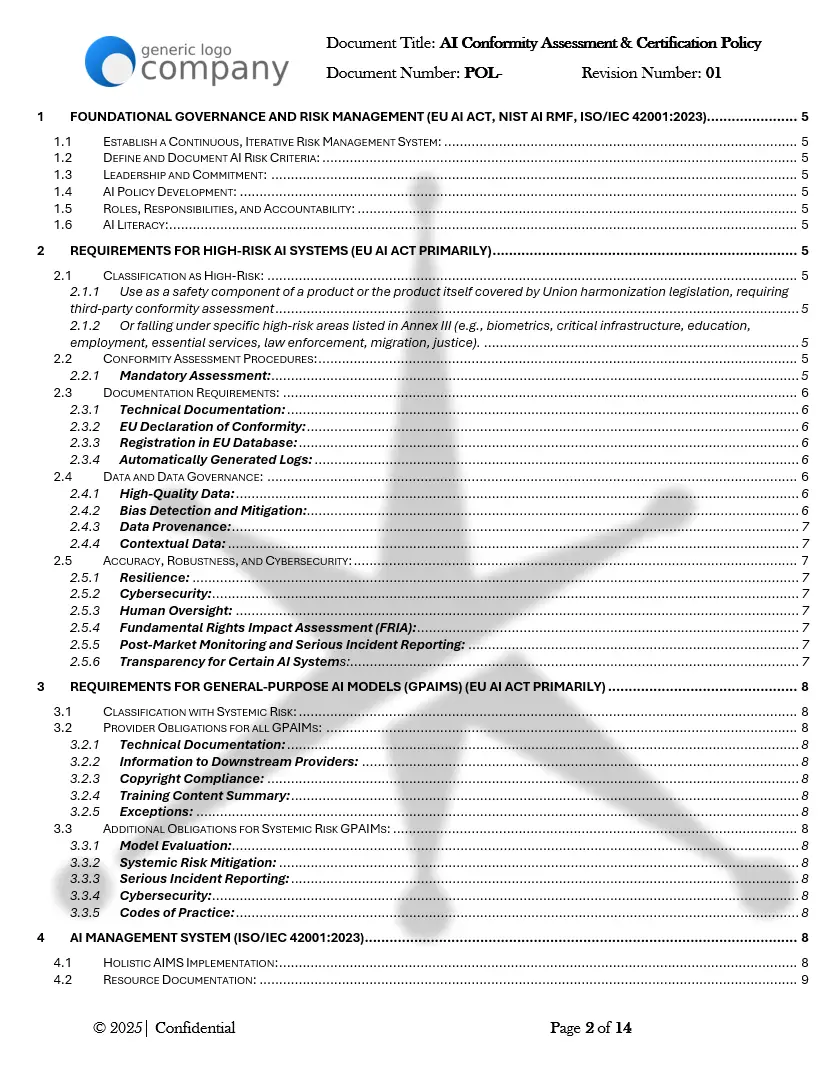
- Foundational Governance and Risk Management section (6 subsections)
- High-Risk AI Systems Requirements section (6 major areas with detailed subsections)
- General-Purpose AI Models (GPAIMs) requirements section
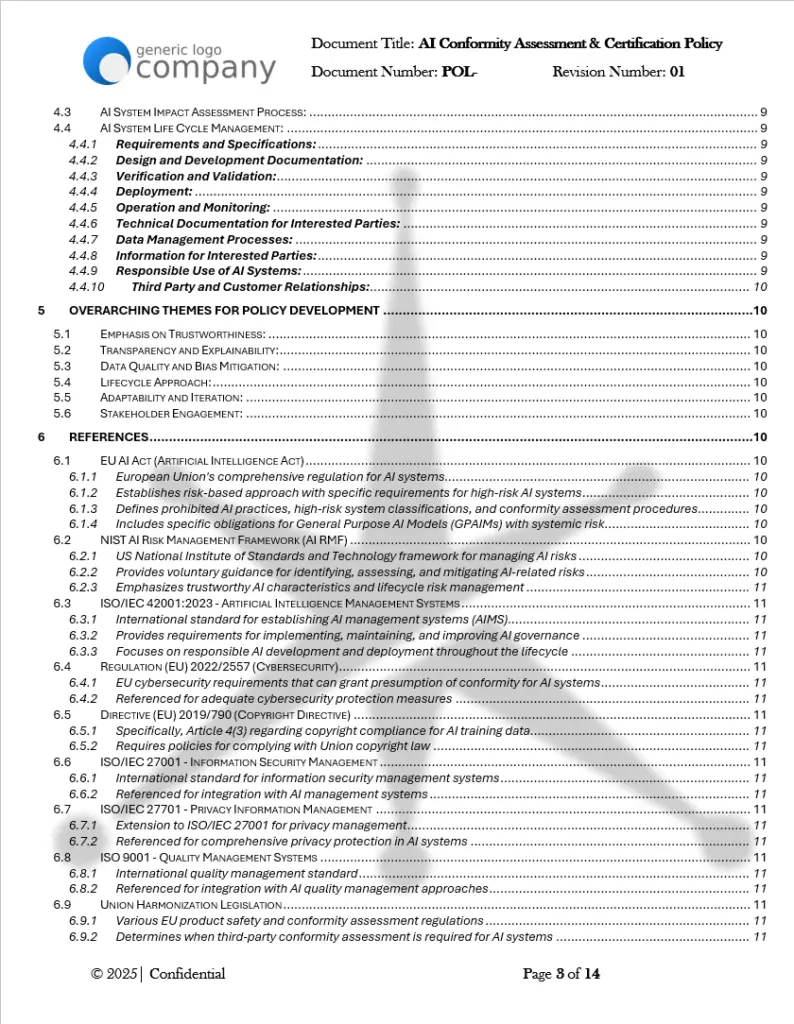
- AI Management System guidance aligned with ISO/IEC 42001:2023 (4 main areas covering lifecycle management)
- Overarching Themes for Policy Development section
- References section documenting 11 regulatory frameworks and standards
- Definitions section with 27 key terms
- Version History and Approvers tracking sections
Why This Matters
Organizations developing, deploying, or using AI systems face an increasingly complex regulatory landscape. The EU AI Act establishes binding requirements for AI systems operating in or affecting EU markets, including specific obligations for high-risk systems and General Purpose AI Models. Simultaneously, the NIST AI Risk Management Framework provides voluntary guidance adopted by many U.S. organizations, while ISO/IEC 42001:2023 establishes international standards for AI management systems.
Creating documentation that addresses these overlapping frameworks requires significant expertise in regulatory interpretation and policy development. Without structured documentation, organizations may struggle to demonstrate conformity during audits or face gaps when deploying AI systems across different jurisdictions.
This template provides a starting point for policy development by organizing requirements from multiple frameworks into a cohesive structure. Organizations can customize the template to their specific operational context while maintaining alignment with recognized standards. The document requires professional review and organizational adaptation before implementation.
Framework Alignment
The template includes sections structured around requirements from:
- EU AI Act (Artificial Intelligence Act) — Risk-based approach, high-risk system classifications, conformity assessment procedures, GPAIM obligations
- NIST AI Risk Management Framework (AI RMF) — Voluntary guidance for identifying, assessing, and mitigating AI-related risks
- ISO/IEC 42001:2023 — AI Management Systems (AIMS) requirements for implementing and maintaining AI governance
- ISO/IEC 27001 — Information security management system integration references
- ISO/IEC 27701 — Privacy information management references
- ISO 9001 — Quality management system integration references
- Regulation (EU) 2022/2557 — Cybersecurity requirements references
- Directive (EU) 2019/790 — Copyright compliance requirements (Article 4(3))
- Union Harmonization Legislation — Product safety and conformity assessment references
- GDPR — Data Protection Impact Assessment (DPIA) complementary requirements
Key Features
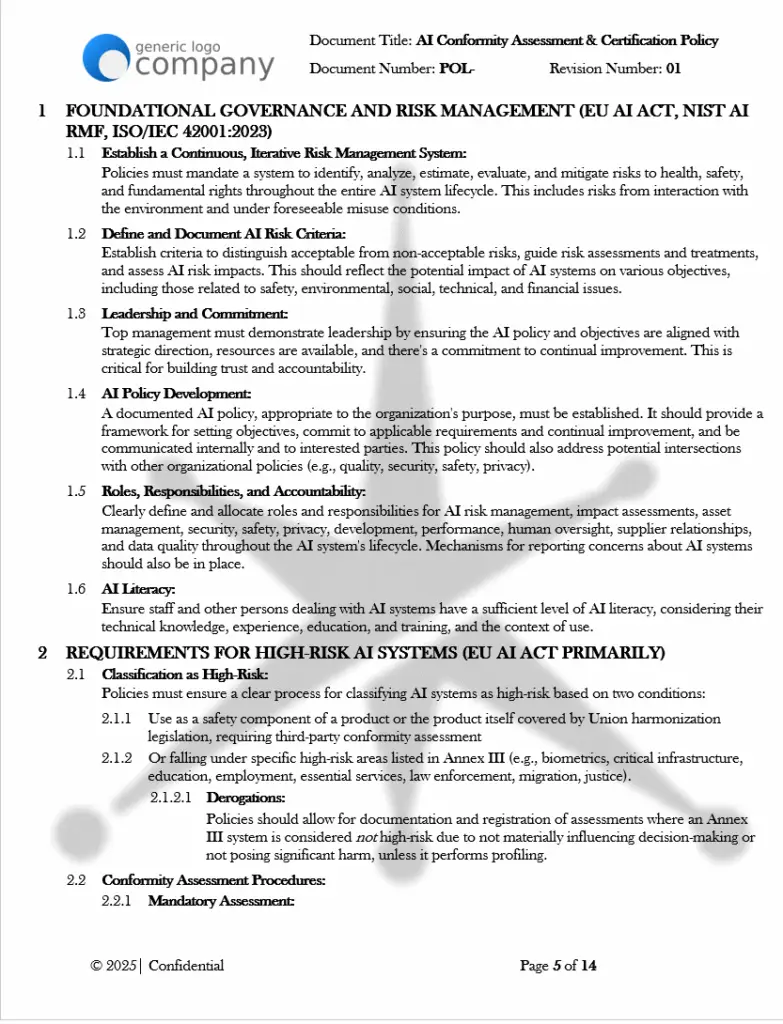
Foundational Governance Section:
- Continuous, iterative risk management system requirements
- AI risk criteria definition and documentation guidance
- Leadership and commitment requirements
- AI policy development framework
- Roles, responsibilities, and accountability structures
- AI literacy requirements for staff
High-Risk AI System Requirements:
- Classification procedures based on EU AI Act criteria
- Conformity assessment procedure guidance (third-party and internal control)
- Technical documentation requirements (Annex IV references)
- EU Declaration of Conformity structure (Annex V)
- EU Database registration requirements
- Data governance and quality requirements
- Accuracy, robustness, and cybersecurity requirements
- Human oversight design requirements
- Fundamental Rights Impact Assessment (FRIA) guidance
- Post-market monitoring and serious incident reporting procedures
- Transparency requirements for specific AI system types
GPAIM Provider Obligations:
- Systemic risk classification criteria
- Technical documentation requirements (Annexes XI and XII)
- Information provision to downstream providers
- Copyright compliance policy requirements
- Training content summary requirements
- Model evaluation and adversarial testing (red teaming) guidance
- Codes of practice references
AI Management System Components (ISO/IEC 42001:2023 aligned):
- AIMS implementation guidance with integration points
- Resource documentation requirements
- AI system impact assessment process
- Lifecycle management covering requirements, design, verification, deployment, and operation
- Data management process requirements
- Third-party and customer relationship procedures
Comparison Table: Generic Policy vs. Professional Template
| Aspect | Generic/DIY Approach | This Professional Template |
|---|---|---|
| Framework Coverage | Single framework or partial coverage | Structured sections for EU AI Act, NIST AI RMF, and ISO/IEC 42001:2023 |
| Definitions | Ad-hoc or missing terminology | 27 pre-defined key terms with descriptions |
| High-Risk Classification | Basic or absent | Detailed procedures including Annex III criteria and derogation documentation |
| Lifecycle Coverage | Limited to single phase | Requirements through design, development, deployment, operation, and monitoring |
| GPAIM Requirements | Often absent | Dedicated section for General Purpose AI Model provider obligations |
| Supporting References | Minimal citation | 11 documented regulatory frameworks and standards |
| Structure | Variable organization | Consistent hierarchical structure with numbered sections |
FAQ Section (Schema-Friendly)
Q: What file format is this template delivered in? A: Documents are optimized for Microsoft Word to ensure proper formatting and collaborative editing capabilities. The template includes structured sections that can be customized to your organization’s requirements.
Q: Does this template guarantee compliance with the EU AI Act? A: No. This template provides a structured framework designed to support compliance efforts, but actual compliance depends on proper organizational implementation, customization to your specific context, and professional review. Templates cannot guarantee regulatory compliance as this requires ongoing organizational commitment and may require legal counsel.
Q: What customization is required before using this template? A: Organizations need to customize the template to reflect their specific AI systems, operational context, risk profile, organizational structure, and applicable jurisdictions. The template provides the framework structure; content must be adapted to your actual practices and systems.
Q: Is this template suitable for organizations outside the EU? A: The template includes frameworks with different geographic scopes. NIST AI RMF is U.S.-focused voluntary guidance, while ISO/IEC 42001:2023 is an international standard. Organizations operating globally or selling into EU markets may benefit from multi-framework alignment regardless of their headquarters location.
Q: Does this template include technical documentation requirements? A: Yes. The template references technical documentation requirements from EU AI Act Annexes IV, V, XI, and XII, providing a framework for what documentation should address. Actual technical documentation must be developed based on your specific AI systems.
Q: How often should this policy be reviewed and updated? A: The template includes Version History and Approvers tracking sections. Organizations should establish review cadences based on regulatory developments, organizational changes, and AI system modifications. The template’s Overarching Themes section addresses adaptability and iteration as ongoing requirements.
Ideal For Section
This template is designed for:
- AI Developers and Providers implementing governance over AI system development
- Enterprise Organizations deploying AI systems subject to regulatory requirements
- Compliance and Legal Teams establishing AI governance documentation
- Risk Management Professionals developing AI risk assessment frameworks
- Organizations seeking ISO/IEC 42001 alignment for AI management systems
- Entities subject to EU AI Act including providers and deployers of high-risk systems
- Companies with international operations requiring multi-framework documentation
Pricing Strategy Options
Single Template: Contact for pricing based on organizational requirements and customization needs.
Bundle Option: May be combined with additional AI governance templates (such as AI Risk Assessment frameworks, Model Card policies, or AI Incident Response playbooks) depending on organizational compliance scope.
Enterprise Option: Available as part of comprehensive AI governance documentation suites for organizations requiring multiple policy documents.
⚖️ Differentiator
This AI Conformity Assessment & Certification Policy provides a structured framework that addresses requirements from three major regulatory and standards frameworks (EU AI Act, NIST AI RMF, and ISO/IEC 42001:2023) in a single integrated document. The template includes 27 defined key terms for consistent terminology, dedicated sections for both high-risk AI systems and General Purpose AI Models (GPAIMs), and lifecycle management guidance spanning from design through operation. Rather than focusing on a single framework, the template’s multi-framework structure supports organizations operating across jurisdictions or pursuing multiple compliance objectives. The document references 11 regulatory frameworks and standards, providing clear traceability between policy sections and their regulatory foundations while requiring organizational customization and professional review before implementation.