Over 10 years we help companies reach their financial and branding goals. Engitech is a values-driven technology agency dedicated.

Gallery

Contacts

411 University St, Seattle, USA

engitech@oceanthemes.net

+1 -800-456-478-23

ai acceptable use policy template

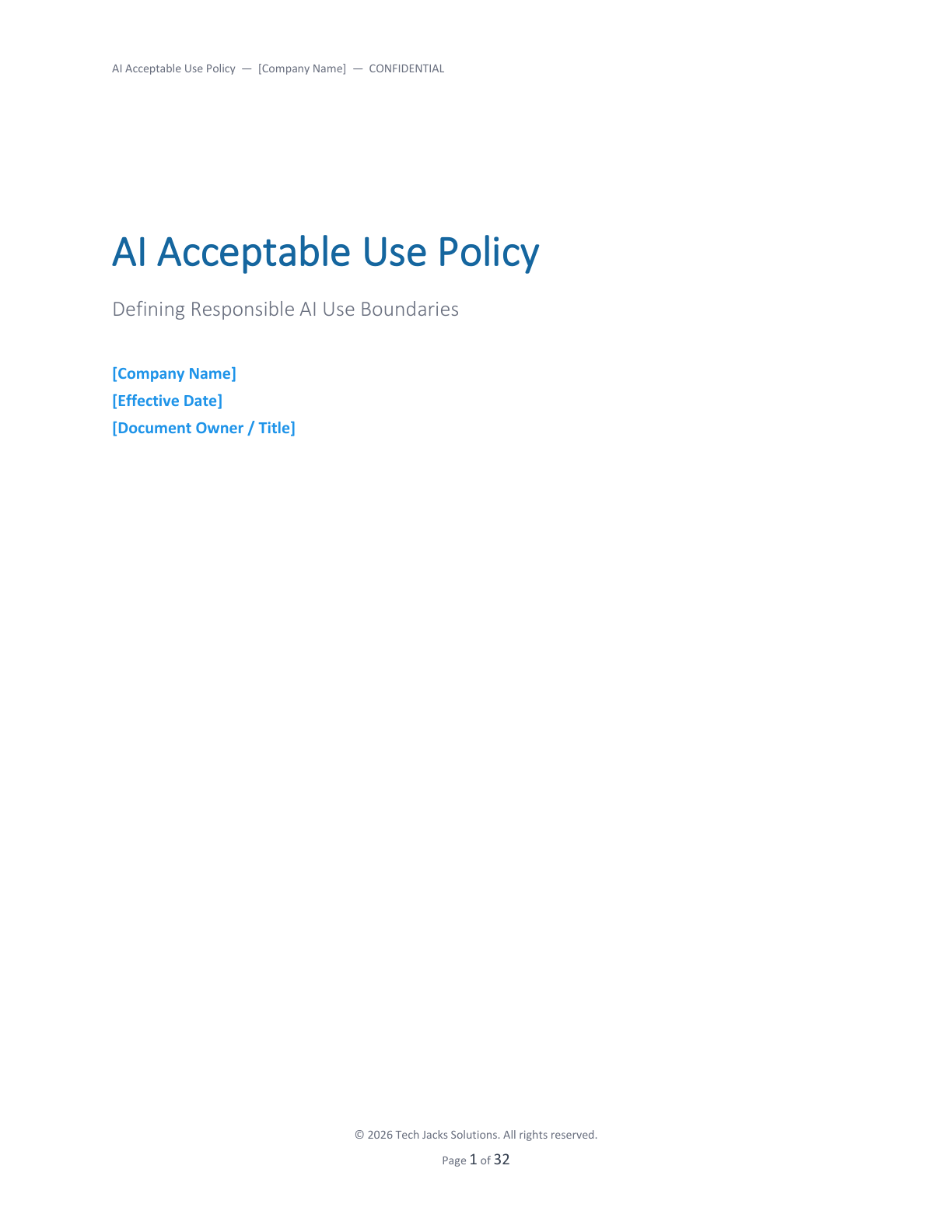
AI Acceptable Use Policy Template

A structured framework designed to support organizations in establishing responsible AI governance practices aligned with NIST AI RMF, EU AI Act, and OECD AI Principles.

[Download Now]


This AI Acceptable Use Policy template provides organizations with a comprehensive framework for governing AI systems across their operations. The template includes pre-structured sections covering governance, technical controls, data privacy, risk management, and compliance alignment. Organizations will need to customize placeholders, define organizational roles, and adapt examples to their specific context and risk profile. This structured approach can help reduce documentation development time while providing a foundation for establishing responsible AI use practices.

Key Benefits

Structured Governance Framework – Includes defined roles and responsibilities for AI oversight across executive, committee, and technical levels

Framework Alignment – Incorporates references to NIST AI Risk Management Framework, EU AI Act, OECD AI Principles, and ISO 27001

Comprehensive Scope – Covers AI usage guidelines, data handling protocols, technical security controls, and enforcement mechanisms

Risk Management Tools – Provides appendices including Risk Classification Matrix, Ethics Review Committee Charter, and Emergency Response Workflow

Customizable Structure – Designed as an editable Microsoft Word template with bracketed placeholders for organizational customization

Technical Control Guidance – Includes sections on MLOps pipeline security, model governance, logging and monitoring requirements

Who Uses This?

Designed for:

  • Organizations implementing AI systems and requiring governance documentation
  • Compliance officers establishing AI oversight frameworks
  • IT security teams developing responsible AI use guidelines
  • Risk managers creating AI-specific policy documentation
  • Companies seeking alignment with AI governance frameworks

The template includes 12 major sections with detailed subsections covering governance structure, usage guidelines, technical controls, enforcement protocols, training requirements, and maintenance procedures. Seven appendices provide supporting frameworks including risk classification matrices, ethics committee charters, incident response workflows, and vendor management guidelines.


Why This Matters: Establishing Responsible AI Governance

Organizations deploying AI systems face complex challenges around governance, risk management, and regulatory alignment. The NIST AI Risk Management Framework emphasizes the need for structured governance throughout the AI lifecycle. The EU AI Act establishes specific obligations for high-risk AI systems, including continuous risk management, robust data governance, and human oversight requirements. The OECD AI Principles call for AI that respects human rights and democratic values.

An AI Acceptable Use Policy provides the foundational documentation for addressing these requirements. It establishes clear guidelines for permissible and prohibited AI use, defines accountability structures, and creates processes for risk assessment and incident response. Without such documentation, organizations may lack consistent approaches to AI deployment, potentially leading to compliance gaps or ethical concerns.

This template provides a starting point for organizations to develop their AI governance documentation, requiring customization to reflect specific organizational contexts, technologies, and risk profiles.

Framework Alignment

The template incorporates references to the following frameworks explicitly mentioned in the source document:

NIST AI Risk Management Framework (AI RMF):

  • Voluntary framework for managing AI risks and cultivating trustworthy AI systems
  • Structured around four core functions: Govern, Map, Measure, and Manage
  • Integrated risk management throughout AI lifecycle

EU AI Act:

  • Risk-based classification of AI systems with specific obligations for high-risk applications
  • Requirements for Risk Management Systems, Data Governance, Technical Documentation
  • Mandates for automatic event logging, transparency, human oversight, and post-market monitoring

OECD AI Principles:

  • Five values-based principles for responsible AI stewardship
  • Emphasis on human agency and oversight, technical robustness and safety
  • Privacy and data governance, transparency, diversity and non-discrimination

Supporting Standards:

  • ISO 27001 for Information Security Management Systems alignment
  • HIPAA for healthcare AI data privacy compliance
  • IEEE Ethically Aligned Design (P7003 Algorithmic Bias Considerations)
  • GAO AI Accountability Framework for governance, data, performance, and monitoring

Key Features

Based on the actual template content:

Governance & Accountability (Section 3):

  • Defined roles including Executive Sponsor, AI Governance Committee, Model Owners, Data Steward, Legal & Compliance
  • AI Governance Structure with charter documentation and escalation protocols
  • Cross-functional oversight framework

AI Usage Guidelines (Section 4):

  • Ethical principles based on OECD AI Principles and IEEE Ethically Aligned Design
  • Data handling protocols including anonymization, consent management, and access controls
  • Allowed and restricted use case examples (customizable)
  • Permissible and prohibited uses with clear distinctions

Technical & Security Controls (Section 5):

  • Model security including access management, version control, runtime protections
  • MLOps pipeline security with source code scans and supply chain checks
  • Logging and monitoring requirements with audit trails and real-time alerts

Risk Management & Ethics (Section 4.6):

  • Mandatory ethics review requirements for high-risk AI cases
  • Risk Classification Matrix (Appendix A)
  • Emergency response procedures for AI incidents

Enforcement & Violations (Section 6):

  • Disciplinary action frameworks ranging from warnings to access termination
  • Incident management procedures with corporate incident response alignment
  • Reporting mechanisms including anonymous reporting options

Training & Awareness (Section 7):

  • Mandatory AI training curriculum covering principles, regulations, privacy, and security
  • Annual training requirements with tracking via Learning Management Systems
  • Ongoing communication through policy summaries and workshops

Review & Maintenance (Section 8):

  • Annual policy review schedule with stakeholder involvement
  • Metrics and KPIs including training completion, violation reporting, incident resolution
  • Audit and compliance provisions

Supporting Appendices:

  • Risk Classification Matrix (High/Medium/Low risk levels with examples)
  • Ethics Review Committee Charter with defined roles
  • Emergency & Incident Response Workflow (5-step process)
  • AI Tool Approval Workflow (5-step approval process)
  • Risk Management Process Guide (Identification through Review)
  • Vendor and Third-party AI Management Guidelines
  • Integration with Broader Governance Frameworks

Comparison Table: Generic Approach vs. Professional Template

FeatureGeneric Policy ApproachAI Acceptable Use Policy Template
Governance StructureUndefined roles and responsibilitiesDefined roles across 5 governance levels including Executive Sponsor, AI Governance Committee, Model Owners, Data Steward, Legal & Compliance
Framework AlignmentNo framework referencesExplicit alignment with NIST AI RMF, EU AI Act, OECD AI Principles, ISO 27001, HIPAA, IEEE standards
Risk ManagementGeneric risk statementsIncludes Risk Classification Matrix with High/Medium/Low categorization, mandatory ethics review protocols, emergency response workflows
Technical ControlsBasic security mentionsComprehensive MLOps pipeline security, model governance, version control, runtime protections, logging and monitoring requirements
Use Case GuidanceVague acceptable use statementsSpecific allowed and restricted use cases, permissible vs. prohibited uses with examples
Data PrivacyGeneral privacy remindersDetailed data handling protocols including anonymization, consent management, access controls, encryption requirements
Incident ResponseNo defined process5-step Emergency & Incident Response Workflow with defined responsible parties
Vendor ManagementNot addressedDedicated appendix for vendor and third-party AI management guidelines
Training RequirementsOptional training suggestionsMandatory AI training with defined curriculum, annual frequency, LMS tracking
Supporting DocumentationStandalone policy7 appendices including Ethics Committee Charter, AI Tool Approval Workflow, Risk Management Process Guide

FAQ Section

Q: What frameworks does this AI Acceptable Use Policy template reference? A: The template includes references to NIST AI Risk Management Framework, EU AI Act, OECD AI Principles, ISO 27001, HIPAA, IEEE Ethically Aligned Design, and GAO AI Accountability Framework. Organizations should verify current framework requirements during customization.

Q: What customization is required for this template? A: Organizations need to replace all bracketed placeholders (e.g., [Company], [Product]) with specific organizational information, define responsible roles, customize use case examples, update the Risk Classification Matrix for their context, and adapt technical controls to their specific technology stack. The Quick Start Guide provides detailed customization instructions.

Q: Does this template include technical security controls for AI systems? A: Yes, Section 5 includes technical and security controls covering model security (access management, version control, runtime protections), MLOps pipeline security (source code scans, supply chain checks, deployment guardrails), and logging and monitoring requirements (audit trails, real-time alerts, lifecycle observability).

Q: What file format is this template delivered in? A: Documents are optimized for Microsoft Word to ensure proper formatting and collaborative editing capabilities. This allows organizations to customize content, track changes, and integrate with existing document management systems.

Q: Is this template suitable for organizations subject to the EU AI Act? A: The template includes references to EU AI Act requirements including risk-based classification, continuous Risk Management Systems, Data Governance obligations, and human oversight mandates. Organizations subject to the EU AI Act should customize the template to address their specific classification level and compliance obligations, potentially with legal counsel review.

Q: What appendices are included with this policy template? A: The template includes seven appendices: Risk Classification Matrix, Ethics Review Committee Charter, Emergency & Incident Response Workflow, AI Tool Approval Workflow, Risk Management Process Guide, Vendor and Third-party AI Management Guidelines, and Integration with Broader Governance Frameworks.

Q: Does this template address “Shadow AI” concerns? A: Yes, Section 4.3.2 addresses prohibited uses including “deploying unapproved third-party AI solutions or ‘shadow AI’ systems.” The template includes an AI Tool Approval Workflow (Appendix D) designed to support comprehensive inventory management and access controls to prevent unauthorized AI system deployment.

Ideal For

Organizations implementing AI systems:

  • Technology companies deploying machine learning models
  • SaaS providers integrating AI-augmented features
  • Enterprises using generative AI tools across operations
  • Data science teams requiring governance documentation

Compliance and risk professionals:

  • Chief Compliance Officers establishing AI governance frameworks
  • Risk managers developing AI-specific oversight processes
  • Information Security Officers aligning AI security controls with broader ISMS
  • Data Privacy Officers addressing AI data handling requirements

Specific use cases:

  • Organizations preparing for SOC 2 or ISO 27001 audits that include AI systems
  • Companies establishing AI Ethics Review Committees
  • Businesses deploying high-risk AI applications requiring documented oversight
  • Multinational organizations aligning with GDPR, HIPAA, or EU AI Act requirements
  • Startups building AI governance foundations before scaling operations

Pricing Strategy Options

Single Template: Contact for pricing based on organizational requirements and customization needs.

Bundle Option: May be combined with additional AI governance templates (AI Risk Management Framework, AI Model Development Lifecycle Policy, AI Incident Response Playbook) depending on organizational compliance scope.

Enterprise Option: Available as part of comprehensive AI governance documentation suites that may include multiple policy templates, risk assessment frameworks, and implementation guidance.

Pricing reflects the documented structure and scope of the template. Organizations should assess their specific governance needs and customization requirements.


Differentiator

What Makes This AI Acceptable Use Policy Template Unique

This template provides a comprehensive framework that integrates governance, technical controls, and regulatory alignment in a single structured document. Unlike generic acceptable use policies, this template includes specific guidance on AI-specific risks such as model drift, bias testing, prompt injection attacks, and confabulation/hallucination in generative AI systems.

The template incorporates seven supporting appendices that transform abstract policy statements into actionable frameworks. The Risk Classification Matrix provides concrete examples of High/Medium/Low risk AI applications. The AI Tool Approval Workflow creates a 5-step process from submission through final approval. The Emergency & Incident Response Workflow defines specific responsible parties for each step of incident management.

The document includes a comprehensive Definitions section (Section 10) with 15 AI-specific terms including definitions for AI Systems, AI Incidents, High-Risk AI Systems, General-Purpose AI Models, Bias, Explainability, Transparency, Human Oversight, Model Cards, Validation, Robustness, Prompt Injection, Confabulation/Hallucination, Shadow AI, and Data/Model Drift. These definitions align with terminology used in NIST AI RMF, EU AI Act, and OECD frameworks.

The template addresses both product-based and operational AI uses, covering internal AI tools, external third-party platforms, AI-augmented SaaS features, and machine learning pipelines. This broad scope allows organizations to establish consistent governance across diverse AI applications rather than maintaining separate policies for different AI use cases.

Section 8 provides specific metrics and KPIs for policy effectiveness measurement, including percentage of employees completing AI training, number of reported policy violations, time to resolve AI incidents, model bias or drift detection metrics, and frequency of policy consultations. This measurable approach supports continuous improvement of AI governance practices.

The Quick Start Guide provides clear customization instructions, reducing implementation time while ensuring organizations properly adapt the template to their specific context. This balance of structure and flexibility allows the template to serve organizations ranging from early-stage startups to established enterprises with complex regulatory requirements.


This template is designed to support organizations in developing AI governance documentation and requires customization to reflect specific organizational contexts, compliance obligations, and risk profiles. Organizations should review and adapt all content with appropriate legal and compliance counsel.

Author

Tech Jacks Solutions