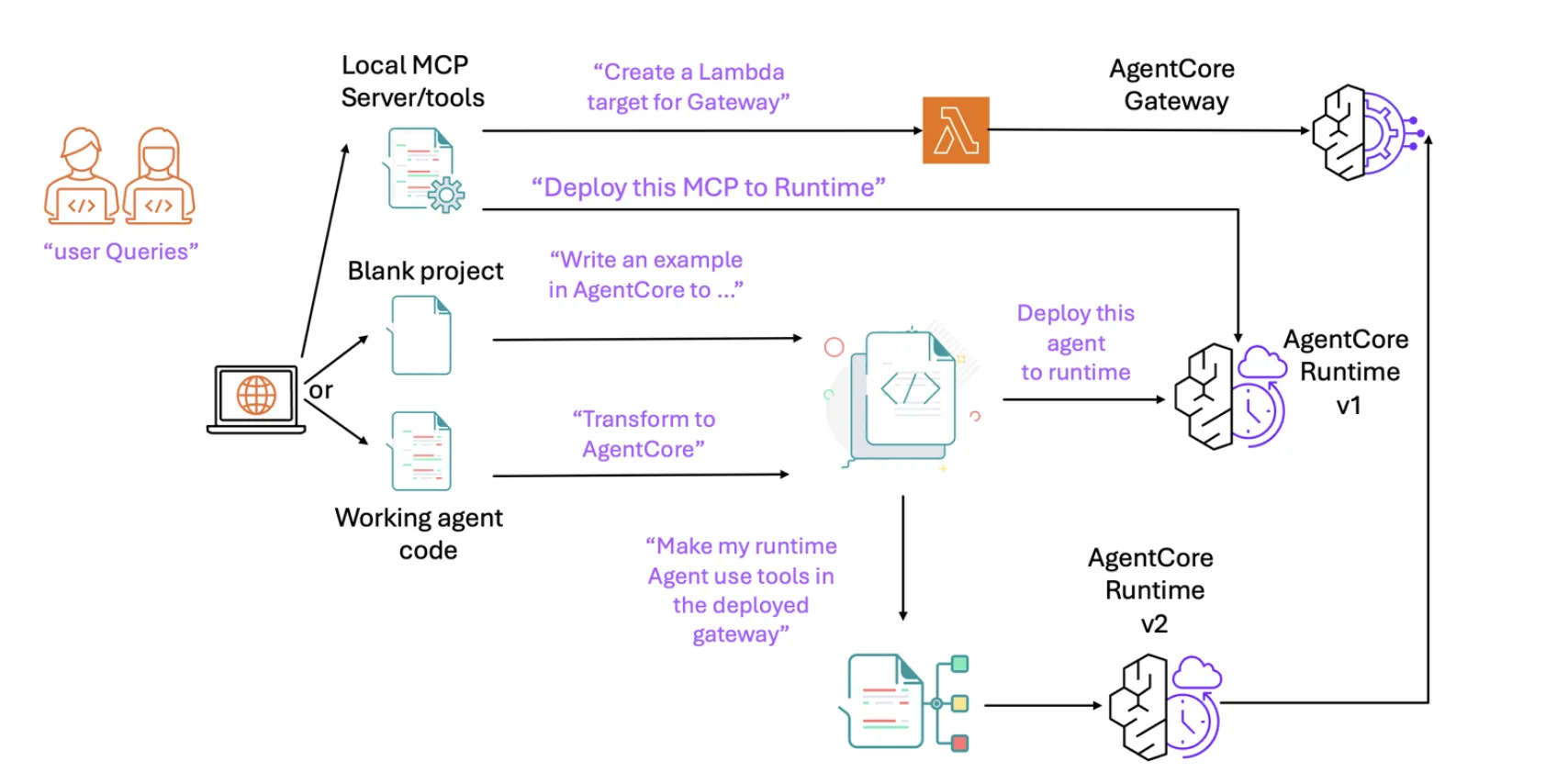
AWS released an open-source Model Context Protocol (MCP) server for Amazon Bedrock AgentCore, providing a direct path from natural-language prompts in agentic IDEs to deployable agents on AgentCore Runtime. The package ships with automated transformations, environment provisioning, and Gateway/tooling hooks designed to compress typical multi-step integration work into conversational commands. So, what exactly is it?
The post AWS Open-Sources an MCP Server for Bedrock AgentCore to Streamline AI Agent Development appeared first on MarkTechPost. Read More

Comment (1)
Leave a comment
You must be logged in to post a comment.
BC
October 5, 2025The MCP server for AgentCore addresses a real integration challenge, but the framing of “conversational commands” overstates how smoothly this works. Having tested similar IDE-integrated deployment workflows, the gap between “describe what you want” and “working deployed agent” involves multiple LLM calls, each with opportunities for misunderstanding requirements or generating incorrect configurations. The automation fails when edge cases arise that weren’t part of the training data.
The layered context approach (client → AWS docs → framework docs → SDK docs → steering files) sounds comprehensive but creates huge context windows that reduce model performance. Testing similar patterns locally, embedding 50K+ tokens of documentation into context, doesn’t guarantee the model extracts the right info – it often relies on superficial pattern matches rather than truly understanding relationships between components.
The workflow diagram shows a straightforward bootstrap→author→deploy→test cycle, but real agent development includes debugging IAM permissions, handling rate limits, managing state across versions, and dealing with runtime errors that only appear under production load. The MCP server can automate smooth deployment paths but can’t reason about why your agent fails intermittently under concurrent requests or how to improve real-world usage.
The “low-friction entry point” claim assumes the underlying complexity disappears instead of being abstracted. You still need to understand AgentCore Runtime constraints, Gateway tool integration, and Memory stack behavior to debug when automated transformations produce broken agents. The MCP server simplifies manual steps but doesn’t eliminate the need for knowledge.