
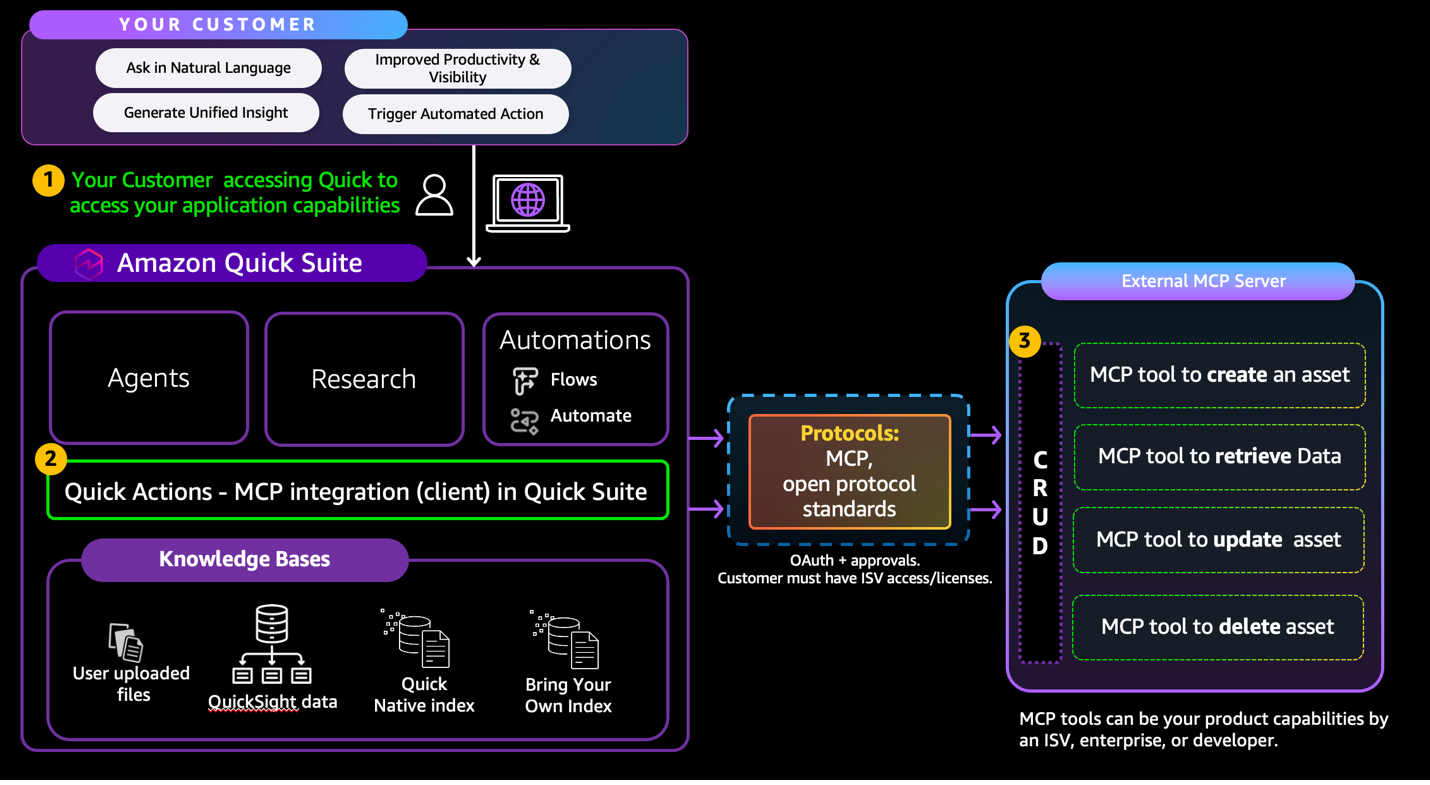
Integrate external tools with Amazon Quick Agents using Model Context Protocol (MCP)Artificial Intelligence In this post, you’ll use a six-step checklist to build a new MCP server or validate and adjust an existing MCP server for Amazon Quick integration. The Amazon Quick User Guide describes the MCP client behavior and constraints. This is a “How to” guide for detailed implementation required by 3P partners to integrate with Amazon Quick with MCP.
In this post, you’ll use a six-step checklist to build a new MCP server or validate and adjust an existing MCP server for Amazon Quick integration. The Amazon Quick User Guide describes the MCP client behavior and constraints. This is a “How to” guide for detailed implementation required by 3P partners to integrate with Amazon Quick with MCP. Read More

All About Google Colab File ManagementKDnuggets This is the ultimate guide to uploading, downloading, and saving files in Colab.
This is the ultimate guide to uploading, downloading, and saving files in Colab. Read More

Quantum computer breakthrough tracks qubit fluctuations in real timeArtificial Intelligence News — ScienceDaily Qubits, the heart of quantum computers, can change performance in fractions of a second — but until now, scientists couldn’t see it happening. Researchers at NBI have built a real-time monitoring system that tracks these rapid fluctuations about 100 times faster than previous methods. Using fast FPGA-based control hardware, they can instantly identify when a qubit shifts from “good” to “bad.” The discovery opens a new path toward stabilizing and scaling future quantum processors.
Qubits, the heart of quantum computers, can change performance in fractions of a second — but until now, scientists couldn’t see it happening. Researchers at NBI have built a real-time monitoring system that tracks these rapid fluctuations about 100 times faster than previous methods. Using fast FPGA-based control hardware, they can instantly identify when a qubit shifts from “good” to “bad.” The discovery opens a new path toward stabilizing and scaling future quantum processors. Read More
Simple Baselines are Competitive with Code Evolutioncs.AI updates on arXiv.org arXiv:2602.16805v1 Announce Type: new
Abstract: Code evolution is a family of techniques that rely on large language models to search through possible computer programs by evolving or mutating existing code. Many proposed code evolution pipelines show impressive performance but are often not compared to simpler baselines. We test how well two simple baselines do over three domains: finding better mathematical bounds, designing agentic scaffolds, and machine learning competitions. We find that simple baselines match or exceed much more sophisticated methods in all three. By analyzing these results we find various shortcomings in how code evolution is both developed and used. For the mathematical bounds, a problem’s search space and domain knowledge in the prompt are chiefly what dictate a search’s performance ceiling and efficiency, with the code evolution pipeline being secondary. Thus, the primary challenge in finding improved bounds is designing good search spaces, which is done by domain experts, and not the search itself. When designing agentic scaffolds we find that high variance in the scaffolds coupled with small datasets leads to suboptimal scaffolds being selected, resulting in hand-designed majority vote scaffolds performing best. We propose better evaluation methods that reduce evaluation stochasticity while keeping the code evolution economically feasible. We finish with a discussion of avenues and best practices to enable more rigorous code evolution in future work.
arXiv:2602.16805v1 Announce Type: new
Abstract: Code evolution is a family of techniques that rely on large language models to search through possible computer programs by evolving or mutating existing code. Many proposed code evolution pipelines show impressive performance but are often not compared to simpler baselines. We test how well two simple baselines do over three domains: finding better mathematical bounds, designing agentic scaffolds, and machine learning competitions. We find that simple baselines match or exceed much more sophisticated methods in all three. By analyzing these results we find various shortcomings in how code evolution is both developed and used. For the mathematical bounds, a problem’s search space and domain knowledge in the prompt are chiefly what dictate a search’s performance ceiling and efficiency, with the code evolution pipeline being secondary. Thus, the primary challenge in finding improved bounds is designing good search spaces, which is done by domain experts, and not the search itself. When designing agentic scaffolds we find that high variance in the scaffolds coupled with small datasets leads to suboptimal scaffolds being selected, resulting in hand-designed majority vote scaffolds performing best. We propose better evaluation methods that reduce evaluation stochasticity while keeping the code evolution economically feasible. We finish with a discussion of avenues and best practices to enable more rigorous code evolution in future work. Read More
NeuDiff Agent: A Governed AI Workflow for Single-Crystal Neutron Crystallographycs.AI updates on arXiv.org arXiv:2602.16812v1 Announce Type: new
Abstract: Large-scale facilities increasingly face analysis and reporting latency as the limiting step in scientific throughput, particularly for structurally and magnetically complex samples that require iterative reduction, integration, refinement, and validation. To improve time-to-result and analysis efficiency, NeuDiff Agent is introduced as a governed, tool-using AI workflow for TOPAZ at the Spallation Neutron Source that takes instrument data products through reduction, integration, refinement, and validation to a validated crystal structure and a publication-ready CIF. NeuDiff Agent executes this established pipeline under explicit governance by restricting actions to allowlisted tools, enforcing fail-closed verification gates at key workflow boundaries, and capturing complete provenance for inspection, auditing, and controlled replay. Performance is assessed using a fixed prompt protocol and repeated end-to-end runs with two large language model backends, with user and machine time partitioned and intervention burden and recovery behaviors quantified under gating. In a reference-case benchmark, NeuDiff Agent reduces wall time from 435 minutes (manual) to 86.5(4.7) to 94.4(3.5) minutes (4.6-5.0x faster) while producing a validated CIF with no checkCIF level A or B alerts. These results establish a practical route to deploy agentic AI in facility crystallography while preserving traceability and publication-facing validation requirements.
arXiv:2602.16812v1 Announce Type: new
Abstract: Large-scale facilities increasingly face analysis and reporting latency as the limiting step in scientific throughput, particularly for structurally and magnetically complex samples that require iterative reduction, integration, refinement, and validation. To improve time-to-result and analysis efficiency, NeuDiff Agent is introduced as a governed, tool-using AI workflow for TOPAZ at the Spallation Neutron Source that takes instrument data products through reduction, integration, refinement, and validation to a validated crystal structure and a publication-ready CIF. NeuDiff Agent executes this established pipeline under explicit governance by restricting actions to allowlisted tools, enforcing fail-closed verification gates at key workflow boundaries, and capturing complete provenance for inspection, auditing, and controlled replay. Performance is assessed using a fixed prompt protocol and repeated end-to-end runs with two large language model backends, with user and machine time partitioned and intervention burden and recovery behaviors quantified under gating. In a reference-case benchmark, NeuDiff Agent reduces wall time from 435 minutes (manual) to 86.5(4.7) to 94.4(3.5) minutes (4.6-5.0x faster) while producing a validated CIF with no checkCIF level A or B alerts. These results establish a practical route to deploy agentic AI in facility crystallography while preserving traceability and publication-facing validation requirements. Read More
Node Learning: A Framework for Adaptive, Decentralised and Collaborative Network Edge AIcs.AI updates on arXiv.org arXiv:2602.16814v1 Announce Type: new
Abstract: The expansion of AI toward the edge increasingly exposes the cost and fragility of cen- tralised intelligence. Data transmission, latency, energy consumption, and dependence on large data centres create bottlenecks that scale poorly across heterogeneous, mobile, and resource-constrained environments. In this paper, we introduce Node Learning, a decen- tralised learning paradigm in which intelligence resides at individual edge nodes and expands through selective peer interaction. Nodes learn continuously from local data, maintain their own model state, and exchange learned knowledge opportunistically when collaboration is beneficial. Learning propagates through overlap and diffusion rather than global synchro- nisation or central aggregation. It unifies autonomous and cooperative behaviour within a single abstraction and accommodates heterogeneity in data, hardware, objectives, and connectivity. This concept paper develops the conceptual foundations of this paradigm, contrasts it with existing decentralised approaches, and examines implications for communi- cation, hardware, trust, and governance. Node Learning does not discard existing paradigms, but places them within a broader decentralised perspective
arXiv:2602.16814v1 Announce Type: new
Abstract: The expansion of AI toward the edge increasingly exposes the cost and fragility of cen- tralised intelligence. Data transmission, latency, energy consumption, and dependence on large data centres create bottlenecks that scale poorly across heterogeneous, mobile, and resource-constrained environments. In this paper, we introduce Node Learning, a decen- tralised learning paradigm in which intelligence resides at individual edge nodes and expands through selective peer interaction. Nodes learn continuously from local data, maintain their own model state, and exchange learned knowledge opportunistically when collaboration is beneficial. Learning propagates through overlap and diffusion rather than global synchro- nisation or central aggregation. It unifies autonomous and cooperative behaviour within a single abstraction and accommodates heterogeneity in data, hardware, objectives, and connectivity. This concept paper develops the conceptual foundations of this paradigm, contrasts it with existing decentralised approaches, and examines implications for communi- cation, hardware, trust, and governance. Node Learning does not discard existing paradigms, but places them within a broader decentralised perspective Read More
Beyond Pipelines: A Fundamental Study on the Rise of Generative-Retrieval Architectures in Web Researchcs.AI updates on arXiv.org arXiv:2602.17450v1 Announce Type: cross
Abstract: Web research and practices have evolved significantly over time, offering users diverse and accessible solutions across a wide range of tasks. While advanced concepts such as Web 4.0 have emerged from mature technologies, the introduction of large language models (LLMs) has profoundly influenced both the field and its applications. This wave of LLMs has permeated science and technology so deeply that no area remains untouched. Consequently, LLMs are reshaping web research and development, transforming traditional pipelines into generative solutions for tasks like information retrieval, question answering, recommendation systems, and web analytics. They have also enabled new applications such as web-based summarization and educational tools. This survey explores recent advances in the impact of LLMs-particularly through the use of retrieval-augmented generation (RAG)-on web research and industry. It discusses key developments, open challenges, and future directions for enhancing web solutions with LLMs.
arXiv:2602.17450v1 Announce Type: cross
Abstract: Web research and practices have evolved significantly over time, offering users diverse and accessible solutions across a wide range of tasks. While advanced concepts such as Web 4.0 have emerged from mature technologies, the introduction of large language models (LLMs) has profoundly influenced both the field and its applications. This wave of LLMs has permeated science and technology so deeply that no area remains untouched. Consequently, LLMs are reshaping web research and development, transforming traditional pipelines into generative solutions for tasks like information retrieval, question answering, recommendation systems, and web analytics. They have also enabled new applications such as web-based summarization and educational tools. This survey explores recent advances in the impact of LLMs-particularly through the use of retrieval-augmented generation (RAG)-on web research and industry. It discusses key developments, open challenges, and future directions for enhancing web solutions with LLMs. Read More
NVIDIA Releases Dynamo v0.9.0: A Massive Infrastructure Overhaul Featuring FlashIndexer, Multi-Modal Support, and Removed NATS and ETCDMarkTechPost NVIDIA has just released Dynamo v0.9.0. This is the most significant infrastructure upgrade for the distributed inference framework to date. This update simplifies how large-scale models are deployed and managed. The release focuses on removing heavy dependencies and improving how GPUs handle multi-modal data. The Great Simplification: Removing NATS and etcd The biggest change in
The post NVIDIA Releases Dynamo v0.9.0: A Massive Infrastructure Overhaul Featuring FlashIndexer, Multi-Modal Support, and Removed NATS and ETCD appeared first on MarkTechPost.
NVIDIA has just released Dynamo v0.9.0. This is the most significant infrastructure upgrade for the distributed inference framework to date. This update simplifies how large-scale models are deployed and managed. The release focuses on removing heavy dependencies and improving how GPUs handle multi-modal data. The Great Simplification: Removing NATS and etcd The biggest change in
The post NVIDIA Releases Dynamo v0.9.0: A Massive Infrastructure Overhaul Featuring FlashIndexer, Multi-Modal Support, and Removed NATS and ETCD appeared first on MarkTechPost. Read More
How to Build Transparent AI Agents: Traceable Decision-Making with Audit Trails and Human GatesMarkTechPost In this tutorial, we build a glass-box agentic workflow that makes every decision traceable, auditable, and explicitly governed by human approval. We design the system to log each thought, action, and observation into a tamper-evident audit ledger while enforcing dynamic permissioning for high-risk operations. By combining LangGraph’s interrupt-driven human-in-the-loop control with a hash-chained database, we
The post How to Build Transparent AI Agents: Traceable Decision-Making with Audit Trails and Human Gates appeared first on MarkTechPost.
In this tutorial, we build a glass-box agentic workflow that makes every decision traceable, auditable, and explicitly governed by human approval. We design the system to log each thought, action, and observation into a tamper-evident audit ledger while enforcing dynamic permissioning for high-risk operations. By combining LangGraph’s interrupt-driven human-in-the-loop control with a hash-chained database, we
The post How to Build Transparent AI Agents: Traceable Decision-Making with Audit Trails and Human Gates appeared first on MarkTechPost. Read More
Beyond In-Domain Detection: SpikeScore for Cross-Domain Hallucination Detectioncs.AI updates on arXiv.org arXiv:2601.19245v5 Announce Type: replace
Abstract: Hallucination detection is critical for deploying large language models (LLMs) in real-world applications. Existing hallucination detection methods achieve strong performance when the training and test data come from the same domain, but they suffer from poor cross-domain generalization. In this paper, we study an important yet overlooked problem, termed generalizable hallucination detection (GHD), which aims to train hallucination detectors on data from a single domain while ensuring robust performance across diverse related domains. In studying GHD, we simulate multi-turn dialogues following LLMs’ initial response and observe an interesting phenomenon: hallucination-initiated multi-turn dialogues universally exhibit larger uncertainty fluctuations than factual ones across different domains. Based on the phenomenon, we propose a new score SpikeScore, which quantifies abrupt fluctuations in multi-turn dialogues. Through both theoretical analysis and empirical validation, we demonstrate that SpikeScore achieves strong cross-domain separability between hallucinated and non-hallucinated responses. Experiments across multiple LLMs and benchmarks demonstrate that the SpikeScore-based detection method outperforms representative baselines in cross-domain generalization and surpasses advanced generalization-oriented methods, verifying the effectiveness of our method in cross-domain hallucination detection.
arXiv:2601.19245v5 Announce Type: replace
Abstract: Hallucination detection is critical for deploying large language models (LLMs) in real-world applications. Existing hallucination detection methods achieve strong performance when the training and test data come from the same domain, but they suffer from poor cross-domain generalization. In this paper, we study an important yet overlooked problem, termed generalizable hallucination detection (GHD), which aims to train hallucination detectors on data from a single domain while ensuring robust performance across diverse related domains. In studying GHD, we simulate multi-turn dialogues following LLMs’ initial response and observe an interesting phenomenon: hallucination-initiated multi-turn dialogues universally exhibit larger uncertainty fluctuations than factual ones across different domains. Based on the phenomenon, we propose a new score SpikeScore, which quantifies abrupt fluctuations in multi-turn dialogues. Through both theoretical analysis and empirical validation, we demonstrate that SpikeScore achieves strong cross-domain separability between hallucinated and non-hallucinated responses. Experiments across multiple LLMs and benchmarks demonstrate that the SpikeScore-based detection method outperforms representative baselines in cross-domain generalization and surpasses advanced generalization-oriented methods, verifying the effectiveness of our method in cross-domain hallucination detection. Read More