Authored by Derrick Jackson & Co-Author Lisa Yu | Last updated 09/21/2025
Table of Contents
Pressed For Time?
Review or Download our 2-3 min Quick Slides or the 5-7 min Article Insights to gain knowledge with the time you have!
Security+ Certification Overview
Your Foundation for Cybersecurity Success in a Transformed Market
The cybersecurity job landscape isn’t what it was three years ago.
CompTIA Security+ certification remains one of the most recognized cybersecurity credentials globally, but the market it serves has fundamentally changed. Since November 2023, the latest SY0-701 exam has validated essential security skills for over 760,000 professionals worldwide. That credential still opens doors, but different ones than most people expect.
Here’s what most career overview won’t tell you: traditional entry-level cybersecurity roles declined 25.88% from 2022 to 2024. Security Engineer positions dropped 24.97%. Cloud Security Engineer roles fell 43%. Organizations increasingly rely on AI-driven security automation and managed security services, reducing demand for large in-house security teams.
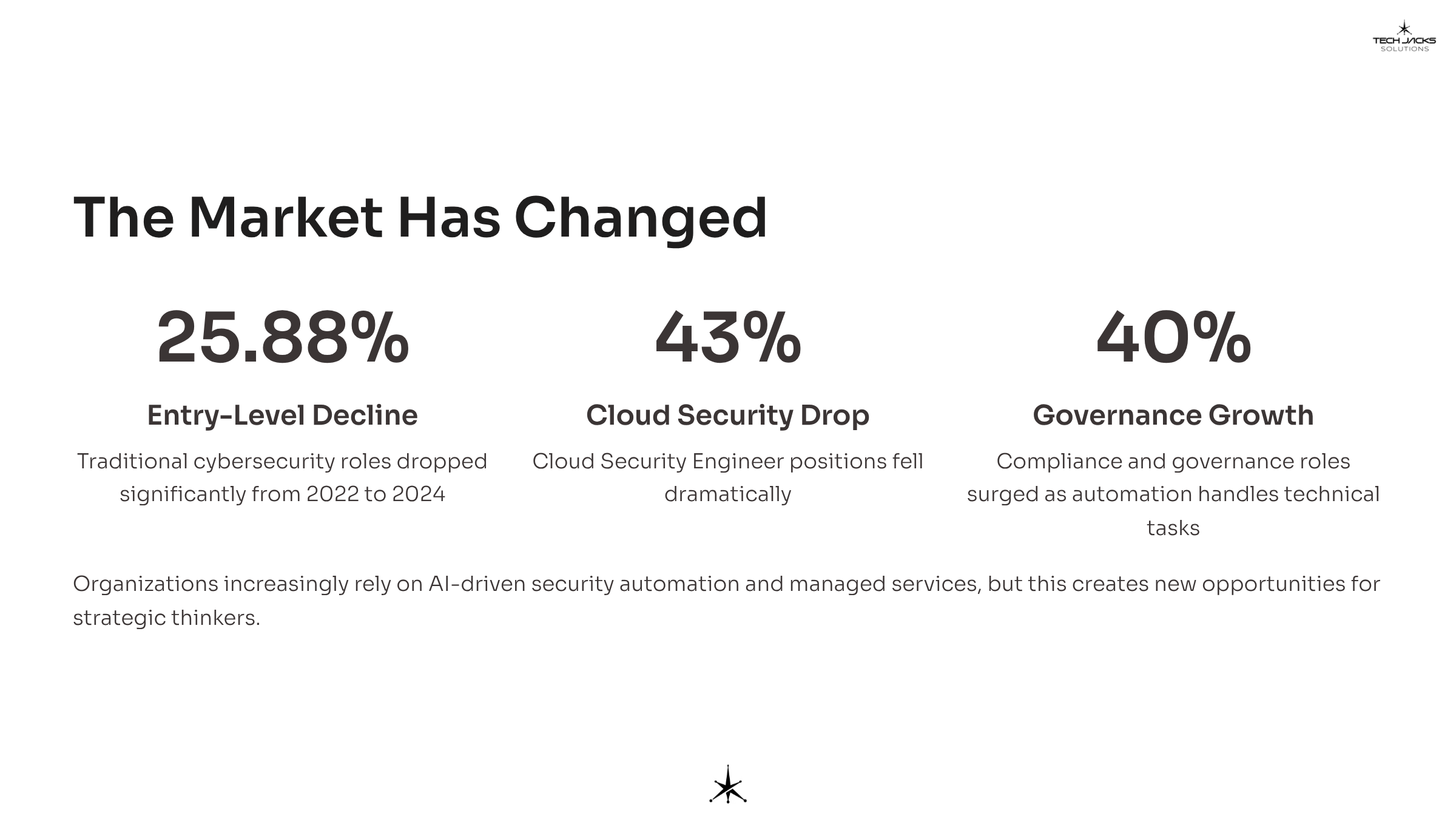
But this transformation creates new opportunities for those who understand the evolving landscape. While routine SOC monitoring gets automated, governance and compliance roles surged 40%. The U.S. government still mandates Security+ for cybersecurity roles through DoD 8140/8570 requirements, creating stable demand that transcends market trends.
Security+ provides cybersecurity literacy for the modern workplace. Rather than guaranteeing entry-level positions, it prepares professionals for roles that complement automation while meeting genuine market demands.
Who Should Consider This Certification?
Security+ serves five distinct professional groups, each facing unique market realities and opportunities in 2025’s transformed landscape.
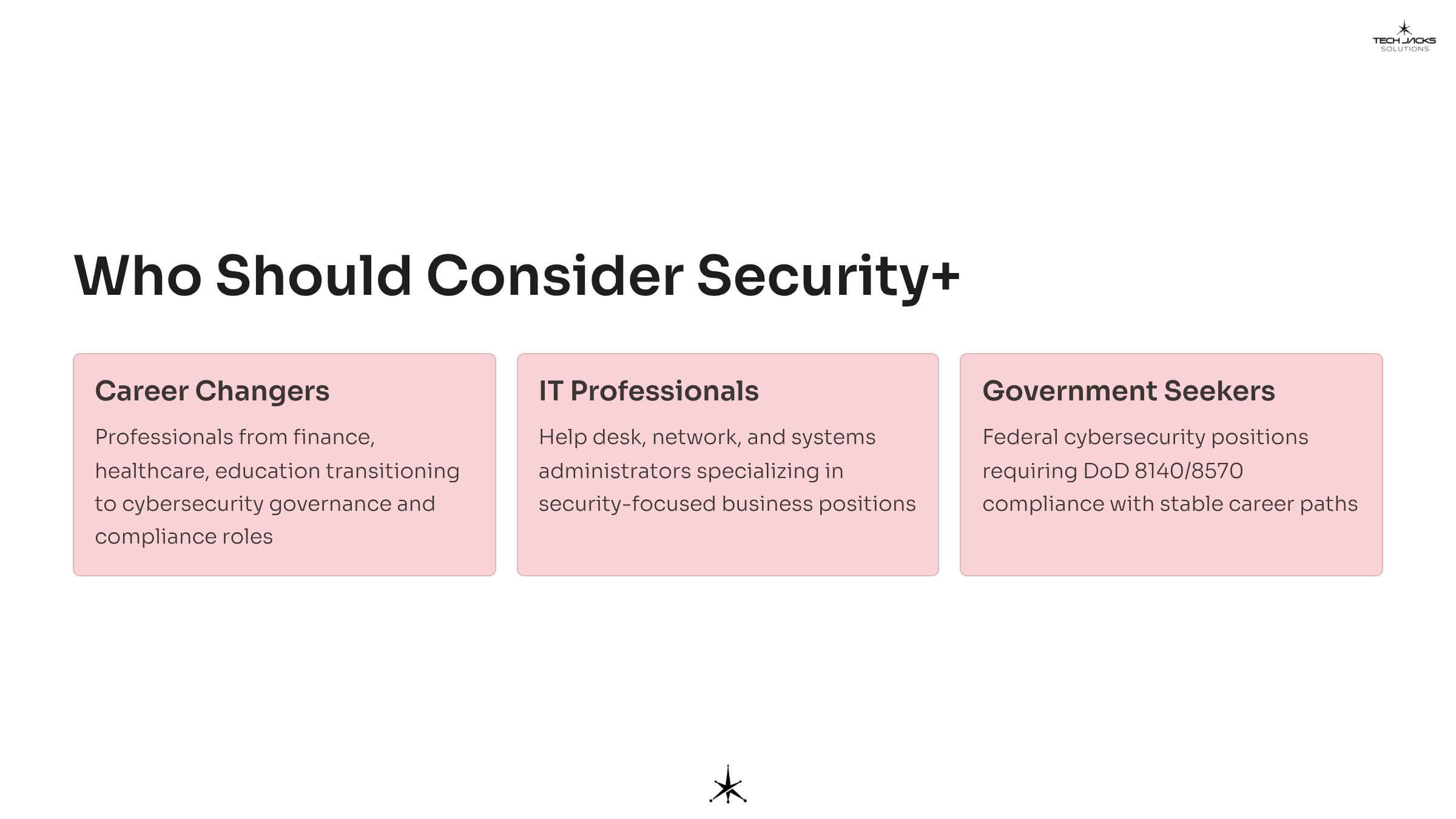
Career Changers represent the strongest opportunity despite market headwinds. Professionals from finance, healthcare, education, or other fields can leverage Security+ to transition into cybersecurity, but they need realistic expectations. The certification doesn’t require previous IT experience, though CompTIA recommends Network+ knowledge for optimal success. Career changers succeed by targeting governance, compliance, and risk management roles rather than traditional SOC positions. A healthcare professional with Security+ becomes attractive to healthcare organizations needing HIPAA compliance experts, not necessarily for monitoring security alerts.
Early-Career IT Professionals can use Security+ to specialize beyond general support roles, but the path has narrowed. Help desk technicians, network administrators, and systems administrators increasingly find Security+ valuable for transitioning into security-focused business roles rather than purely technical positions. The certification validates their existing technical foundation while demonstrating commitment to cybersecurity specialization in areas that complement rather than compete with automation.
Students and Recent Graduates benefit from Security+’s academic integration, but they must understand current market dynamics. Many cybersecurity degree programs incorporate Security+ preparation into their curriculum. New graduates with Security+ stand out in competitive job markets, but for roles requiring strategic thinking and business acumen rather than just technical skills. AI will likely replace some technical skills needed in cybersecurity, making human judgment and communication increasingly valuable.
Government and DoD Job Seekers find Security+ essential, not optional. Federal cybersecurity positions and defense contractor roles frequently require Security+ as a baseline qualification. This creates the most stable job market with clear advancement paths and security clearance opportunities, largely insulated from private sector automation trends.
Business Professionals in AI-Era Organizations increasingly need security skills as AI integration accelerates. Marketing professionals using AI tools, developers implementing machine learning, and business analysts working with data platforms all benefit from understanding security implications. Security+ provides this foundation without requiring deep technical expertise, positioning professionals to bridge business and security functions.
Each group faces different market realities. Career changers typically need 3-6 months of dedicated study plus strategic positioning toward compliance roles. IT professionals with networking experience often succeed with 1-2 months of focused preparation for specialized positions. Students can integrate Security+ preparation into existing coursework while building complementary business skills.
The certification’s broad applicability means it adds value across industries, but success requires understanding which roles resist automation and outsourcing. Financial services, healthcare, manufacturing, retail, and technology companies all need security professionals, but increasingly for governance, risk management, and strategic roles rather than traditional monitoring positions.
5 Core Domains: What You Need to Master
The SY0-701 exam organizes cybersecurity knowledge into five domains, each weighted by importance and frequency of real-world application in today’s market.
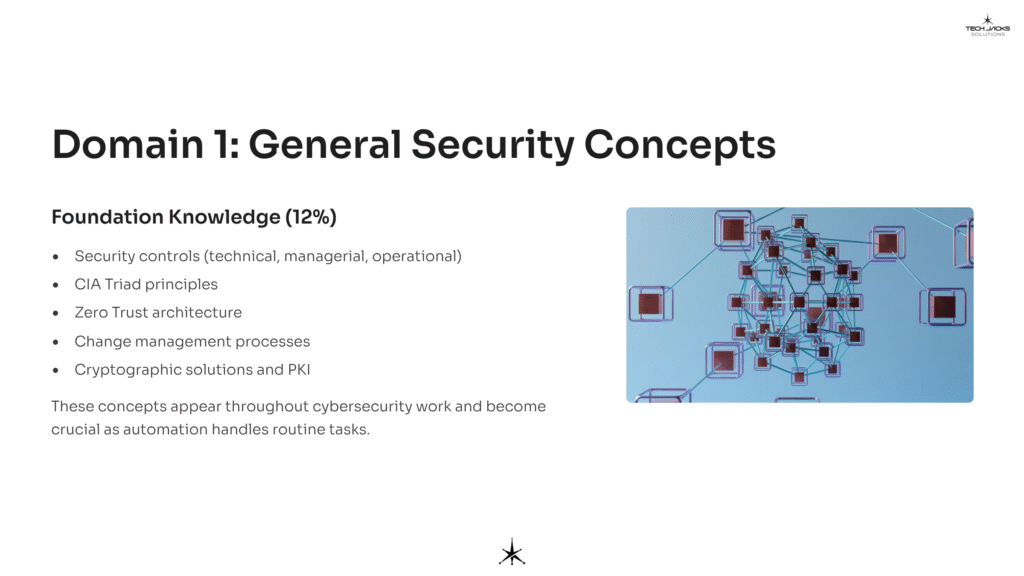
Domain 1: General Security Concepts (12%) establishes the foundational language of cybersecurity. This domain covers security controls (technical, managerial, operational), the Confidentiality, Integrity, and Availability (CIA) Triad, Zero Trust architecture, change management processes, and cryptographic solutions including PKI, encryption, hashing, and digital signatures. These concepts appear throughout cybersecurity work and become increasingly important as automation handles routine tasks. You’ll use CIA Triad principles to evaluate every security decision. Zero Trust architecture drives modern network design discussions with executives. Understanding cryptography helps you implement secure communications and explain data protection requirements to business stakeholders.
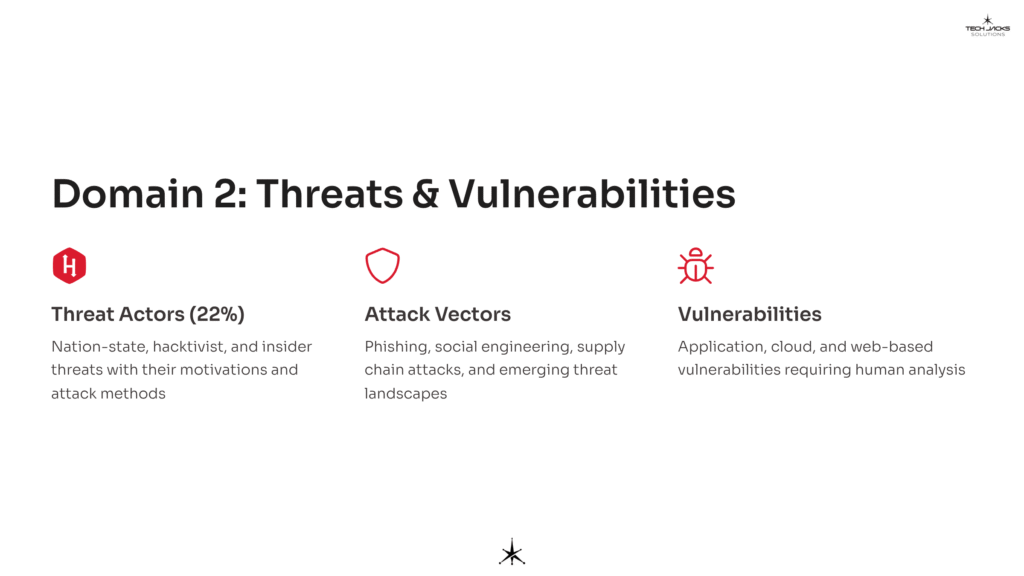
Domain 2: Threats, Vulnerabilities, and Mitigations (22%) focuses on the adversary landscape. You’ll study threat actors and their motivations (nation-state, hacktivist, insider threats), threat vectors and attack surfaces (phishing, social engineering, supply chain attacks), various vulnerability types (application, cloud, web-based), indicators of compromise analysis, and mitigation techniques. This knowledge directly applies to Security Operations Center (SOC) work, incident response, and vulnerability management roles that survive automation by requiring human judgment and strategic thinking. Understanding attacker motivations helps predict their methods and targets, skills that complement rather than compete with AI-driven detection systems.
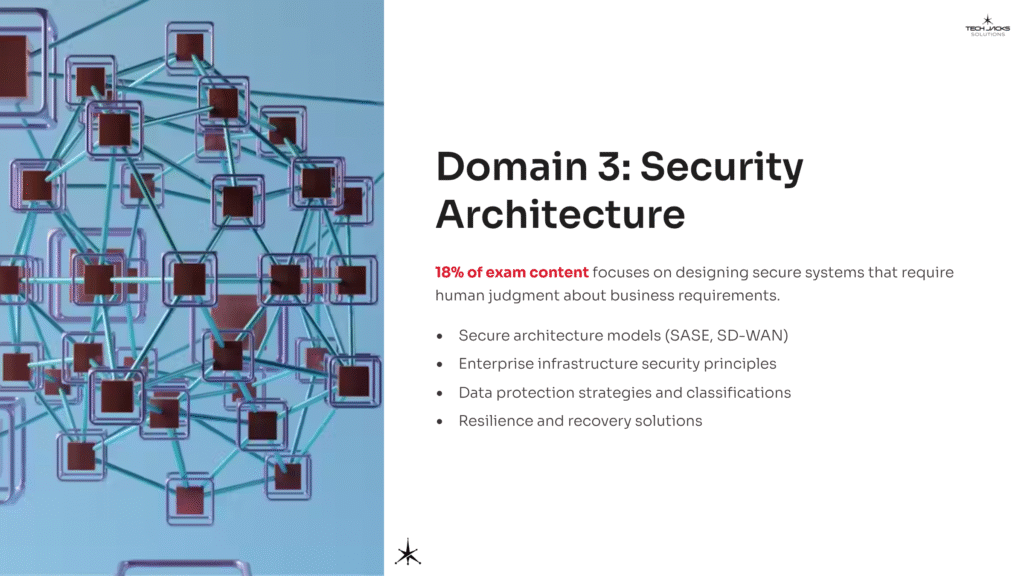
Domain 3: Security Architecture (18%) addresses designing secure systems. Topics include secure architecture models (SASE, SD-WAN), applying security principles to enterprise infrastructure, data protection strategies and classifications, and implementing resilience and recovery solutions (high availability, backups, site considerations). Systems administrators and security engineers use these skills daily when designing network segments, implementing access controls, and planning disaster recovery. These architectural decisions increasingly require human judgment about business requirements that AI cannot fully understand.
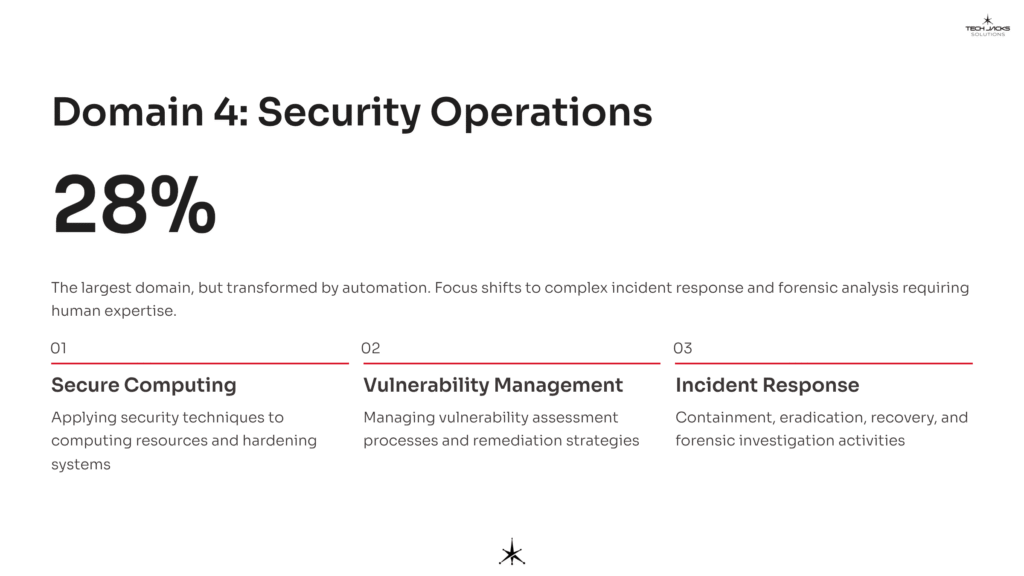
Domain 4: Security Operations (28%) represents the largest domain but has been most affected by automation trends. Content covers applying security techniques to computing resources (secure baselines, hardening), vulnerability management processes, security alerting and monitoring with SIEM tools, incident response activities (containment, eradication, recovery), and using data sources for investigations (log analysis, digital forensics). While routine SOC monitoring tasks get automated, complex incident response and forensic analysis still require human expertise. The heavy weighting reflects industry demand for operational security skills that can work alongside automated systems.
Domain 5: Security Program Management and Oversight (20%) covers governance and compliance aspects that have gained importance as automation handles technical tasks. Elements include security governance, risk management processes (risk assessment, Business Impact Analysis), third-party risk management, security compliance with frameworks and regulations (NIST, GDPR, HIPAA, PCI-DSS), audits and assessments, and implementing security awareness practices. IT auditors, compliance analysts, and security managers rely heavily on this knowledge. Governance and compliance roles increased 40% from 2023 to 2024, making this domain increasingly valuable.
The domain weights guide study time allocation, but market realities suggest emphasizing Security Program Management and Security Architecture for sustainable career value. These areas require human judgment, business understanding, and communication skills that complement rather than compete with automation.
What to Expect From the Exam
The SY0-701 exam challenges candidates through a carefully designed assessment that goes beyond simple memorization.
Exam Structure and Format: The linear exam presents a maximum of 90 questions within a 90-minute time limit. To pass, you need a score of 750 on a scale of 100-900. The linear format means questions appear in fixed sequence, and difficulty doesn’t adapt based on previous answers.
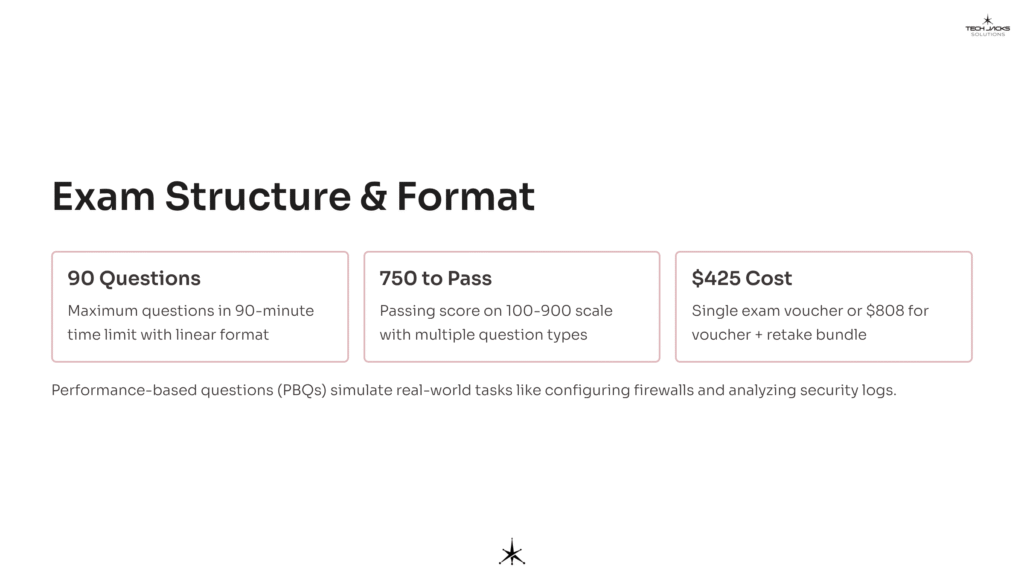
Question Types include multiple-choice (single and multiple correct answers), drag-and-drop activities, and performance-based questions (PBQs). PBQs typically appear at the exam’s beginning and simulate real-world tasks like configuring firewalls, analyzing security logs, or troubleshooting network security issues. These hands-on simulations separate Security+ from purely theoretical certifications and prepare candidates for practical work scenarios.
Testing Options provide flexibility. You can take the exam at Pearson VUE testing centers worldwide or through Pearson VUE’s OnVUE online proctoring platform from home or office. Online testing requires meeting technical and environmental requirements, including stable internet, working webcam, and distraction-free space.
Exam Costs present straightforward pricing. A single exam voucher costs $425 USD according to CompTIA’s official marketplace. CompTIA offers a “Voucher + Retake” bundle for $808 USD, providing a second attempt at reduced cost compared to purchasing two separate vouchers.
Retake Policy allows immediate reattempt after a first failure. After a second failure, you must wait 14 calendar days before subsequent attempts. This policy encourages thorough preparation while providing reasonable second chances.
Global Recognition extends beyond U.S. borders. The exam maintains consistent standards worldwide, with over 760,000 active Security+ holders as of early 2024. This global community creates networking opportunities and career mobility across countries and regions.
Career Impact and Compensation in Today’s Market
Security+ delivers quantifiable career benefits, but they’ve shifted significantly from traditional cybersecurity career paths.
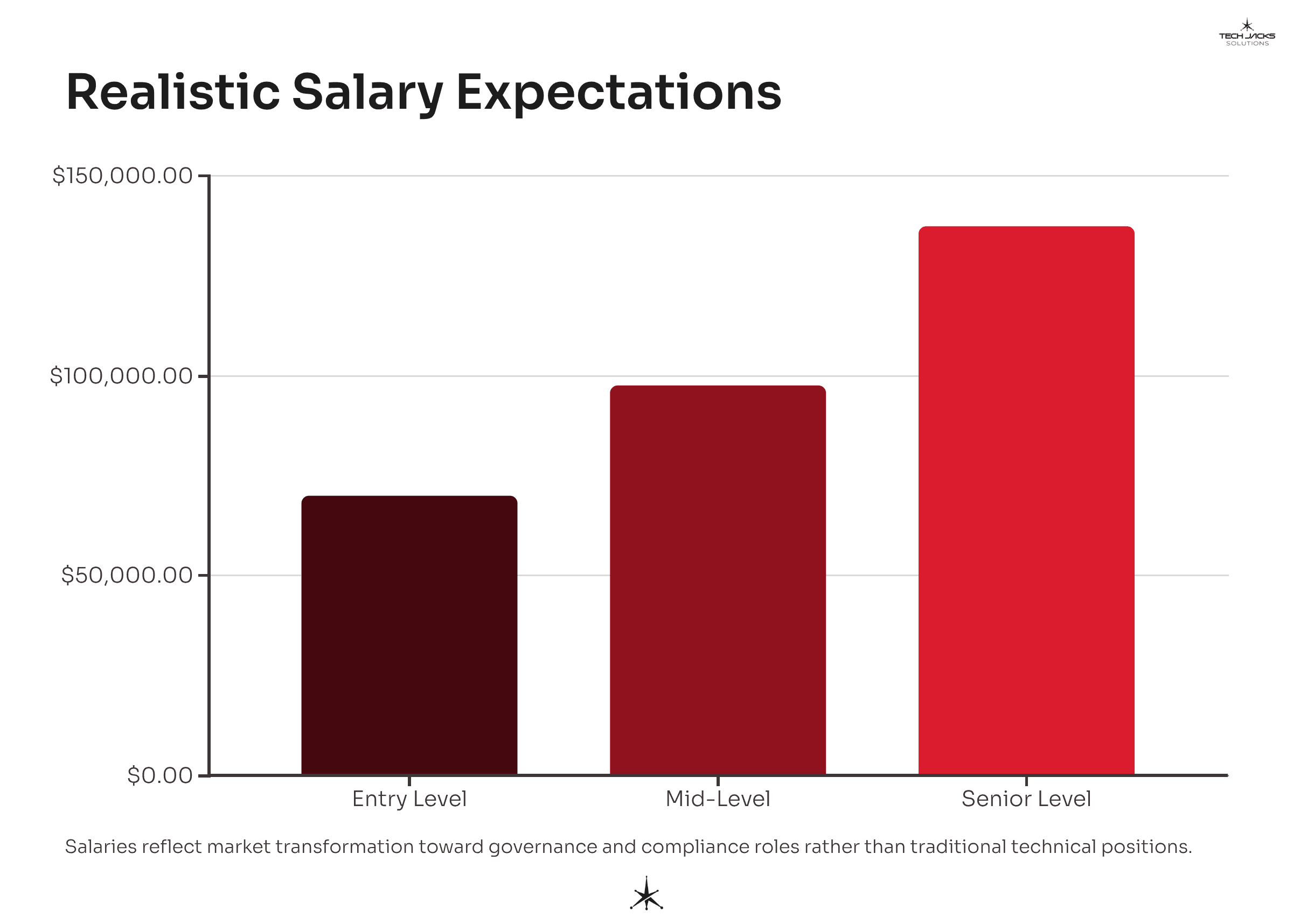
Realistic Salary Expectations by Role Type reflect market transformation. Entry-level cybersecurity positions face increased competition, with employers seeking candidates who can demonstrate both technical and business skills beyond basic certification requirements. More stable opportunities exist in compliance and governance roles (0-2 years) earning $60,000-$80,000, with positions like GRC Analyst, IT Compliance Specialist, and Security Awareness Coordinator. Mid-level professionals (2-5 years) in risk management and architecture roles advance to $80,000-$115,000, taking positions such as Risk Analyst, Security Consultant, and Compliance Manager. Senior-level professionals (5+ years) reach $115,000-$160,000+, becoming Security Program Managers, Chief Compliance Officers, and Information Security Managers.
Geographic Salary Variations still reflect cost of living and demand differences. High-cost metropolitan areas like San Francisco, New York, and Washington D.C. typically offer salary premiums that reflect both higher living costs and intense competition for qualified cybersecurity professionals who can work effectively with automated systems.
Industry Sector Variations affect compensation significantly. Finance and Banking ($80,000-$105,000+), Healthcare ($75,000-$100,000+), and Aerospace and Defense sectors often pay premiums for qualified security professionals. Government positions offer stability, benefits, and security clearance opportunities that increase long-term earning potential while providing insulation from private sector automation trends.
Market Reality Check shows Security+’s competitive position has evolved. It provides similar earning potential to foundational CompTIA Network+ (average ~$98k) but falls below specialized certifications like CompTIA CySA+ (average ~$111k) and expert-level credentials like (ISC)² CISSP (average ~$130k-$168k). However, job market data shows 70,019 job openings requiring Security+ as of mid-2024, though many require additional specialized skills beyond the certification alone.
Government Sector Opportunities create unique stability. The DoD 8140/8570 directive mandates that personnel with privileged access to DoD systems hold approved certifications. Security+ meets this requirement, creating stable demand in Washington D.C., Virginia, Maryland, and areas with significant federal presence that remains largely insulated from private sector outsourcing trends.
Honest Assessment of Job Competition reveals increased market pressure. According to the U.S. Bureau of Labor Statistics, Information Security Analysts held about 182,800 jobs in 2024, with employment projected to grow 29% through 2034. However, this growth concentrates in roles requiring strategic thinking and business acumen rather than traditional technical monitoring. Security+ holders who succeed combine the certification with specialized skills in emerging areas like AI governance, cloud compliance, or risk management.
Prerequisites and Experience Requirements
Security+ maintains an accessible approach while setting realistic expectations for market success.
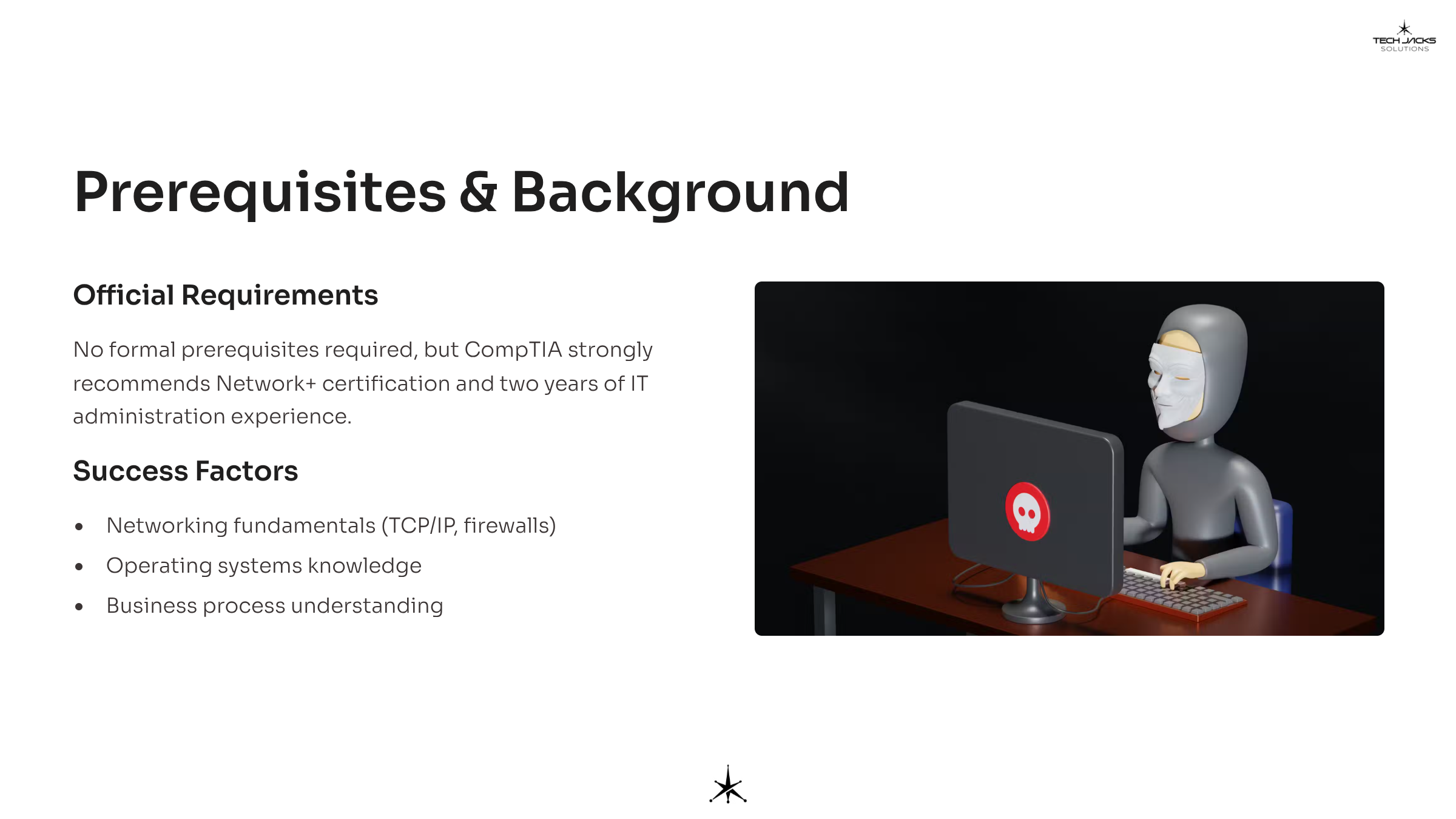
Official Prerequisites require no formal certifications, training courses, or age restrictions. CompTIA strongly advises that candidates possess CompTIA Network+ certification and at least two years of hands-on IT administration experience with security focus. This recommendation has become more important as employers seek candidates who can work effectively in automated environments.
Recommended Background for Market Success tells a different story than basic eligibility. Building a home lab with networking equipment, virtual machines, and security tools provides hands-on practice that increasingly distinguishes candidates. Participating in online Capture the Flag (CTF) competitions develops problem-solving skills. Contributing to open-source security projects demonstrates practical capabilities to future employers. Understanding business processes and risk management concepts becomes increasingly valuable as technical tasks get automated.
Alternative Pathways exist for candidates lacking traditional IT experience. Professional backgrounds in audit, compliance, risk management, or business analysis provide relevant experience for governance-focused security roles. Teaching, training, or communication experience translates well to security awareness and education positions. Project management experience applies to security program implementation roles.
Foundational Knowledge Areas prove essential for success. Networking fundamentals (TCP/IP, subnetting, VLANs, firewalls) appear throughout security contexts. Operating systems knowledge (Windows, Linux command-line basics) helps with system hardening and log analysis. Basic understanding of databases, web applications, and cloud services provides context for modern security challenges. Increasingly important: business process understanding and ability to communicate technical concepts to non-technical stakeholders.
Timeline Expectations and Market Positioning vary significantly by target role. Candidates seeking traditional SOC positions face intense competition and should plan 4-6 months including specialized skills development. Those targeting governance and compliance roles often succeed with 2-3 months of certification preparation plus business skills development. Students can integrate Security+ preparation into semester-long coursework while building complementary skills in business analysis, project management, or risk assessment.
Success Factors Beyond Technical Knowledge include business acumen, communication skills, and understanding of regulatory requirements. The ability to translate technical risks into business language becomes increasingly valuable. Experience with audit processes, regulatory compliance, and risk assessment frameworks distinguishes candidates in today’s market.
Preparation Strategy: How to Pass Security+
Successful Security+ preparation requires a multi-faceted approach combining certification study with strategic career positioning.
Study Timeline Planning depends on your background and career goals. Experienced IT professionals typically need 1-2 months of focused preparation for the certification alone. Career changers and those without IT experience should plan 3-6 months, equivalent to approximately 120+ study hours, plus additional time for developing complementary business skills. Students can integrate preparation into semester-long coursework while building portfolios that demonstrate practical application.
Official CompTIA Resources provide the most direct exam alignment. The CertMaster suite includes CertMaster Learn (comprehensive eLearning platform), CertMaster Labs (hands-on virtual environment for PBQ practice), and CertMaster Practice (adaptive practice testing). While premium-priced, these resources offer guaranteed exam objective coverage and increasingly include scenario-based learning that reflects real-world application.
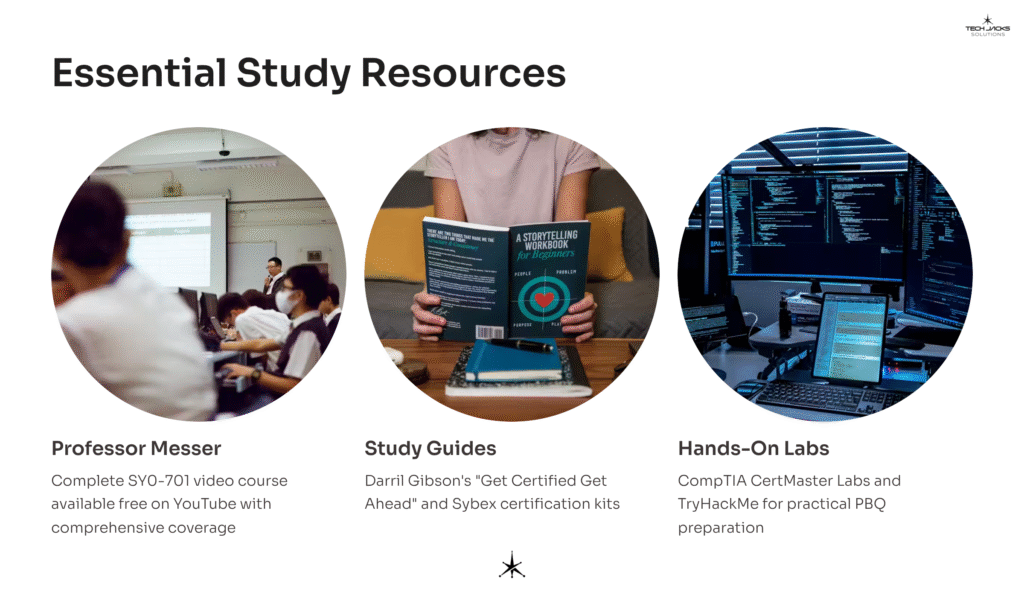
Free and Cost-Effective Resources deliver excellent value. Professor Messer’s complete SY0-701 video course provides comprehensive coverage at no cost through YouTube. His paid resources (course notes, practice exams) add significant value at reasonable prices. This combination serves as the foundation for many successful study plans while providing practical context for theoretical concepts.
Third-Party Video Courses offer structured learning paths. Udemy instructors like Jason Dion, Andrew Ramdayal, and Mike Meyers provide highly-rated courses with video lectures, study guides, and practice exams. These courses often cost $15-$25 during promotional periods. Jason Dion’s practice exams receive particular praise for closely mirroring actual exam difficulty and question formats while emphasizing practical application scenarios.
Essential Study Guides complement video resources. The CompTIA Security+ Get Certified Get Ahead: SY0-701 Study Guide by Darril Gibson and Joe Shelley earns consistent recommendations for clear explanations and exam-focused content. The CompTIA Security+ Certification Kit (Exam SY0-701) published by Sybex provides comprehensive coverage with practice tests and online learning tools that emphasize real-world application.
Hands-On Practice proves essential for PBQ success and career preparation. CompTIA’s CertMaster Labs provide browser-based virtual environments for practicing real-world scenarios. TryHackMe offers cybersecurity challenges that develop practical skills. Building a home lab with virtual machines, pfSense firewalls, and security tools creates unlimited practice opportunities while building portfolio content for job applications.
Strategic Study Approach maximizes retention and career preparation. Start with comprehensive video content (Professor Messer) to establish broad knowledge across all domains. Read detailed study guides (Gibson or Sybex) to deepen understanding and reinforce concepts. Take extensive practice exams (Jason Dion) to master question formats and identify knowledge gaps. Complete hands-on labs to develop practical skills needed for PBQs and real-world application. Most importantly: document your learning journey and practical projects to demonstrate capabilities to potential employers.
Common Preparation Mistakes lead to both exam failure and career disappointment. Underestimating the exam’s breadth and relying solely on memorization prove inadequate. Neglecting hands-on practice leaves candidates unprepared for PBQs and practical work scenarios. Lacking foundational networking knowledge makes security concepts difficult to grasp. Treating Security+ as a simple entry-level exam results in insufficient preparation. Most critically: focusing only on technical knowledge without developing business acumen and communication skills limits career prospects in today’s market.
Recent Updates and Market Alignment
The transition from SY0-601 to SY0-701 represents more than routine content updates; it reflects strategic realignment with modern cybersecurity demands and market realities.
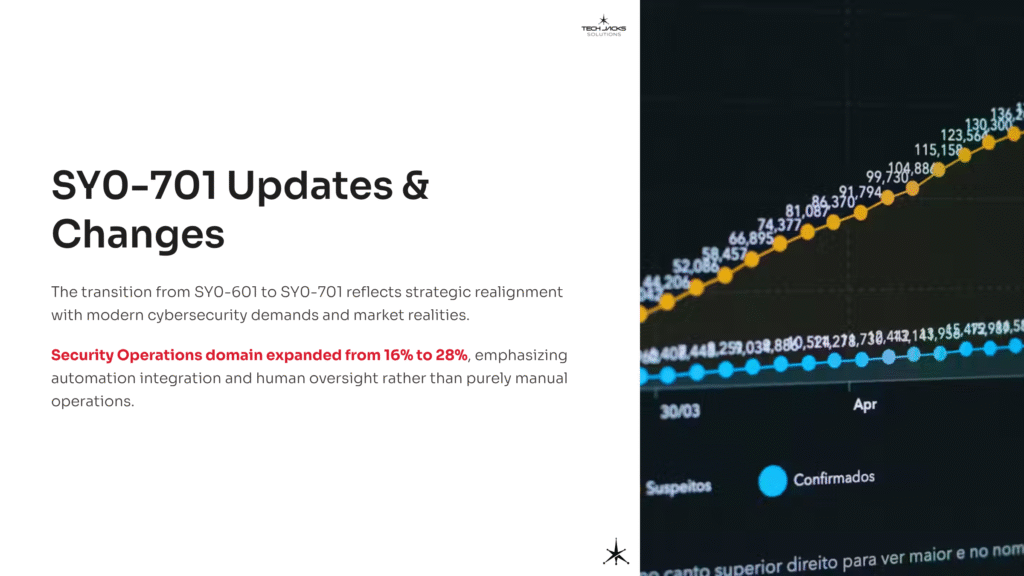
Structural Changes reshape the exam’s emphasis to match industry transformation. The most dramatic modification expanded the “Security Operations” domain from 16% in SY0-601 to 28% in SY0-701, making it the largest exam section. However, this emphasis now includes automation integration and human oversight of automated systems rather than purely manual operations, reflecting how AI-driven security automation is reshaping operational roles.
Domain Reorganization eliminated the dedicated “Implementation” domain (25% of SY0-601) and integrated practical topics into “Security Architecture” and “Security Operations” domains. This shift elevates strategic, ongoing security tasks over one-time configuration activities. A new foundational domain, “General Security Concepts” (12%), consolidates core principles previously dispersed throughout the exam, emphasizing the conceptual understanding needed to work effectively with automated systems.
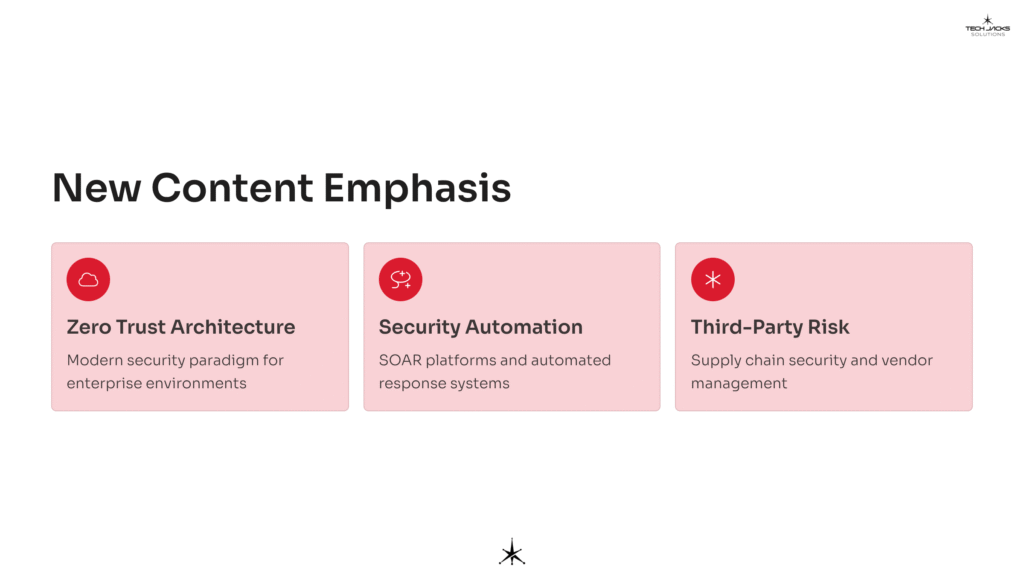
Content Modernization emphasizes contemporary cybersecurity paradigms that reflect real market demands. New topics include Zero Trust architecture, security automation and orchestration (SOAR), third-party risk management, and hybrid/multi-cloud environment security. These additions reflect enterprise security priorities and emerging technology adoption while preparing candidates for roles that require strategic thinking rather than just technical implementation.
Removed Content makes room for strategic concepts. De-emphasized areas include specific command-line tools, detailed digital forensics procedures, and legacy attack frameworks. This signals movement away from rote tool memorization toward conceptual understanding of security processes and methodologies that remain relevant as tools evolve and automate.
PBQ Evolution maintains hands-on emphasis while updating scenarios. Performance-based questions continue appearing at exam start, requiring practical application under time pressure. Updated PBQ scenarios reflect current security challenges like cloud configuration, SIEM analysis, and incident response procedures, but increasingly emphasize decision-making and analysis rather than just technical configuration.
Market Relevance of these changes becomes clear when considering employment trends. The exam’s evolution toward strategic thinking and business alignment parallels the job market’s movement toward governance, risk management, and compliance roles that have shown growth while traditional technical positions decline.
How AI and Automation Are Transforming Security+ Careers
Artificial intelligence and automation create both challenges and opportunities for Security+ certified professionals, fundamentally changing how cybersecurity work gets accomplished and who performs it.
Current AI Integration Reality already impacts daily security operations more than most professionals realize. AI and machine learning enhance threat detection through behavioral analytics, automate routine security responses, and accelerate incident analysis. Security professionals increasingly manage AI-driven systems rather than performing purely manual tasks. SIEM platforms use machine learning to reduce false positives automatically. Automated playbooks handle routine incident response steps without human intervention. Organizations are expanding outsourcing for security operations specifically to access AI-powered capabilities they cannot develop in-house.
Task Evolution Rather Than Simple Replacement characterizes AI’s immediate impact on security roles. Entry-level tasks like basic log review and alert triage become automated, but this creates opportunities for higher-value work among those who adapt. SOC analysts who survive focus on complex investigations, threat hunting, and security architecture rather than routine monitoring. Security engineers design and tune AI systems rather than manually configuring every security control. However, hiring managers aren’t rushing to hire more specialized workers due to uncertainty about which activities AI will ultimately replace.
New Skill Requirements emerge from widespread AI adoption. Security professionals need to understand AI system vulnerabilities, data privacy implications of machine learning, and bias detection in automated decision-making. Skills in prompt engineering for AI security tools, understanding of AI-generated threats, and ability to validate AI-driven security recommendations become valuable differentiators. More importantly: the ability to communicate AI capabilities and limitations to business stakeholders becomes crucial as organizations integrate AI throughout their operations.
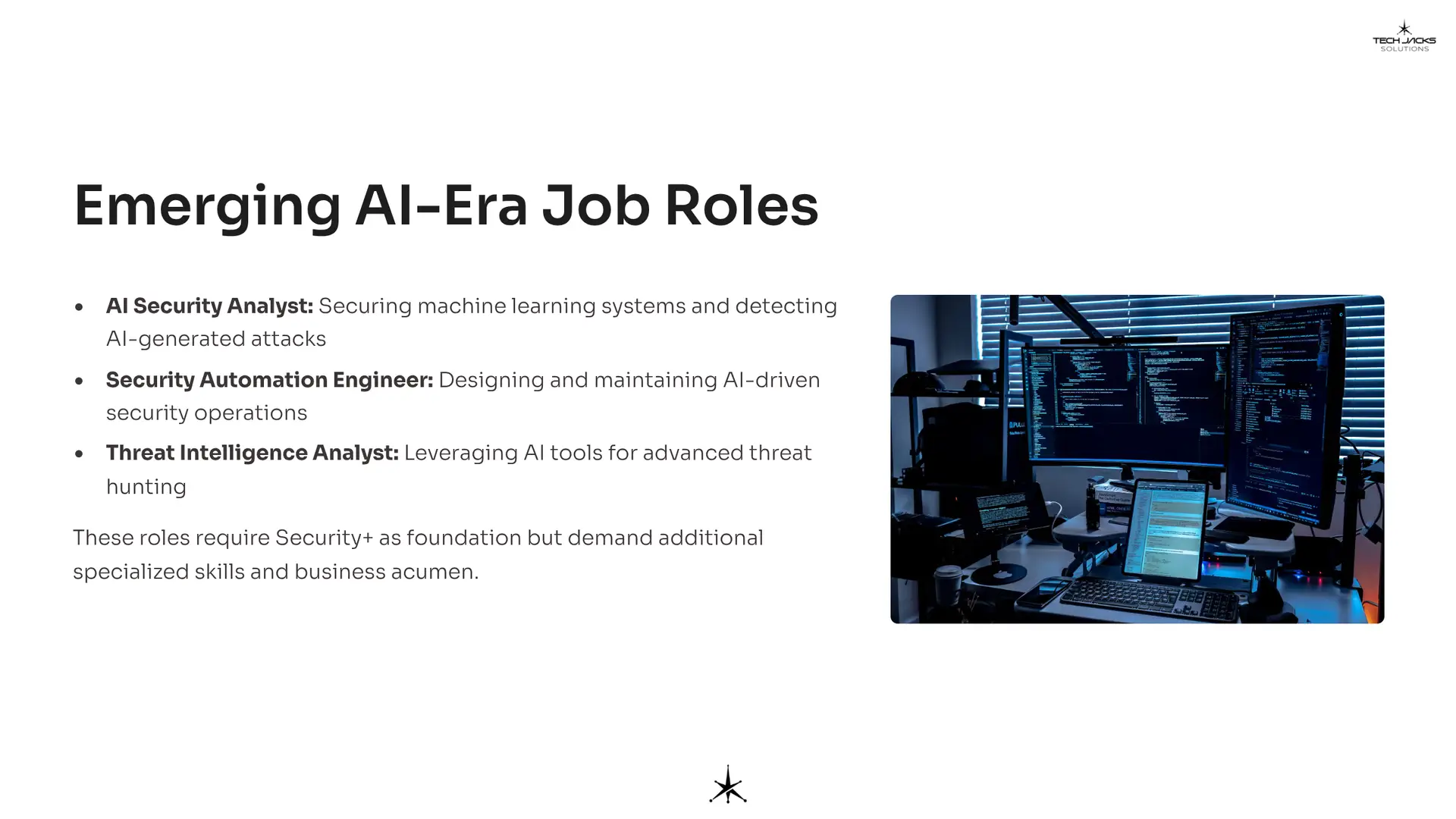
Emerging Job Roles blend traditional security knowledge with AI expertise, but they require higher skill levels than traditional entry positions. AI Security Analyst positions focus on securing machine learning systems and detecting AI-generated attacks. Security Automation Engineers design and maintain AI-driven security operations. Threat Intelligence Analysts leverage AI tools for advanced threat hunting and predictive analysis. These roles typically require Security+ as a foundation but demand additional specialized skills and business acumen.
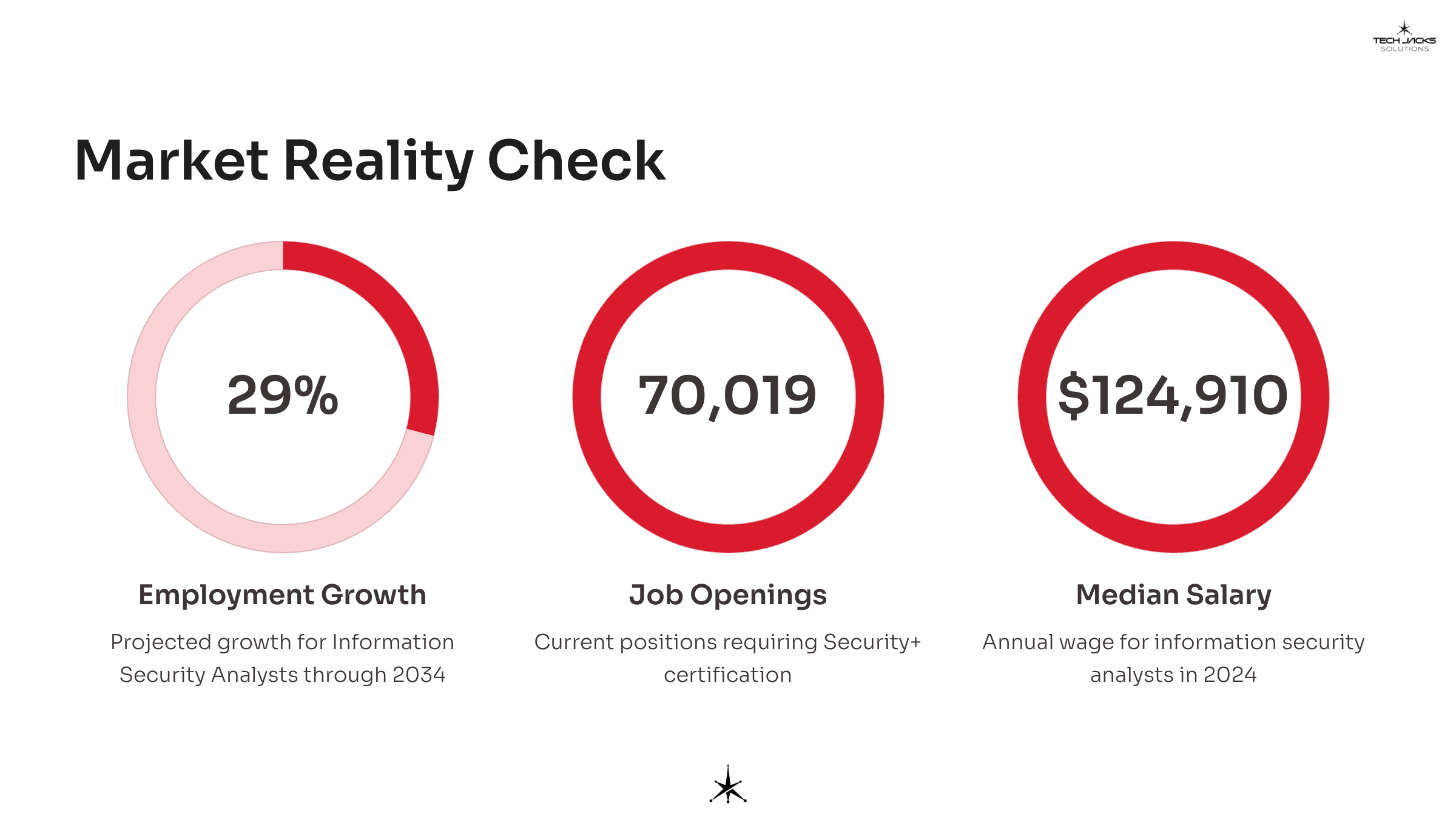
Market Reality Check shows both opportunity and competition. The U.S. Bureau of Labor Statistics projects 29% employment growth for Information Security Analysts from 2024 to 2034, but this growth concentrates in roles requiring strategic thinking and human judgment. The median annual wage for information security analysts was $124,910 in May 2024 according to the Bureau of Labor Statistics. However, the cybersecurity workforce gap remains significant, but organizations increasingly prefer fewer, more skilled professionals over large teams of entry-level analysts.
5-Year Career Outlook favors adaptable Security+ professionals who understand business requirements. The certification’s broad foundational knowledge provides flexibility to specialize in AI-augmented roles. Professionals who combine Security+ knowledge with business skills, regulatory understanding, and communication abilities position themselves for leadership opportunities as organizations integrate AI throughout their security operations. However, those expecting traditional technical career paths may find limited opportunities.
Competitive Strategies help Security+ holders thrive in AI-enhanced environments. Develop familiarity with AI security tools and platforms while understanding their business applications. Learn AI ethics and bias implications for security decisions in organizational contexts. Practice explaining AI system recommendations to non-technical stakeholders using business language. Focus on creative problem-solving and critical thinking skills that complement AI capabilities while addressing business needs. Most importantly: understand that success requires combining technical knowledge with business acumen, communication skills, and strategic thinking.
Is CompTIA Security+ Worth It in 2025?
Yes, but with important caveats that require honest assessment of market realities and personal career goals.

Market Demand Validation demonstrates sustained but transformed employer interest. CyberSeek data showing 70,019 job openings requiring Security+ represents significant opportunity, though many positions now require additional skills beyond the certification alone. Security+ remains the second-most requested certification after advanced-level CISSP, but employers increasingly use it as a baseline qualification rather than a complete job preparation.
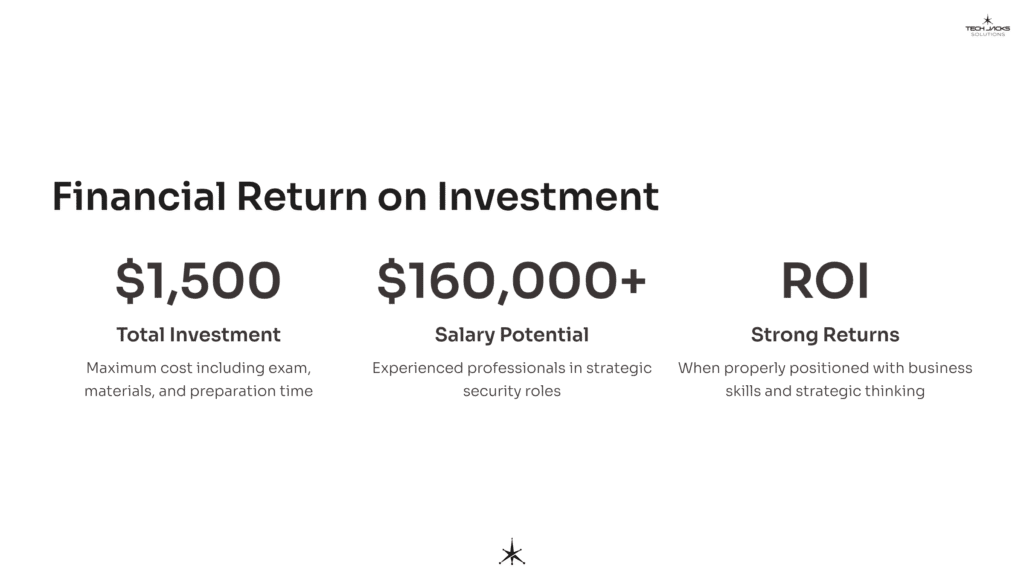
Financial Return on Investment proves compelling when properly positioned. Total certification costs (exam, study materials, preparation time) typically range $600-$1,500. However, career progression depends more on how you leverage the certification than on the credential itself. Those who use Security+ as a foundation for developing business skills, regulatory knowledge, and strategic thinking often see substantial returns. Those expecting immediate employment solely based on the certification may find disappointing results in today’s competitive market.
Government Sector Advantages create unique and stable value. DoD 8140/8570 mandate ensures stable demand for Security+ in federal cybersecurity roles. This requirement doesn’t change with technology trends or economic cycles, providing career stability and advancement opportunities with security clearance potential. Government positions often provide insulation from private sector automation and outsourcing trends while offering competitive compensation and benefits.
Industry Evolution Alignment positions Security+ advantageously for those who understand market direction. The SY0-701 update’s emphasis on cloud security, Zero Trust architecture, and operational security skills matches enterprise technology adoption patterns. AI integration enhances rather than threatens Security+ careers for professionals who develop complementary skills in business analysis, risk management, and stakeholder communication.
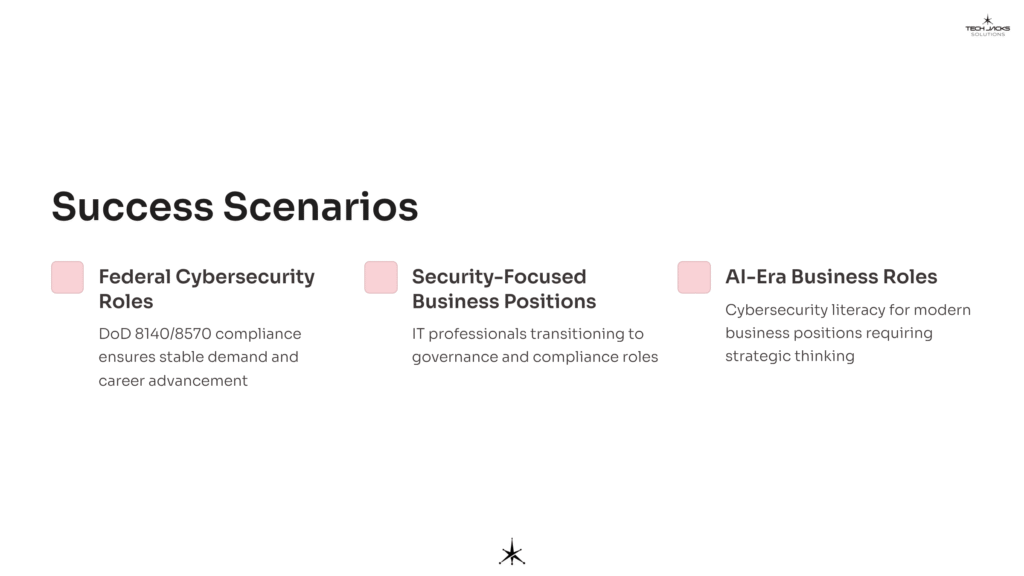
Realistic Success Scenarios include professionals seeking federal cybersecurity roles, IT professionals transitioning to security-focused business positions, and individuals developing cybersecurity literacy for AI-era business roles. Security+ provides maximum value when combined with specialized knowledge in governance, risk management, compliance, or emerging technology areas like AI security and cloud governance.
Honest Limitations deserve clear acknowledgment. Experienced security managers and architects might benefit more from pursuing advanced certifications directly, though Security+ provides valuable foundational knowledge. IT professionals seeking purely technical roles may find limited opportunities as automation advances. Those unwilling to develop business skills and strategic thinking will struggle regardless of certification status. Most importantly: Security+ alone no longer guarantees employment in an increasingly competitive and automated market.
Future-Proofing Considerations support Security+ value for adaptable professionals. Cybersecurity fundamentals remain constant even as specific technologies evolve. Understanding threat analysis, risk management, incident response, and security architecture provides lasting career value that transcends tool changes. The certification’s vendor-neutral approach ensures skills transfer across technology changes and career movements. However, success requires continuous learning and adaptation to emerging market demands.
Strategic Decision Framework helps determine whether Security+ fits your situation. Pursue Security+ if you’re seeking federal employment, transitioning from IT to security-focused business roles, developing cybersecurity literacy for modern business positions, or building foundational knowledge for advanced specialization. Reconsider if you’re expecting immediate employment without additional skills, seeking purely technical hands-on roles, or unwilling to develop business acumen and communication abilities.
Getting Started: Your Next Steps for Success
Transform Security+ from aspiration to achievement through systematic preparation and strategic career planning that acknowledges market realities.
Step 1: Assess Current Knowledge and Market Position honestly. Take a diagnostic practice exam to identify knowledge gaps across the five domains. CompTIA provides free sample questions to gauge your readiness. More importantly: assess your background against current market demands. If you’re lacking foundational networking knowledge, consider CompTIA Network+ first or dedicate extra time to networking fundamentals. If you’re targeting governance roles, evaluate your understanding of business processes and regulatory requirements. If aiming for federal positions, research security clearance requirements and timelines.
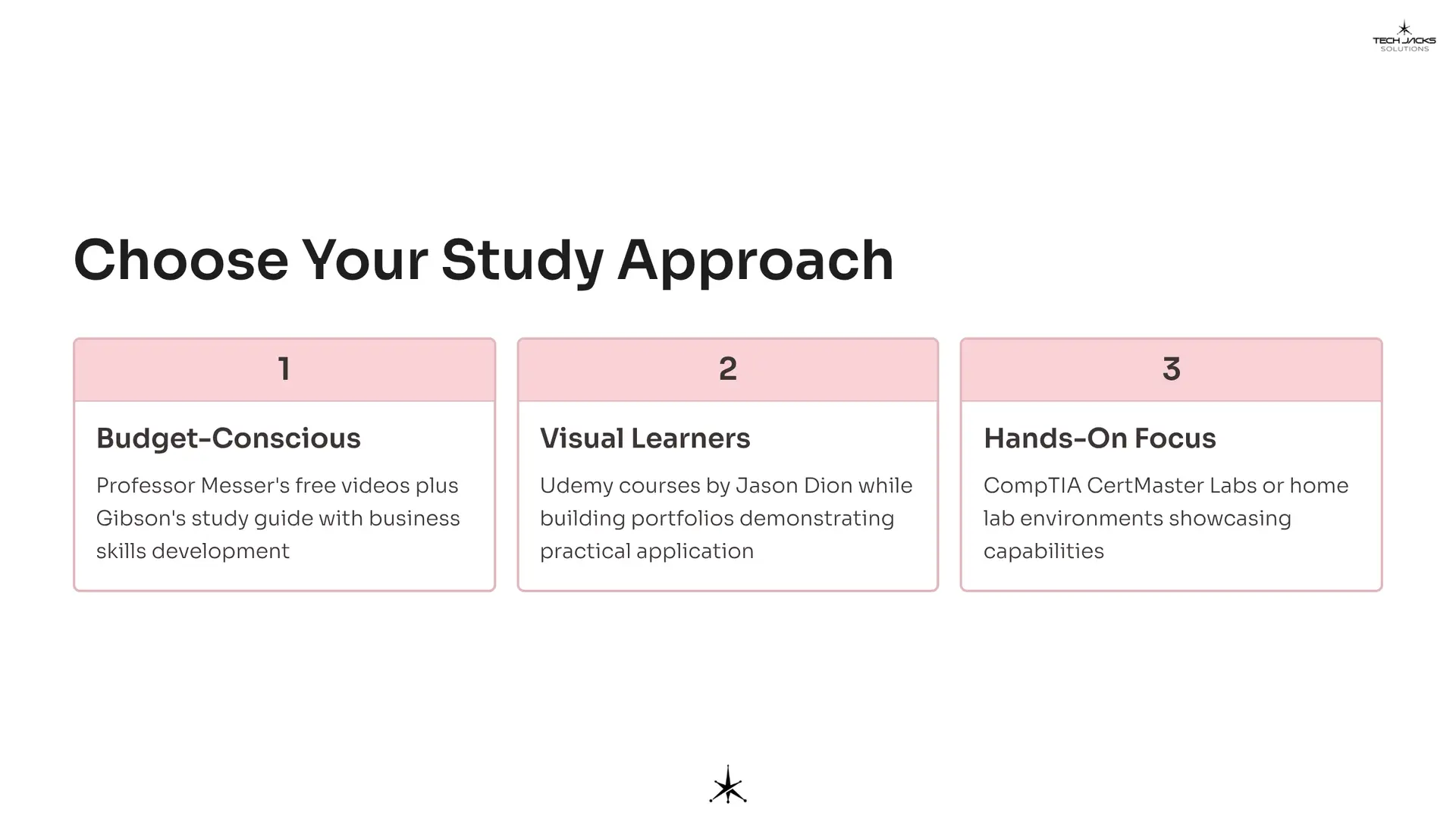
Step 2: Choose Study Approach and Career Positioning based on learning preferences, budget, and market goals. Budget-conscious learners can succeed with Professor Messer’s free videos plus Gibson’s study guide, but should supplement with business skills development. Visual learners benefit from Udemy courses by Jason Dion or Andrew Ramdayal while building portfolios that demonstrate practical application. Hands-on learners should prioritize lab access through CompTIA CertMaster Labs or building home lab environments that showcase capabilities to potential employers.
Step 3: Create Realistic Study and Career Plan aligned with your schedule and market positioning. Full-time students can spread preparation over a semester while developing complementary skills in business analysis or project management. Working professionals typically succeed with 10-15 hours weekly over 2-3 months for certification preparation, plus additional time for market positioning. Career changers should plan 4-6 months with 15-20 hours weekly study commitment, including development of business skills, regulatory knowledge, and professional networking.
Step 4: Register and Schedule Strategically while building market presence. Purchase exam vouchers directly from CompTIA or authorized partners. Consider the voucher + retake bundle if you’re uncertain about first-attempt success. Schedule your exam 2-3 weeks after completing preparation to maintain momentum while allowing final review time. Simultaneously, begin building professional presence on LinkedIn, joining relevant professional groups, and researching target employers and roles.
Step 5: Plan Market-Aligned Career Strategy before earning the certification. Research target job roles and required qualifications beyond Security+ alone. Network with Security+ professionals through LinkedIn groups and local cybersecurity meetups, focusing on those in governance, compliance, and risk management roles. Prepare your resume to highlight Security+ alongside relevant experience, business skills, and practical projects. Consider pursuing internships or entry-level positions in compliance or risk management while preparing for the exam.
Step 6: Develop Business Acumen Alongside Security Knowledge to maximize career opportunities. Explore business process improvement methodologies and their security implications. Understand regulatory frameworks like GDPR, HIPAA, and SOX in business contexts. Practice explaining technical security concepts to non-technical audiences using business language. Stay current with cybersecurity governance discussions and industry regulations. Consider pursuing complementary credentials in audit, risk management, or project management.
Step 7: Build Professional Network and Continuous Learning Strategy for long-term success. Join professional organizations like (ISC)², ISACA, or local cybersecurity groups, focusing on governance and compliance special interest groups. Plan your certification maintenance strategy through CEU activities or pursuing higher-level certifications. Consider specialization paths like CompTIA CySA+ for defensive security combined with business skills, or risk management certifications that complement Security+ foundation. Most importantly: develop mentoring relationships with professionals who have successfully navigated the changing cybersecurity market.
Step 8: Position for AI-Era Success by understanding technology’s business implications. Learn about AI governance frameworks and their security implications for organizations. Develop skills in risk assessment for emerging technologies like machine learning and automation systems. Practice communicating AI security risks and opportunities to business stakeholders. Stay informed about regulatory developments in AI governance and data privacy that create new compliance requirements and career opportunities.
Building Your Cybersecurity Future Responsibly
CompTIA Security+ represents a strategic foundation for cybersecurity careers, but success requires understanding both its value and market limitations.
The certification provides essential cybersecurity literacy for the modern workplace. Rather than guaranteeing entry-level positions, it prepares professionals for roles that require strategic thinking, business acumen, and the ability to work effectively with automated systems. The market has transformed dramatically, with traditional technical roles declining while governance, compliance, and risk management positions grow.
Government demand remains stable through DoD 8140/8570 requirements, creating reliable career paths for those willing to pursue federal opportunities. Private sector success increasingly requires combining Security+ with business skills, regulatory knowledge, and communication abilities that distinguish candidates in a competitive, automation-influenced market.
The numbers tell a complex story: 70,000+ open positions requiring Security+, but many demand skills beyond the certification alone. 29% employment growth projected through 2034, but concentrated in strategic rather than purely technical roles. Salary potential reaching $160,000+ for experienced professionals, but requiring adaptation to market evolution rather than following traditional career paths.
Security+ provides cybersecurity knowledge that can’t be outsourced, offshored, or easily automated when combined with business understanding and strategic thinking. For professionals who approach it strategically, understand market realities, and commit to continuous adaptation, it remains a valuable career investment.
Ready to begin with realistic expectations? Visit the official CompTIA Security+ page to explore exam details and start your certification journey with a clear understanding of both opportunities and challenges ahead.
Reference Resource List
- CompTIA Official Security+ Certification Page
- CompTIA Exam Vouchers Official Marketplace
- CompTIA Wikipedia Overview
- Computing Technology Industry Association Profile
- Security+ Exam Cost Analysis
- Professor Messer’s Free SY0-701 Course
- Jason Dion Udemy Security+ Course
- CompTIA Continuing Education Program
- CyberSeek Job Market Analysis
- Security+ Salary Data – ZipRecruiter
- Security+ Domains Evolution Analysis
- DoD 8140/8570 Requirements
- CompTIA CertMaster Training Suite
- Security+ Study Guide by Gibson
- Pearson VUE Testing Centers
- 2025 Cybersecurity Job Market Disruption Analysis
- Cybersecurity Outsourcing Trends Report
- 2024 ISC2 Cybersecurity Workforce Study
- U.S. Bureau of Labor Statistics – Information Security Analysts
- NIST CyberSeek 2025 Job Market Update
- Cybersecurity Talent Shortage Analysis