Authored by Derrick Jackson & Co-Author Lisa Yu
Table of Contents
Pressed For Time
Review or Download our 2-3 min Quick Slides or the 5-7 min Article Insights to gain knowledge with the time you have!
The AWS Certified Machine Learning Engineer – Associate certification launched in October 2024, marking Amazon’s strategic expansion into role-based AI/ML credentials. This certification validates your ability to build, deploy, and maintain machine learning solutions using Amazon SageMaker and other core AWS ML services.
This certification targets a specific professional: the engineer who bridges the gap between data science prototypes and production-ready ML systems. If you’re an MLOps engineer, data engineer, or DevOps professional looking to validate your cloud ML skills, this credential directly addresses your role.
What is the AWS Machine Learning Certification?
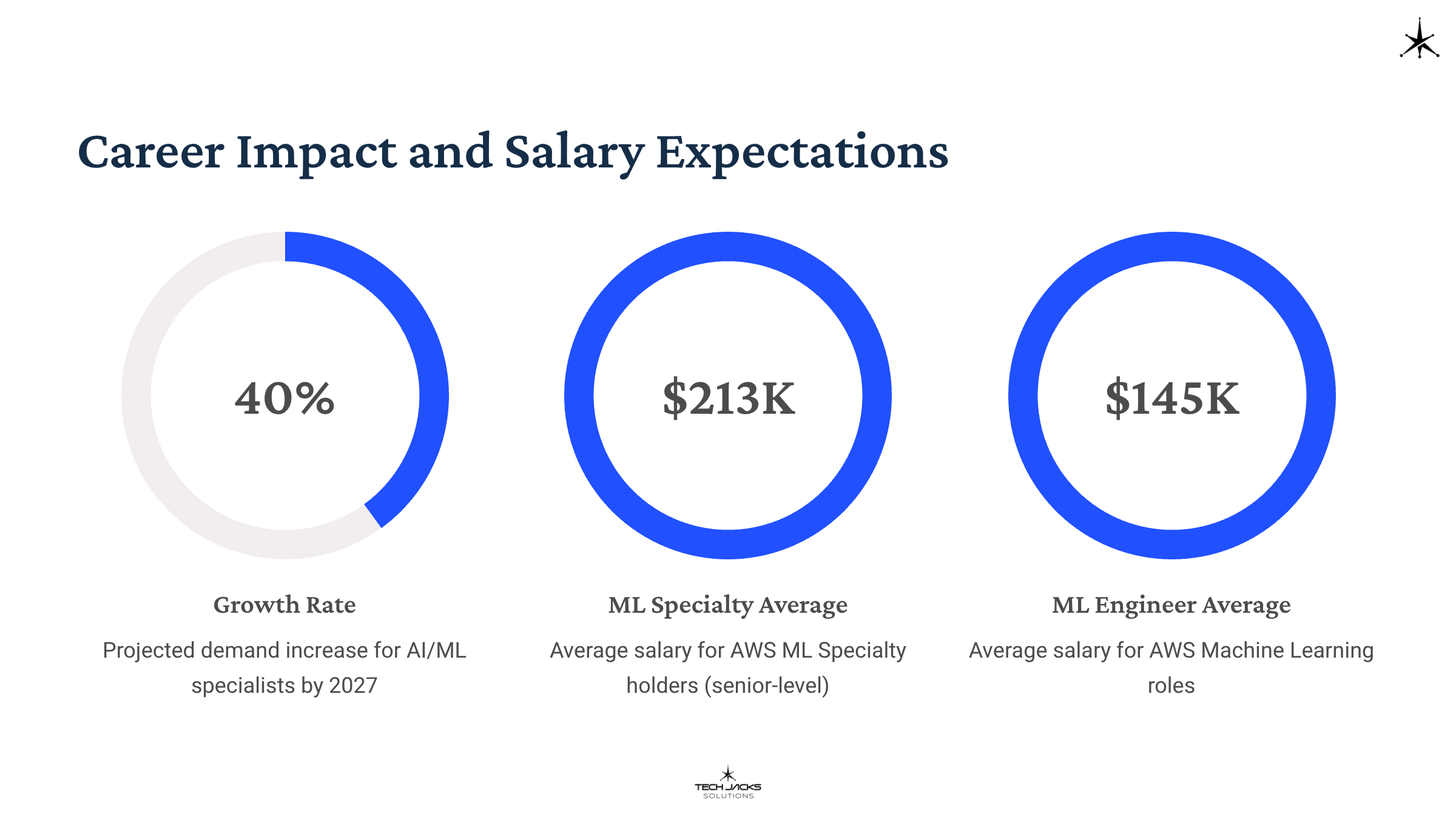
The AWS Certified Machine Learning Engineer – Associate (MLA-C01) represents Amazon’s response to a critical industry gap. According to the World Economic Forum’s “Future of Jobs Report 2023,” demand for AI and Machine Learning Specialists will grow 40% by 2027. AWS created this certification to provide a clear pathway for professionals to acquire and validate these in-demand skills.
The certification emerged from beta testing that ran from August 13 to October 28, 2024, with standard registration opening in October 2024. AWS offered a limited-edition “Early Adopter” digital badge for those who passed before February 15, 2025, signaling their push to rapidly build a certified professional community.
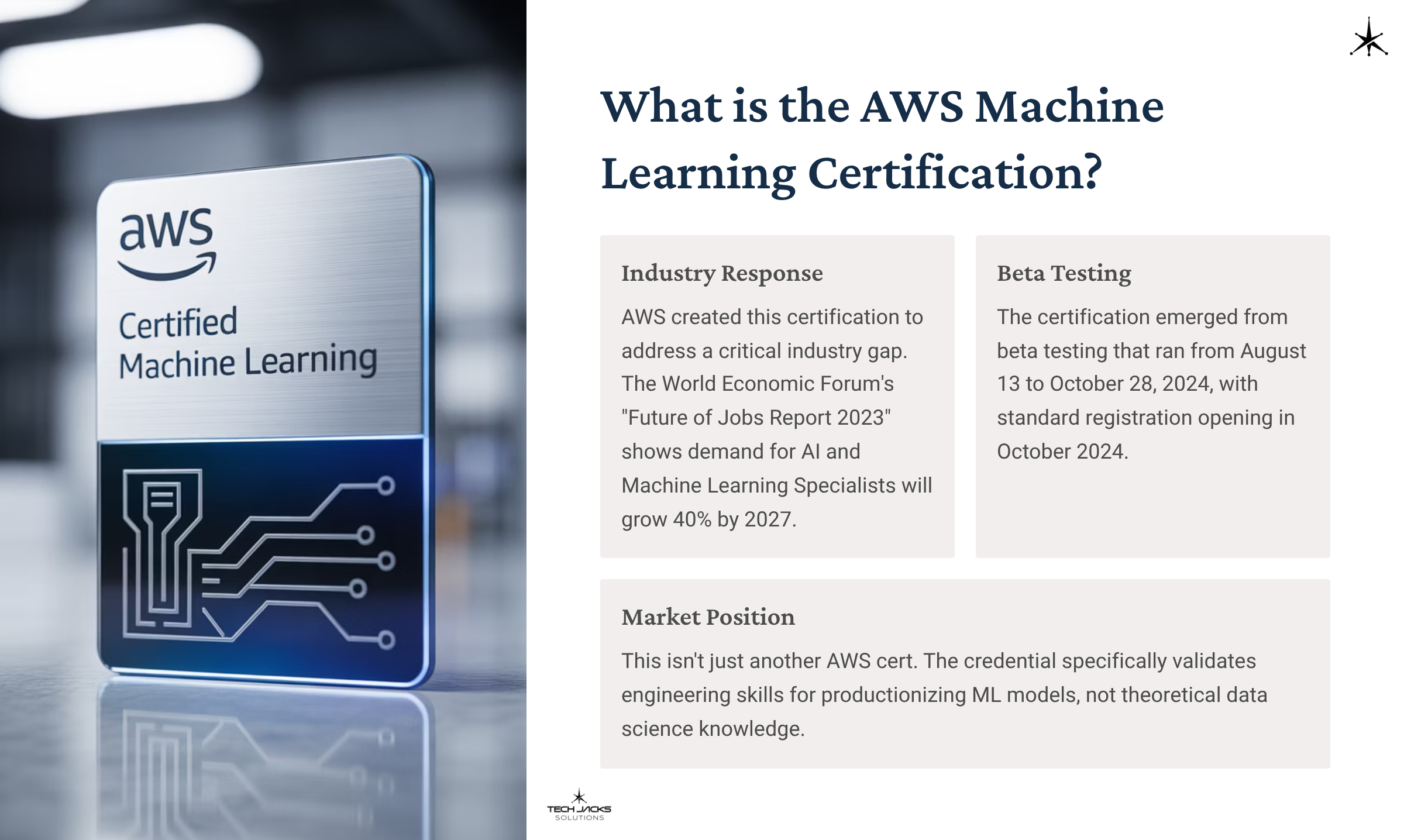
This isn’t just another AWS cert. The credential specifically validates engineering skills for productionizing ML models, not theoretical data science knowledge. AWS positions it as the middle tier in their AI/ML pathway, sitting between the foundational AI Practitioner and the advanced Machine Learning Specialty certifications.
As of January 2025, there were over 1.42 million active AWS Certifications held by 1.05 million unique individuals globally. This large community enhances the credibility and recognition of every AWS credential, including the Machine Learning Engineer – Associate.
The certification is issued by Amazon Web Services, the dominant cloud provider holding the largest Infrastructure as a Service (IaaS) and Platform as a Service (PaaS) market share. This market position directly translates to credential value in the job market.
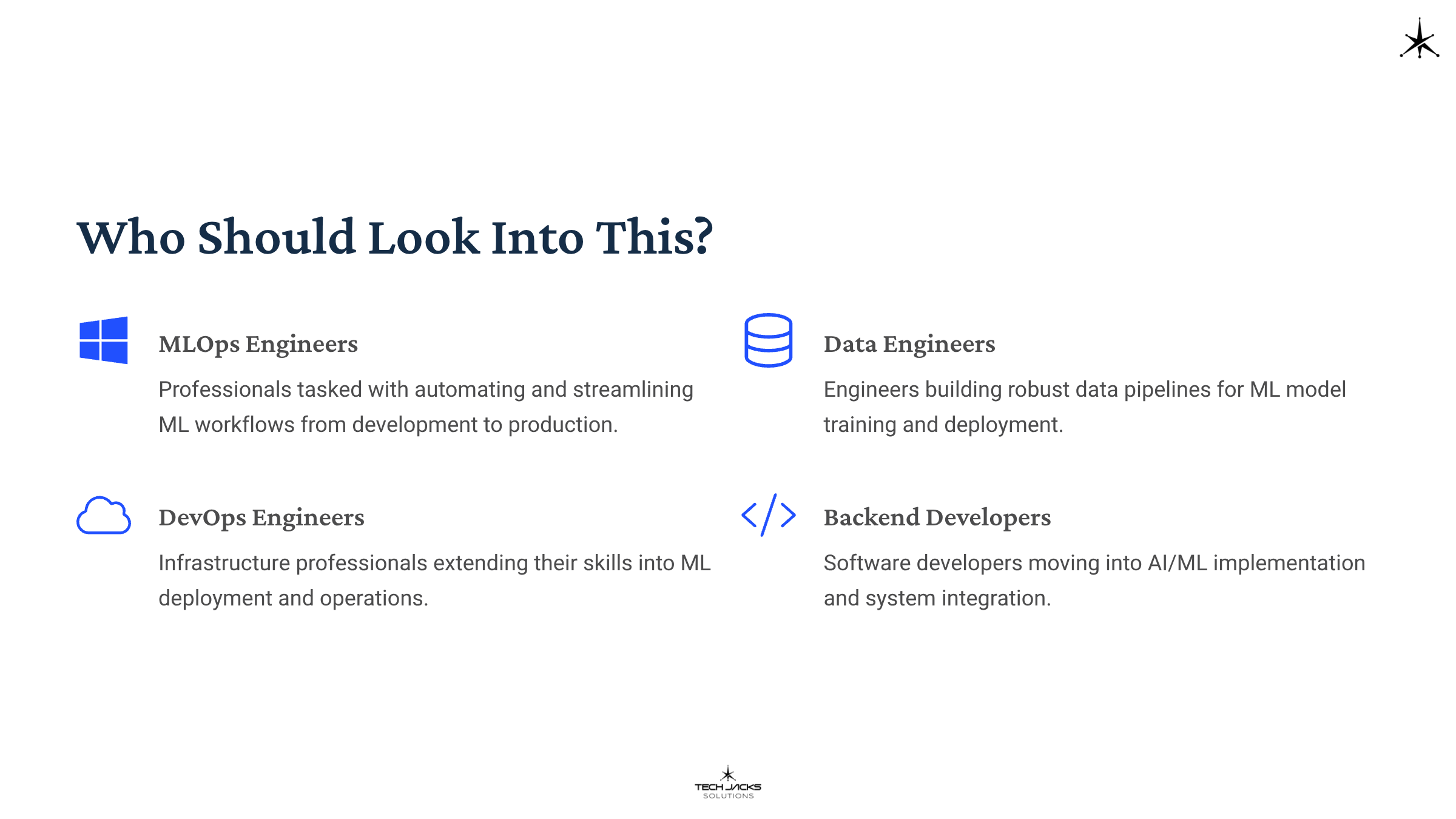
Who Should Look Into This?
Primary Target Audiences
The MLA-C01 explicitly targets technology professionals responsible for the operational aspects of the machine learning lifecycle. The certification exam guide specifically identifies:
- MLOps Engineers tasked with automating and streamlining ML workflows
- Data Engineers building robust data pipelines for ML model training
- DevOps Engineers extending their skills into ML deployment
- Backend Software Developers moving into AI/ML implementation
- AI Specialists focused on practical implementation over research
Key Industries Actively Hiring
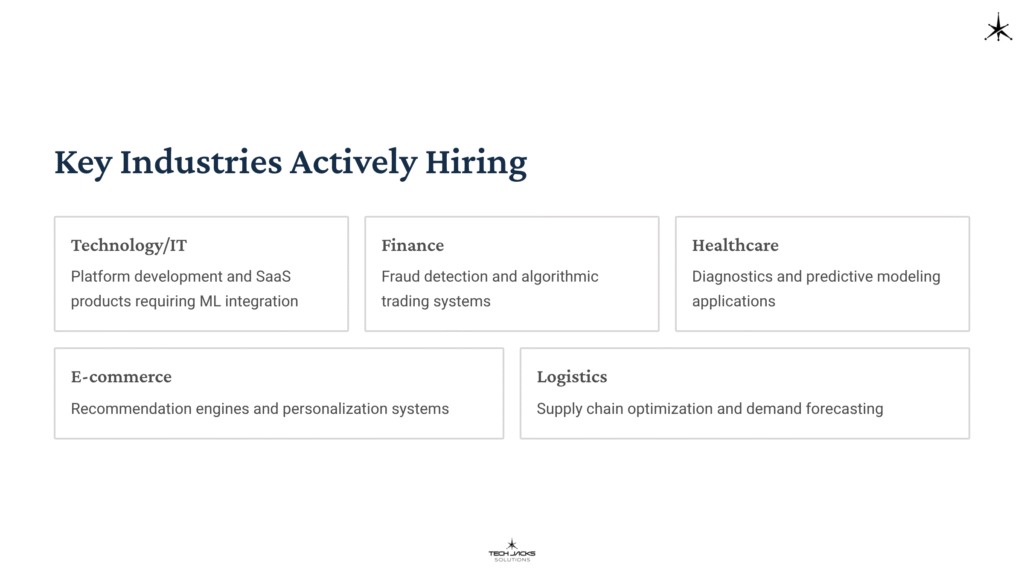
The demand for ML engineering skills is particularly strong across these sectors:
- Technology/IT – For platform development and SaaS products
- Finance – For fraud detection and algorithmic trading systems
- Healthcare – For diagnostics and predictive modeling applications
- E-commerce – For recommendation engines and personalization
- Logistics – For supply chain optimization and demand forecasting
Job postings from companies like Amazon, Capital One, and Guidewire Software confirm active hiring in these sectors.
Experience Requirements
AWS recommends at least one year of hands-on experience building, deploying, and maintaining ML solutions using Amazon SageMaker and other core AWS ML services. Additionally, one year of professional experience in a related technology role (backend software developer, DevOps engineer, data engineer, or data scientist) provides the foundational knowledge needed for success.
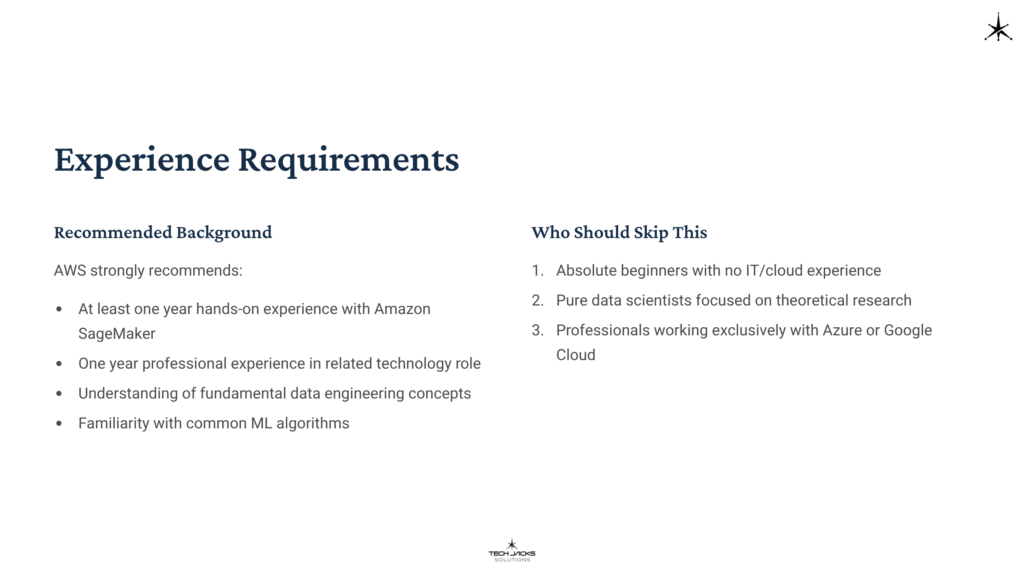
Who Should Skip This Certification
Three groups should reconsider:
- Absolute beginners with no prior experience in IT, cloud computing, or programming should start with AWS Certified Cloud Practitioner
- Pure data scientists or researchers whose work primarily focuses on theoretical modeling and algorithm research may find the engineering emphasis misaligned
- Professionals in non-AWS environments working exclusively with Microsoft Azure or Google Cloud would benefit more from platform-specific certifications
Additional AWS Certifications for Review
4 Core Domains: What You Need to Master
The exam tests four distinct domains, each weighted differently. Understanding this structure is critical for effective preparation.
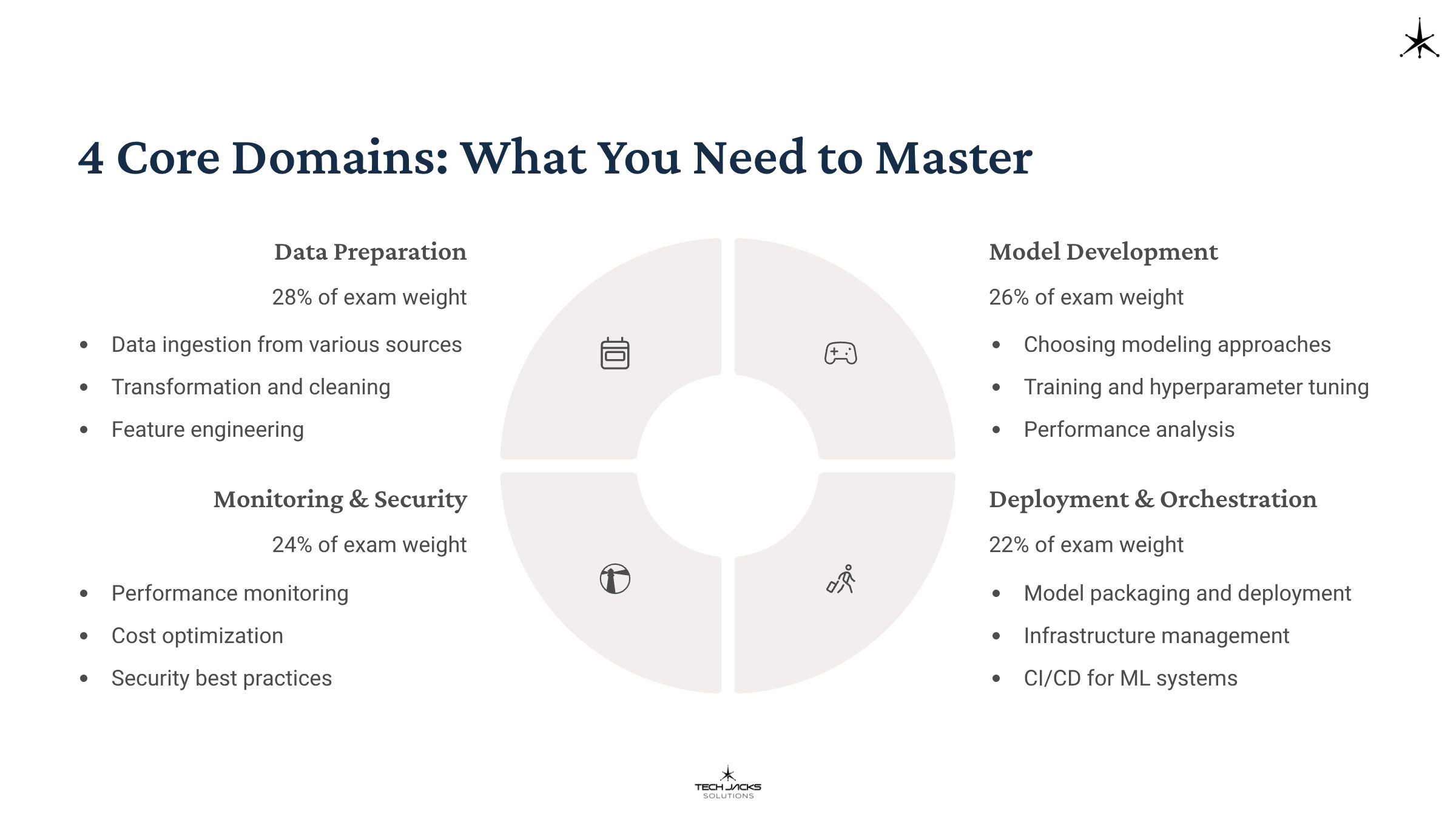
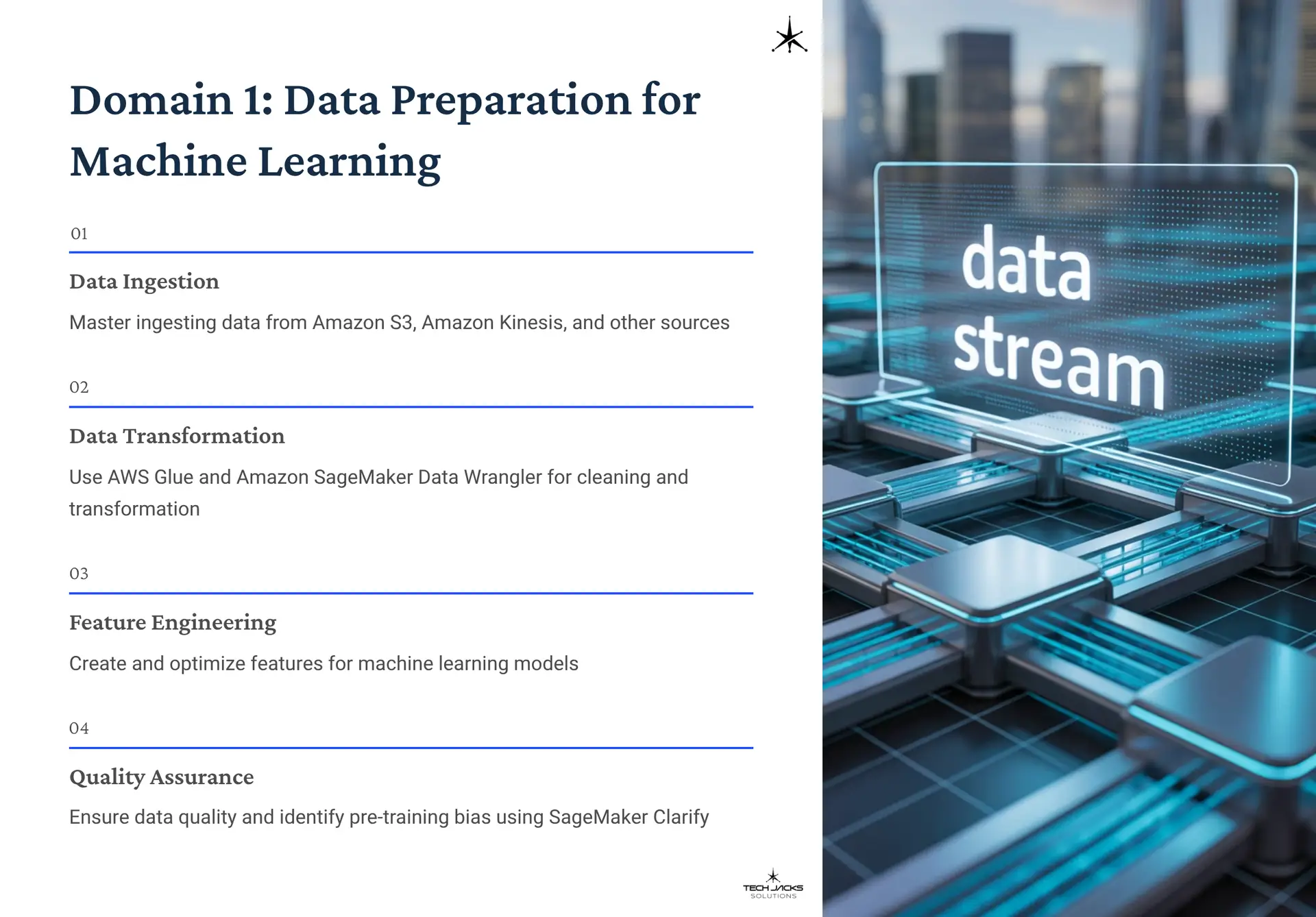
Domain 1: Data Preparation for Machine Learning (28%) The heaviest weighted section focuses on foundational data engineering tasks. You’ll need to master:
- Ingesting data from various sources (Amazon S3, Amazon Kinesis)
- Transforming and cleaning data using AWS Glue and Amazon SageMaker Data Wrangler
- Performing feature engineering
- Ensuring data quality and integrity
- Identifying and mitigating pre-training data bias using Amazon SageMaker Clarify
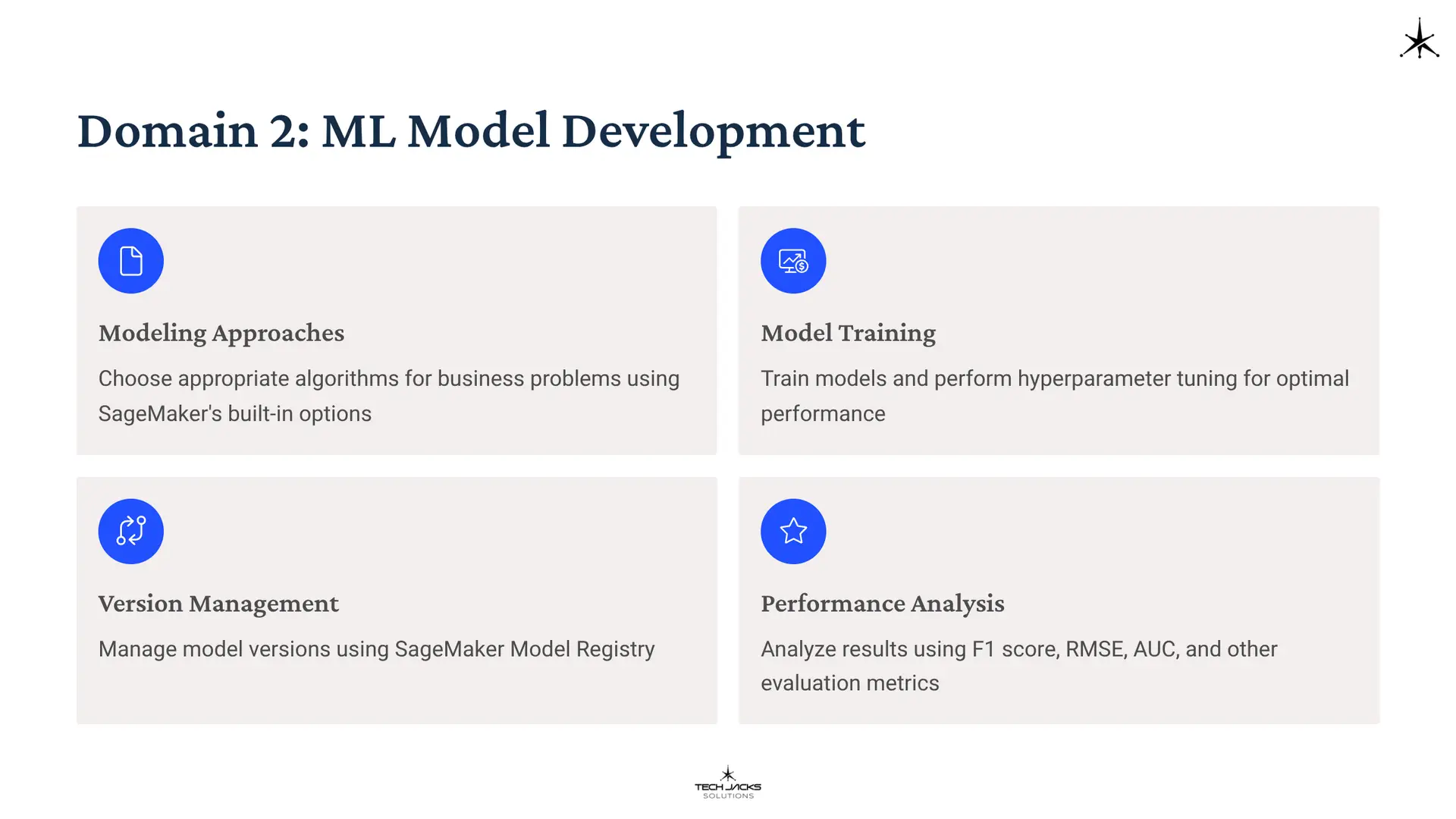
Domain 2: ML Model Development (26%) This domain covers the core lifecycle of building and refining models:
- Choosing appropriate modeling approaches for business problems
- Using AWS AI services (Amazon Rekognition, Amazon Bedrock) and Amazon SageMaker’s built-in algorithms
- Training models and performing hyperparameter tuning
- Managing model versions in the SageMaker Model Registry
- Analyzing performance using evaluation metrics (F1 score, RMSE, AUC)
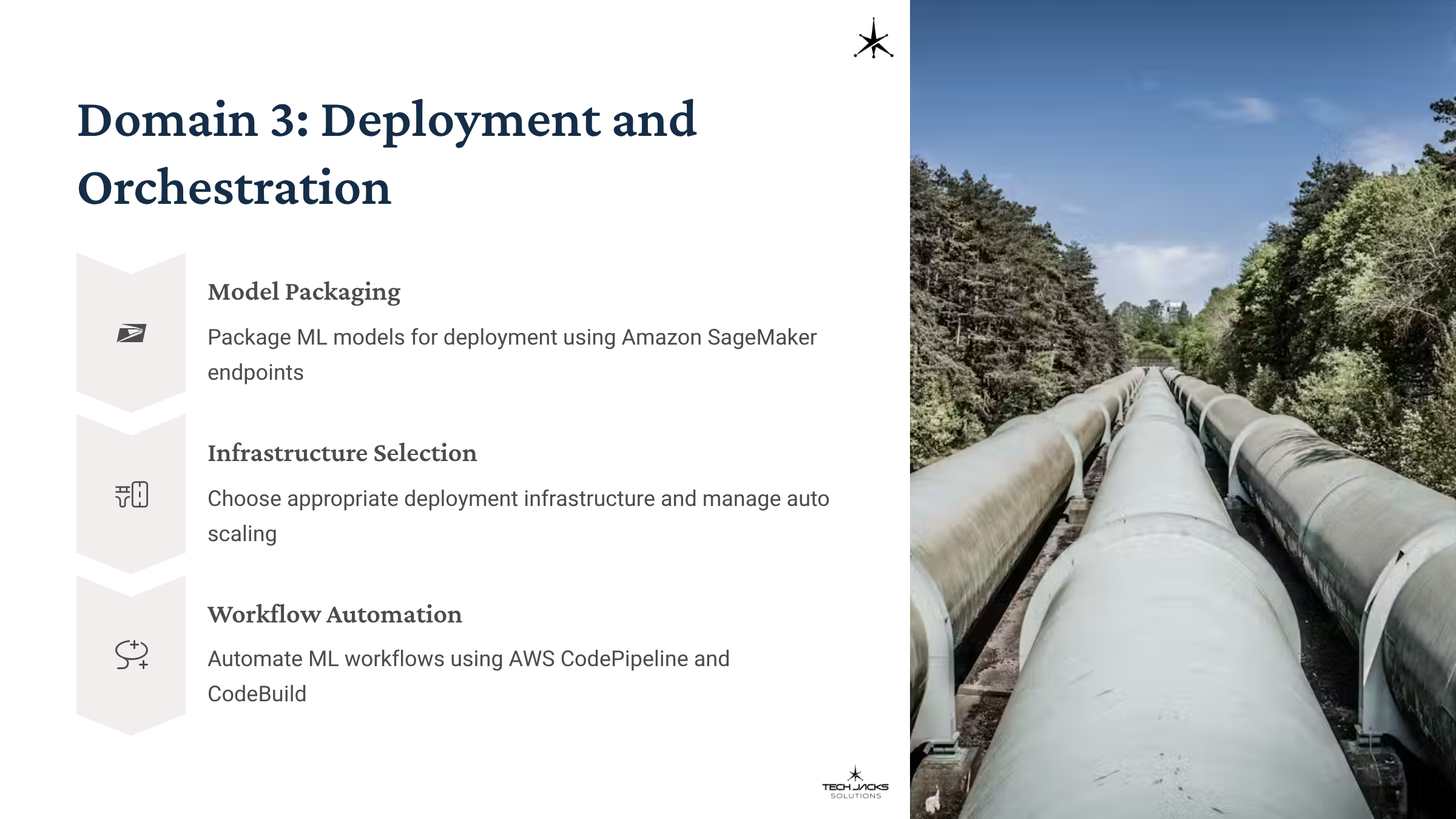
Domain 3: Deployment and Orchestration of ML Workflows (22%) The operational heart validates your ability to:
- Package ML models and deploy them using Amazon SageMaker endpoints
- Select appropriate deployment infrastructure
- Manage and optimize endpoints through A/B testing and auto scaling
- Automate ML workflows using AWS CodePipeline and AWS CodeBuild
- Implement CI/CD principles for ML systems
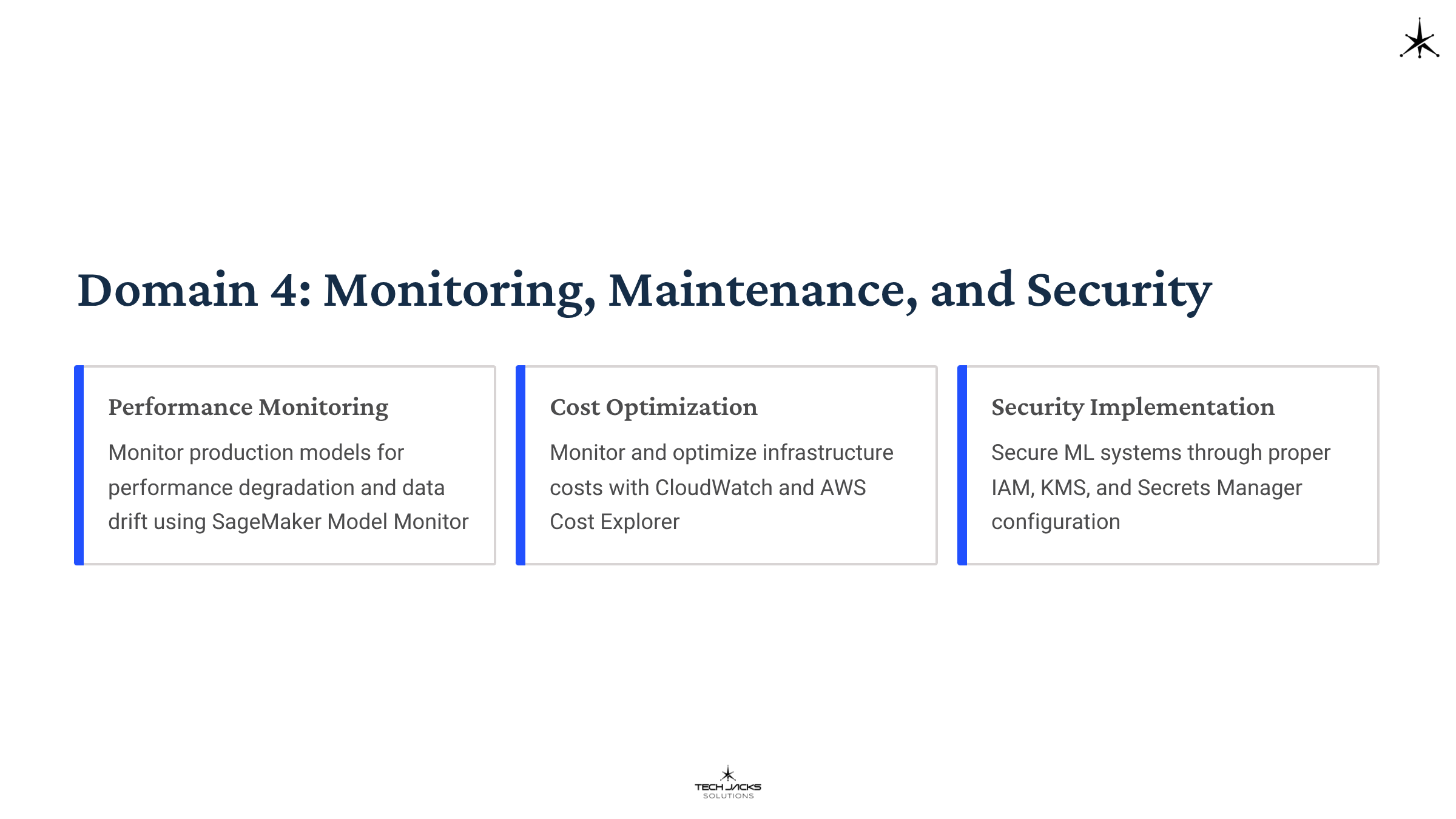
Domain 4: ML Solution Monitoring, Maintenance, and Security (24%) Post-deployment skills include:
- Monitoring production models for performance degradation and data drift using Amazon SageMaker Model Monitor
- Monitoring and optimizing infrastructure costs with Amazon CloudWatch and AWS Cost Explorer
- Securing ML systems through proper AWS IAM, AWS KMS, and AWS Secrets Manager configuration
- Implementing security best practices throughout the ML lifecycle
What to Expect From the Exam
Exam Structure
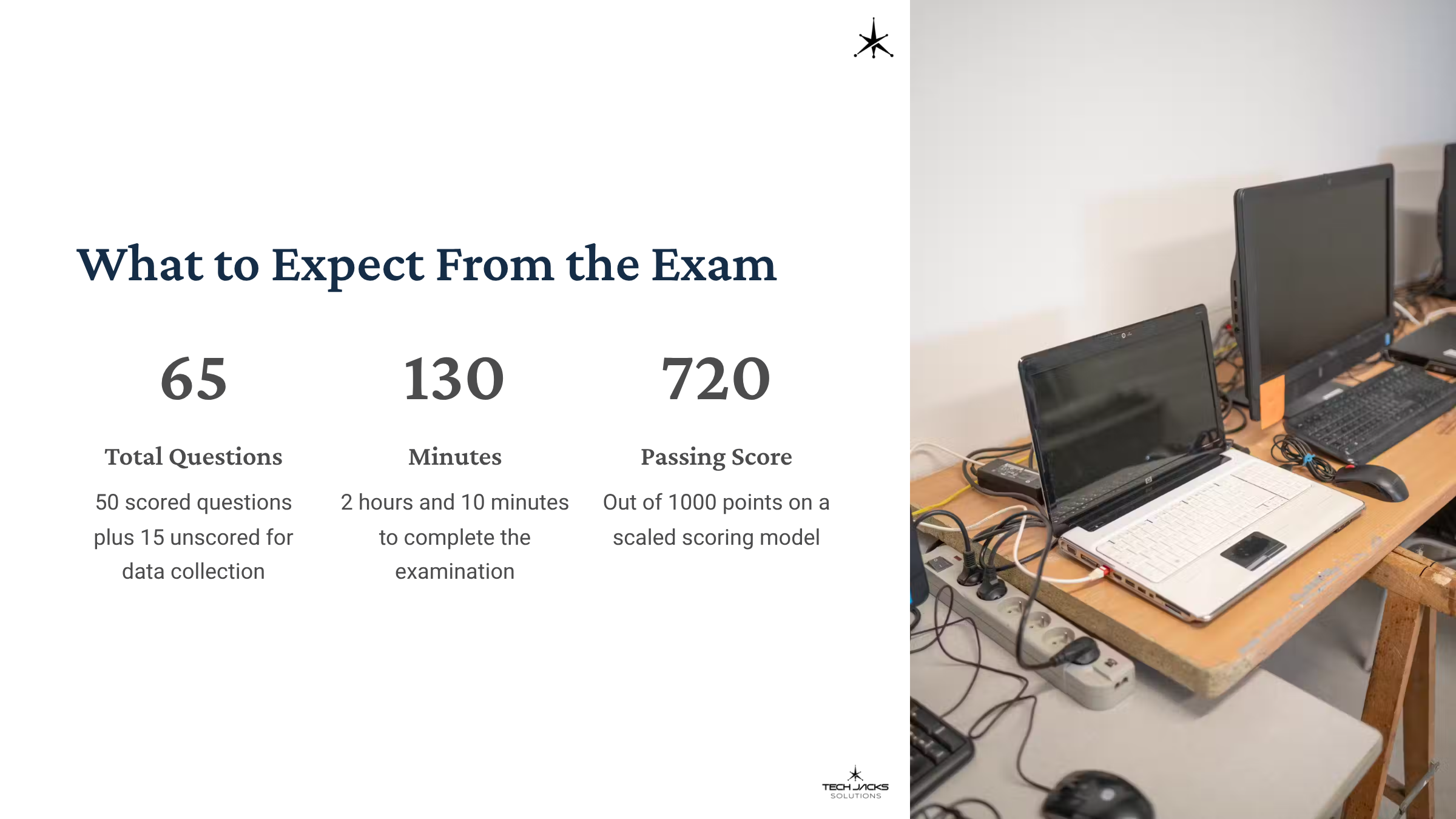
- 65 questions total (50 scored, 15 unscored for data collection)
- 130 minutes (2 hours and 10 minutes) to complete
- Multiple choice, multiple response, ordering, matching, and case study questions
- Linear format (not adaptive) – questions presented in fixed order
- Passing score: 720 out of 1000 on a scaled scoring model
Question Formats
- Multiple Choice: One correct response and three incorrect responses
- Multiple Response: Two or more correct responses from five or more options
- Ordering: A list of items to be placed in the correct sequence
- Matching: A set of prompts to be matched with a set of responses
- Case Study: A scenario followed by several questions related to it
Logistics and How Much Does AWS Machine Learning Certification Costs
- Exam fee: $150 USD
- Retake fee: $150 USD
- Valid for 3 years with no annual maintenance fees
- 50% discount voucher provided after passing any AWS exam for future attempts
Testing Experience The exam isn’t adaptive, meaning you can navigate forward and backward to review or change answers. Community feedback from beta testers suggests Domains 1 (Data Preparation) and 3 (Deployment and Orchestration) are the most challenging, requiring deep knowledge of how to configure services in complex, scenario-based problems.
Career Impact and Salary Expectations
U.S. Salary Benchmarks
While direct salary data for this new certification doesn’t exist yet, we can triangulate from related roles and the senior-level ML Specialty:
- Skillsoft’s 2024 IT Skills and Salary Report: $213,267 average for AWS Certified Machine Learning – Specialty holders (senior-level credential)
- ZipRecruiter (September 2025): AWS Machine Learning Engineers average $128,769; broader “Aws Machine Learning” role averages $145,725
- Payscale (2025 data): Machine Learning Engineers listing AWS as a skill average $128,413, approximately $5,600 more than those without AWS skills ($122,798)
Compensation by Experience Level
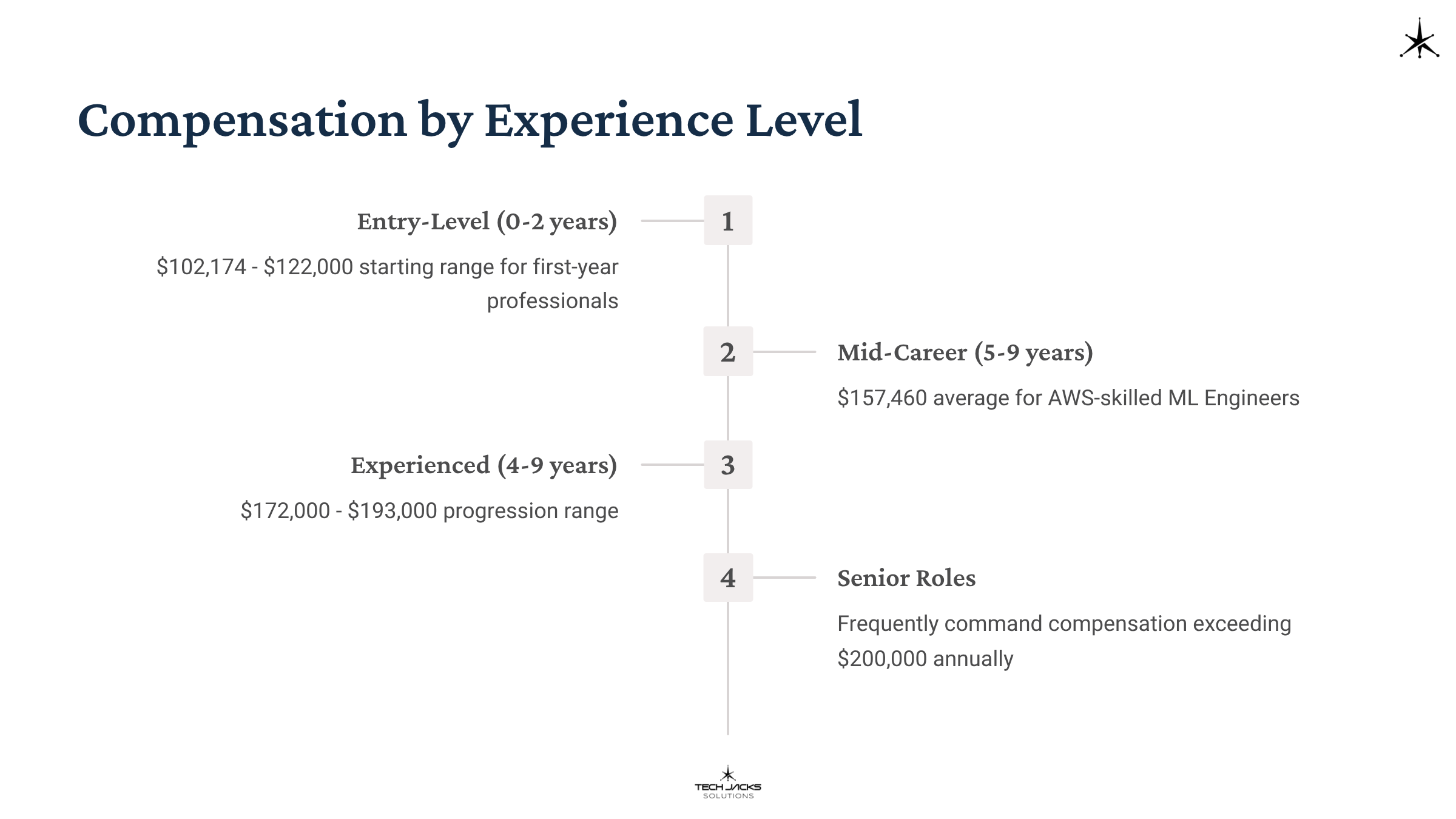
- Entry-Level (0-2 years): Payscale shows $102,174 for less than one year experience, rising to $121,367 for 1-4 years. InfosecInstitute data suggests starting range of $122,000 for first-year professionals
- Mid-Career (5-9 years): Payscale reports AWS-skilled ML Engineers earn average $157,460
- Experienced (4-9 years): InfosecInstitute shows progression to $172,000 (4-6 years) and $193,000 (7-9 years)
- Senior roles: Frequently command compensation exceeding $200,000 annually
Geographic Variations Location dramatically impacts compensation:
- Santa Clara, California: Average $189,407
- San Francisco: Average ~$180,000
- Berkeley, California: Average ~$178,000
- Richardson, Texas: Average $130,871
- Government/Federal Sector: Ranges from $60,102-$79,412 for Department of Defense roles, though IT Specialist (GS-15) positions with AI/ML responsibilities can start at $148,871 or higher
Job Market Demand
The U.S. Bureau of Labor Statistics forecasts employment in computer and information technology occupations will grow “much faster than the average” for all occupations, projecting 34% growth rate for Data Scientists specifically between 2024 and 2034.
Reports indicate that many IT leaders face challenges filling AI/ML specialist roles, with difficulty varying by region and industry. Current job postings on platforms like Indeed and ZipRecruiter rarely require the certification but frequently list it as “preferred” or “a plus.”
The real value? The certification acts as a powerful differentiator, helping resumes pass automated screening and providing third-party validation of AWS-specific skills to hiring managers.
Prerequisites and Experience Requirements
Official Prerequisites None. There are no mandatory prerequisites for taking the AWS Certified Machine Learning Engineer – Associate exam. You don’t need to hold the AWS Certified Cloud Practitioner or any other certification before attempting the MLA-C01.
Recommended Background AWS strongly recommends:
- At least one year of hands-on experience building, deploying, and maintaining ML solutions using Amazon SageMaker and other core AWS ML services
- At least one year of professional experience in a related technology role
- Solid understanding of fundamental data engineering concepts (data formats, ingestion, transformation)
- Familiarity with common ML algorithms and their use cases
- Software engineering best practices for developing modular and reusable code
Bridging Experience Gaps For candidates lacking the recommended experience, AWS provides structured pathways through AWS Skill Builder. The official Exam Prep Plans include digital courses, hands-on labs, and interactive game-based learning modules like AWS Cloud Quest, allowing individuals to gain practical experience in a controlled environment.
How to Prepare for AWS Machine Learning Certification
Study Timeline by Experience Level
Analysis of community reports for similar Associate-level exams provides this framework:
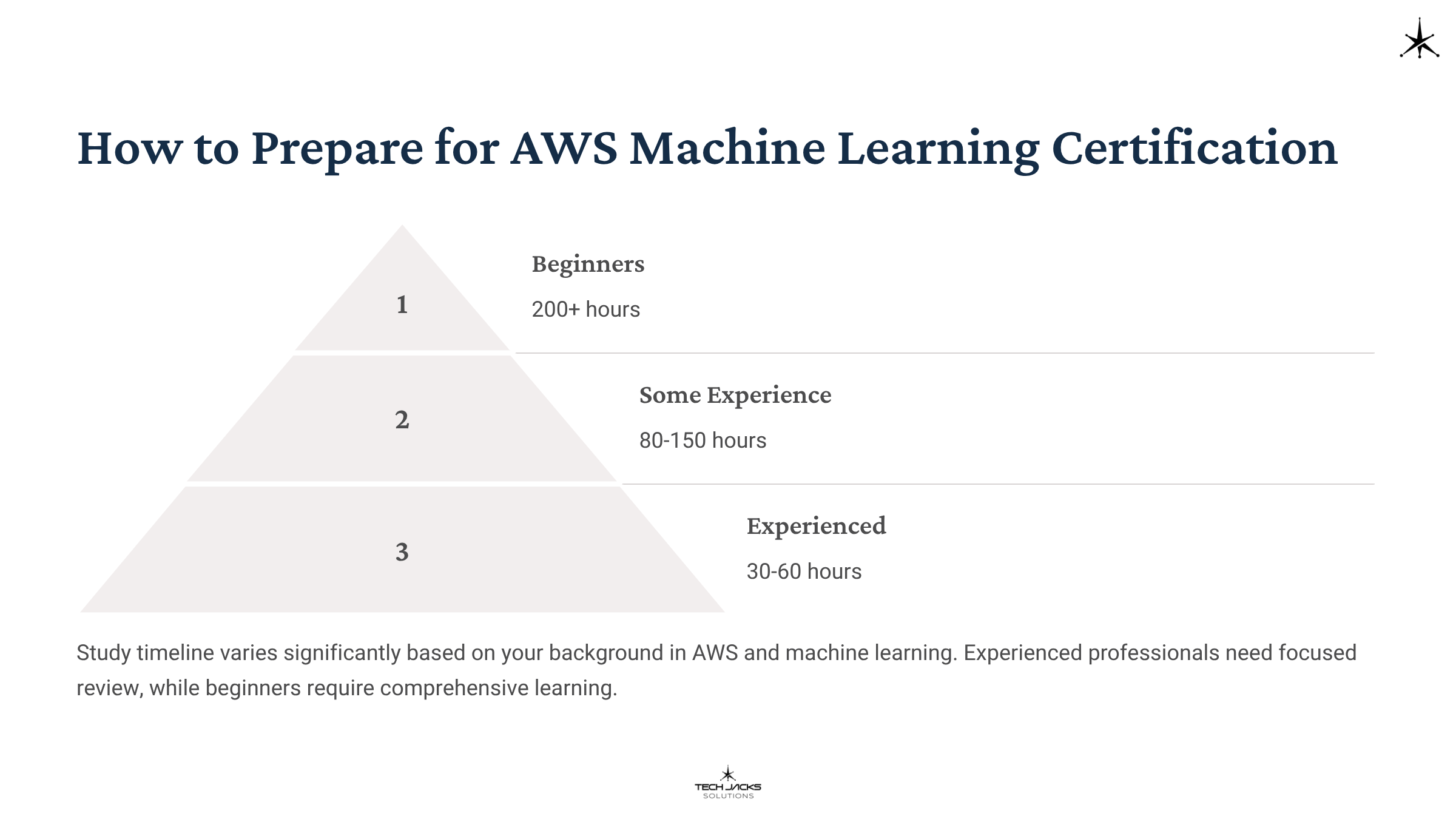
- Experienced Professionals (strong background in both AWS and ML): 30-60 hours of focused study to review exam-specific topics and take practice tests
- Some Experience (general IT or software development background, new to AWS ML): 80-150 hours of comprehensive study to learn key services and complete hands-on labs
- Beginners (new to both cloud computing and machine learning): 200+ hours; strongly recommended to first pursue foundational certifications like AWS Certified Cloud Practitioner or Solutions Architect – Associate
Official AWS Resources AWS Skill Builder serves as the central hub for official training:
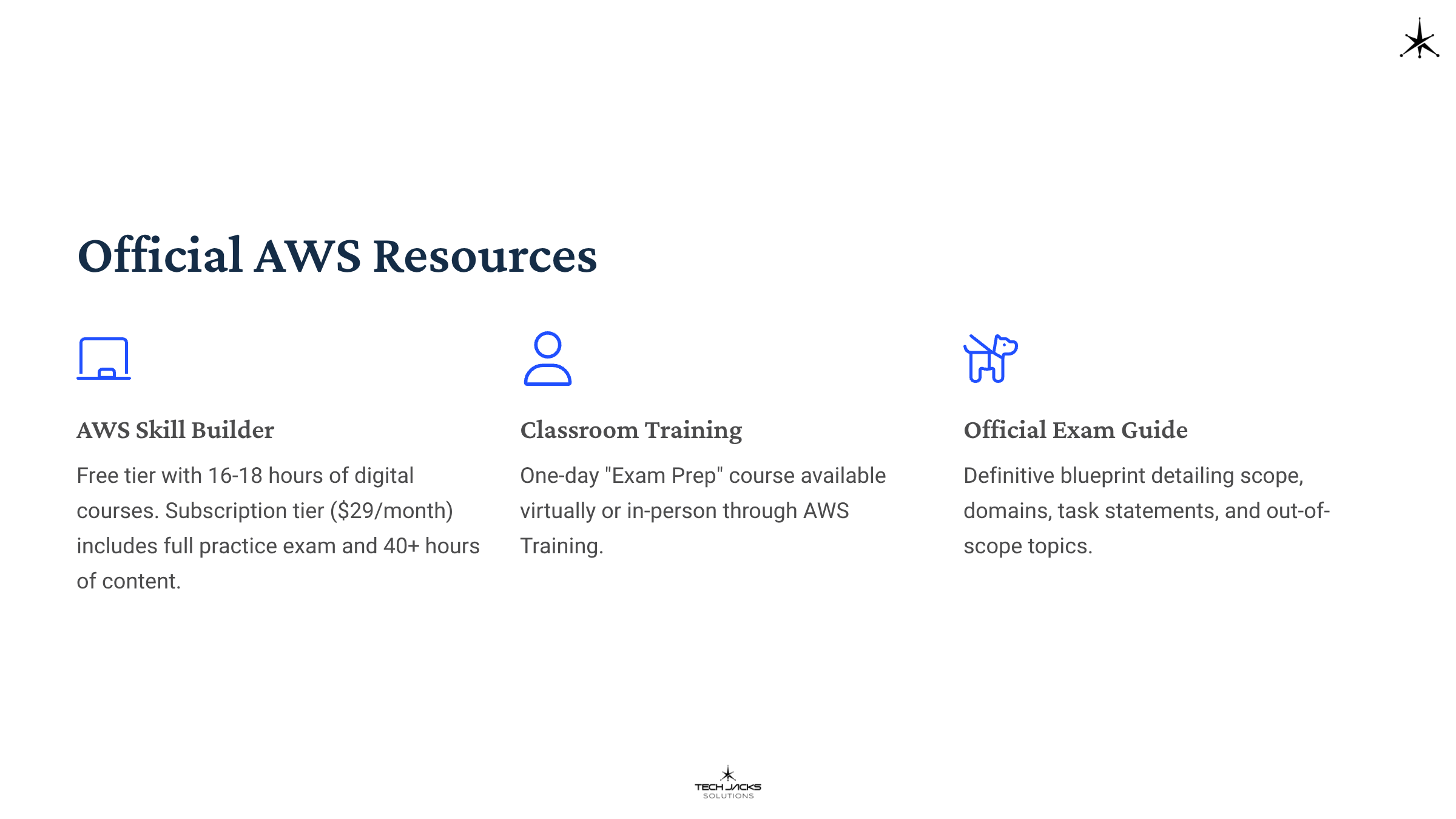
- Free Tier: Exam Prep Plan with 16-18 hours of digital courses, domain-specific review modules, and 20 practice questions
- Subscription Tier ($29 USD per month): Full-length practice exam, numerous hands-on labs, AWS Cloud Quest access, total content exceeding 40 hours
Additional official resources:
- AWS Classroom Training: One-day “Exam Prep: AWS Certified Machine Learning Engineer – Associate” course (virtual or in-person)
- Official Exam Guide: The definitive blueprint detailing scope, domains, task statements, and out-of-scope topics
- Free webinars and AWS Twitch streams: Regular exam readiness sessions
Popular Third-Party Resources
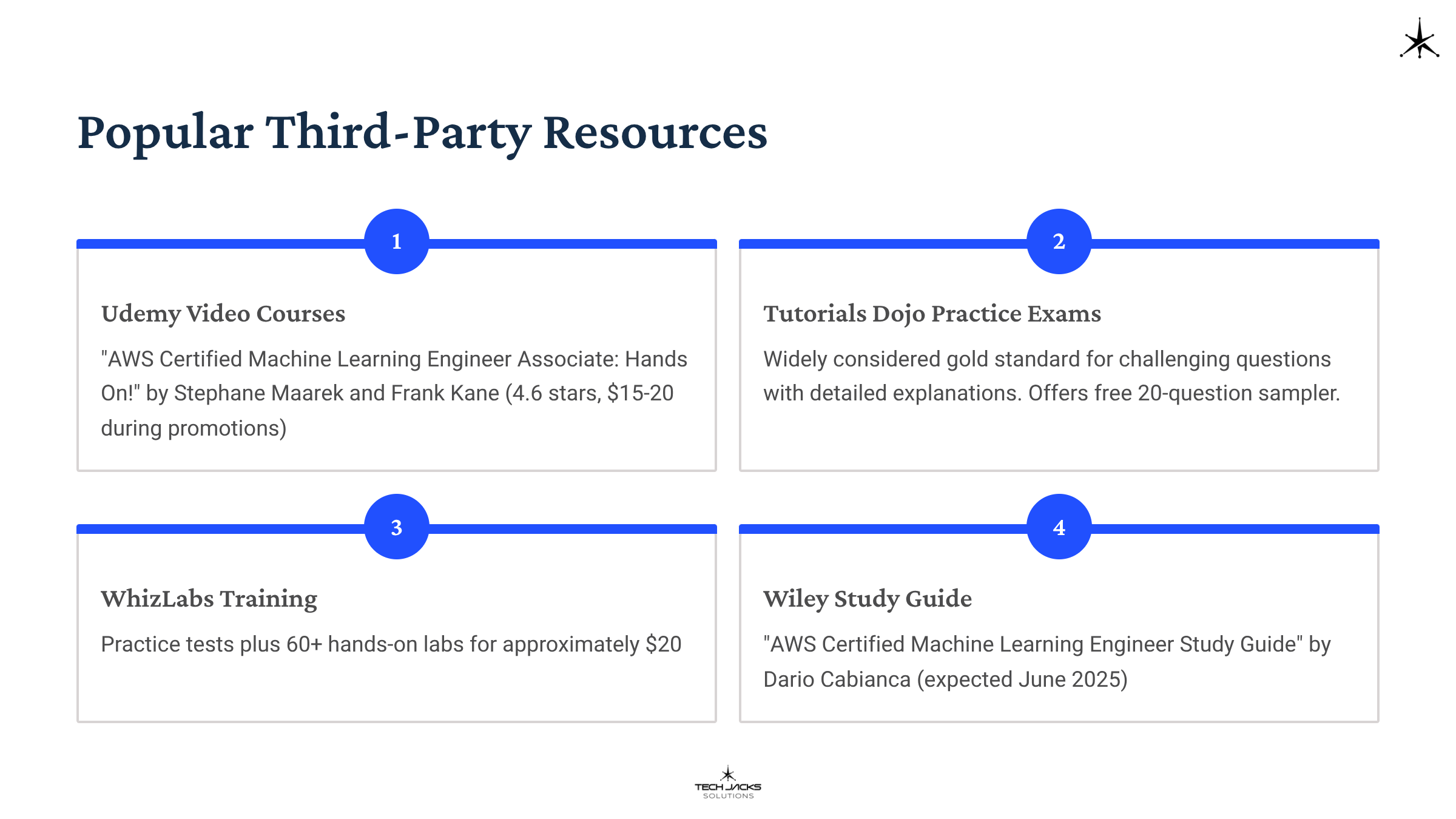
- Video Courses: Udemy’s “AWS Certified Machine Learning Engineer Associate: Hands On!” by Stephane Maarek and Frank Kane (4.6 stars from 3,200+ reviews, $15-20 during promotions)
- Practice Exams: Tutorials Dojo widely considered gold standard for challenging questions with detailed explanations; offers free 20-question sampler
- WhizLabs: Practice tests plus 60+ hands-on labs (~$20)
- Study Guide: Wiley publishing “AWS Certified Machine Learning Engineer Study Guide: Associate (MLA-C01) Exam” by Dario Cabianca (expected June 2025)
How to Pass AWS Machine Learning Certification
Most Effective Study Method
Successful candidates report following this structured approach:
- Foundational Learning: Begin with comprehensive video course for high-level understanding of all topics
- Deep Dive: Read official AWS documentation for key services, then apply knowledge through hands-on labs in AWS Management Console
- Knowledge Assessment: Use high-quality practice exams as diagnostic tools
- Refinement: Thoroughly review every question (both correct and incorrect) to understand underlying concepts
- Validation: Cycle between targeted study and practice exams until consistently scoring 80-90%
Key Success Strategies
- Focus on practical, hands-on experience over memorization
- Understand how to configure services, not just high-level concepts
- Practice scenario-based problem solving
- Join study groups in r/AWSCertifications community
Pass Rates AWS doesn’t publish official pass rates. Third-party claims of 72% first-attempt failure rate for Solutions Architect – Associate are widely considered marketing tactics and not based on official data. Community feedback indicates candidates following structured study plans with hands-on experience and reputable practice exams have high first-attempt success probability.
How Difficult Is AWS Machine Learning Certification?
Difficulty Assessment
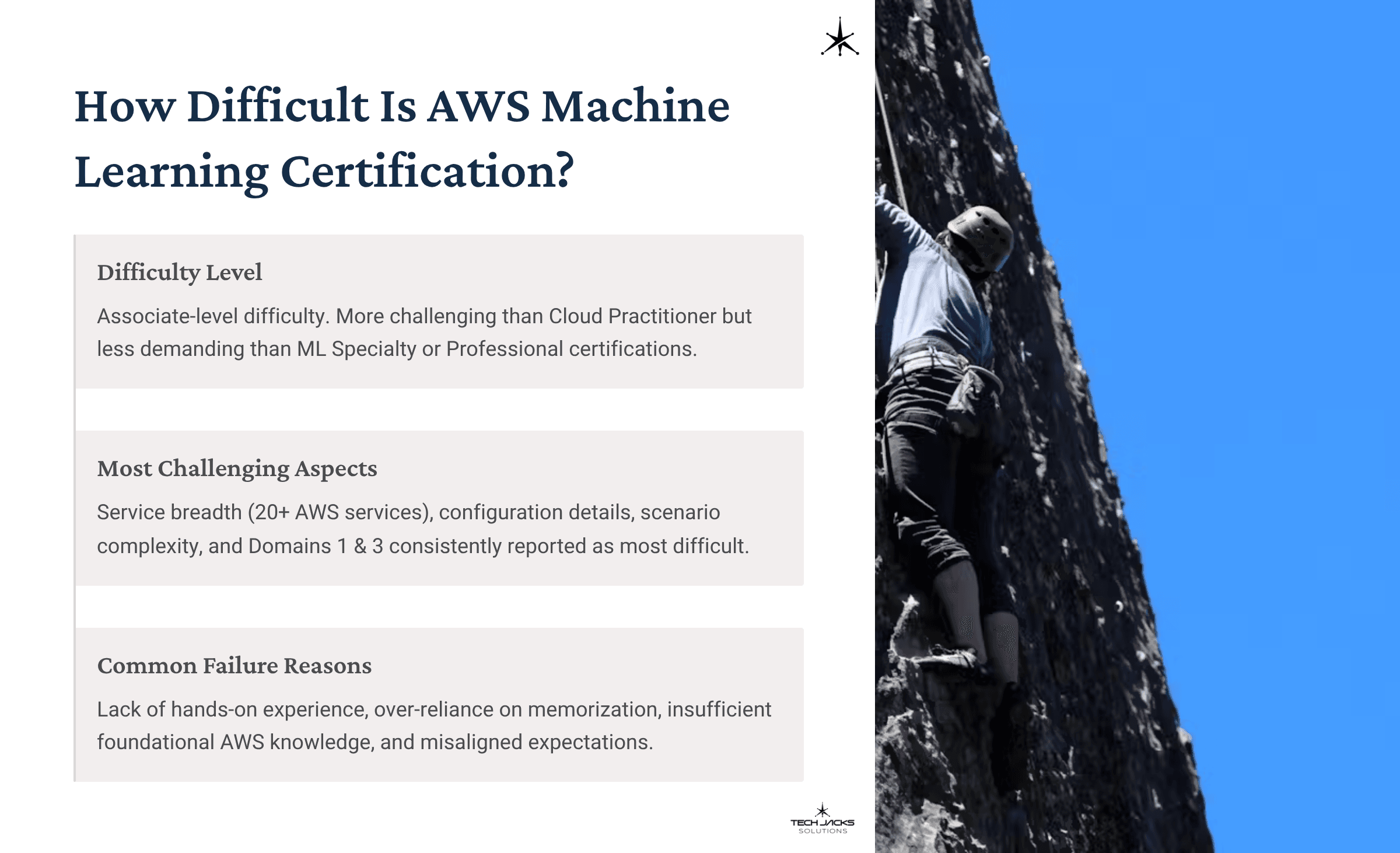
Based on community feedback, the MLA-C01 sits firmly at associate-level difficulty. It’s more challenging than Cloud Practitioner but less demanding than the ML Specialty or Professional-level certifications.
Most Challenging Aspects
- Service Breadth: Working knowledge required for 20+ AWS services
- Configuration Details: Questions test specific parameter settings and service configurations
- Scenario Complexity: Multi-step problems requiring end-to-end solution design
- Domains 1 and 3: Data Preparation and Deployment/Orchestration consistently reported as most difficult
Beta exam participants specifically note these domains test not just what a service does, but precisely how to configure it in complex, scenario-based problems.
Is AWS Machine Learning Certification Hard?
The certification is challenging but achievable with proper preparation. The exam heavily favors practical, hands-on skills over deep theoretical knowledge. You won’t be deriving algorithms or proving mathematical theorems. Instead, you’ll choose the correct AWS service for a business requirement and configure it properly.
Common Reasons for Failure
- “Paper Certification”: Passing through rote memorization or unauthorized “brain dumps” without true understanding
- Lack of foundational AWS knowledge (VPC, IAM, S3)
- Attempting without hands-on experience with services
- Misaligned expectations: pursuing for pure data science role when content focuses on engineering
Failure is most often attributed to lack of practical experience or over-reliance on memorization instead of conceptual understanding.
Competitive Certifications Comparison
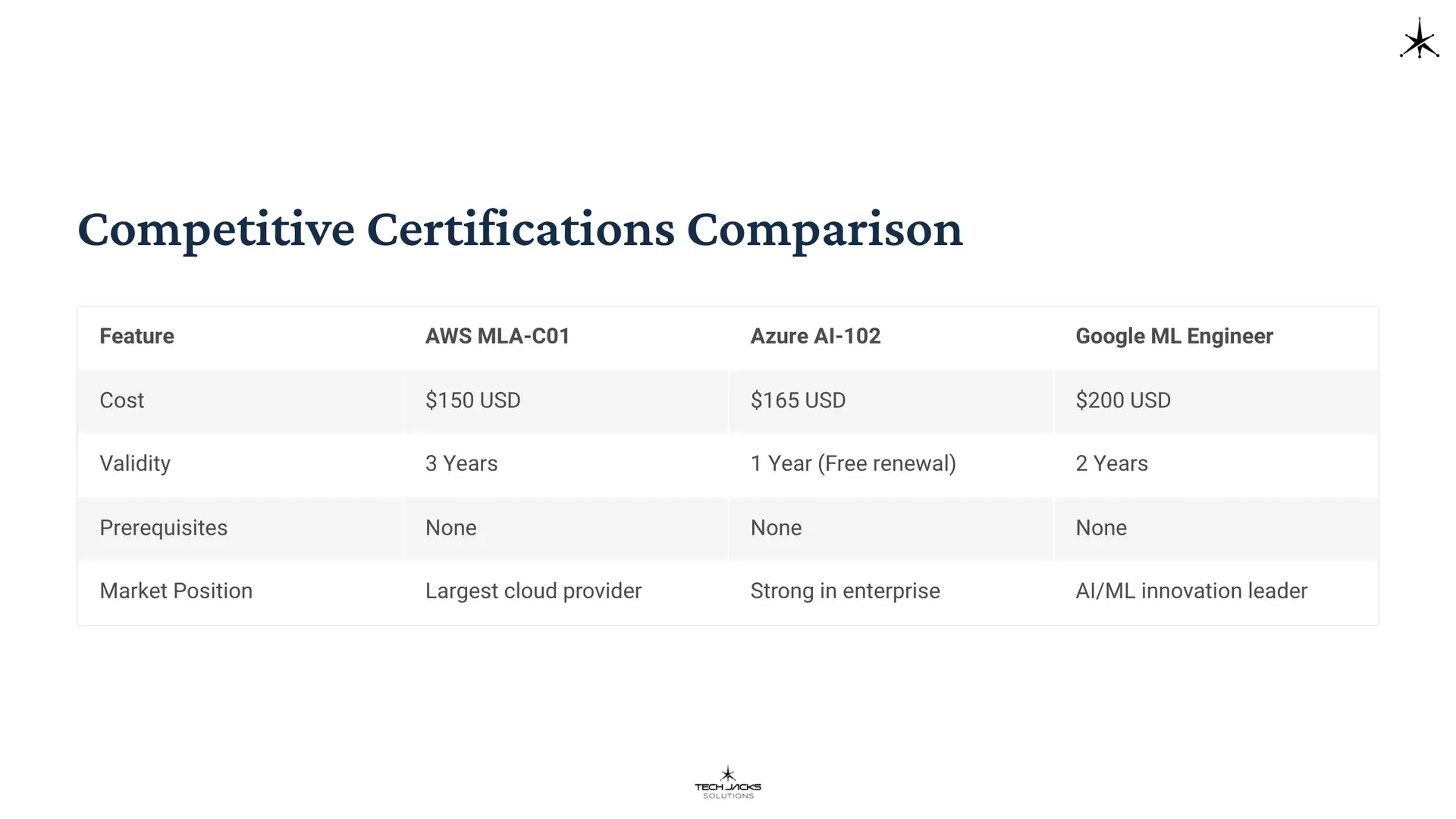
Understanding how the MLA-C01 compares to competing credentials helps inform career decisions:
| Feature | AWS ML Engineer Associate (MLA-C01) | Microsoft Azure AI Engineer Associate (AI-102) | Google Professional ML Engineer |
| Target Audience | ML Engineers, MLOps Engineers, DevOps Engineers focused on operationalizing models | AI Engineers and Developers building and managing AI solutions on Azure | ML professionals designing, building, and productionizing ML models on GCP |
| Exam Cost | $150 USD | $165 USD | $200 USD |
| Validity Period | 3 Years | 1 Year (Free annual renewal assessment) | 2 Years |
| Prerequisites | None (1+ year experience recommended) | None (Experience with Azure and Python recommended) | None (3+ years industry experience recommended) |
| Key Services | Amazon SageMaker ecosystem, AWS Glue, AWS Developer Tools, Amazon Kinesis | Azure AI Services (Cognitive Services), Azure Machine Learning, Azure OpenAI Service | Vertex AI Platform, BigQuery ML, TensorFlow, Kubeflow |
| Market Position | Backed by largest cloud provider; strong in startups and wide range of industries | Strong in enterprise environments and companies heavily invested in Microsoft stack | Leader in AI/ML innovation; strong in tech-first companies and data-centric roles |
Key Administrative Differences
- Azure: Certifications valid only one year but renewed free through online assessment
- AWS: Three-year validity but requires paid exam ($150) to recertify
- Google: Two-year validity, full exam fee required for recertification
Recent Updates and What’s Changed
2024-2025 Evolution
The MLA-C01 represents AWS’s shift from a single high-level Machine Learning – Specialty (MLS-C01) targeting professionals with 2+ years experience to a tiered structure:
- AWS Certified AI Practitioner (foundational, business-focused)
- AWS Certified Machine Learning Engineer – Associate (hands-on, engineering-focused)
- AWS Certified Machine Learning – Specialty (advanced, comprehensive)
This structure mirrors successful AWS certification tracks and allows professionals to align credentials precisely with job functions and career aspirations.
Key Changes in Focus
- Stronger emphasis on MLOps and CI/CD practices
- Integration of generative AI services like Amazon Bedrock
- Focus on cost optimization and monitoring
- Security and compliance throughout ML lifecycle
- Practical engineering over theoretical modeling
How AI is Transforming Machine Learning Engineer Careers
Current Integration
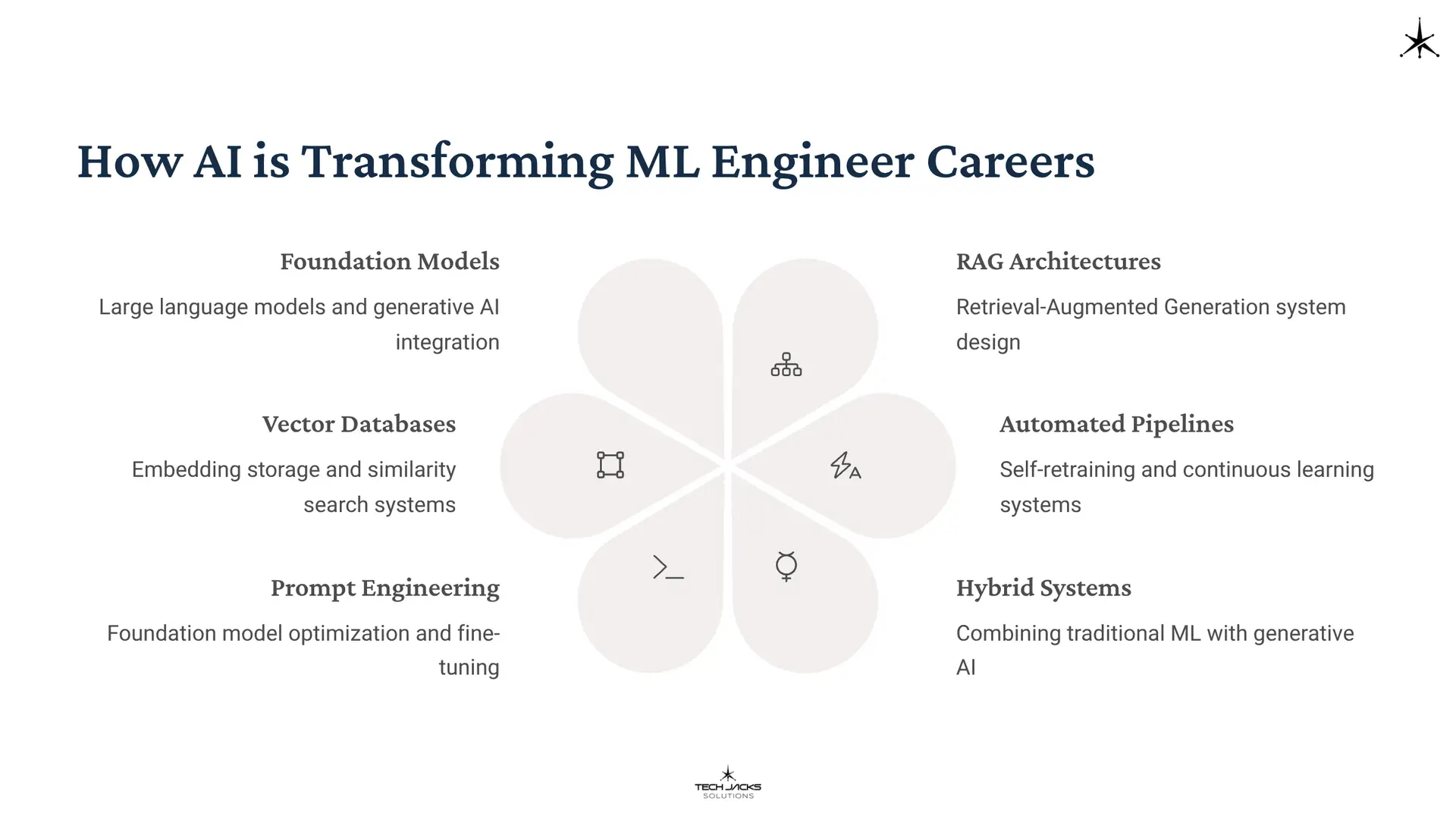
The certification directly addresses AI’s impact on ML engineering roles. Modern ML engineers orchestrate entire AI systems including:
- Foundation models and large language models
- RAG (Retrieval-Augmented Generation) architectures
- Automated retraining pipelines
- Hybrid architectures combining traditional ML and generative AI
Skills Becoming Essential
- Prompt engineering for foundation models
- Vector database management
- AI safety and bias detection using tools like SageMaker Clarify
- Cost optimization for large model inference
- Integration of services like Amazon Bedrock
5-Year Outlook The World Economic Forum projects 40% growth in AI/ML specialist demand by 2027. The role will evolve from model deployment to AI system orchestration. Engineers combining traditional MLOps skills with emerging AI capabilities will command premium salaries and maximum career flexibility.
How to Get AWS Machine Learning Certification
Step-by-Step Process
- Assess current knowledge against the four exam domains (28% Data Prep, 26% Model Development, 22% Deployment, 24% Monitoring)
- Choose study approach: Self-paced ($29/month AWS Skill Builder) vs. instructor-led training
- Create realistic timeline: 30-150 hours based on experience level
- Set up free AWS account for hands-on practice
- Register for exam through AWS Certification Account
- Schedule with Pearson VUE: Choose testing center or online proctoring
- Complete practice exams until scoring 80%+ consistently
- Take exam within 130-minute time limit
- Plan next steps: Consider ML Specialty after gaining experience
Is AWS Machine Learning Certification Worth It in 2025?
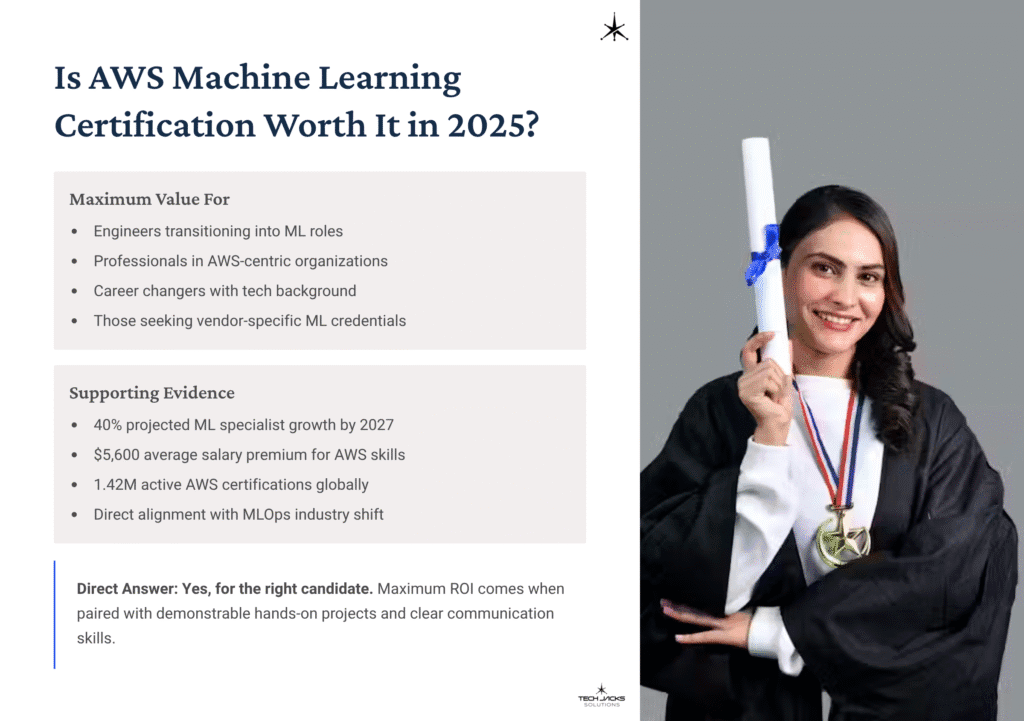
Direct Answer: Yes, for the right candidate.
The certification provides maximum value for:
- Engineers transitioning into ML roles needing validated skills
- Professionals in AWS-centric organizations
- Those seeking vendor-specific ML engineering credentials
- Career changers with tech background entering AI/ML field
Supporting Evidence
- 40% projected growth in ML specialist demand by 2027 (World Economic Forum)
- $5,600 average salary premium for AWS skills (Payscale data)
- 1.42 million active AWS certifications held by 1.05 million individuals globally
- Direct alignment with industry shift toward MLOps and production ML
- Growing demand across Technology/IT, Finance, Healthcare, E-commerce, and Logistics sectors
ROI Considerations
- Initial Investment: $150 exam fee (often employer-funded) plus 30-150 hours preparation
- Validity: 3 years with no maintenance fees (50% discount on recertification)
- Career Impact: Increased interview opportunities, stronger salary negotiation position, validated expertise
The certification validates knowledge but projects and experience prove capability. Maximum ROI comes when paired with demonstrable hands-on projects and clear communication skills.
Getting Started: Your Next Steps
Ready to pursue the certification? Here’s your action plan:
- Download the official exam guide to understand exact requirements
- Create free AWS account for hands-on practice
- Assess knowledge gaps using free 20-question practice set
- Join r/AWSCertifications community for peer support
- Choose training approach based on your learning style and budget
- Set realistic timeline considering your current experience
- Schedule exam when practice scores consistently exceed 80%
- Develop AI literacy alongside certification preparation
The AWS Certified Machine Learning Engineer – Associate fills a critical gap in the certification landscape. It validates practical skills needed to operationalize ML in production, distinguishing you in a competitive job market where demand significantly exceeds supply. For engineers ready to prove their ML deployment capabilities on the world’s leading cloud platform, this certification offers a clear, valuable path to career advancement.
Resources and References
Official AWS Resources
- AWS Certification Page
- Official Exam Guide PDF
- AWS Skill Builder Exam Prep
- AWS Training and Certification Blog
- AWS Certification FAQs
Third-Party Training Resources
- Udemy – Stephane Maarek & Frank Kane Course
- Tutorials Dojo Practice Exams
- WhizLabs Training and Labs
- Wiley Study Guide (Coming June 2025)
Salary and Career Data Sources
- Skillsoft 2024 IT Skills and Salary Report
- PayScale ML Engineer Salaries
- ZipRecruiter AWS ML Salaries
- Bureau of Labor Statistics – Data Scientists
- InfosecInstitute AWS ML Salary Analysis
Community Resources