- Version 1
- Download
- File Size 0.00 KB
- File Count 0
- Create Date October 28, 2025
- Last Updated October 28, 2025
- Download
AI Model Card Documentation Guide
Community Edition
A practical framework designed to support creating clear, standardized documentation for AI models through Model Cards
[Download Now]
________________________________________________________________________________
AI Model Card Documentation Guide
What You Get
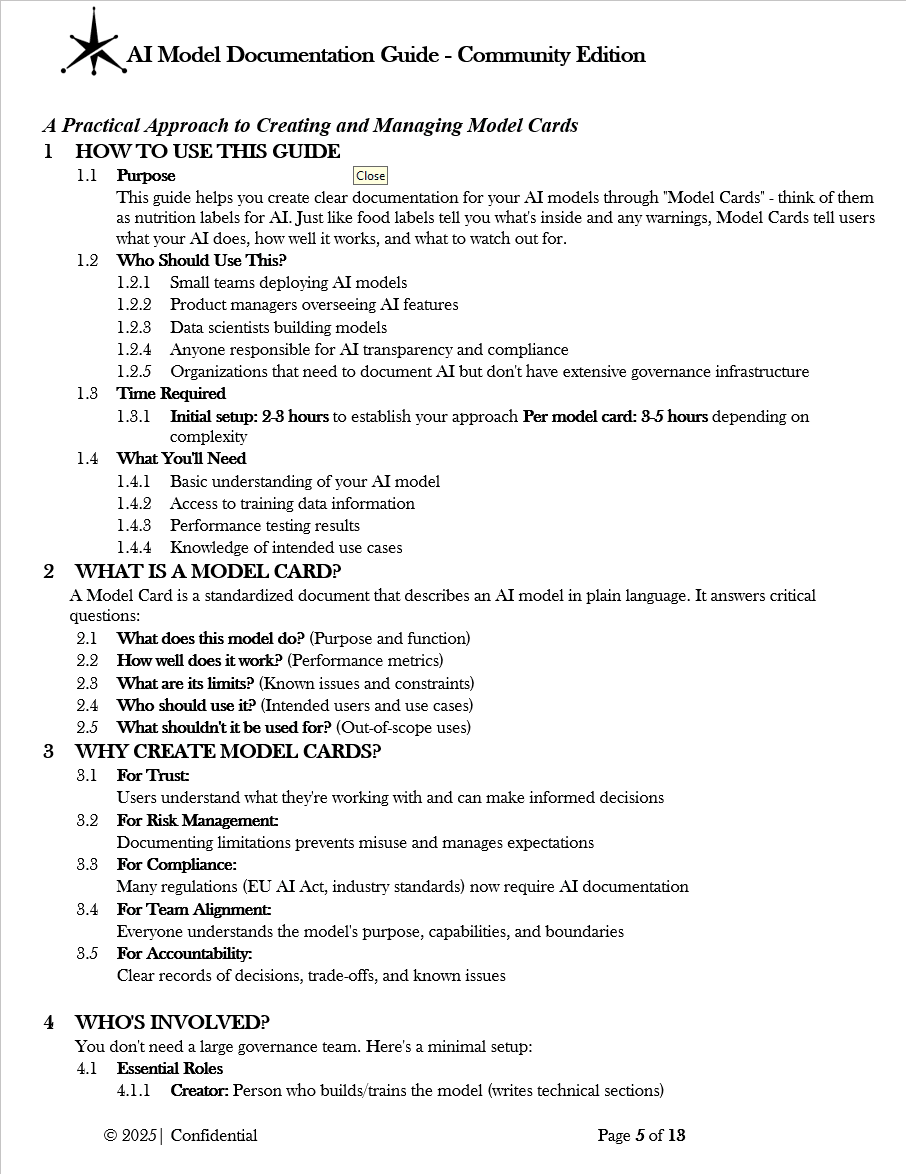
This guide provides a structured approach for documenting AI models through Model Cards. Model Cards function similar to nutrition labels for AI systems, communicating what your model does, how well it performs, and what limitations exist.
The guide includes templates, role definitions, and implementation steps designed to help teams create documentation without building extensive governance infrastructure first. Organizations can typically establish their documentation approach within 2-3 hours of initial setup, with 3-5 hours per Model Card depending on system complexity.
Customization is required. The guide provides foundational structure and examples that teams adapt to their specific models, organizational requirements, and regulatory context.
Key Benefits
- ✓ Provides framework for creating standardized AI model documentation
- ✓ Includes templates for documenting model purpose, performance, and limitations
- ✓ Supports efforts to meet emerging AI transparency requirements
- ✓ Outlines minimal governance roles (Creator, Reviewer, Approver)
- ✓ Aligns with Model Card standards referenced in major AI frameworks
- ✓ Offers guidance on documentation timing and update triggers
- ✓ Designed for teams without extensive compliance infrastructure
- ✓ Includes quick completion checklist for self-assessment
Who Uses This?
Designed for:
- Small to mid-size teams deploying AI models
- Data scientists building models requiring documentation
- Product managers overseeing AI features
- Technical leads responsible for deployment decisions
- Organizations establishing initial AI documentation practices
- Teams needing to demonstrate AI system transparency
What's Inside
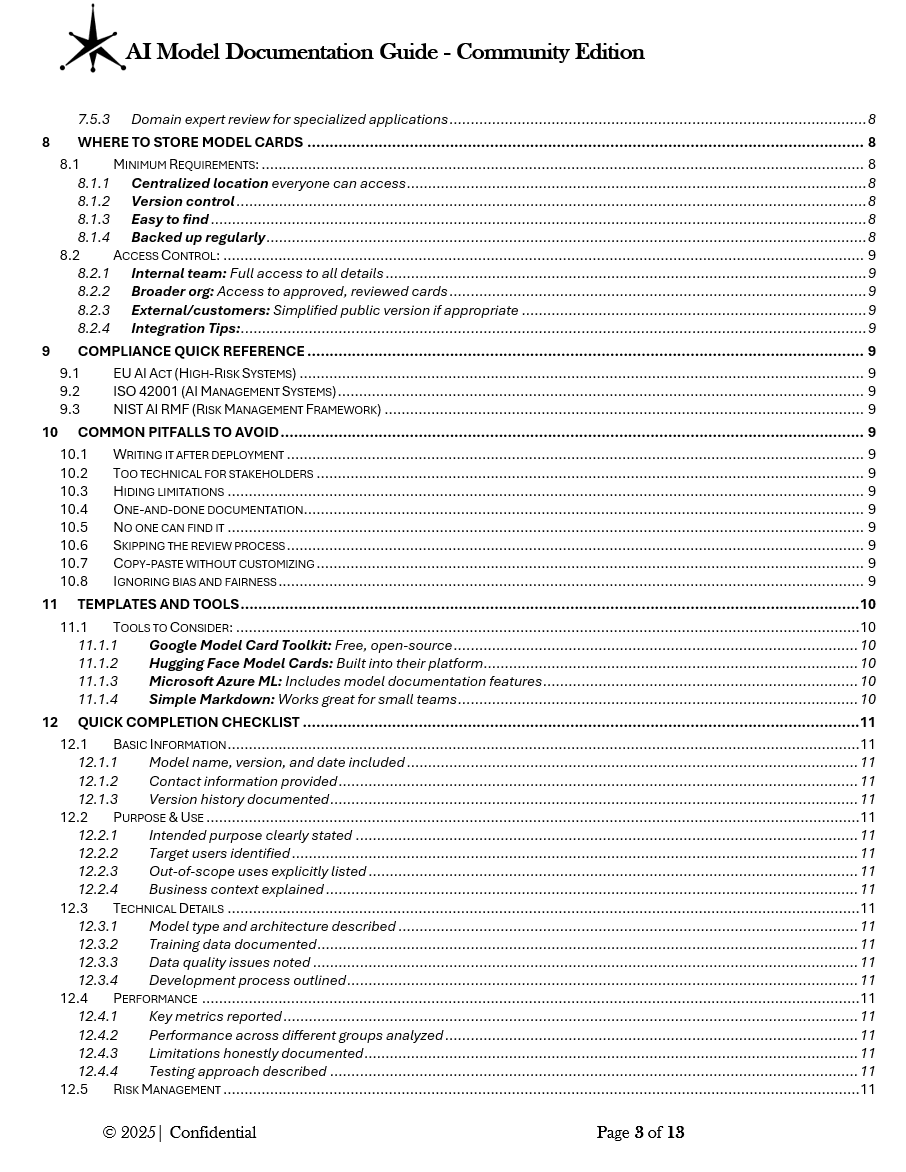
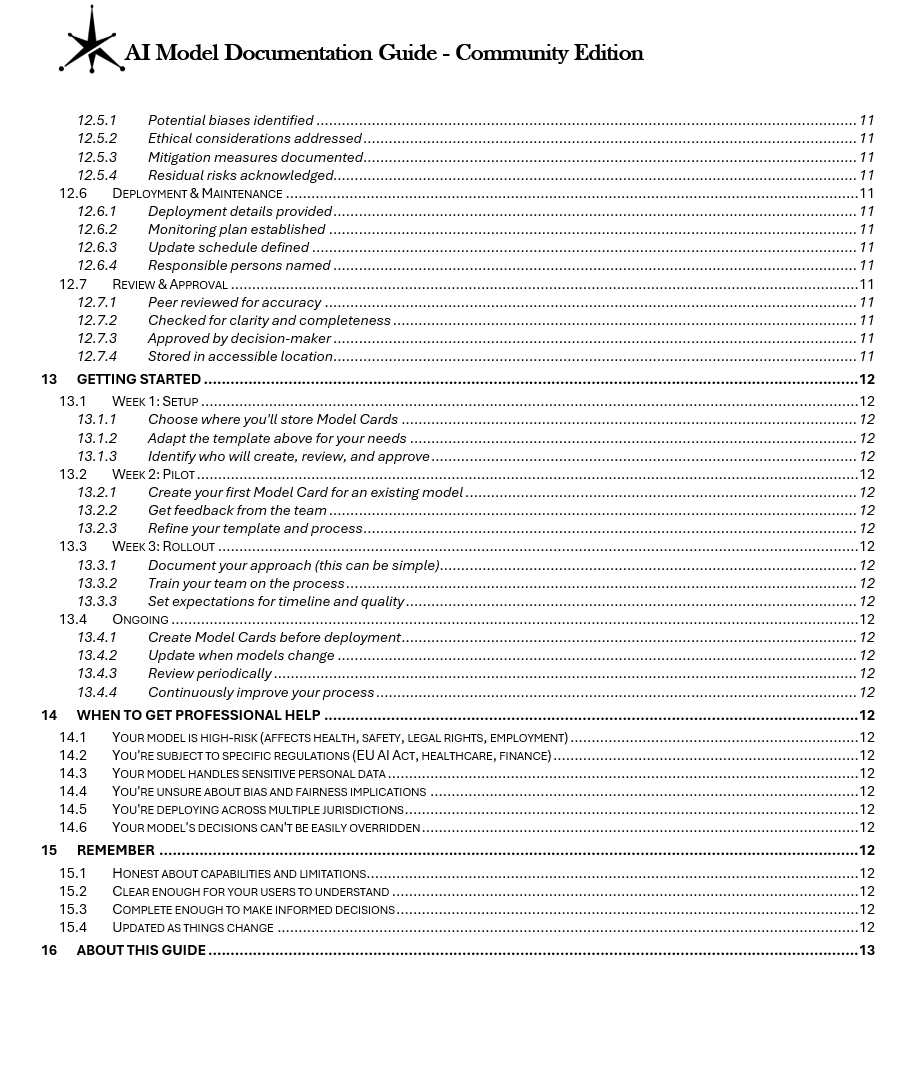
The guide includes sections on Model Card fundamentals, implementation timing, approval workflows, storage recommendations, compliance quick reference (EU AI Act, ISO 42001, NIST AI RMF), common pitfalls, templates, completion checklist, and a three-week getting started roadmap.
________________________________________________________________________________
Why This Matters
AI transparency requirements are expanding. The EU AI Act requires technical documentation for high-risk AI systems including intended purpose, performance characteristics, and known limitations (Articles 11 and 13). ISO/IEC 42001 establishes AI management system requirements that include documentation practices. The NIST AI Risk Management Framework emphasizes documented governance and measurement.
Model Cards provide a standardized format for this documentation. Google introduced Model Cards in 2019 as a transparency tool. Major ML platforms including Hugging Face now incorporate Model Card functionality. Organizations need practical approaches for creating this documentation without extensive compliance teams.
The gap between AI development pace and documentation practices creates risk. Models deployed without clear documentation of limitations, intended use cases, and performance variations can be misused or fail unexpectedly. This guide addresses that gap through structured templates and clear role definitions.
Framework Alignment
This guide references three major AI governance frameworks:
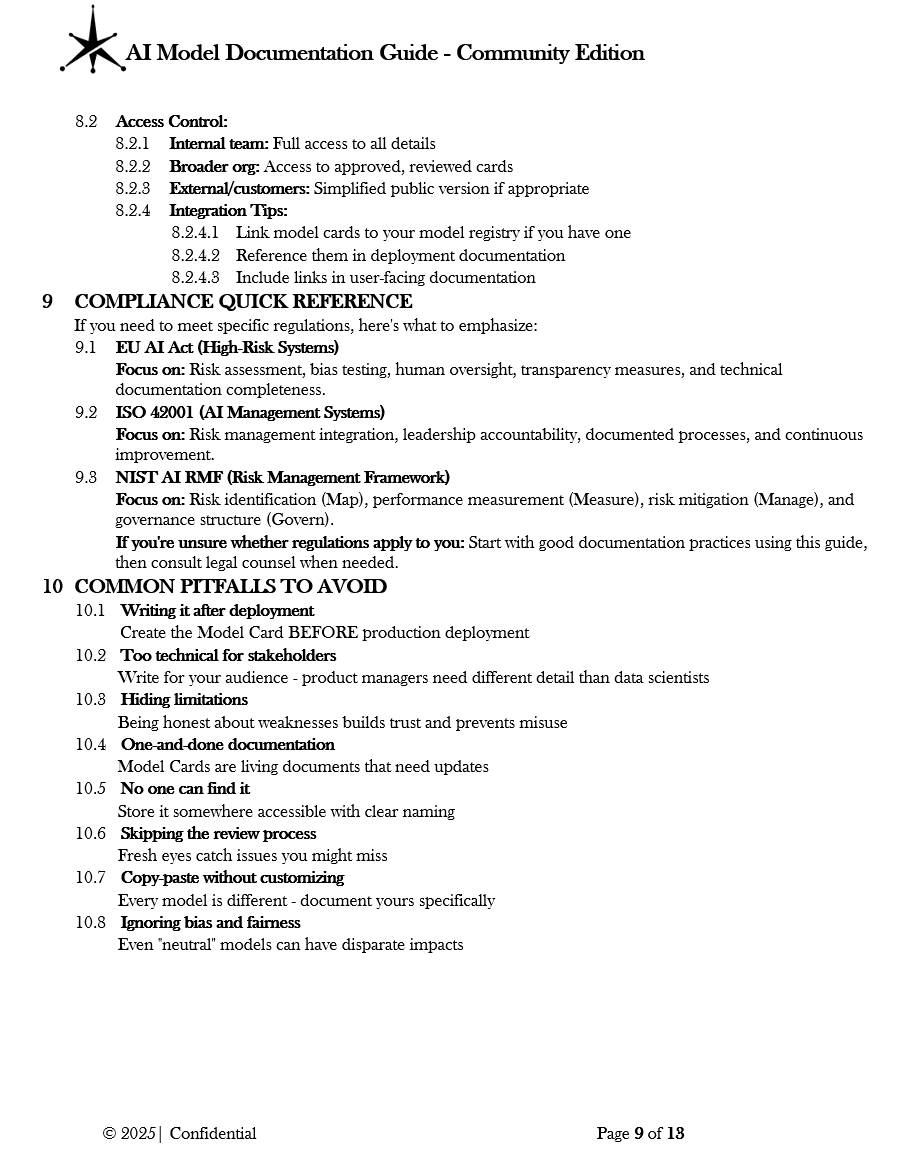
EU AI Act: The guide includes documentation elements aligned with technical documentation requirements for high-risk AI systems. Model Card templates address system purpose, performance metrics, limitations, data characteristics, and human oversight considerations referenced in the Act.
NIST AI Risk Management Framework: Documentation practices map to the NIST AI RMF functions of govern, map, measure, and manage. The guide emphasizes risk identification, performance measurement, and monitoring aligned with NIST guidance.
ISO/IEC 42001: The Model Card structure supports AI management system documentation requirements for transparency, risk management, and continuous improvement specified in the standard.
The Community Edition provides foundational alignment. Detailed regulatory crosswalks and compliance mapping tables are included in the Professional Edition.
Key Features
Based directly on the guide's table of contents and documented capabilities:
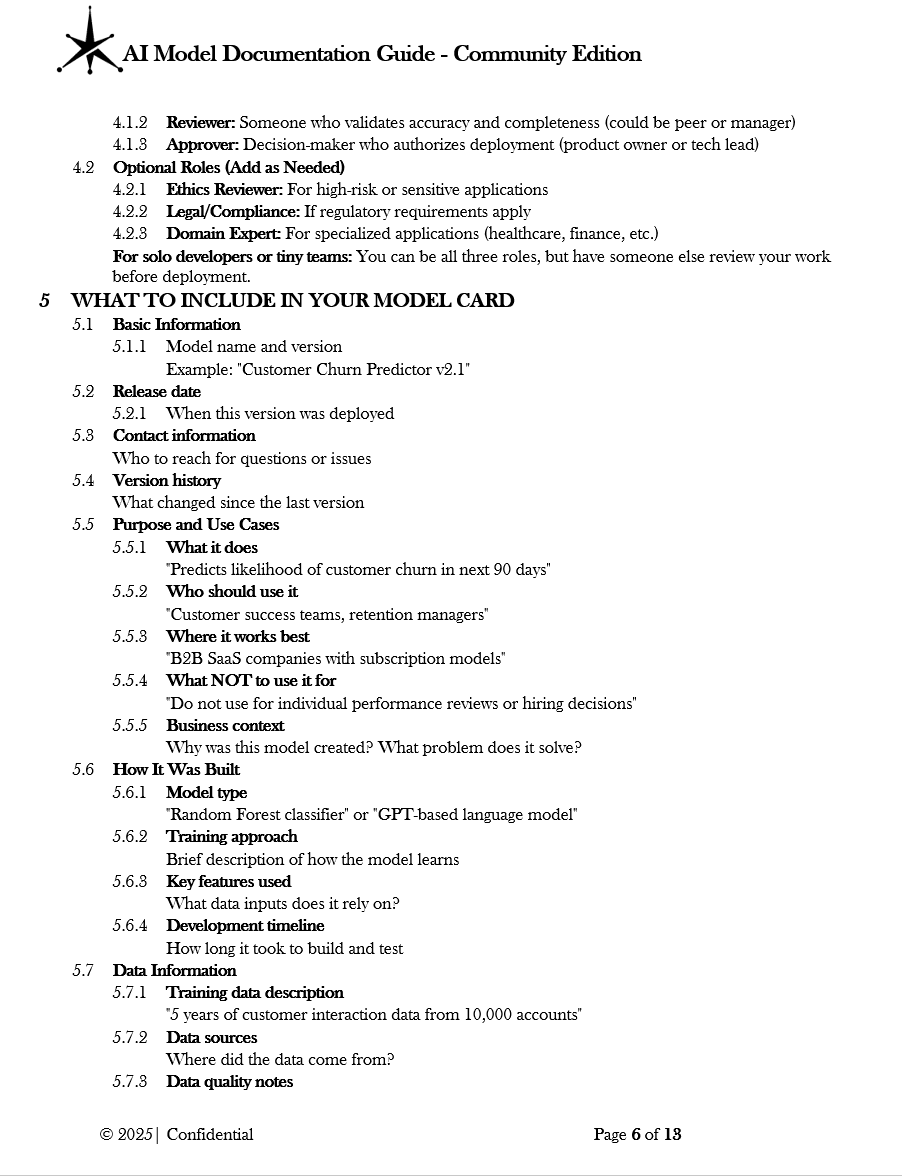
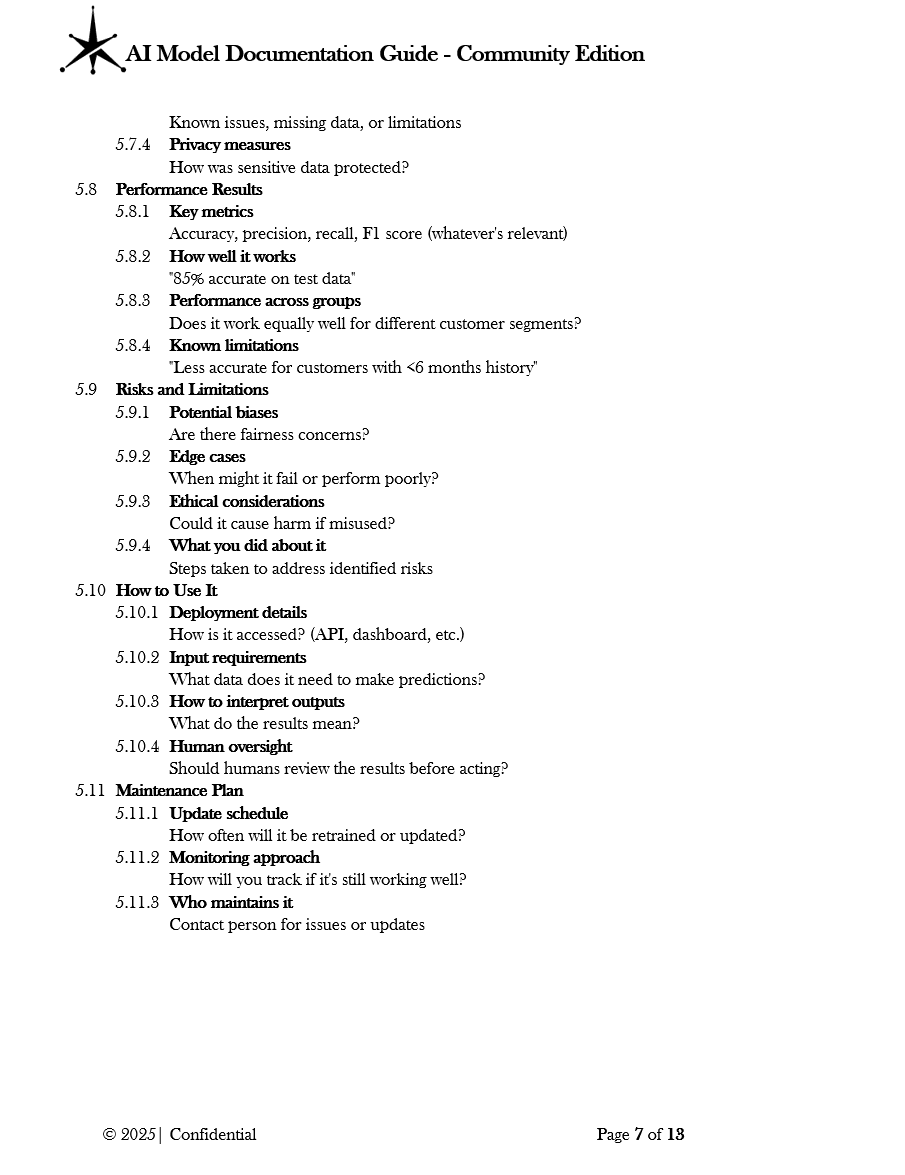
Model Card Structure: Template covering basic information, purpose and use cases, technical details, data information, performance results, risks and limitations, deployment guidance, and maintenance plans
Role Definitions: Clear responsibilities for Creator (builds/documents model), Reviewer (validates accuracy), Approver (authorizes deployment), plus optional roles for ethics review, legal counsel, and domain experts
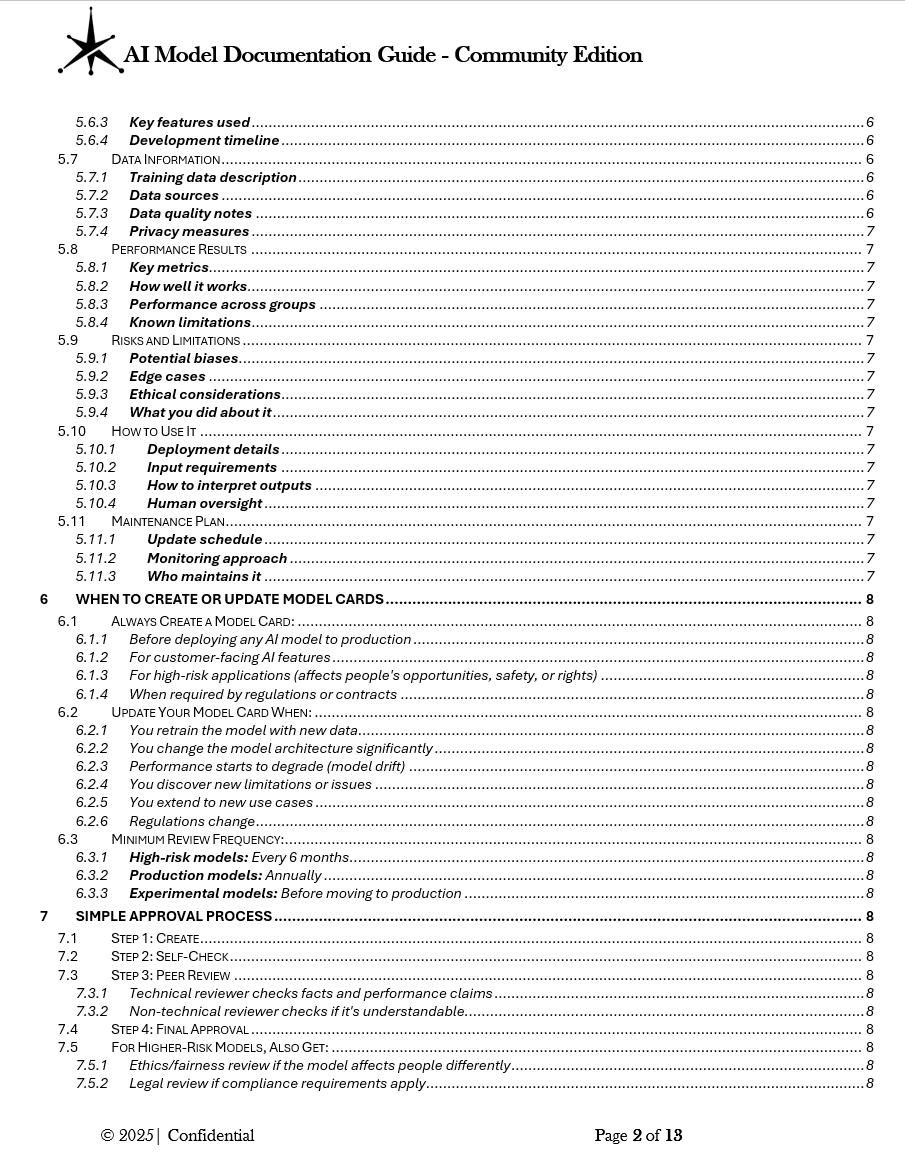
Implementation Timeline: Guidance on when to create Model Cards (pre-deployment, customer-facing systems, high-risk applications) and update triggers (retraining, architecture changes, performance degradation)
Approval Process: Four-step workflow covering creation, self-check, peer review, and final approval with higher-risk model considerations
Risk Domain Coverage: Documentation approach for bias and fairness, transparency and explainability, data quality and integrity, security and privacy, and regulatory alignment
Storage Recommendations: Requirements for centralized location, version control, accessibility, backup procedures, and access control levels
Quick Completion Checklist: Self-assessment tool covering basic information, purpose and use, technical details, performance metrics, risk management, and review approval
Getting Started Roadmap: Three-week implementation plan from setup through pilot creation and rollout
Comparison Table: Basic Approach vs. Documented Guide
| Element | Basic Documentation | This Guide Provides |
| Structure | Ad-hoc notes per team | Standardized Model Card template with defined sections |
| Roles | Undefined responsibilities | Clear Creator/Reviewer/Approver definitions with optional specialists |
| Timing | Document if/when asked | Specific triggers for creation and updates with review frequency |
| Approval | Varies by individual | Documented four-step process with peer and technical review |
| Risk Coverage | Technical metrics only | Five risk domains including bias, transparency, data quality, security, compliance |
| Storage | Email attachments or local files | Centralized requirements with version control and access levels |
| Implementation | Learn through trial and error | Three-week rollout plan with pilot process and team training |
| Compliance Alignment | Generic references | Specific connections to EU AI Act, NIST AI RMF, and ISO 42001 |
FAQ Section
Q: What is a Model Card?
A: A Model Card is standardized documentation for an AI model that describes its purpose, how well it works, known limitations, intended users, and inappropriate uses. Think of it as a nutrition label for AI systems. The concept was introduced by Google in 2019 and is now referenced in major AI governance frameworks.
Q: How long does it take to create a Model Card using this guide?
A: Based on the guide's estimates, initial setup for your organization takes 2-3 hours to establish your documentation approach. Creating an individual Model Card typically requires 3-5 hours depending on model complexity. High-risk models requiring additional reviews may take longer.
Q: Do I need a large governance team to use this?
A: No. The guide is designed for small teams without extensive governance infrastructure. The minimal setup requires three roles: Creator (the person who builds the model), Reviewer (someone who validates accuracy), and Approver (decision-maker for deployment). For solo developers or tiny teams, one person can fill multiple roles with external peer review.
Q: When should I create or update Model Cards?
A: The guide recommends creating Model Cards before deploying any AI model to production, for customer-facing AI features, for high-risk applications, and when required by regulations or contracts. Update Model Cards when you retrain with new data, change model architecture significantly, observe performance degradation, discover new limitations, extend to new use cases, or when regulations change. Minimum review frequency: high-risk models every 6 months, production models annually.
Q: What file formats work with this guide?
A: Documents are optimized for Microsoft Word and Excel to ensure proper formatting and collaborative editing capabilities. The guide references simple Markdown as an option for small teams. Integration guidance is provided for Google Model Card Toolkit, Hugging Face Model Cards, and Microsoft Azure ML.
Q: Does this guarantee compliance with regulations?
A: No. The guide provides templates and frameworks designed to support compliance efforts, but does not guarantee regulatory approval. Organizations should consult legal counsel for specific compliance requirements. The guide indicates when professional help is recommended, including for high-risk systems, specific regulatory contexts (EU AI Act, healthcare, finance), sensitive personal data, bias and fairness concerns, multi-jurisdiction deployments, and systems with decisions that can't be easily overridden.
Ideal For
- Data scientists and ML engineers building models requiring transparency documentation
- Product managers responsible for AI features and need to demonstrate system capabilities and limitations
- Technical leads making deployment decisions based on documented model characteristics
- Small to mid-size organizations establishing AI documentation practices without large compliance teams
- Teams preparing for AI transparency requirements in the EU AI Act or industry standards
- Organizations needing to demonstrate due diligence in AI development and deployment
- Compliance officers building initial AI governance documentation frameworks