- Version 1
- Download
- File Size 0.00 KB
- File Count 0
- Create Date October 29, 2025
- Last Updated October 29, 2025
- Download
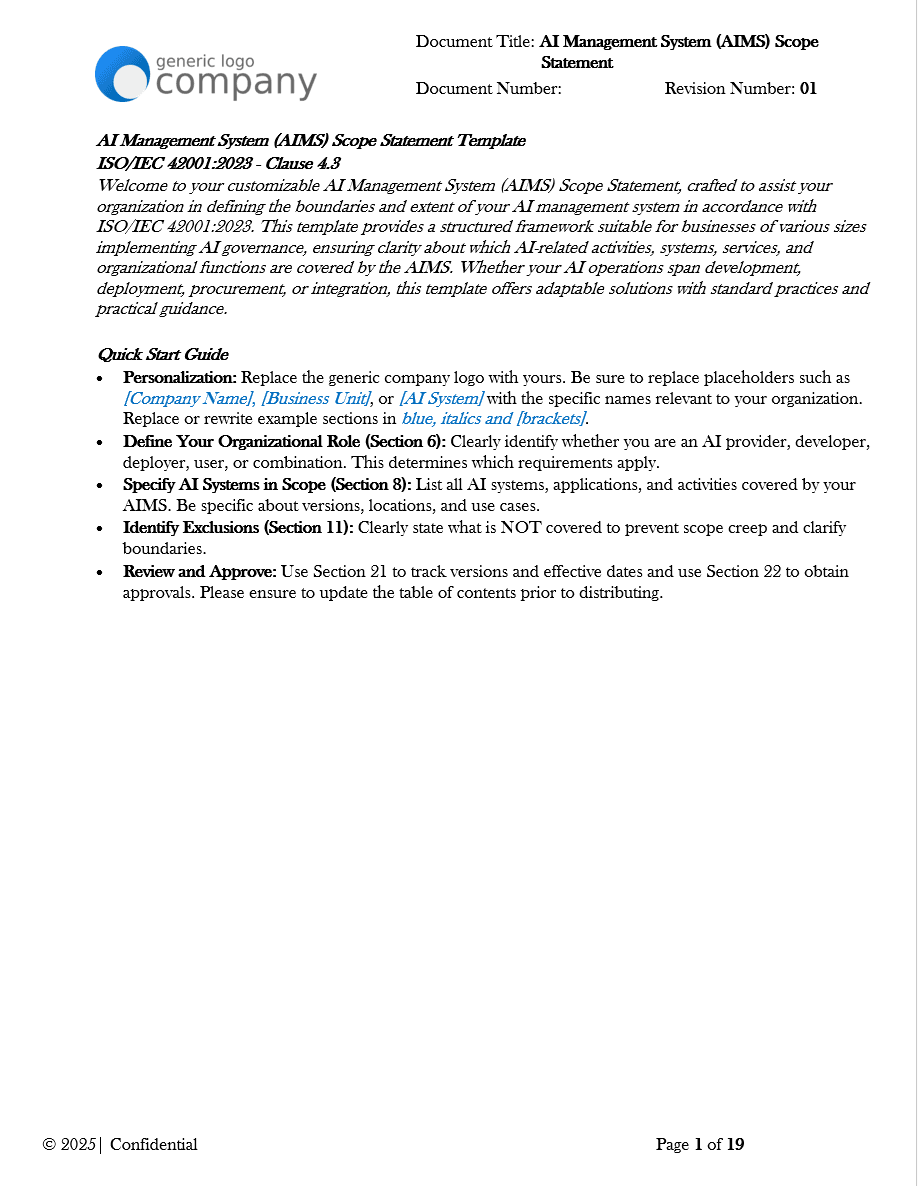
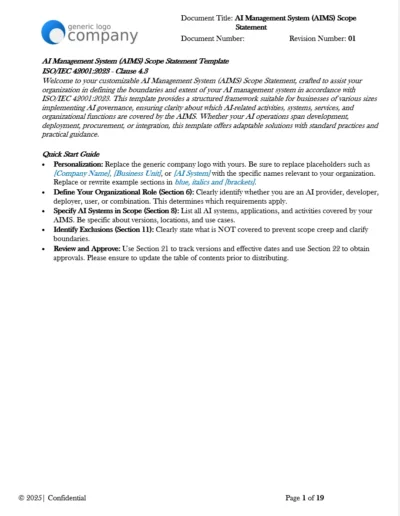
AI Management System (AIMS) Scope Statement Template
ISO/IEC 42001:2023 - Clause 4.3 Compliance Documentation
A customizable template designed to support organizations in establishing clear boundaries for their AI Management System, addressing ISO/IEC 42001:2023 requirements for scope determination and organizational context analysis.
Accelerate your ISO 42001 Journey: [Buy Now]
Get 40% off (enter your promo code "AIGOV2025" at checkout).
Digital templates; emailed after purchase. Read our Terms of Service
AI Management System (AIMS) Scope Statement Template
This template provides structured frameworks for organizations implementing AI governance under ISO/IEC 42001:2023. The document includes sections for defining which AI systems, activities, services, and organizational functions fall within your AIMS boundaries, along with guidance for documenting internal and external context factors, interested party requirements, and compliance interfaces.
Organizations will need to customize placeholders, replace example content, and adapt sections to reflect their specific AI operations, organizational structure, and regulatory environment. The template includes guidance for completing organizational context analysis, defining AI ecosystem roles, mapping lifecycle coverage, and documenting exclusions with proper justifications.
Key Benefits
✓ Provides structured framework for ISO/IEC 42001:2023 Clause 4.3 scope determination ✓ Includes sections for organizational context analysis covering internal and external factors ✓ Contains guidance for defining AI ecosystem roles (provider, developer, deployer, user) ✓ Supports documentation of AI lifecycle phases from planning through decommissioning ✓ Includes frameworks for identifying exclusions and documenting justifications ✓ Provides structures for documenting interfaces with existing management systems ✓ Contains sections for scope maintenance, review triggers, and change management ✓ Includes compliance reference sections for ISO 42001, EU AI Act, and NIST AI RMF
⚠️ Important: Customization Requirements
This template provides professional structure and guidance but requires substantial organizational effort to complete. Organizations should expect to invest hours of internal work for discovery, stakeholder analysis, customization of all sections, and validation. This template does not guarantee ISO 42001 certification and does not eliminate the need for organizational analysis, stakeholder alignment, or expert consultation on complex scope decisions. It is a starting framework designed to save research and formatting time, not a completed solution.
Who This Template Is Designed For
This template is designed for organizations establishing or maintaining AI Management Systems under ISO/IEC 42001:2023, including:
- Compliance officers implementing AI governance frameworks
- Risk managers defining AI system boundaries and oversight
- Information security teams integrating AI controls with existing management systems
- Legal teams documenting regulatory compliance scope
- AI governance councils establishing organizational AI policies
- Chief AI Officers structuring enterprise AI management approaches
What's Included
The template contains structured sections covering:
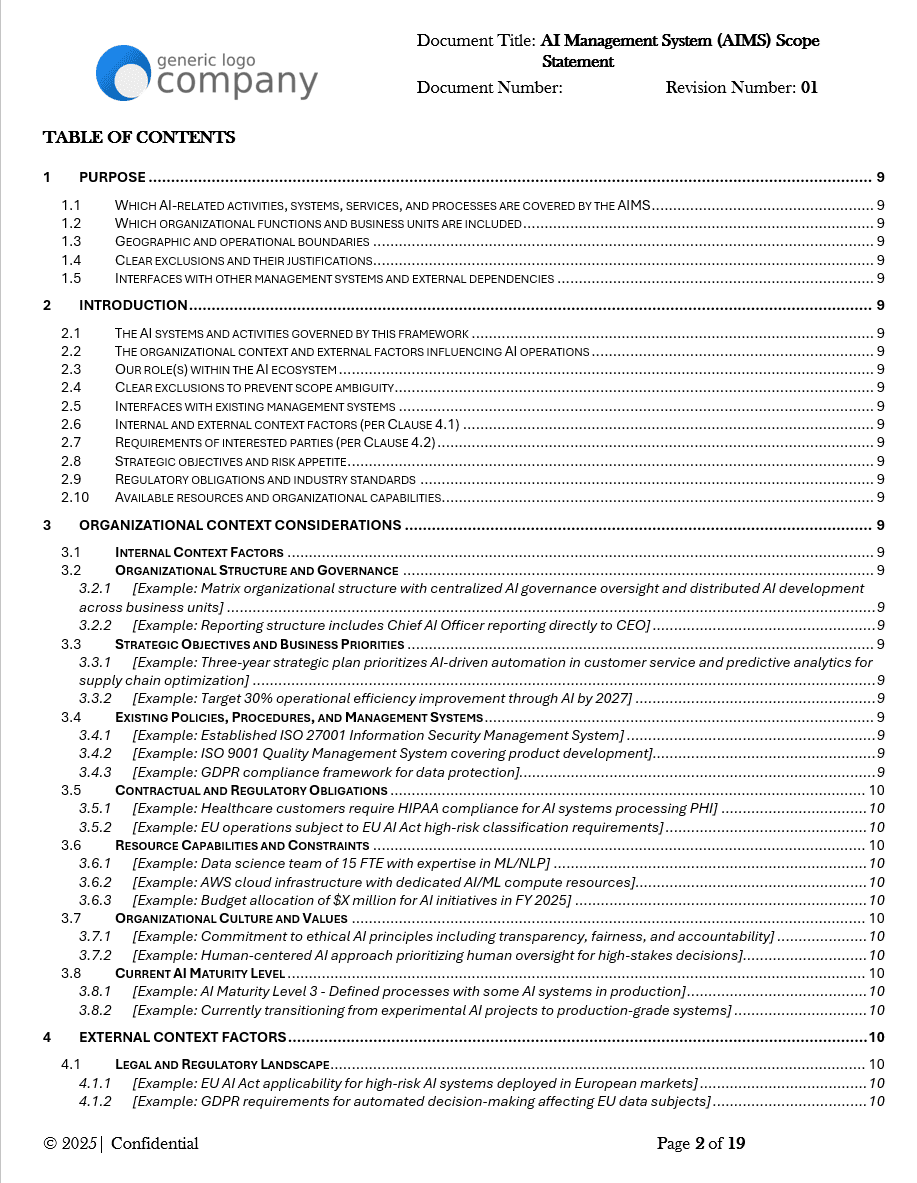
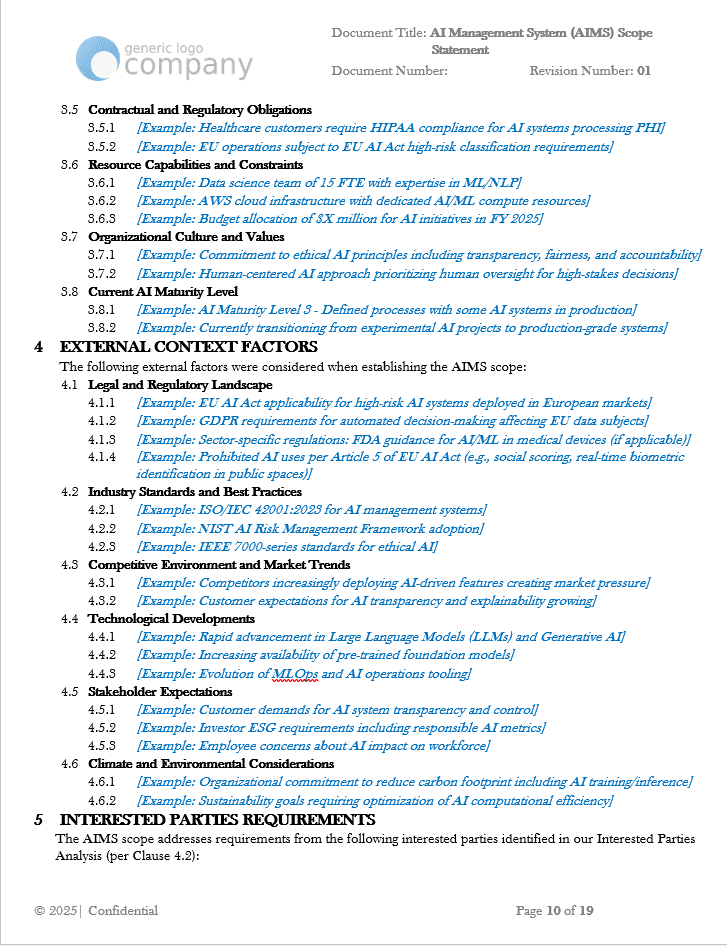
- Organizational context analysis (internal and external factors per Clause 4.1)
- Interested parties requirements documentation (per Clause 4.2)
- AI ecosystem role definitions (provider, developer, deployer, user, distributor)
- AI lifecycle phase coverage mapping (8 phases from planning to decommissioning)
- AI systems and activities inventory frameworks
- Organizational functions coverage documentation
- Geographic scope definition and exclusion documentation
- Integration approaches with ISO 27001, ISO 9001, GDPR/ISO 27701, ISO 22301
- Third-party AI system governance frameworks
- Scope maintenance, review frequency, and change management processes
- Version control and approval documentation tables
Why This Matters
ISO/IEC 42001:2023 Clause 4.3 requires organizations to determine the boundaries and applicability of their AI Management System. This scope determination is foundational for compliance because it establishes which AI activities, systems, and organizational functions are governed by the AIMS, which controls apply, and how the system interfaces with existing organizational processes.
Organizations implementing AI systems face increasing regulatory requirements. The EU AI Act (Regulation 2024/1689) requires risk management systems and quality management approaches. NIST AI Risk Management Framework emphasizes governance functions and organizational culture. ISO/IEC 42001:2023 provides a structured management system approach requiring clear scope definition as the basis for risk assessment, control selection, and compliance demonstration.
Without properly documented scope boundaries, organizations may face unclear accountability, inconsistent governance application, compliance gaps, and difficulties demonstrating regulatory adherence during audits or assessments. This template provides frameworks for organizations to systematically analyze their context, define their AI ecosystem roles, document what's included and excluded from governance, and establish maintenance processes.
Framework Alignment
This template is designed to support documentation requirements for:
ISO/IEC 42001:2023
- Clause 4.3: Determining the scope of the AI management system
- Clause 4.1: Understanding the organization and its context
- Clause 4.2: Understanding the needs and expectations of interested parties
EU AI Act (Regulation 2024/1689)
- Article 9: Risk management system requirements
- Article 17: Quality management system provisions
- Article 6 and Annex III: High-risk AI system classification
NIST AI Risk Management Framework (AI RMF 1.0)
- Govern Function: Organizational AI risk management culture and processes
ISO/IEC 22989:2022
- AI concepts and terminology standards
Related Management Systems
- ISO 27001: Information Security Management System integration
- ISO 9001: Quality Management System alignment
- ISO 27701/GDPR: Privacy Information Management interfaces
- ISO 22301: Business Continuity Management connections
Key Features
Organizational Context Analysis Framework The template includes structured sections for documenting internal context factors (organizational structure, strategic objectives, existing management systems, contractual obligations, resource capabilities, culture and values, AI maturity level) and external context factors (legal and regulatory landscape, industry standards, competitive environment, technological developments, stakeholder expectations, environmental considerations).
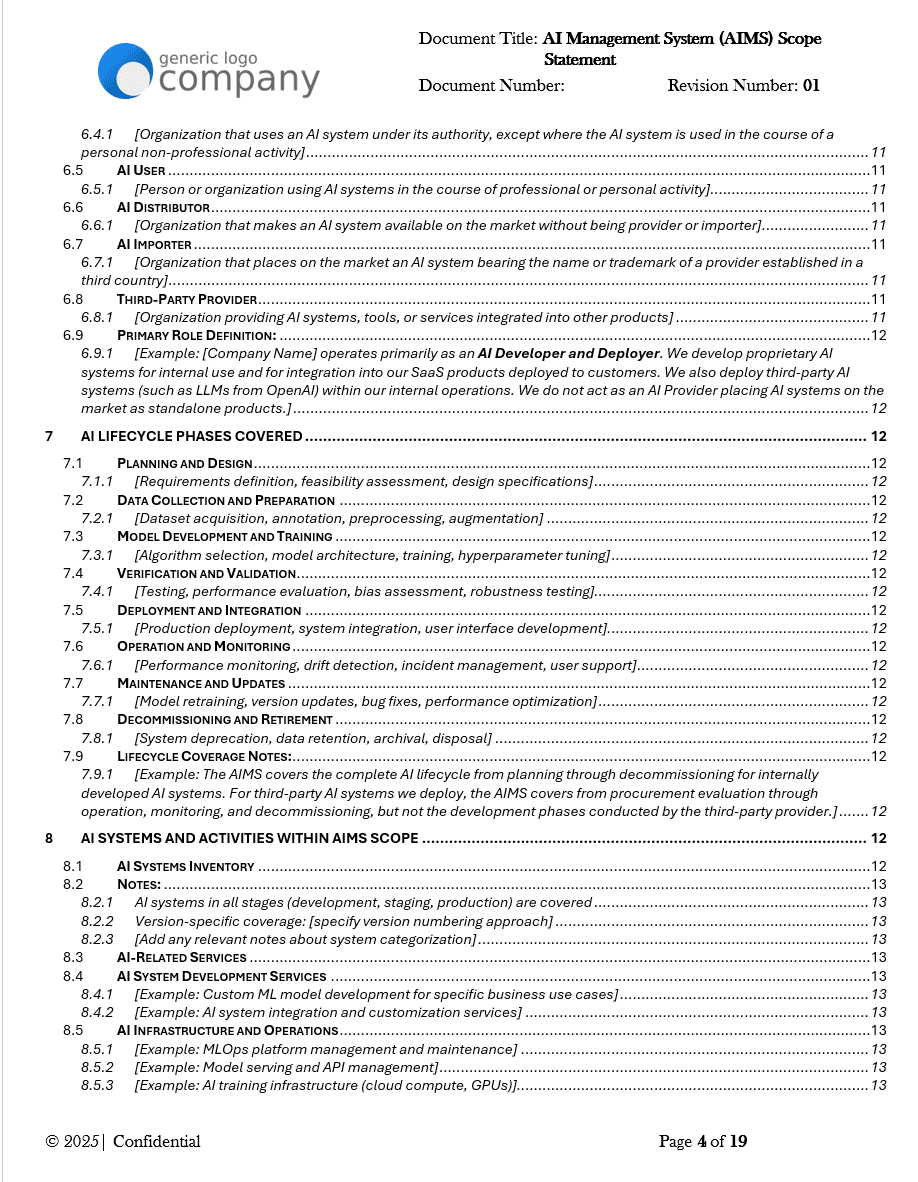
AI Ecosystem Role Definition Provides definitions and guidance for documenting organizational roles including AI Provider, AI Developer, AI Deployer, AI User, AI Distributor, AI Importer, and Third-Party Provider, aligned with EU AI Act terminology and ISO/IEC 42001 role classifications.
Lifecycle Phase Coverage Documentation Contains sections for documenting coverage across eight AI lifecycle phases: Planning and Design, Data Collection and Preparation, Model Development and Training, Verification and Validation, Deployment and Integration, Operation and Monitoring, Maintenance and Updates, and Decommissioning and Retirement.
Inventory and Classification Frameworks Includes table structures for documenting AI systems with fields for system name, type, risk classification, status, and primary use case, along with third-party AI system tracking with provider information, governance approach, and risk level.
Exclusions Documentation with Justification Provides frameworks for clearly documenting what falls outside AIMS scope (research systems, legacy systems being decommissioned, third-party tools for non-critical functions, non-AI automated systems) with structured justification criteria including outside organizational control, insufficient risk, non-AI technology, temporary status, and resource constraints.
Management System Integration Guidance Contains sections for documenting how the AIMS interfaces with ISO 27001 Information Security Management Systems, ISO 9001 Quality Management Systems, GDPR/ISO 27701 Privacy frameworks, ISO 22301 Business Continuity Management, and industry-specific standards, including shared processes and integration approaches.
Scope Maintenance and Change Management Includes frameworks for documenting review frequency (annual, upon significant changes, following management review, as part of internal audit), triggers for scope changes (new systems, significant system changes, organizational changes, regulatory changes, stakeholder requirements), and change management processes (proposal, impact analysis, review and approval, documentation update, communication, effectiveness review).
Compliance Reference Sections Contains structured references to ISO/IEC 42001:2023 requirements, EU AI Act articles, NIST AI RMF functions, and ISO/IEC 22989 concepts, supporting organizations in mapping their scope documentation to specific regulatory and standards requirements.
Comparison Table: Generic Approach vs. Professional Template
| Aspect | Generic Approach | AI Management System Scope Statement Template |
|---|---|---|
| Scope Definition | Vague boundaries without systematic analysis of what's included or excluded | Structured frameworks for documenting AI systems, activities, services, organizational functions, and geographic boundaries with clear exclusion justifications |
| Organizational Context | Limited consideration of internal and external factors influencing scope | Comprehensive sections covering Clause 4.1 context analysis including strategic objectives, resource capabilities, regulatory landscape, stakeholder expectations, and technological developments |
| Role Clarity | Unclear organizational position in AI ecosystem | Explicit role definitions for AI Provider, Developer, Deployer, User, Distributor, Importer with guidance for documenting primary roles aligned with regulatory terminology |
| Lifecycle Coverage | Ambiguous coverage across AI development and deployment phases | Documented coverage across eight distinct lifecycle phases with guidance for differentiating internally developed vs. third-party AI system coverage |
| Management System Integration | Disconnected from existing ISO certifications and compliance frameworks | Structured interfaces with ISO 27001, ISO 9001, GDPR/ISO 27701, ISO 22301 including shared processes and integration approaches |
| Maintenance Process | Static document without systematic review or change management | Defined review frequency, change triggers, impact analysis procedures, approval processes, and effectiveness review mechanisms |
FAQ Section
Q: What regulatory frameworks does this template address? A: This template is designed to support ISO/IEC 42001:2023 Clause 4.3 scope determination requirements. It includes reference sections for the EU AI Act (Regulation 2024/1689), NIST AI Risk Management Framework, and ISO/IEC 22989 terminology standards. Organizations must independently assess their specific regulatory obligations and customize the template accordingly.
Q: Does this template guarantee ISO 42001 certification? A: No. This template provides documentation frameworks for one clause of ISO/IEC 42001:2023. Certification requires implementation of all applicable standard requirements, supporting policies and procedures, operational controls, and successful third-party audit. This template supports scope documentation but does not constitute a complete AIMS or guarantee certification outcomes.
Q: What customization is required and how long does it take? A: Organizations should expect to invest 80-100 hours of internal effort to properly customize this template. This includes conducting stakeholder interviews and organizational discovery, inventorying all AI systems, replacing all placeholder text with actual organizational details, rewriting all example content for specific context, completing tables with actual system information, documenting actual organizational roles and context factors, obtaining stakeholder review and approval, and establishing maintenance processes. The template provides structure and guidance but requires substantial organizational analysis and customization to produce a certification-ready scope statement.
Q: Can this template be used for organizations with multiple AI ecosystem roles? A: Yes. The template includes sections for documenting organizations that operate in multiple capacities (for example, as both AI Developer and AI Deployer). Organizations should document all applicable roles and clarify how scope boundaries differ based on role type.
Q: How does this template integrate with existing management systems? A: The template includes dedicated sections for documenting interfaces with ISO 27001, ISO 9001, GDPR/ISO 27701, and ISO 22301 management systems. It provides frameworks for identifying shared processes (document control, change management, internal audits, management review) and documenting integration approaches. Organizations should adapt these sections based on their existing certifications.
Q: What file format is this template provided in? A: Documents are optimized for Microsoft Word to ensure proper formatting and collaborative editing capabilities. Organizations can edit placeholders, tables, and sections directly within Word, maintaining document structure and formatting throughout customization.
Q: How should exclusions from scope be justified? A: The template provides structured justification criteria including outside organizational control, insufficient risk, non-AI technology classification, temporary status, and resource constraints. Organizations should document each exclusion with clear rationale and commit to periodic review of whether excluded items should be brought into scope.
Ideal For Section
This template is designed for use by:
- Compliance Officers and Risk Managers establishing AI governance frameworks and defining management system boundaries for regulatory compliance demonstration
- Information Security Teams integrating AI-specific controls with existing ISO 27001 Information Security Management Systems
- Quality Managers aligning AI governance with ISO 9001 Quality Management System processes
- Legal and Privacy Teams documenting AI system coverage for GDPR, EU AI Act, and sector-specific regulatory requirements
- Chief AI Officers and AI Governance Councils defining organizational AI strategies, roles, and oversight boundaries
- Internal Audit Teams establishing audit scope for AI management system assessments
- External Consultants supporting organizations with ISO 42001 implementation projects
- Organizations seeking ISO 42001 certification requiring foundational scope documentation as part of AIMS development
⚖️ Differentiator
This template provides structured documentation frameworks specifically designed for ISO/IEC 42001:2023 Clause 4.3 scope determination requirements. Unlike generic policy templates, this document includes dedicated sections for organizational context analysis addressing both internal factors (strategic objectives, resource capabilities, existing management systems, organizational culture) and external factors (regulatory landscape, industry standards, competitive environment, technological developments, stakeholder expectations) as required by Clause 4.1.
The template distinguishes between different AI ecosystem roles (provider, developer, deployer, user, distributor, importer) using definitions aligned with both ISO/IEC 42001 and EU AI Act terminology. It provides frameworks for documenting coverage across complete AI lifecycle phases from planning through decommissioning, with guidance for differentiating scope coverage between internally developed and third-party AI systems.
Organizations implementing multiple management system standards will benefit from integrated interface sections documenting how the AIMS connects with ISO 27001, ISO 9001, GDPR/ISO 27701, and ISO 22301 frameworks, including identification of shared processes and integration approaches. The template includes systematic maintenance processes with defined review frequency, change triggers, impact analysis procedures, and effectiveness review mechanisms, supporting ongoing scope adequacy rather than static documentation.
The structured table formats for AI systems inventory, third-party AI tracking, version history, and approval documentation provide consistency across organizational documentation and support audit evidence requirements. By including both included and excluded elements with clear justification criteria, the template supports organizations in preventing scope ambiguity and establishing defensible boundaries for their AI Management System implementation.