- Version
- Download
- File Size 0.00 KB
- File Count 0
- Create Date September 18, 2025
- Last Updated September 18, 2025
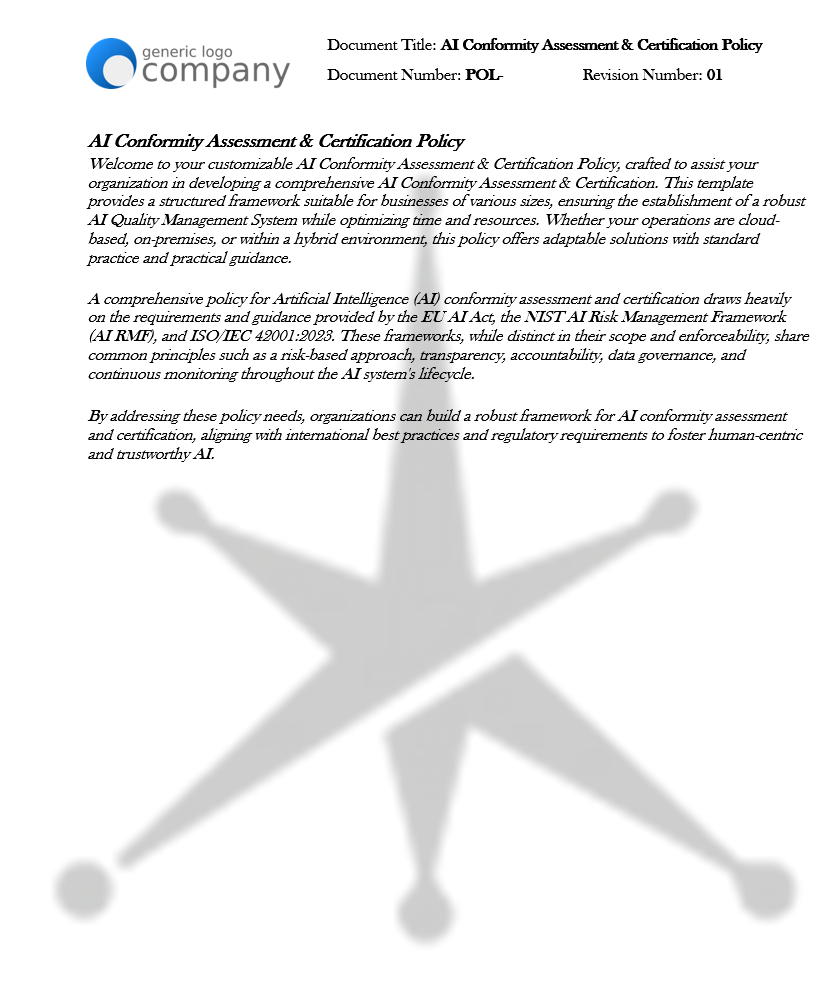
AI Conformity Assessment and Certification Policy
A complete governance policy framework integrating EU AI Act, NIST AI RMF, and ISO/IEC 42001:2023 requirements into a unified, board-ready compliance structure.
Conform with EU AI ACT, ISO 42001 with our Template [Buy Now]
Digital templates; emailed after purchase. Read our Terms of Service
Get 40% off (enter your promo code "AIGOV2025" at checkout).
AI Conformity Assessment and Certification Policy
This enterprise-grade policy establishes a comprehensive governance framework for AI conformity assessment and certification. Unlike piecing together multiple policies for different regulations, this integrated framework addresses EU AI Act, NIST AI RMF, and ISO/IEC 42001:2023 requirements in one cohesive document. Organizations customize it with their specific details and context, similar to adopting any enterprise policy framework. The policy architecture, regulatory mappings, and governance structure are complete and board-ready.
Key Benefits:
- ✓ Integrated governance framework across three major regulations
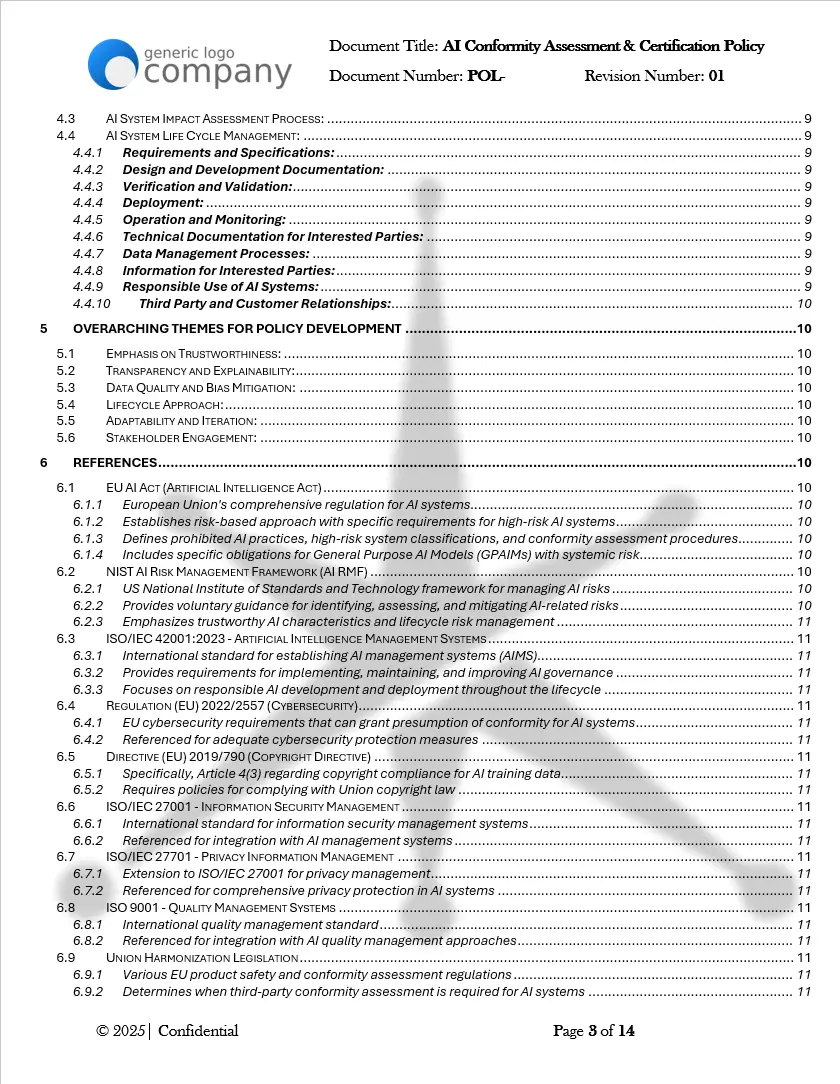
- ✓ Board-ready policy structure with 50+ comprehensive sections
- ✓ Complete regulatory requirement mapping with specific citations
- ✓ Risk-based classification system per EU AI Act Annex III
- ✓ 27 regulatory definitions ensuring consistent terminology
- ✓ Clear roles, responsibilities, and accountability structures
- ✓ Audit-defensible documentation of compliance obligations
Who Uses This?
Designed for enterprises, regulated organizations, and companies deploying AI systems in global markets requiring formal governance policies for board approval and regulatory compliance.
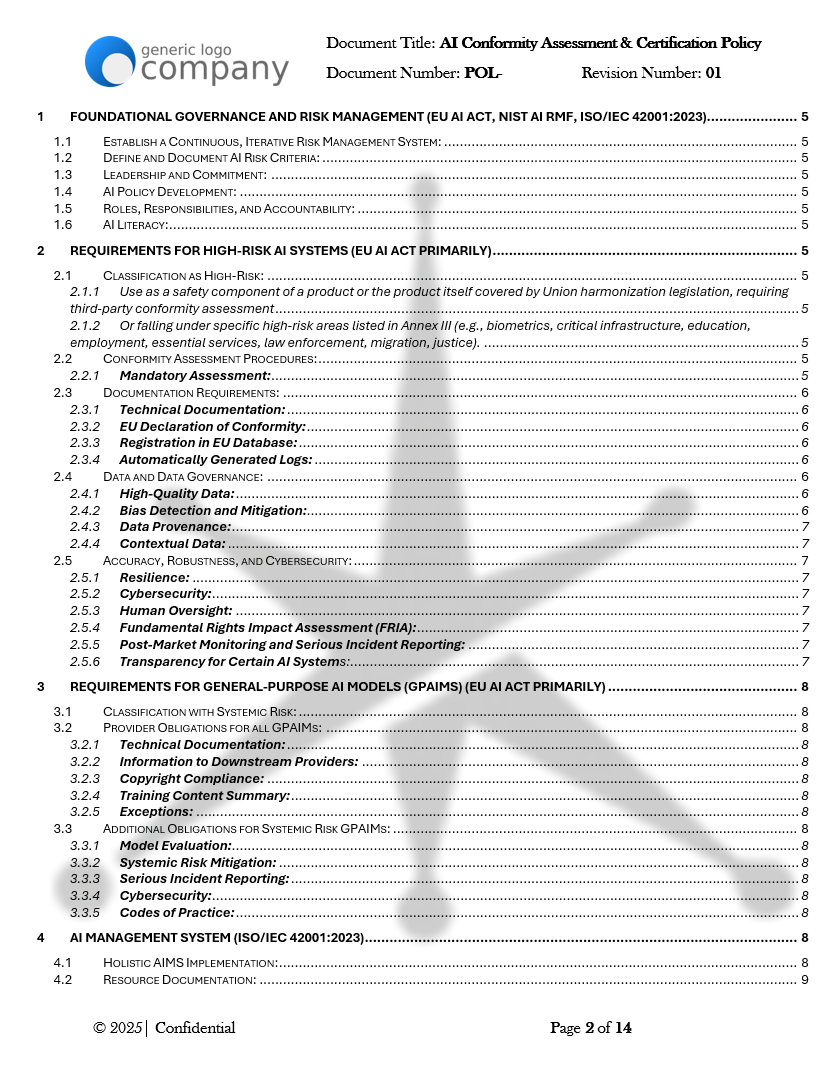
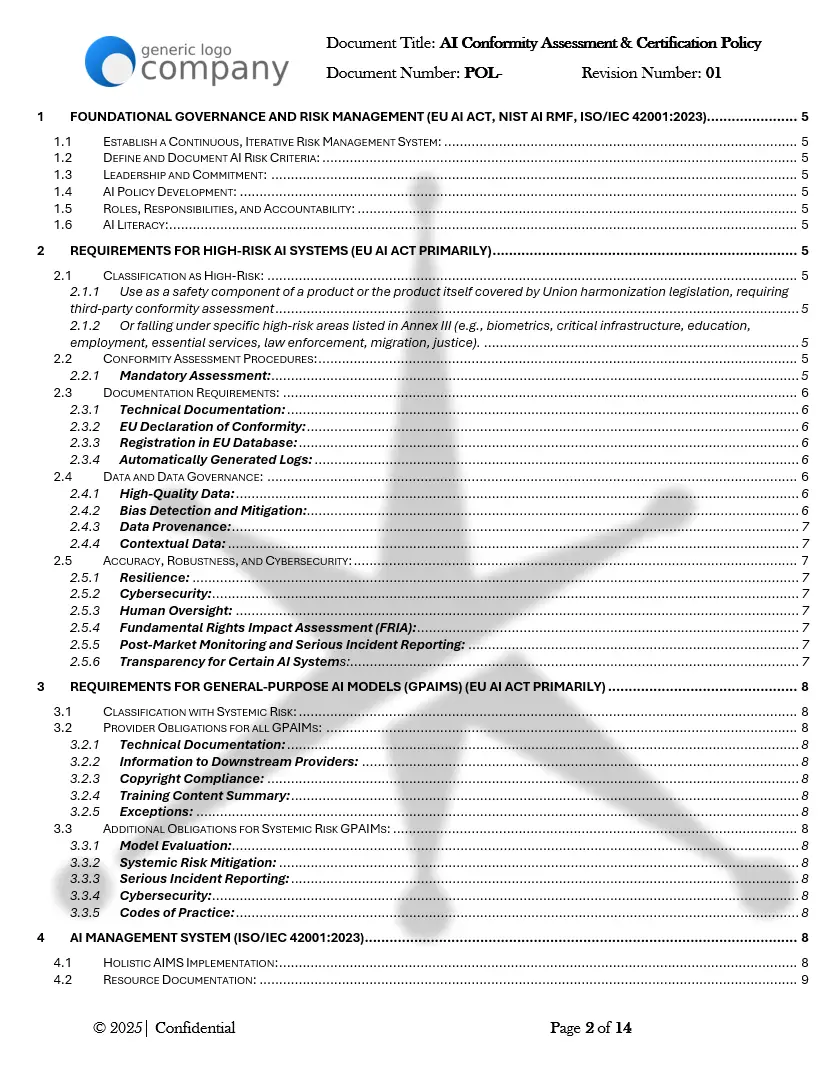
The policy includes 9 main sections establishing foundational governance, high-risk AI system requirements, GPAIM obligations, management system integration, and comprehensive regulatory references.
Understanding Policy vs. Procedures:
This is a governance policy, not an implementation guide. Like all enterprise policies, it establishes WHAT the organization commits to doing and WHY, not HOW to do it. Implementation procedures, forms, and tools are separate operational documents developed under this policy's governance framework.
Think of it this way:
- Policy (This Document): "We will conduct conformity assessments for high-risk AI systems per EU AI Act requirements"
- Procedure (Separate): Step-by-step instructions for conducting assessments
- Tools (Separate): Assessment forms and checklists
The Strategic Value:
Most organizations struggle to understand how EU AI Act, NIST AI RMF, and ISO 42001 relate to each other. This policy integrates all three into a single governance framework, eliminating confusion and ensuring comprehensive coverage. Without this integration, organizations risk:
- Contradictory policies across frameworks
- Gaps in regulatory coverage
- Excessive documentation overlap
- Audit findings for incomplete governance
What Makes This Board-Ready:
- Executive-Appropriate Language: Technical requirements translated into governance commitments
- Complete Regulatory Mapping: Demonstrates comprehensive understanding of obligations
- Risk-Based Structure: Aligns with enterprise risk management approaches
- Clear Accountability: Defines roles and responsibilities at governance level
- Approval-Ready Format: Includes version control and approver sections
Framework Coverage:
EU AI Act Compliance:
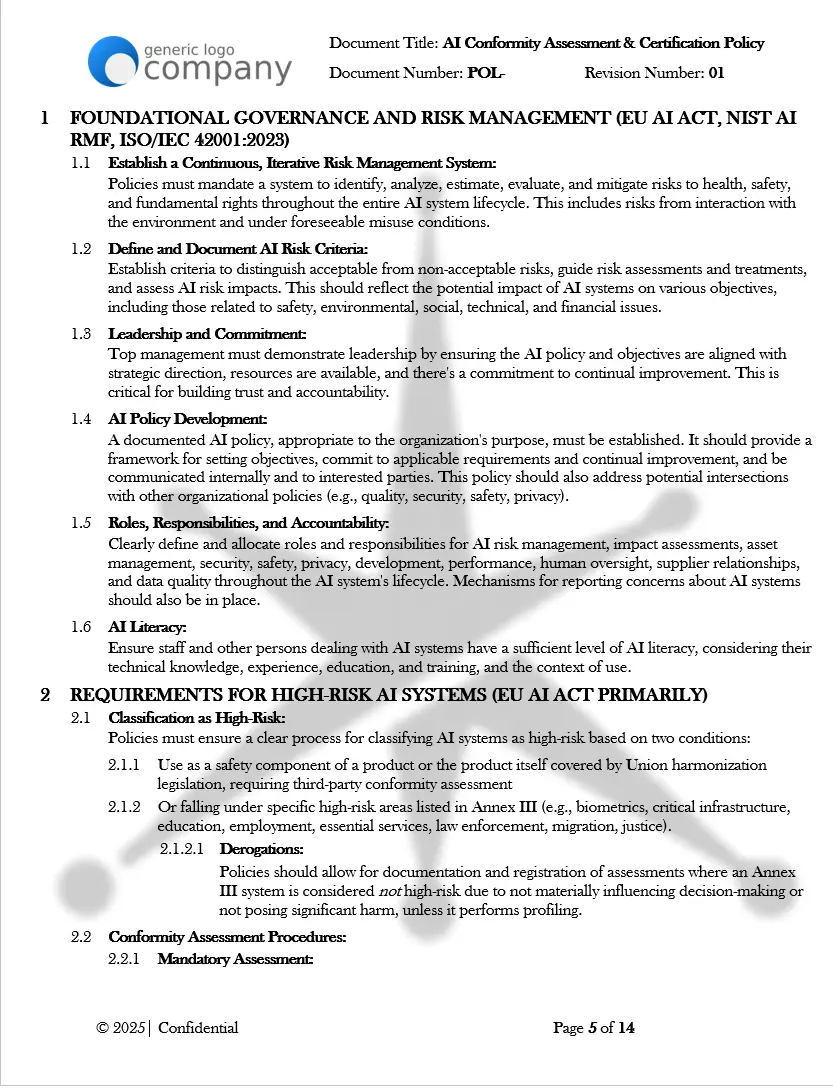
- High-risk system classification procedures (Annex III)
- Conformity assessment requirements (Articles 43-45)
- Technical documentation obligations (Annex IV)
- EU Declaration of Conformity structure (Annex V)
- GPAIM systemic risk obligations
- Post-market monitoring requirements
NIST AI Risk Management Framework:
- Continuous risk management system
- Trustworthy AI characteristics
- Lifecycle risk approach
- Stakeholder engagement requirements
ISO/IEC 42001:2023 Integration:
- AI Management System (AIMS) alignment
- Quality management integration
- Impact assessment processes
- Resource documentation requirements
Customization Required:
Like any enterprise policy template, organizations need to:
- Insert organization name and details
- Specify applicable jurisdiction and scope
- Define specific roles within their structure
- Set internal thresholds and criteria
- Add organization-specific commitments
This typically takes 10-20 hours for policy customization
Comparison to Alternatives:
| Approach | Cost | Time | Result |
|---|---|---|---|
| Consultant Development | $15,000-40,000 | 2-3 months | Custom policy |
| Law Firm Creation | $25,000-50,000 | 1-2 months | Legal framework |
| Internal Development | 200+ hours staff time | 3-6 months | Variable quality |
| This Policy Framework | $450 | 10-20 hours customization | Complete framework |
FAQ Section :
Q: Is this a complete policy or just an outline? A: This is a complete policy framework with comprehensive sections, regulatory mappings, and governance structure. Like all enterprise policies, it requires customization with your organization's specific details but the policy architecture is complete.
Q: What's the difference between this policy and implementation procedures? A: Policies establish governance commitments and requirements (the "what"). Procedures provide step-by-step instructions (the "how"). This policy tells you what must be done per regulations; your team develops procedures for how to do it.
Q: Do we need legal review before adopting this? A: As with any governance policy, legal review is recommended to ensure alignment with your jurisdiction and specific operational context. The framework provides comprehensive regulatory mapping to facilitate that review.
Q: How long does customization typically take? A: Most organizations complete customization in 10-20 hours, primarily inserting organizational details, defining specific roles, and adjusting scope statements to match their operations.
Q: Does this replace the need for procedures and tools? A: No. This policy establishes the governance framework under which procedures and tools are developed. It defines requirements; operational teams create implementation methods.
Q: Is this appropriate for small companies? A: This enterprise-grade policy is most valuable for organizations with formal governance structures, board oversight, or regulatory compliance obligations. Small startups might find it more comprehensive than needed.
Ideal For Section:
- Enterprises deploying AI systems in regulated markets
- Organizations facing EU AI Act compliance requirements
- Companies seeking board-approved AI governance
- Compliance teams establishing formal AI policies
- Organizations requiring integrated multi-framework governance
- Businesses undergoing AI conformity assessments
- Companies with high-risk AI system classifications
⚖️ Differentiator
This policy uniquely integrates three major AI governance frameworks into a single, coherent document. Rather than maintaining separate policies for EU AI Act, NIST AI RMF, and ISO 42001 compliance, organizations adopt one comprehensive framework. The policy includes specific regulatory article citations, annex references, and requirement mappings that demonstrate to auditors, regulators, and boards that the organization fully understands and commits to its AI governance obligations. This level of integration and completeness typically requires months of legal and compliance work, condensed into an immediately deployable governance framework.