

Authored by Derrick Jackson & Co-Author Lisa Yu : updated 10/07/2025
Table of Contents
CISSP Certification Overview
CISSP Certification Guide: Requirements, Cost, Salary & How Hard Is It? (2025)
Most cybersecurity certifications validate technical skills. CISSP certification does something different.
It validates whether you can lead. Whether you understand the business impact of security decisions. Whether you’ve accumulated enough real-world experience to make judgment calls that protect organizations from threats that don’t yet exist.
Quick Answer: What Is CISSP?
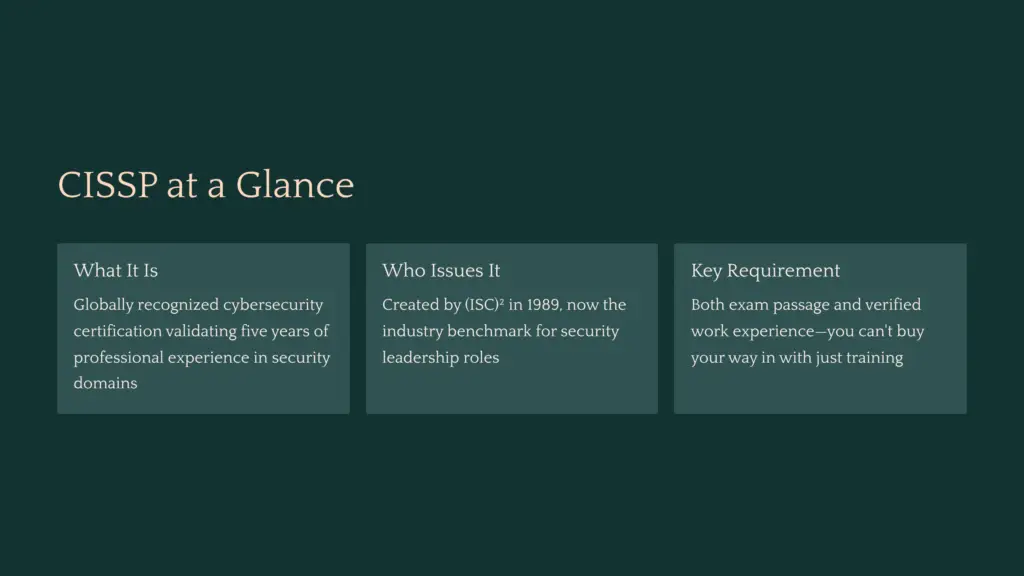
CISSP (Certified Information Systems Security Professional) is a globally recognized cybersecurity certification that validates five years of professional experience in at least two of eight security domains, along with passing a comprehensive exam. Created by (ISC)² in 1989, it’s the gold standard credential for security leadership roles, requiring both exam passage and verified work experience.
The CISSP certification isn’t an entry ticket to cybersecurity. It’s a benchmark that separates practitioners from leaders. Created by (ISC)² in 1989, this credential has become what hiring managers look for when they need someone who can architect security programs, not just implement them.
Here’s what makes it interesting. You can’t buy your way into CISSP certification with a training course. Can’t fake it with a weekend boot camp. You need five years of paid, full-time work in at least two of the eight security domains before they’ll even let you apply for certification after passing the exam.
That experience requirement filters out the theoretical knowledge and keeps the focus on proven capability.
What Does CISSP Stand For?
CISSP stands for Certified Information Systems Security Professional. The acronym represents a vendor-neutral certification administered by the International Information System Security Certification Consortium (ISC)², a non-profit organization dedicated to advancing the cybersecurity profession.
What Is CISSP Certification?
The International Information System Security Certification Consortium, better known as (ISC)², operates as a non-profit 501(c)(6) professional corporation. Founded in 1989, the organization set out to create a standardized program for certifying cybersecurity professionals when the field was still figuring out what that even meant.
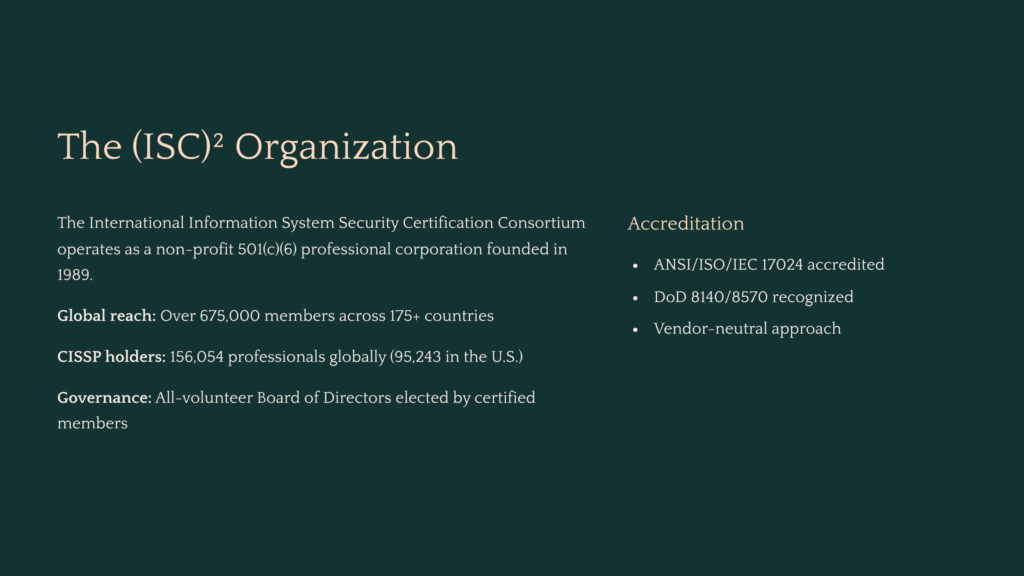
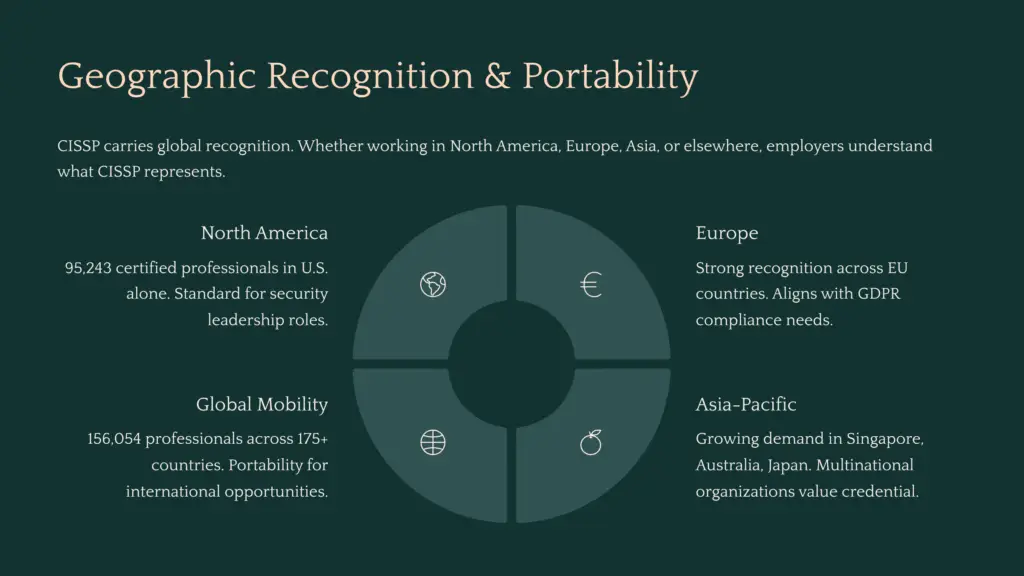
Today, (ISC)² serves over 675,000 members, associates, and candidates across more than 175 countries. The CISSP sits at the center of their certification portfolio as the flagship credential. As of July 2022, 156,054 professionals held the CISSP certification globally, with the largest concentration in the United States at 95,243.
What separates (ISC)² from vendor-specific certification programs? It’s vendor-neutral. The knowledge applies whether you’re securing AWS infrastructure, Microsoft environments, or hybrid systems. The organization doesn’t push any particular technology stack. Instead, it focuses on the principles, frameworks, and practices that work across platforms.
The governance structure matters here. An all-volunteer Board of Directors, composed of (ISC)²-certified professionals elected by the membership, runs the organization. No one on the board gets paid for their service. This structure keeps the focus on advancing the profession rather than maximizing revenue.
(ISC)²’s mission states they aim to “strengthen the influence, diversity, and vitality of the cybersecurity profession through advocacy, expertise, and workforce empowerment that accelerates cyber safety and security in an interconnected world.” Their vision? “A safe and secure cyber world.”
That non-profit status enables programs like the One Million Certified in Cybersecurity pledge, which offers free training and exams for their entry-level CC credential. A for-profit entity would struggle to justify giving away a million certifications.
The CISSP certification carries ANSI/ISO/IEC 17024 accreditation, a global standard for personnel certification bodies. It’s also recognized by the U.S. Department of Defense under DoD 8140/8570. These aren’t vanity badges. They’re verification that the certification meets rigorous quality standards.
CISSP Certification Requirements: Who Qualifies?
The CISSP certification targets experienced security practitioners. Not beginners. Not people hoping to break into cybersecurity.
If you’re managing security teams, making architectural decisions, or advising executives on risk, this certification validates what you already know. It gives you a credential that HR departments recognize and a common language to use with other security leaders globally.
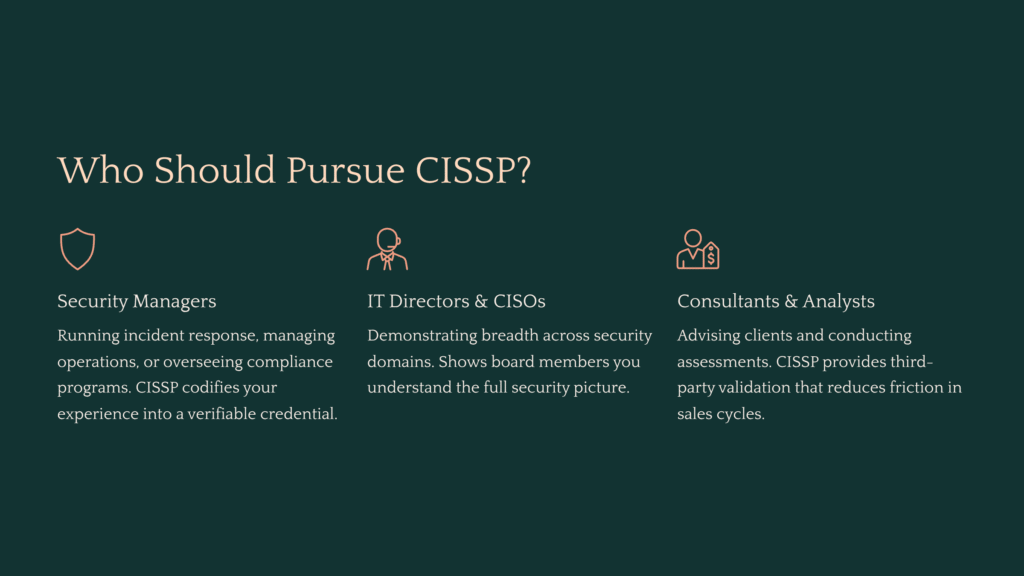
Security managers benefit most directly. You’re already running incident response, managing security operations, or overseeing compliance programs. The CISSP certification codifies that experience into a verifiable credential. It helps when you’re competing for director-level roles or trying to move from technical implementation to strategic planning.
IT directors and CISOs use CISSP to demonstrate breadth across the security domain. You might be an expert in network security but need to show competency in software security, governance, or physical security. The eight-domain structure forces you to develop that breadth. When you walk into a board meeting with CISSP after your name, it signals you understand the full security picture.
Consultants and analysts rely on CISSP differently. You’re advising clients, conducting assessments, or designing security programs for organizations you don’t work for directly. Clients need assurance you know what you’re doing. CISSP provides that third-party validation. It reduces the friction in sales cycles and helps you command higher rates.
The certification also fits professionals making lateral moves. A network engineer moving into security architecture. A systems administrator stepping into security operations. A developer shifting toward application security. If you’ve accumulated five years of experience touching security in some capacity, CISSP can accelerate that transition.
What about entry-level security professionals? CISSP isn’t your next step. Focus on CompTIA Security+, the (ISC)² Systems Security Certified Practitioner (SSCP), or the entry-level Certified in Cybersecurity (CC) first. Build the foundational knowledge and accumulate experience. CISSP will be waiting when you’re ready.
Geographic considerations matter less with CISSP certification than with some credentials. The certification carries recognition globally. Whether you’re working in North America, Europe, Asia, or elsewhere, employers understand what CISSP certification represents. That portability becomes valuable if you’re considering international opportunities or working with multinational organizations.
CISSP Certification Domains: 8 Core Areas Explained
CISSP certification covers eight security domains. Each carries a different weight on the exam, reflecting its importance in real-world security practice.
The domains aren’t isolated topics you memorize separately. They interconnect. Access control decisions affect security operations. Architecture choices impact risk management. You need to understand how these pieces fit together.
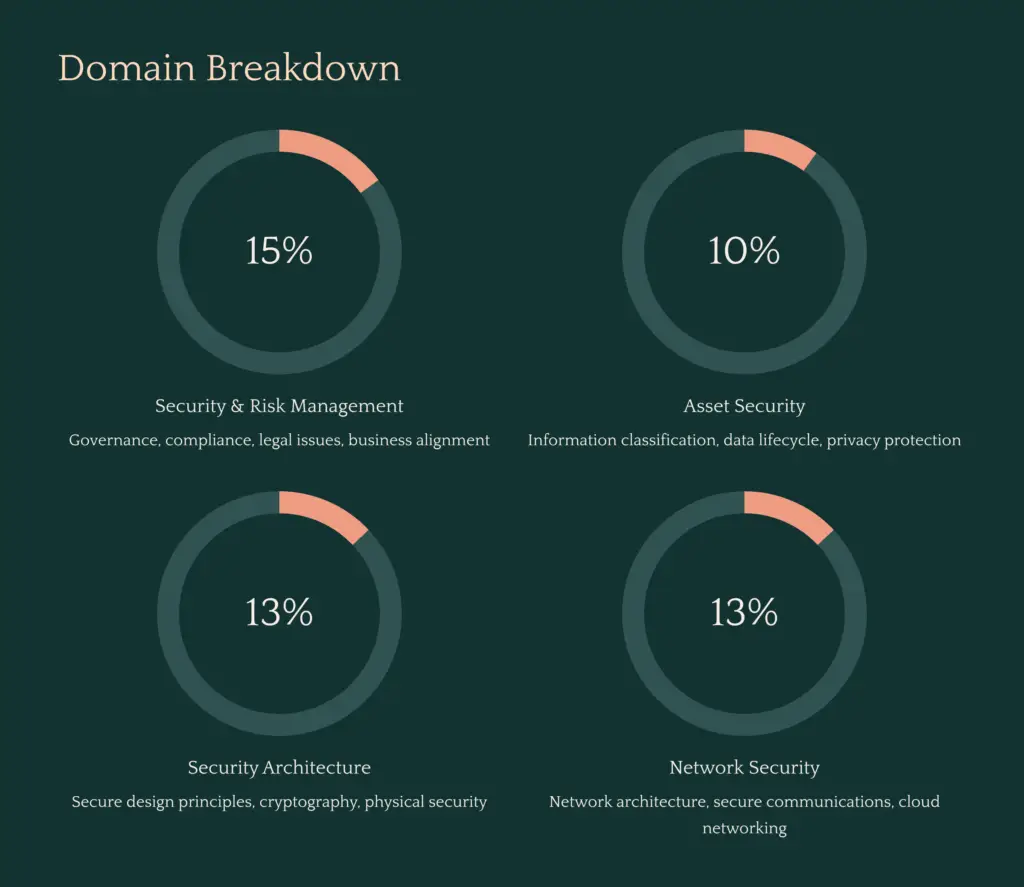
Security and Risk Management (15%)
This domain covers the business side of security. You’ll work with security governance, compliance requirements, and legal issues. Understanding how to align security with business objectives matters here. Risk management frameworks, business continuity planning, and security policies all fall under this domain.
The focus includes security concepts, security controls, threat modeling, and supply chain risk management. You need to know how to communicate risk to executives who care more about business impact than technical details.
Asset Security (10%)
Information and asset classification systems form the core of this domain. How do you identify what needs protection? How do you handle data throughout its lifecycle? What controls do you put in place for different classification levels?
Privacy protection, data retention requirements, and secure disposal all appear here. You’ll also cover data security controls and handling requirements for various data states (at rest, in transit, in use).
Security Architecture and Engineering (13%)
This domain digs into secure design principles. Security models, evaluation criteria, and security capabilities of information systems. You need to understand cryptography, physical security, and secure network architecture.
The engineering aspect covers applying security principles to site and facility design. How do you design systems that remain secure by default? What architectural patterns prevent common security failures?
Communication and Network Security (13%)
Network architecture, secure network components, and secure communication channels dominate this domain. You’ll cover network attacks and countermeasures. How do you design network segments? What controls do you implement for wireless, mobile, and remote access?
The domain includes both traditional networking concepts and modern cloud networking. Understanding how to secure data in transit across different network types becomes critical.
Identity and Access Management (IAM) (13%)
IAM sits at the intersection of security and usability. How do you prove someone is who they claim to be? How do you control what they can access once authenticated?
Physical and logical access controls both appear here. Single sign-on, multi-factor authentication, privileged access management, and identity as a service all fall under this domain. You need to understand authentication protocols, authorization mechanisms, and identity lifecycle management.
Security Assessment and Testing (12%)
Testing validates whether your security controls actually work. This domain covers security assessment and testing strategies. Vulnerability assessments, penetration testing, security audits, and security process data collection.
You’ll need to understand different testing methodologies. What’s the difference between black box, white box, and gray box testing? When do you use each approach? How do you interpret and act on test results?
Security Operations (13%)
This domain focuses on the day-to-day security work. Investigations, logging and monitoring, incident management, disaster recovery, and managing physical security. How do you respond when something goes wrong? How do you maintain security in normal operations?
Preventive measures, detective capabilities, and incident response procedures all appear here. The domain also covers forensics, evidence collection, and recovery.
Software Development Security (11%)
Security needs to be built in, not bolted on. This domain covers security in the software development lifecycle. Secure coding practices, database security, and security implications of acquired software.
You’ll work with different development methodologies and understand how to integrate security into each. DevSecOps, secure coding standards, and application security testing all fall under this domain.
Each domain connects to the others. Decisions you make in architecture affect your ability to monitor in operations. Identity management depends on proper asset classification. The exam tests whether you can think across these boundaries.
How Hard Is CISSP? Exam Format and Difficulty
The CISSP exam runs long. You get up to four hours to complete 100-175 questions. The exact number depends on how you perform because the exam uses Computerized Adaptive Testing (CAT).
CAT adjusts question difficulty based on your answers. Answer correctly and you get harder questions. Miss questions and the exam probes whether you understand fundamental concepts. The adaptive format means some candidates complete the minimum 100 questions in less time, while others work through up to 175 questions using more of the available four hours.
What Is the CISSP Pass Rate?
(ISC)² doesn’t publicly release official pass rate statistics for the CISSP exam. However, the certification’s reputation for difficulty and the five-year experience requirement create a natural filter. Most candidates who sit for the exam have substantial security backgrounds and dedicated preparation time, which contributes to reasonable pass rates among qualified candidates.
How Long Is the CISSP Exam?
The CISSP exam allows up to four hours for completion. The adaptive format means your actual testing time varies based on performance. Some candidates finish in 90-120 minutes with 100 questions, while others use the full four hours working through up to 175 questions. Plan for the full time block to avoid rushing.

How Much Is the CISSP Exam in 2025?
The exam costs $749. That’s just the exam fee. It doesn’t include training materials, practice exams, or study resources. You’ll pay that fee each time you attempt the exam if you don’t pass on the first try.
The passing score sits at 700 out of 1,000 points. Don’t try to calculate your score during the exam. The adaptive format makes traditional scoring meaningless. Focus on answering each question based on CISSP’s “think like a manager” mindset.
Question types include multiple choice and advanced innovative questions. Some questions present scenarios. Others test whether you can apply concepts to new situations. Memorizing definitions won’t cut it. You need to understand why security controls matter and when to apply them.
Testing happens at Pearson VUE centers globally. You schedule your exam through the (ISC)² website, which redirects you to Pearson VUE’s platform. The partnership ensures standardized, proctored testing whether you’re testing in New York, London, Singapore, or anywhere else Pearson VUE operates.
You can’t bring anything into the testing center. No notes, books, or electronic devices. The exam is closed book. However, Pearson VUE provides a basic calculator and scratch paper if you need them.
Results appear on screen when you finish. Pass or fail, you’ll know immediately. (ISC)² sends a formal score report within a few weeks with domain-by-domain performance breakdowns. This helps if you need to retake the exam and want to focus your study efforts.
CISSP Certification Salary: Career Impact in 2025
Total CISSP Certification Cost Breakdown
Before discussing salary impact, let’s address the total investment required. The estimated total cost for the first CISSP certification cycle (three years) ranges from $2,154 to $5,554.
Here’s the breakdown:
- Exam fee: $749
- Training costs: $1,000 to $4,400 (depending on format and provider)
- Annual Maintenance Fees: $135 × 3 years = $405
- Total first cycle: $2,154 to $5,554
This investment pays back quickly for most professionals. The salary premium from holding CISSP certification typically exceeds the total certification cost within the first year.

Salary Impact and Career Growth
CISSP certified professionals command higher salaries than their non-certified peers. The certification signals to employers that you’ve got both experience and verified knowledge.
Exact salary numbers vary by location, industry, and role. A CISSP holder working as a security analyst in a mid-sized city will earn less than a CISSP-certified CISO in a major tech hub. But the certification consistently correlates with better compensation across these variations.
CISSP Certification Salary Ranges by Region
According to the most recent data, CISSP holders report competitive compensation:
- North America: Average salaries reflecting senior security roles
- Geographic variations: Major tech hubs (San Francisco, New York, Seattle) offer premium compensation above national averages
- Industry premiums: Financial services, healthcare, and technology sectors typically pay 15-25% above general market rates
- Government positions: Federal and defense contractor roles often include additional benefits (security clearances, pension plans, job stability)
Salary data varies significantly by source, role, and experience level. Use multiple salary research tools (Glassdoor, PayScale, LinkedIn Salary) to benchmark compensation in your specific market and role.
Career progression matters more than just salary. CISSP opens doors to senior positions. Security manager, security architect, security consultant, and director-level roles all commonly list CISSP as required or strongly preferred. Some organizations won’t interview candidates for these positions without it.
Government and defense contractors particularly value CISSP. The U.S. Department of Defense recognizes CISSP under DoD 8140/8570, making it a baseline requirement for many federal security positions. If you’re interested in government work, CISSP significantly expands your opportunities.
The certification also provides negotiating leverage. When you’re discussing compensation for a new role or pushing for a raise, CISSP gives you concrete evidence of your qualifications. It’s easier to justify higher pay when you can point to an industry-recognized credential that required years of experience to earn.
Job market statistics support CISSP’s value. Positions requiring CISSP see strong demand. The cybersecurity workforce gap means experienced security professionals remain in short supply. Certification helps you stand out in that competitive market.
Geographic variations in salary exist. Major tech hubs like San Francisco, New York, and Seattle offer higher base salaries but also come with higher costs of living. Regional markets might offer lower absolute salaries but better quality of life calculations. CISSP provides portability if you want to move between markets.
Industry matters too. Financial services, healthcare, and technology companies typically pay premium salaries for security talent. Government work offers different benefits, including job stability, pension plans, and clearance opportunities. CISSP certification fits all these sectors.
CISSP Prerequisites: 5-Year Experience Requirements
You can’t walk into CISSP straight from college. The experience requirement demands five years of cumulative, paid, full-time work in at least two of the eight CISSP domains.
That five-year clock needs to tick while you’re doing actual security work. Part-time jobs don’t count. Unpaid internships don’t count. The work needs to be professional, compensated, and relevant to the Common Body of Knowledge.
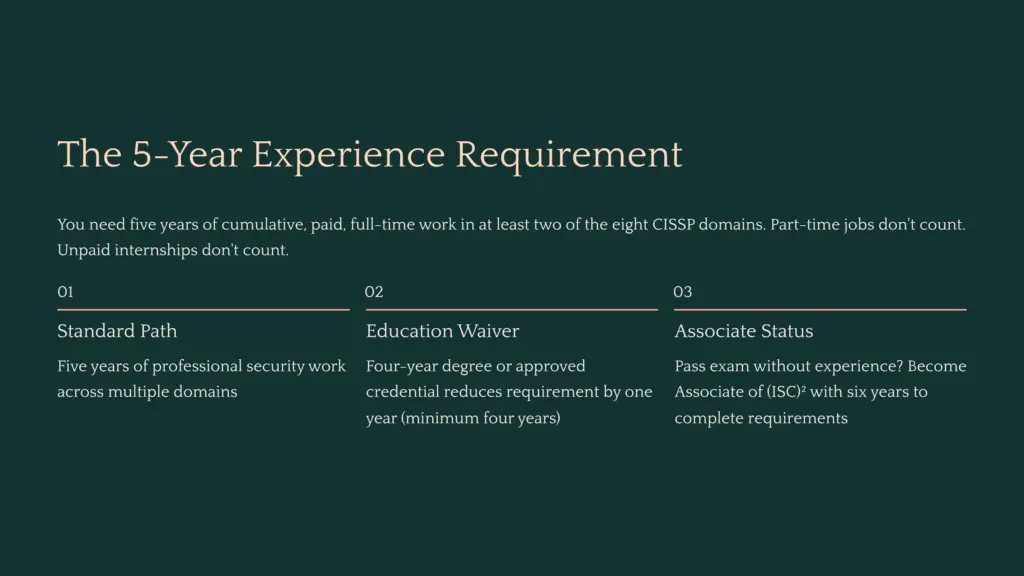
You can reduce the experience requirement by one year if you hold a four-year college degree or regional equivalent. An advanced degree in a relevant field also qualifies for this waiver. You can also subtract one year if you hold certain approved credentials from (ISC)²’s list.
Even with waivers, you still need four years minimum. There’s no way to reduce the requirement below that threshold.
What if you pass the exam but don’t have the experience yet? You become an Associate of (ISC)². This designation recognizes that you’ve passed the exam and demonstrated the technical knowledge. You get up to six years to accumulate the required experience and transition to full certification.
The Associate status isn’t worthless. You’re part of the (ISC)² community, get access to member benefits, and can list the credential on your resume. But you can’t call yourself CISSP certified until you’ve met the experience requirement and completed the endorsement process.
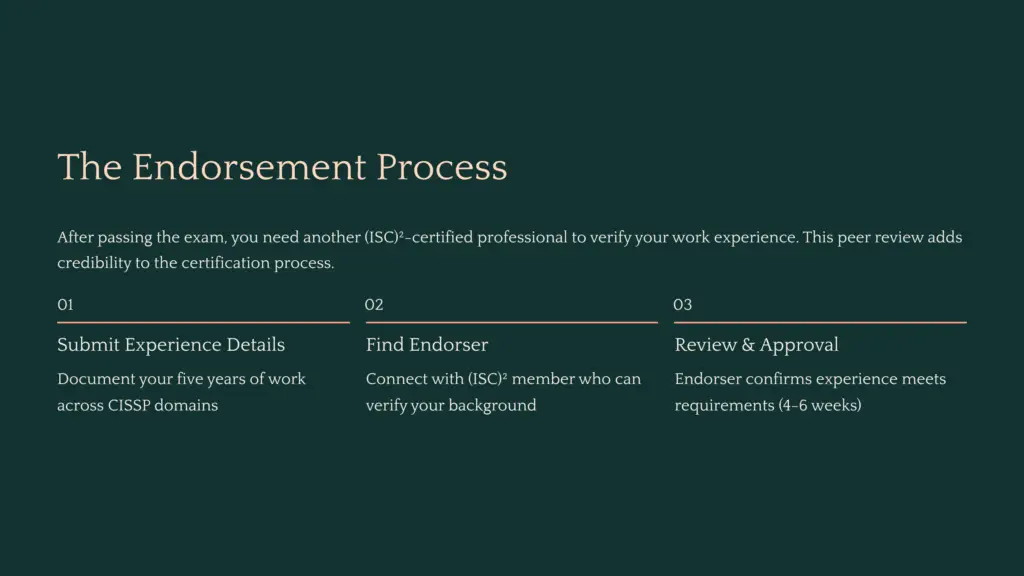
The endorsement process requires another (ISC)²-certified professional to verify your work experience. You submit your experience details, and an (ISC)² member reviews and confirms that your background meets the requirements. This peer review adds credibility to the process.
Experience across multiple domains matters. If you’ve spent five years doing only network security, you’ll struggle with the broader CISSP content. The exam assumes knowledge across all eight domains. Your real-world experience should reflect that breadth.
What counts as qualifying experience? Here are some examples. Managing security operations for your organization. Designing security architectures. Conducting security assessments. Developing security policies. Managing identity and access control systems. Responding to security incidents. Implementing security controls.
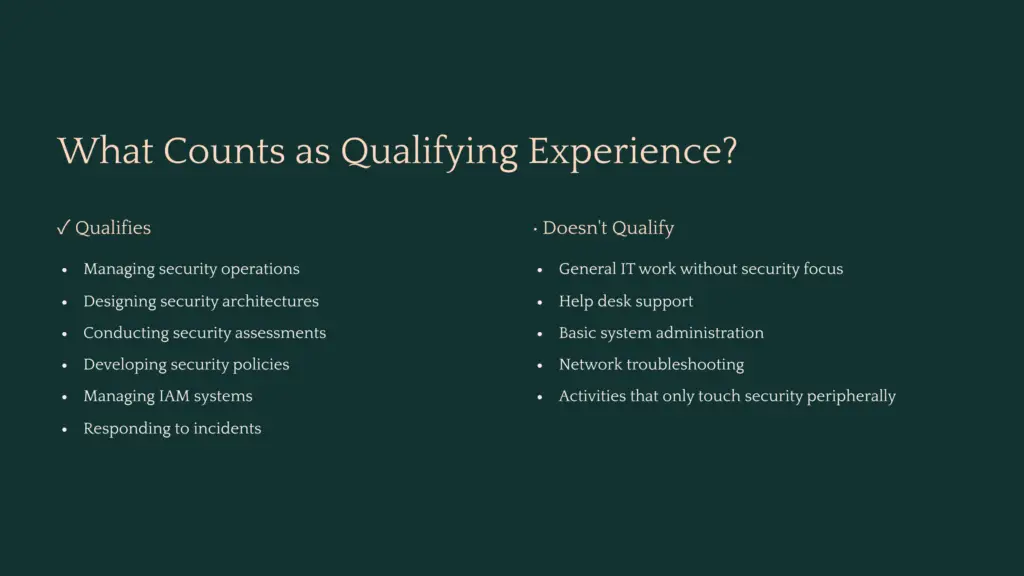
What doesn’t count? General IT work without a security focus. Help desk support. Basic system administration. Network troubleshooting. These activities might touch security, but they don’t constitute security work for CISSP purposes.
The difficulty level is honest. CISSP isn’t easy. The exam tests whether you can think strategically about security problems. Whether you understand the business implications of technical decisions. Whether you’ve accumulated enough experience to make sound judgments in ambiguous situations.
If you’re early in your career, don’t rush into CISSP certification. Build foundational knowledge first. Get hands-on experience. Work your way up through other certifications like Security+ or SSCP. CISSP certification will be more valuable and more achievable when you’ve got the experience to back it up.
How to Get CISSP Certification: Training and Study Guide
How Long to Study for CISSP?
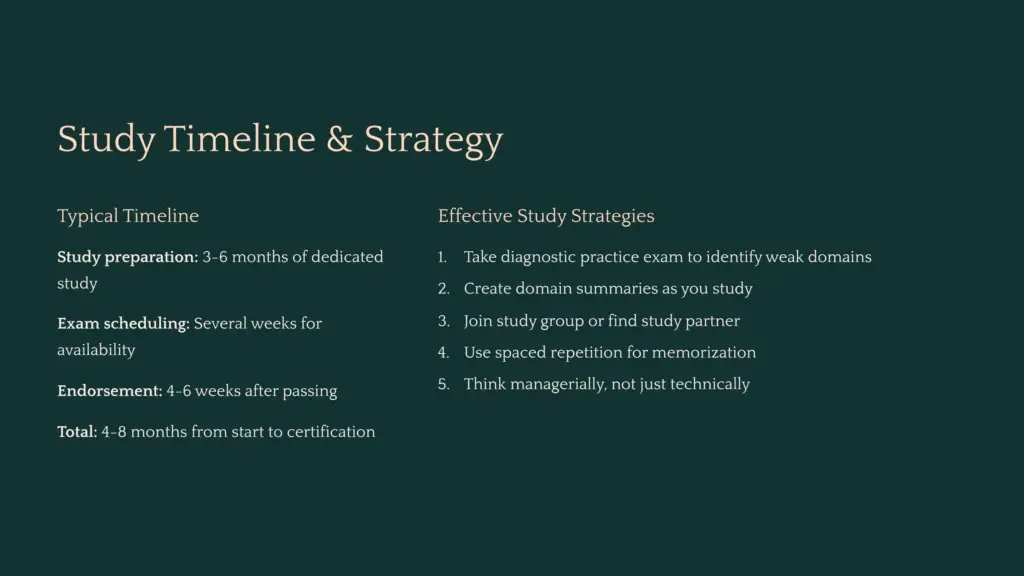
Most people invest between 3-6 months of dedicated study before attempting CISSP certification. That timeline assumes you’ve got the prerequisite experience and are studying while working full-time.
The amount of study time depends on your background. If your daily work covers most CISSP domains, you might need less preparation. If you’re strong in technical areas but weak in governance and risk management, budget more time for those domains.
How Long Does It Take to Get CISSP Certification?
The complete timeline from start to certification varies by individual:
- Study preparation: 3-6 months (documented timeline for most candidates)
- Exam scheduling and completion: Several weeks (depends on testing center availability)
- Endorsement process: 4-6 weeks after passing exam (processing time varies)
- Total estimated timeline: 4-8 months from starting study to full certification
Note: These are general estimates based on typical experiences. Processing times vary based on application volume and individual circumstances.
This assumes you have the five years of required experience already. If you’re working toward that requirement, add the time needed to accumulate your remaining experience months or years.
CISSP Certification Training Options
(ISC)² doesn’t mandate training. You can register for the exam without taking any official courses. However, most successful candidates use structured preparation materials.
Official (ISC)² resources include the CISSP Official Study Guide, official practice tests, and the Common Body of Knowledge (CBK). Members get free digital access to some resources, which partially offsets the $135 annual membership fee.
Training options range widely in price and format. Self-paced online courses cost around $1,000. You get video lectures, practice questions, and study materials you can access on your own schedule. This works well if you’re disciplined and comfortable learning independently.
Intensive boot camps exceed $4,000 and compress preparation into one week of all-day instruction. You’ll cover all eight domains in rapid succession. Boot camps work best as final preparation after you’ve already studied the material. They help you integrate knowledge across domains and practice the strategic thinking CISSP requires.
Instructor-led online classes split the difference. You get scheduled sessions with an instructor, interaction with other students, and structured pacing. Costs typically fall between self-paced courses and boot camps.
Free resources exist but have limitations. You’ll find blog posts, YouTube videos, and study group notes online. These can supplement paid materials but rarely provide comprehensive coverage. The quality varies wildly.
Practice exams matter. The CISSP question style is distinct. Questions often present scenarios with multiple defensible answers. You need to choose the best answer from a manager’s perspective, not just the technically correct answer. Practice exams teach you this mindset.
Study strategies that work:
Start by taking a diagnostic practice exam. This identifies your weak domains so you can focus study time effectively. Don’t try to memorize everything equally. Prioritize the domains where you’re weakest.
Create domain summaries as you study. Writing forces you to synthesize information rather than just reading passively. Your summaries become reference materials for final review.
Join a study group or find a study partner. Explaining concepts to others strengthens your own understanding. You’ll also get exposure to different perspectives on complex topics.
Use spaced repetition for memorization. Study a topic, then revisit it after a few days, then after a week, then after two weeks. This spacing cements information in long-term memory better than cramming.
Think managerially, not technically. When you encounter a question, ask yourself: What would a security manager do? What choice protects the business while managing risk? CISSP tests judgment, not just knowledge.
Read each question carefully. Many wrong answers are technically accurate but don’t address the actual question being asked. Eliminate obviously wrong answers first, then choose the best remaining option.
Don’t skip domains where you have professional experience. The exam covers material broadly. You might know network security cold from your day job but still miss questions if you don’t study the CISSP-specific content.
Budget time for weak areas. If you’ve never worked with legal or compliance issues, the Security and Risk Management domain will require more attention than technical domains you handle daily.
Use official (ISC)² materials for at least part of your preparation. Third-party resources are helpful, but they sometimes emphasize different aspects than the actual exam. Official materials align precisely with exam content.
Common pitfalls to avoid:
Over-relying on dumps or brain dumps. These are prohibited and can get your certification revoked if (ISC)² discovers you used them. More importantly, they teach you to recognize specific questions rather than understand concepts. If the exam adapts around your performance, memorized answers become useless.
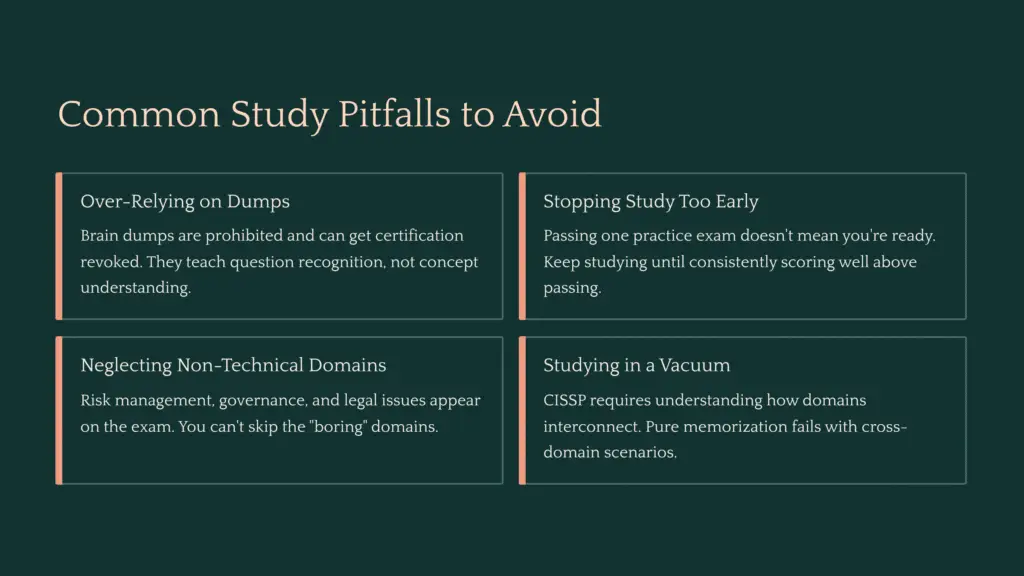
Stopping study too early. Passing a practice exam doesn’t mean you’re ready. The real exam will probe differently. Keep studying until you’re consistently scoring well above passing on multiple practice exams.
Neglecting the non-technical domains. If you’re coming from a technical role, you might blow off risk management, governance, and legal issues as boring. These domains appear on the exam. You can’t skip them.
Studying in a vacuum. CISSP certification requires understanding how domains interconnect. Pure memorization fails when the exam presents cross-domain scenarios.
CISSP Certification Updates: What Changed in 2025
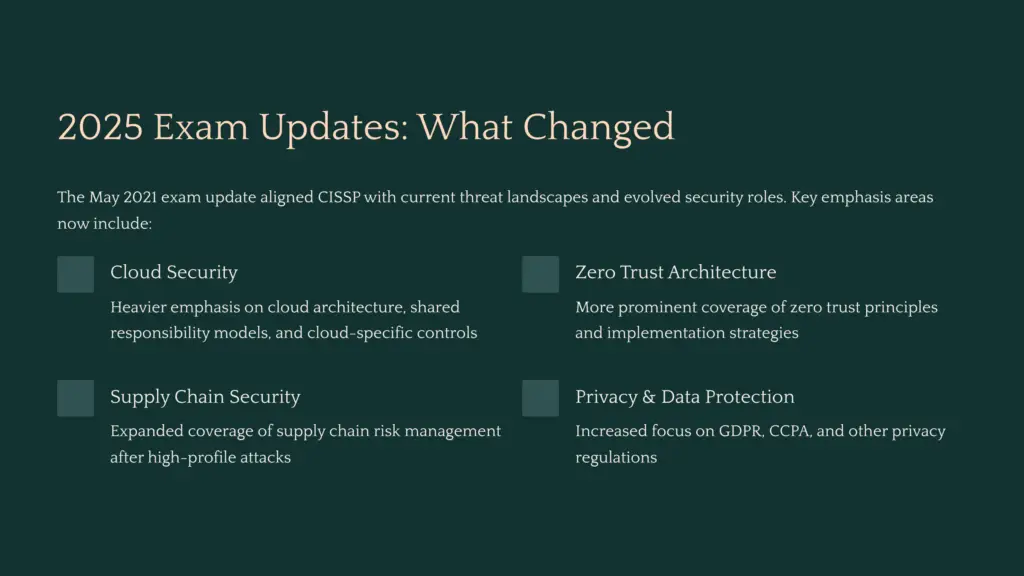
The CISSP exam underwent a significant update in May 2021. (ISC)² revised the exam to align with the current threat landscape and reflect how security roles have evolved.
The domain structure changed from eight to eight domains (but with different emphases and topics). Software Development Security became its own domain rather than being folded into other areas. Communication and Network Security merged topics that were previously separate.
Questions now emphasize cloud security more heavily than previous exam versions. This reflects how organizations have moved infrastructure and applications to cloud platforms. You need to understand cloud security architecture, shared responsibility models, and cloud-specific controls.
Zero trust architecture appears more prominently. As perimeter-based security becomes less relevant, the exam tests whether you understand zero trust principles and implementation strategies.
Supply chain security gained emphasis. Recent high-profile supply chain attacks demonstrated that organizations are only as secure as their weakest vendor. The exam covers supply chain risk management more thoroughly now.
Privacy and data protection requirements increased. With GDPR, CCPA, and other privacy regulations affecting how organizations handle data, CISSP now tests privacy concepts more extensively.
The exam hasn’t gotten easier or harder overall. It has shifted to match what security leaders actually need to know in 2025. If your experience is current, you’ll find the exam reflects real-world challenges you’re already managing.
(ISC)² updates the exam periodically through a rigorous process. They survey certified professionals about what knowledge matters in their roles. They analyze job postings to understand what employers require. They convene subject matter experts to review and refresh content.
This ongoing maintenance keeps CISSP relevant. A certification from 1995 wouldn’t reflect modern security challenges. The periodic updates ensure the credential remains valuable as technology and threats evolve.
If you’re studying older materials, verify they’re for the current exam version. Using outdated study guides wastes time on content that’s no longer tested and misses new topics you need to know.
CISSP and AI Security: Future Career Trends
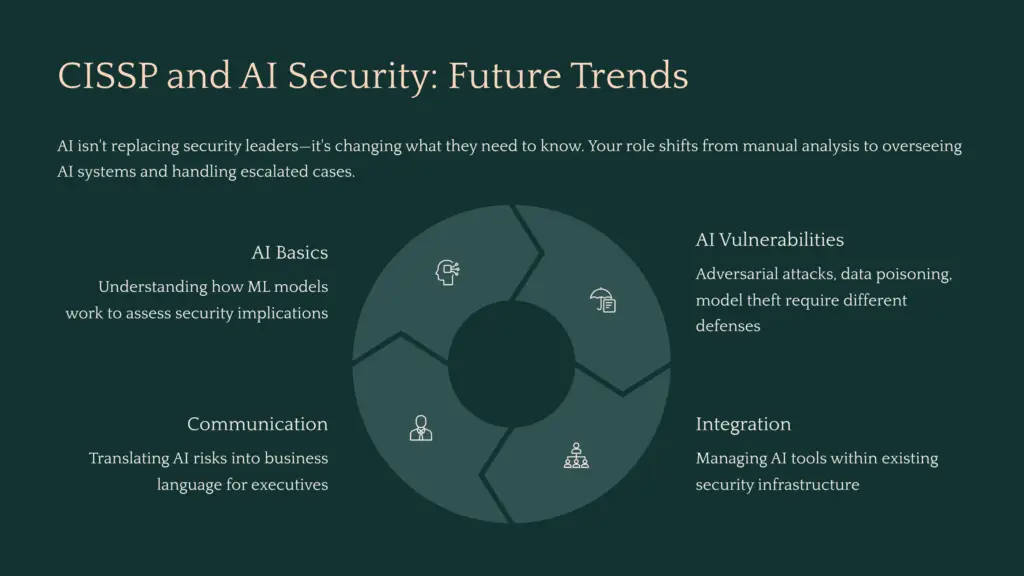
AI isn’t replacing security leaders. It’s changing what they need to know and do.
Security operations centers now use AI-powered tools for threat detection and response. These systems process millions of events per second, identifying patterns humans would miss. As a CISSP-certified professional, you need to understand how these tools work, what they can and cannot do, and how to integrate them into security operations.
Your role shifts from manual analysis to overseeing AI systems and handling the cases they escalate. You make decisions about which AI recommendations to implement. You tune systems to reduce false positives. You ensure AI tools don’t introduce new vulnerabilities.
Risk assessment increasingly involves AI systems themselves. How do you assess risk in an AI-powered application? What controls do you implement for machine learning models? How do you ensure AI systems remain secure and trustworthy?
Governance challenges multiply with AI. Who’s responsible when an AI system makes a security decision that causes a breach? How do you audit AI behavior? What controls ensure AI systems comply with regulations?
These questions fall squarely in CISSP territory. The certification emphasizes governance, risk management, and strategic thinking over technical implementation. Those skills become more valuable, not less, as AI handles routine technical tasks.
New skills you’ll need:
Understanding AI and machine learning basics. You don’t need to build models, but you should understand how they work well enough to assess security implications.
Knowing AI-specific vulnerabilities. Adversarial attacks, data poisoning, model theft, and other AI-specific threats require different defenses than traditional security threats.
Managing AI in the security stack. How do you integrate AI tools with existing security infrastructure? What data do they need? How do you validate their outputs?
Communicating AI risks to executives. Board members understand business risk but may not grasp AI-specific security concerns. Your ability to translate technical AI risks into business language becomes critical.
The job market rewards these combined capabilities. Security leaders who understand both traditional security and AI security command premium compensation. Organizations need people who can bridge these domains.
CISSP positions itself well for this evolution. The certification has always emphasized leadership over pure technical depth. That emphasis serves you well when technology changes rapidly. The strategic thinking that CISSP validates applies whether you’re securing legacy systems or AI-powered applications.
Five-year outlook: Security leadership roles will increasingly require AI literacy. Organizations will expect CISSP-certified professionals to evaluate AI security vendors, assess AI-related risks, and develop governance frameworks for AI usage. The fundamentals CISSP covers won’t change, but you’ll apply them to new technologies.
Staying competitive means continuous learning. Follow AI security research. Understand emerging regulations around AI. Experiment with AI security tools. The CISSP continuing education requirement pushes you toward this ongoing learning anyway.
Your CISSP value increases, not decreases, in an AI-driven landscape. Organizations need experienced security leaders who can make sound judgments about rapidly evolving technology. That’s exactly what CISSP prepares you to do.
Is CISSP Certification Worth It? Cost vs. Value Analysis
Yes. For the right person.
If you’ve got five years of security experience and you’re aiming for leadership roles, CISSP delivers clear value. It’s recognized globally. It opens doors. It validates expertise you’ve already developed through years of work.
The certification costs $2,154 to $5,554 for the first three-year cycle including exam, training, and maintenance fees. That’s not pocket change. But the career impact typically justifies the investment within the first year through salary increases, promotions, or new job opportunities.
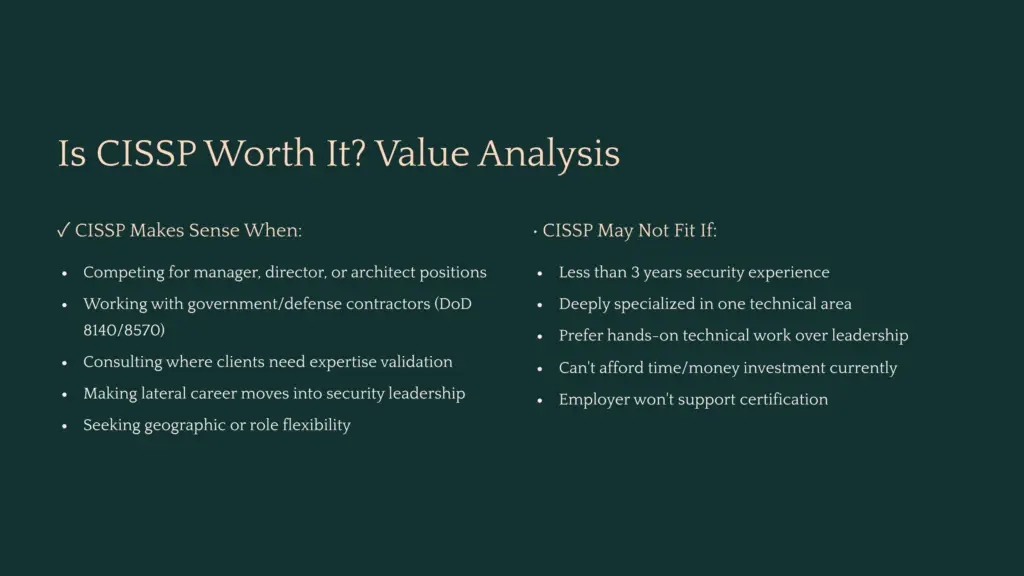
CISSP matters most in certain scenarios:
You’re competing for manager, director, or architect positions where CISSP appears in job requirements. Having the credential moves your resume to the top of the stack.
You’re working with government or defense contractors where DoD 8140/8570 baseline requirements apply. CISSP meets these requirements and becomes mandatory for certain positions.
You’re consulting or contracting where clients need assurance of your expertise. CISSP provides that third-party validation and reduces client concerns about your capabilities.
You’re making a lateral move in your career, shifting from another IT discipline into security leadership. CISSP accelerates that transition by validating security knowledge.
You want geographic or role flexibility. CISSP recognition spans countries and industries, giving you options if you want to relocate or change sectors.
When CISSP isn’t worth it:
You’re early in your security career with less than three years of experience. Focus on foundational certifications first. Build experience. CISSP will be more valuable and achievable later.
You’re deeply specialized in one technical area and plan to stay there. If you’re a penetration tester who wants to keep penetration testing, GIAC certifications might serve you better than CISSP’s broad management focus.
You’re not interested in leadership or strategy. If you prefer hands-on technical work and have no desire to manage teams or advise executives, CISSP’s value diminishes.
Your employer won’t support it and you can’t afford the time and money investment. CISSP requires significant preparation. If that’s not realistic in your current situation, wait until it is.
Compare to alternatives:
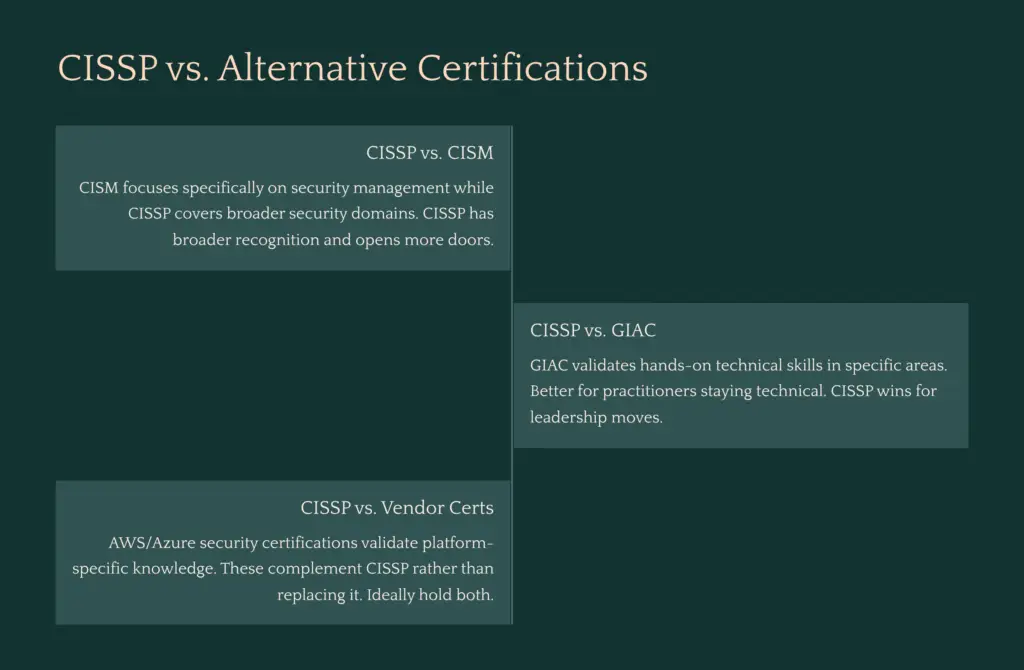
CISSP vs. CISM: CISM focuses specifically on security management while CISSP covers broader security domains. If you’re purely interested in managing security programs rather than technical aspects, CISM might fit better. However, CISSP has broader recognition and opens more doors.
CISSP vs. GIAC: GIAC certifications validate hands-on technical skills in specific security areas. If you’re a practitioner who wants to stay technical, GIAC might be better. If you’re moving into leadership, CISSP wins.
CISSP vs. vendor certifications: Certifications like AWS Certified Security Specialty or Azure Security Engineer validate platform-specific knowledge. These complement CISSP rather than replacing it. Ideally, you hold both vendor-neutral leadership credentials like CISSP and specific platform certifications.
The credential’s longevity matters. CISSP has existed since 1989. It has survived technology shifts, market changes, and the emergence of countless competitor certifications. That staying power indicates lasting value. Organizations worldwide understand what CISSP means. That recognition won’t disappear.
The maintenance requirement ensures your knowledge stays current. You can’t coast on a credential earned years ago. The 120 Continuing Professional Education (CPE) credits over three years force ongoing learning.
Bottom line: CISSP certification delivers value for security professionals with experience who want leadership roles. The certification isn’t perfect. It’s expensive. It requires significant preparation. The continuing education obligation never ends. But if you’re serious about security leadership, CISSP certification remains the most widely recognized credential that validates both breadth and experience.
How to Get CISSP Certified: Complete Step-by-Step Process
Ready to pursue CISSP certification? Here’s your roadmap.
Step 1: Assess Your Current Position
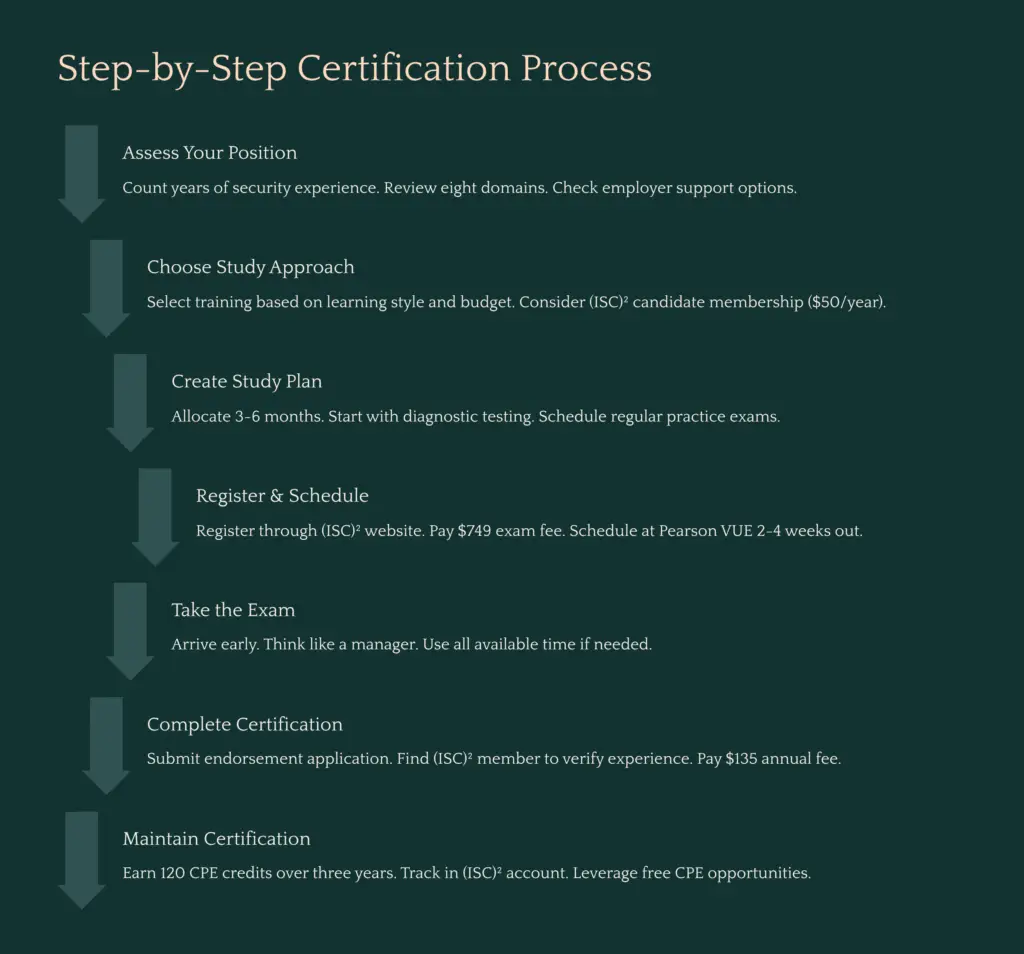
Count your years of relevant security experience. Do you have five years? Can you document work in at least two CISSP certification domains? If yes, proceed. If no, focus on accumulating experience first.
Review the eight domains. Where are you strong? Where are you weak? This assessment guides your study strategy.
Check whether your employer offers support. Some organizations pay for training and exams. Others provide study time during work hours. Ask before you start spending your own money.
Step 2: Choose Your Study Approach
Select training materials based on your learning style and budget. Options include:
Self-paced online training ($1,000 range) for disciplined self-learners who want flexibility.
Instructor-led online classes ($1,500-$2,500) for those who benefit from scheduled sessions and instructor interaction.
Intensive boot camps ($4,000+) for final preparation or those who can dedicate a full week.
Consider joining (ISC)² as a candidate member for access to resources and community support. The $50 annual fee is often waived for the first year.
Step 3: Create Your Study Plan
Allocate 3-6 months for preparation. Plan study time daily or several times per week. Consistency beats cramming.
Start with diagnostic testing to identify weak areas. Focus study time on domains where you’re least comfortable.
Schedule regular practice exams throughout your study period. Track your progress and adjust your plan based on results.
Step 4: Register and Schedule Your Exam
Register through the (ISC)² website. Pay the $749 exam fee. You’ll be redirected to Pearson VUE to schedule your exam date and location.
Schedule your exam 2-4 weeks out from when you’ll complete studying. This gives you a deadline to work toward while leaving time for final preparation.
Verify the testing center location and what you need to bring (usually just valid ID).
Step 5: Take the Exam
Arrive early. Get familiar with the testing environment. Take advantage of the tutorial time to relax before the exam starts.
Remember the “think like a manager” mindset. Choose the best answer for the organization, not just the most technically accurate answer.
Use all available time if you need it. The exam doesn’t reward finishing quickly.
Step 6: Complete the Certification Process
If you pass and have the required experience, complete the endorsement application. Find another (ISC)² member to verify your work history.
If you pass but lack experience, accept Associate status. You have six years to accumulate the required experience.
Pay the $135 Annual Maintenance Fee to activate your CISSP certification.
Step 7: Maintain Your Certification
Start earning CPE credits immediately. You need 120 CPEs over your three-year cycle, with at least 90 in Group A (directly related to CISSP certification domains).
(ISC)² offers free CPE opportunities through webinars and online resources. Take advantage of these to minimize maintenance costs.
Track your CPEs in your (ISC)² account. Don’t wait until the end of your cycle to start logging activities.
That’s the roadmap. The process is straightforward even if the preparation is demanding. Thousands of people complete this journey every year. With proper planning and dedication, you can join them.
Moving Forward
CISSP certification isn’t just another credential. It’s recognition that you’ve accumulated real experience and demonstrated mastery of security leadership principles.
The certification won’t teach you everything about cybersecurity. It won’t make you an expert in every domain overnight. What it does is validate the knowledge you’ve already developed and give you a credential that opens doors throughout your career.
Security leadership matters more in 2025 than ever before. Organizations face increasingly sophisticated threats. Regulatory requirements multiply. Technology evolves rapidly. They need professionals who can think strategically about security, make sound judgments under pressure, and communicate effectively with both technical teams and business executives.
That’s what CISSP certification prepares you to do. Whether you’re protecting critical infrastructure, defending corporate networks, advising on security strategy, or building security programs from scratch, the certification signals that you have both the experience and knowledge to handle leadership responsibilities.
The investment is significant. The preparation takes months. The continuing education never stops. But if you’re serious about security leadership, CISSP certification remains the credential that matters most globally.
For more information, visit the official (ISC)² CISSP certification page.
Frequently Asked Questions About CISSP Certification
How hard is CISSP certification to obtain?
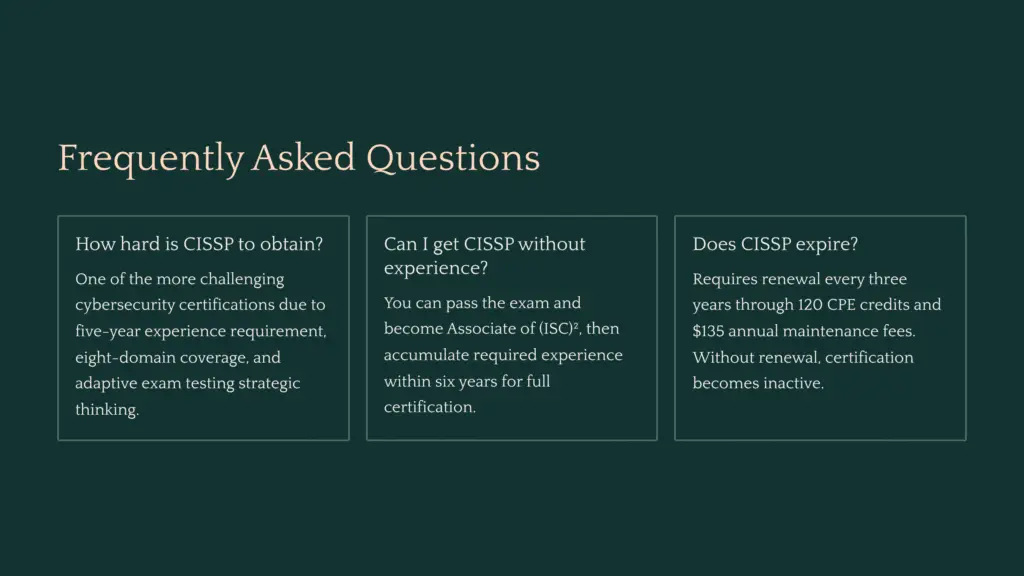
CISSP is considered one of the more challenging cybersecurity certifications due to its five-year experience requirement, eight-domain coverage, and adaptive exam format. Success requires both extensive professional experience and dedicated study preparation. The exam tests strategic thinking and managerial decision-making, not just technical knowledge.
Can I get CISSP certification without experience?
You can pass the CISSP exam without five years of experience and become an Associate of (ISC)². However, you must accumulate the required five years (or four with a degree waiver) within six years to achieve full CISSP certification. The Associate designation recognizes your exam success while you gain the necessary experience.
Does CISSP certification expire?
CISSP certification requires renewal every three years through earning 120 Continuing Professional Education (CPE) credits and paying annual maintenance fees of $135. Without renewal, the certification becomes inactive. At least 90 of the 120 CPEs must be directly related to the CISSP domains (Group A credits).
How much does CISSP certification cost total?
Total first-cycle costs range from $2,154 to $5,554, including exam fee ($749), training ($1,000-$4,400 depending on format), and three years of maintenance fees ($135 per year). The wide range reflects different training options, from self-paced online courses to intensive boot camps.
Is CISSP worth it for my career?
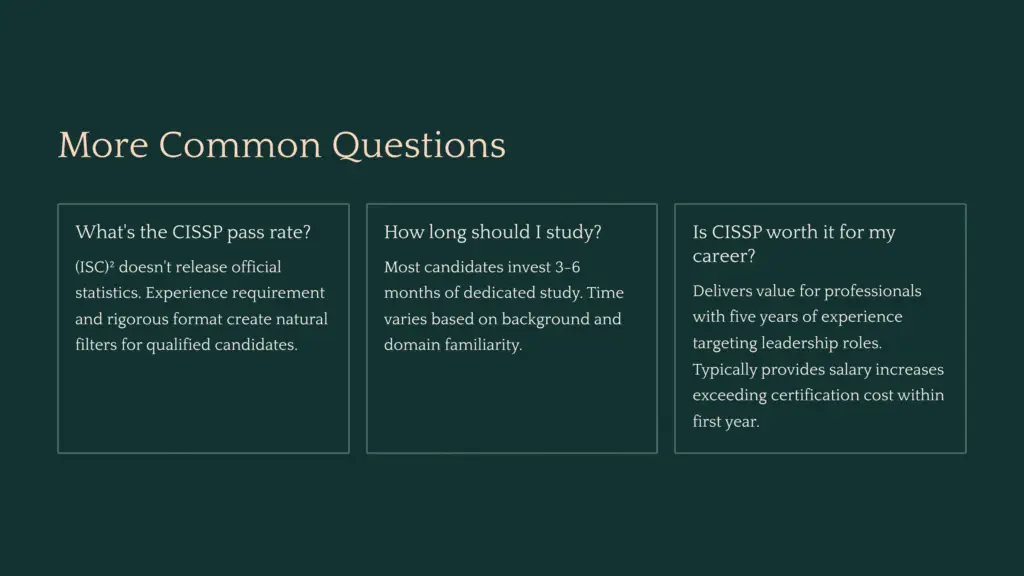
CISSP certification delivers value for security professionals with five years of experience targeting leadership roles. It’s recognized globally, opens doors to senior positions, and typically provides salary increases that exceed the certification cost within the first year. However, it’s not ideal for entry-level professionals or those preferring purely technical roles over management.
What’s the CISSP pass rate?
(ISC)² doesn’t publicly release official pass rate statistics for the CISSP exam. The five-year experience requirement and rigorous exam format create natural filters. Most candidates who sit for the exam have substantial security backgrounds and dedicated preparation, which contributes to reasonable success rates among qualified candidates.
How long should I study for CISSP?
Most candidates invest 3-6 months of dedicated study before attempting the exam. Your required study time depends on your background. If your daily work covers most CISSP domains, you might need less preparation. If you’re strong in technical areas but weak in governance and risk management, budget more time for those domains.
Reference Resource List
- (ISC)² Official Website
- (ISC)² About and Governance
- (ISC)² Mission Statement
- (ISC)² Insights and Research
- (ISC)² Professional Development Resources
- (ISC)² One Million Certified in Cybersecurity Initiative
- (ISC)² Candidate Policies and Benefits
- (ISC)² Frequently Asked Questions
- (ISC)² Associate Program
- (ISC)² Membership Information
- (ISC)² Annual Maintenance Fee Overview
- (ISC)² Cybersecurity Certifications Portfolio
- (ISC)² CISSP Certification Main Page
- (ISC)² CISSP Experience Requirements
- (ISC)² Exam Registration Information
- DoD Approved 8570 Baseline Certifications
- Pearson VUE Testing Centers
- CISSP CPE Credits Information – Infosec Institute
- CISSP CPE Requirements – Master of Project Academy
- (ISC)² Credly Profile with Global Statistics
- CISSP Wikipedia Entry
- CISSP Cost and Salary Analysis – Best Colleges
- CISSP Cost Analysis – Destination Certification
- CISSP Training Boot Camp – University of New Orleans

Alfred Norris
June 26, 2025I would add Thor Pederson the course work on UDEMY
Also for practice Pocket prep