- Version 1
- Download
- File Size 0.00 KB
- File Count 0
- Create Date October 4, 2025
- Last Updated October 20, 2025
- Download
AI Compliance Self Assessment Checklist - Community Edition
A structured framework designed to help organizations evaluate their AI compliance status across data protection, transparency, security, and regulatory requirements.
AI Compliance Self Assessment Checklist
What This Assessment Provides
Organizations deploying AI systems face multiple regulatory requirements across data protection, transparency, fairness, and security. This Community Edition checklist provides a structured approach to evaluating compliance status across nine critical areas, from identifying applicable regulations through incident management and vendor risk.
The assessment uses checkbox frameworks and scoring matrices to help teams identify gaps systematically. Organizations can complete the initial assessment in 2-3 hours, though gathering supporting evidence and implementing remediation actions will require additional time. The checklist includes prioritized action planning templates to help teams focus on high-impact compliance items first.
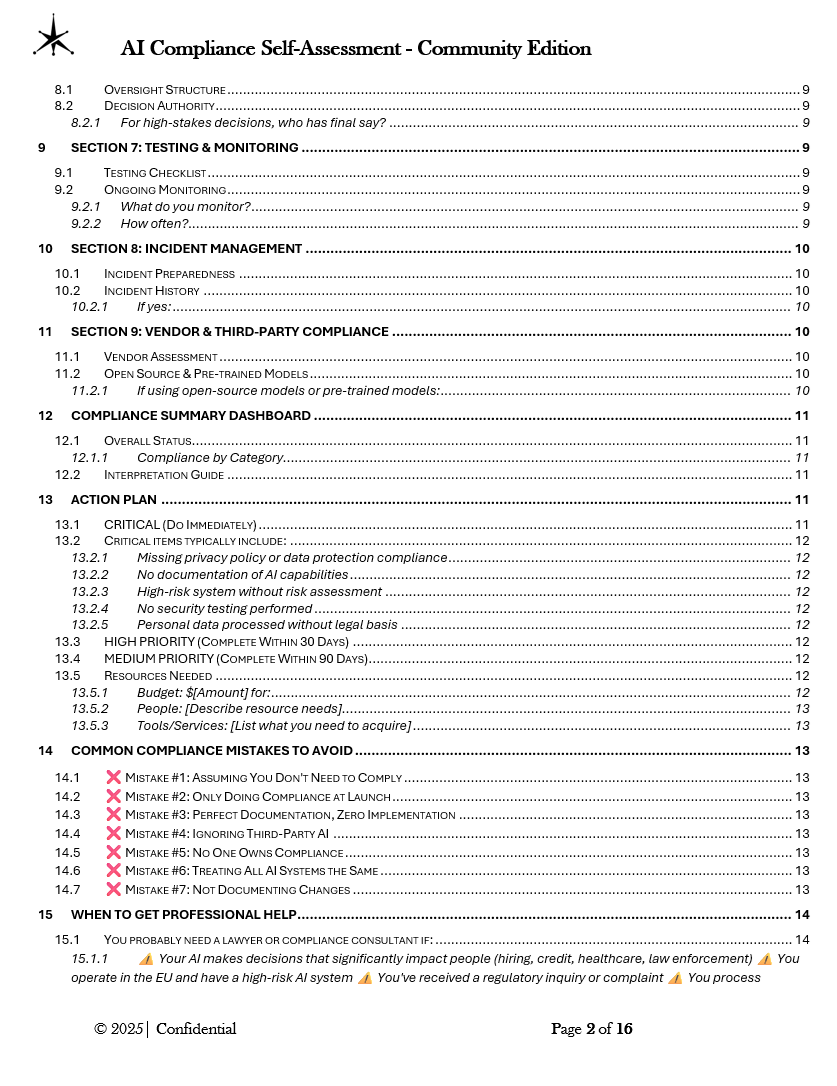
What You Get: ✓ Nine-section assessment framework covering regulatory applicability through vendor compliance ✓ Pre-built scoring matrices for each compliance category with percentage calculations ✓ Geographic and industry-specific regulation identification guides ✓ Risk classification framework aligned with EU AI Act definitions ✓ Action planning templates with priority levels (Critical, High, Medium) ✓ Common compliance mistakes reference guide ✓ Evidence checklist for regulatory documentation requirements
Designed For:
- Small to medium organizations deploying AI without dedicated compliance teams
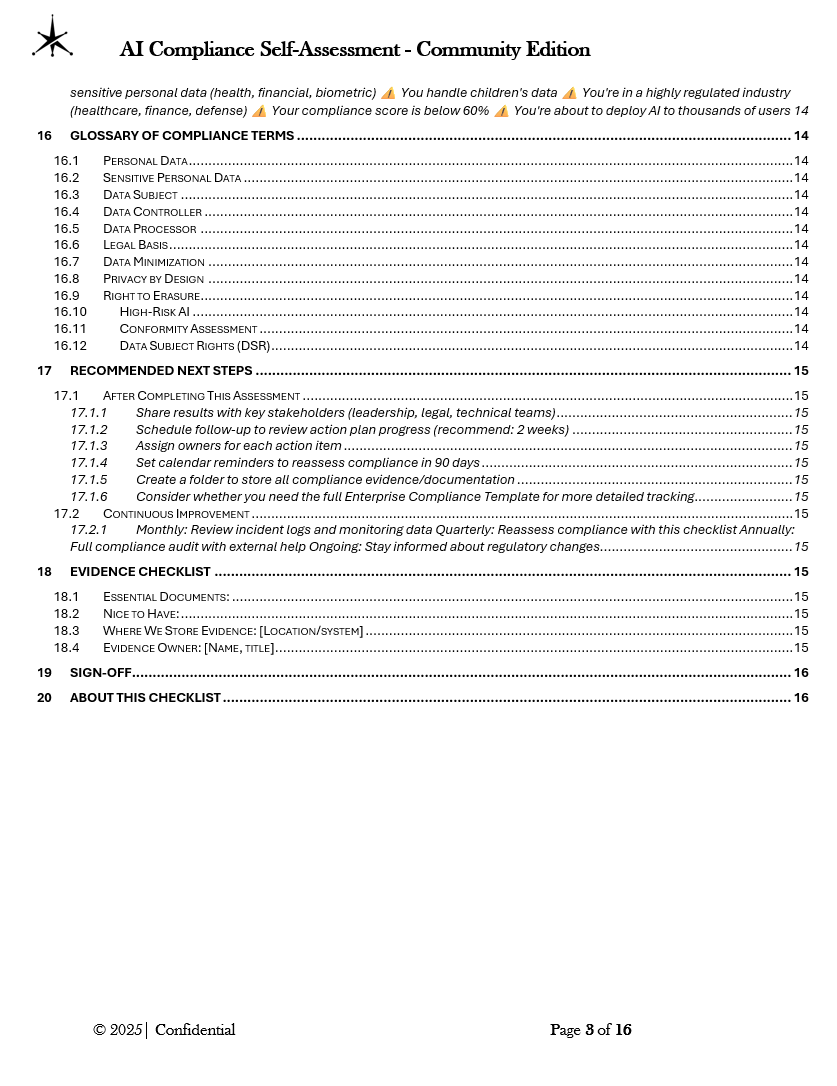
- Technology teams preparing for regulatory scrutiny or audits
- Risk managers evaluating AI compliance gaps across multiple systems
- Organizations needing to understand which regulations apply to their AI use cases
Preview What's Inside: The checklist contains nine assessment sections with fillable tables, checkbox frameworks, and status tracking fields. Each section includes scoring mechanisms and space for documenting evidence locations. The final sections provide action planning templates and guidance on when professional legal help may be needed.
Why AI Compliance Assessment Matters
AI systems operate under multiple overlapping regulatory frameworks depending on geographic scope, industry sector, data types processed, and risk classification. A customer service chatbot processing EU citizen data faces different requirements than a healthcare diagnostic tool or a financial credit scoring system. Organizations need structured approaches to determine which regulations apply and where their current practices have gaps.
This self-assessment approach helps organizations move from informal compliance assumptions to documented evaluation across key regulatory dimensions. The framework incorporates requirements from GDPR for data protection, EU AI Act for high-risk AI systems, and general best practices for transparency, fairness, security, and accountability.
Regulatory Landscape Coverage
The checklist includes guidance for identifying applicable requirements based on:
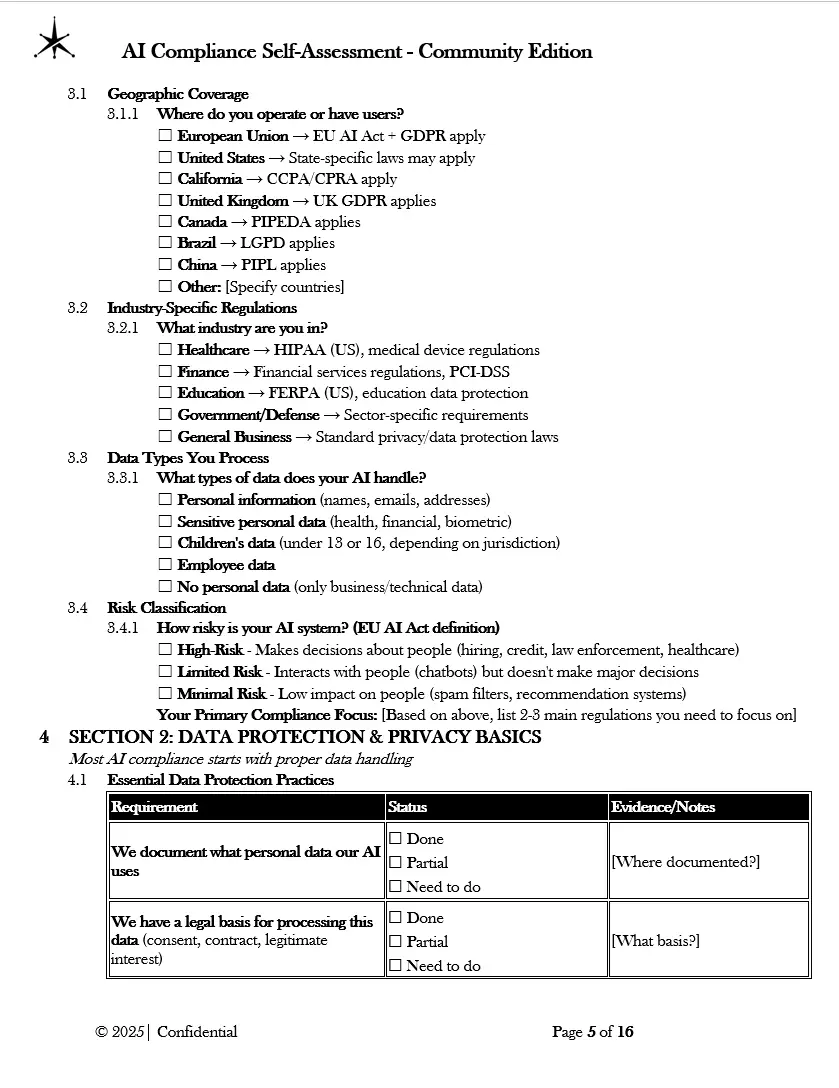
Geographic Coverage: European Union (EU AI Act, GDPR), United States (state-specific laws), California (CCPA/CPRA), United Kingdom (UK GDPR), Canada (PIPEDA), Brazil (LGPD), and China (PIPL).
Industry-Specific Regulations: Healthcare (HIPAA, medical device regulations), Finance (financial services regulations, PCI-DSS), Education (FERPA), Government/Defense (sector-specific requirements).
Data Type Considerations: Personal information, sensitive personal data, children's data, employee data processing requirements.
Risk Classification: High-risk AI systems (hiring, credit, law enforcement, healthcare decisions), limited risk systems (chatbots, customer interaction), minimal risk systems (spam filters, recommendations).
Assessment Framework Structure
Section 1: Regulatory Applicability Structured questions to identify which regulations apply based on geographic presence, industry sector, data types, and AI risk classification. This section helps organizations understand their compliance scope before evaluating specific requirements.
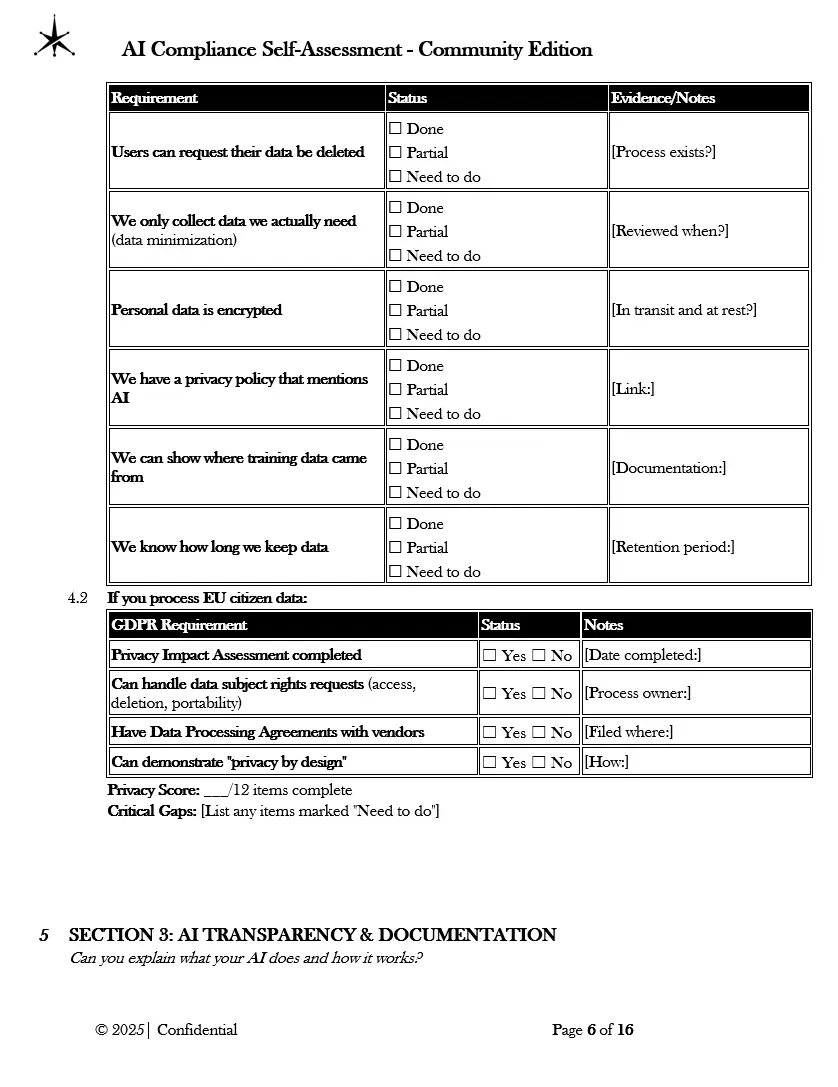
Section 2: Data Protection & Privacy Basics Eight-item checklist covering essential data protection practices including documentation of personal data usage, legal basis establishment, data deletion capabilities, data minimization, encryption, privacy policies, training data provenance, and retention periods. Additional GDPR-specific requirements for EU operations.
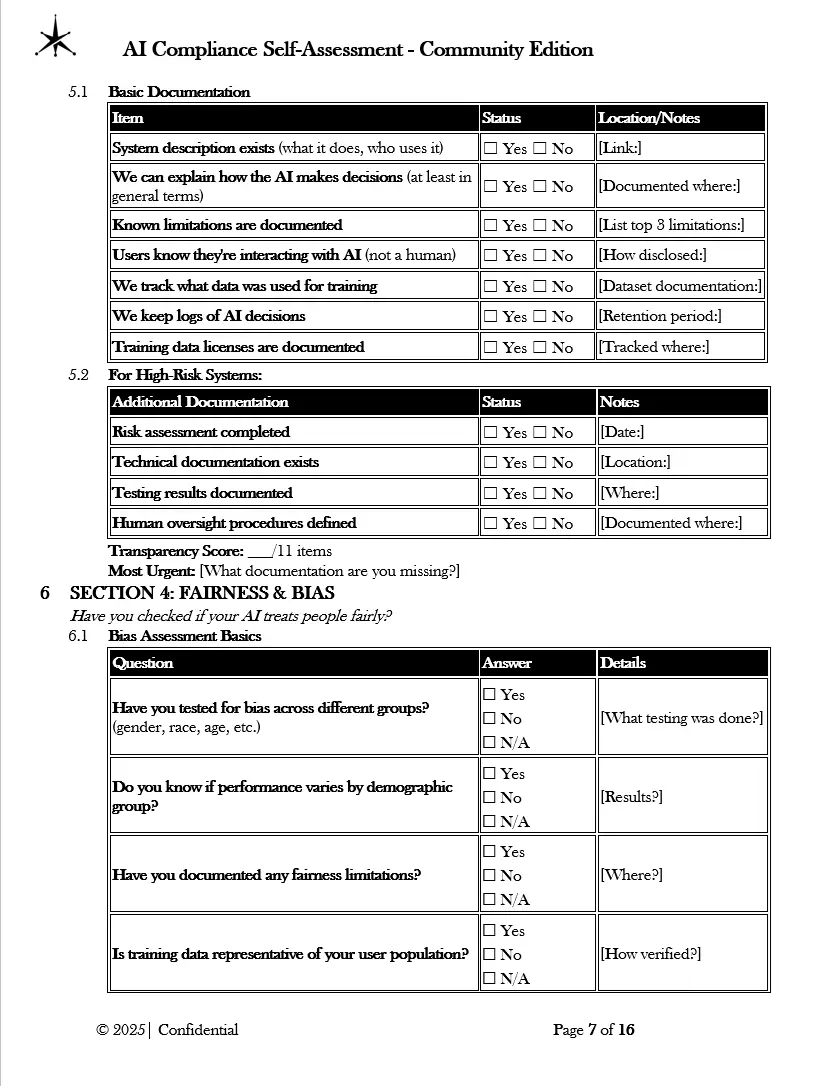
Section 3: AI Transparency & Documentation Seven-item basic documentation checklist covering system descriptions, decision explanations, limitation documentation, AI disclosure to users, training data tracking, decision logging, and license documentation. Additional requirements for high-risk systems including formal risk assessments and human oversight procedures.
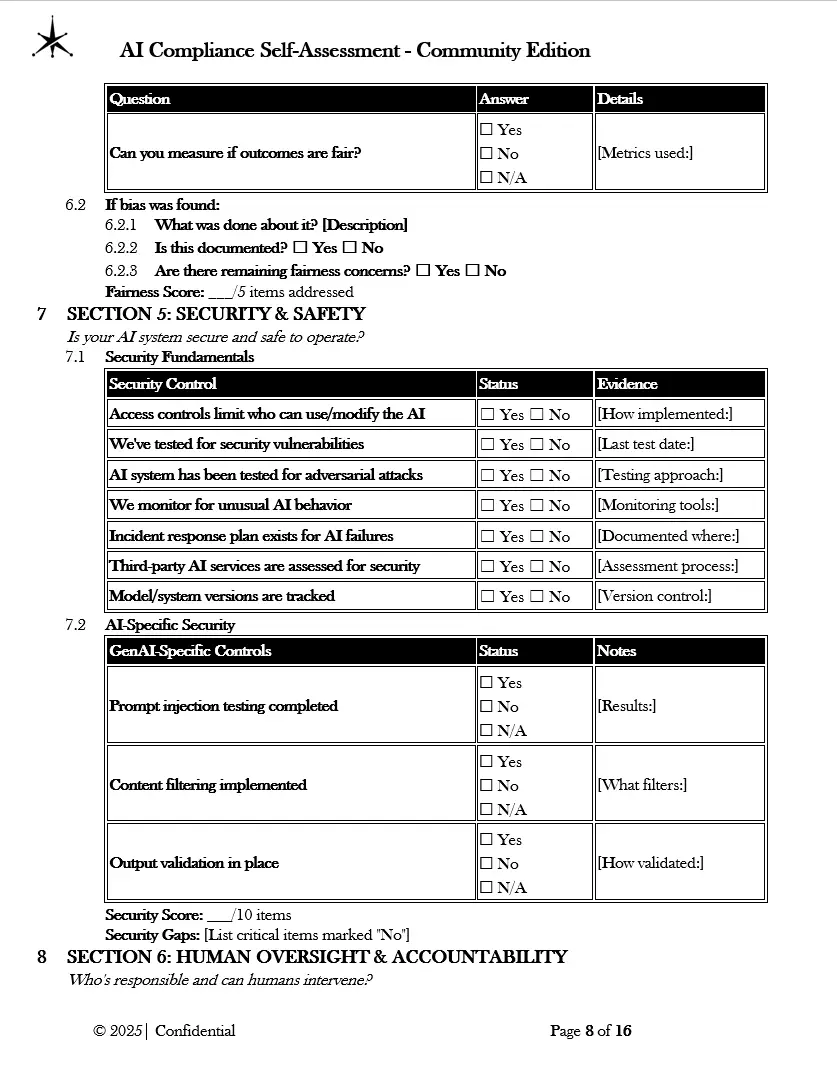
Section 4: Fairness & Bias Five-item assessment framework for bias testing across demographic groups, performance variation analysis, fairness limitation documentation, training data representativeness, and outcome fairness measurement. Includes follow-up questions for systems where bias was identified.
Section 5: Security & Safety Seven fundamental security controls plus three AI-specific security measures covering access controls, vulnerability testing, adversarial attack testing, behavior monitoring, incident response planning, third-party assessment, and version tracking. Additional considerations for generative AI systems including prompt injection testing and output validation.
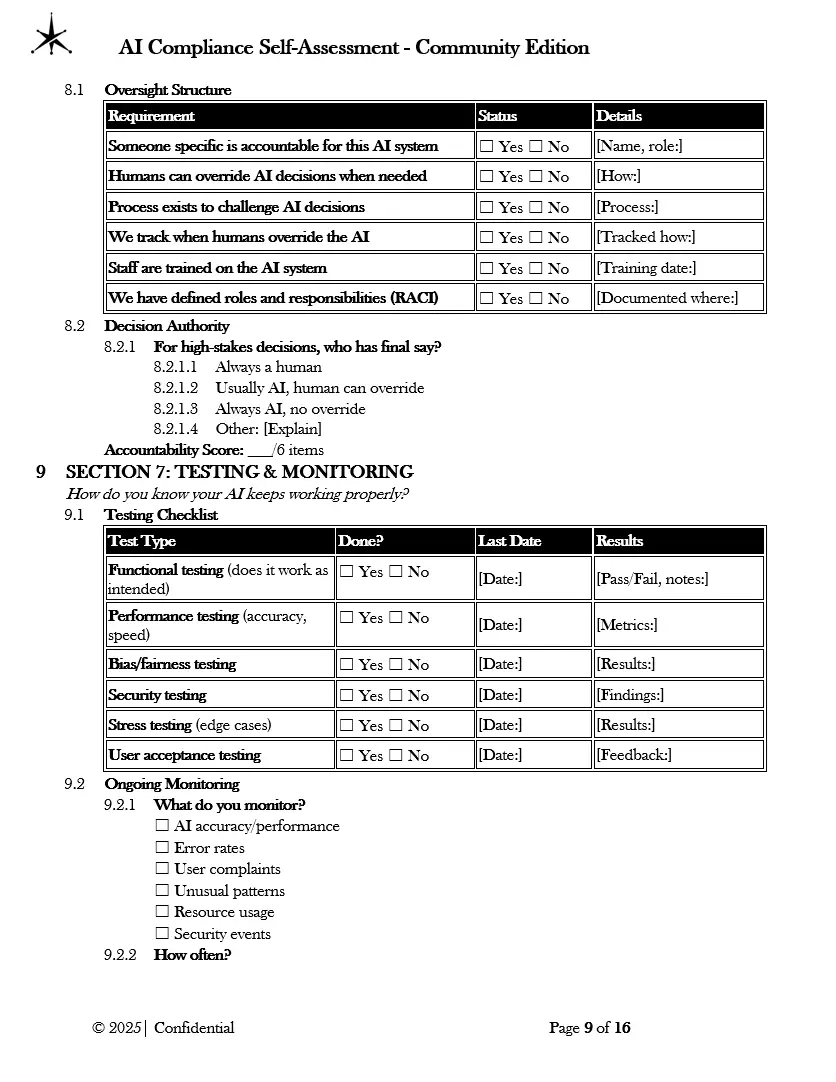
Section 6: Human Oversight & Accountability Six-item framework evaluating accountability assignment, human override capabilities, decision challenge processes, override tracking, staff training, and role definition (RACI framework). Includes decision authority classification for high-stakes determinations.
Section 7: Testing & Monitoring Structured testing checklist covering functional testing, performance testing, bias/fairness testing, security testing, stress testing, and user acceptance testing. Ongoing monitoring framework with frequency options (real-time, daily, weekly, monthly).
Section 8: Incident Management Five-item incident preparedness assessment covering incident planning, notification procedures, documentation practices, regulatory reporting criteria, and post-incident review processes. Includes incident history tracking for learning from past events.
Section 9: Vendor & Third-Party Compliance Assessment tables for evaluating vendor security, data protection terms, certifications, and audit rights. Additional considerations for open-source and pre-trained models including license review, training data knowledge, use case testing, version tracking, and discontinuation planning.
Compliance Summary Dashboard Scoring framework providing percentage completion across all categories with interpretation guidance (80-100% strong foundation, 60-79% good progress, 40-59% significant gaps, below 40% critical attention needed).
Action Planning Templates Three-tier priority framework (Critical/High/Medium) with owner assignment, due dates, and status tracking. Includes resource planning sections for budget, people, and tool requirements.
Comparison Table: Ad Hoc Compliance vs. Structured Assessment
| Aspect | Informal Approach | Self-Assessment Checklist |
|---|---|---|
| Regulatory Identification | Vague assumptions about what "might apply" | Structured identification by geography, industry, data types, and risk level |
| Gap Analysis | Awareness of some issues without systematic evaluation | Scored assessment across 9 categories with percentage tracking |
| Prioritization | Reactive response to immediate concerns | Three-tier priority framework (Critical/High/Medium) with timeline guidance |
| Evidence Management | Scattered documentation across systems | Centralized evidence checklist with ownership assignment |
| Progress Tracking | Informal "to-do" lists without status visibility | Action planning templates with owner, due date, and status fields |
| Reassessment Cadence | Sporadic reviews when problems arise | Defined 90-day reassessment schedule with continuous improvement framework |
FAQ Section
Q: Who should complete this self-assessment? A: This assessment is designed for small to medium organizations deploying AI systems without dedicated compliance officers. It works well for technology teams, risk managers, or cross-functional groups (technical, legal, operations) who need to understand their compliance status. Organizations with high-risk AI systems or those in heavily regulated industries may need more comprehensive assessment frameworks.
Q: How long does this assessment take? A: Initial completion typically requires 2-3 hours for most organizations. However, gathering supporting documentation, verifying security measures, and implementing remediation actions will require additional time. The assessment is designed to be completed progressively, with teams able to document current status first and develop action plans afterward.
Q: Does completing this checklist guarantee compliance? A: No. This self-assessment provides a framework for evaluating compliance status and identifying gaps, but it does not replace legal advice or guarantee regulatory compliance. The checklist helps organizations understand where they stand and what actions may be needed, but implementing those actions and ensuring they meet specific regulatory requirements typically requires additional expertise.
Q: What's the difference between this and hiring a compliance consultant? A: This self-assessment helps organizations identify and prioritize their compliance gaps independently. It's designed for teams who want to understand their status before engaging consultants, or for lower-risk situations where external help may not be immediately necessary. However, the checklist includes guidance on when professional legal or compliance help is recommended based on AI risk level, industry sector, and compliance score.
Q: Can I use this for multiple AI systems? A: Yes. The assessment includes space to list multiple AI systems being evaluated. Organizations can complete separate assessments for each system or conduct a combined assessment if systems share similar characteristics. For organizations with numerous AI deployments, the Enterprise template may provide more efficient tracking across system portfolios.
Q: What format is this checklist? A: The checklist is provided as a Microsoft Word document to enable form filling, collaborative editing, and easy adaptation to organizational needs. Organizations can save completed assessments as documentation evidence for compliance programs.
Ideal For
- Organizations Without Compliance Teams deploying AI and needing structured evaluation frameworks
- Technology Startups building compliance foundations as they scale AI deployments
- Risk Managers conducting preliminary assessments before engaging external consultants
- Product Teams preparing AI systems for launch and needing compliance readiness checks
- Small Business Owners using AI tools and wanting to understand regulatory obligations
- IT Managers evaluating vendor AI services and organizational compliance posture
About This Checklist
Version: Community Edition 1.0
Format: Microsoft Word (.docx)
Page Count: 16 pages
Created by: Tech Jack Solutions
What This Provides:
- General compliance guidance
- Self-assessment framework
- Action planning tools
What This Does NOT Provide:
- Legal advice
- Guarantee of regulatory compliance
- Detailed technical specifications
- Industry-specific guidance
Disclaimer: This checklist provides a framework for evaluating AI compliance status but does not constitute legal, compliance, or regulatory advice. Organizations should consult with qualified legal and compliance professionals to ensure their AI systems meet applicable regulatory requirements. Completing this assessment does not guarantee compliance with any specific regulation.
Remember: Compliance is a journey, not a destination. Start where you are, document what you do, and improve continuously.