


- Version 1
- Download 1
- File Size 138.82 KB
- File Count 1
- Create Date October 4, 2025
- Last Updated October 20, 2025
- Download
Agentic AI Governance Guide - Community Edition
A structured template designed to support organizations deploying autonomous AI systems with comprehensive safety, risk, and compliance documentation frameworks.
Agentic AI Governance Guide - Community Edition
What This Template Provides
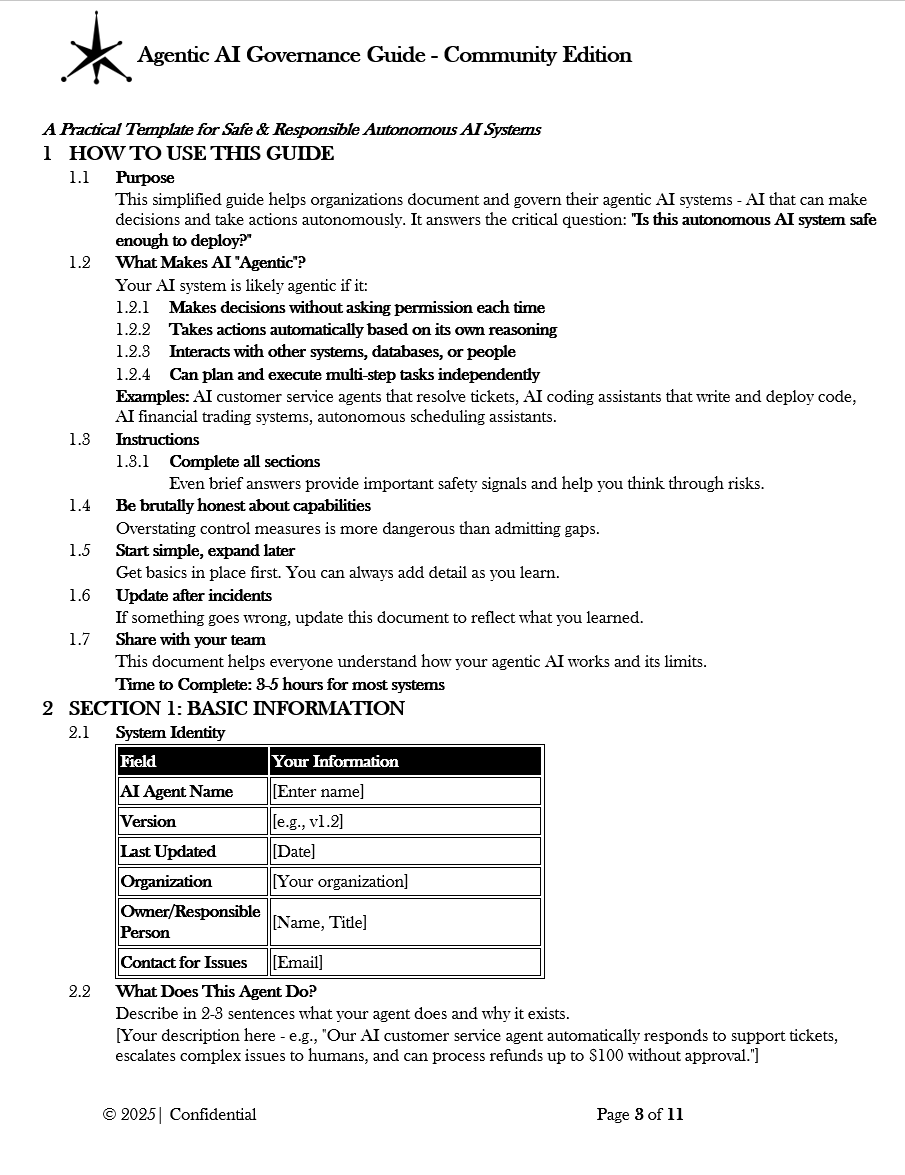
Autonomous AI systems that make decisions without constant human approval need different governance approaches than traditional software. This Community Edition template provides a structured framework for documenting your agentic AI systems across 11 critical areas, from basic system identification through performance tracking.
The template includes pre-built sections for safety controls, risk assessment matrices, incident response planning, and compliance checklists. Organizations will need to customize the content based on their specific use cases, regulatory requirements, and risk tolerance. Most teams complete initial documentation in 3-5 hours, though thorough implementation may require additional time depending on system complexity.
What You Get:
✓ 11-section documentation framework covering system identity through performance tracking
✓ Pre-built risk assessment matrices with likelihood and impact evaluation
✓ Three-tier autonomy classification system (Human-in-the-Loop, Human-on-the-Loop, Human-out-of-the-Loop)
✓ Safety control checklists including kill switch protocols and pre-action validation
✓ Incident response planning templates with severity-based escalation procedures
✓ Privacy and data compliance documentation frameworks
✓ Pre-deployment verification checklist aligned with governance best practices
Designed For:
- Organizations deploying AI customer service agents, coding assistants, or automated decision systems
- Risk managers and compliance officers establishing governance frameworks for autonomous AI
- AI product teams implementing safety controls and oversight mechanisms
- Technology leaders documenting AI systems for board-level reporting
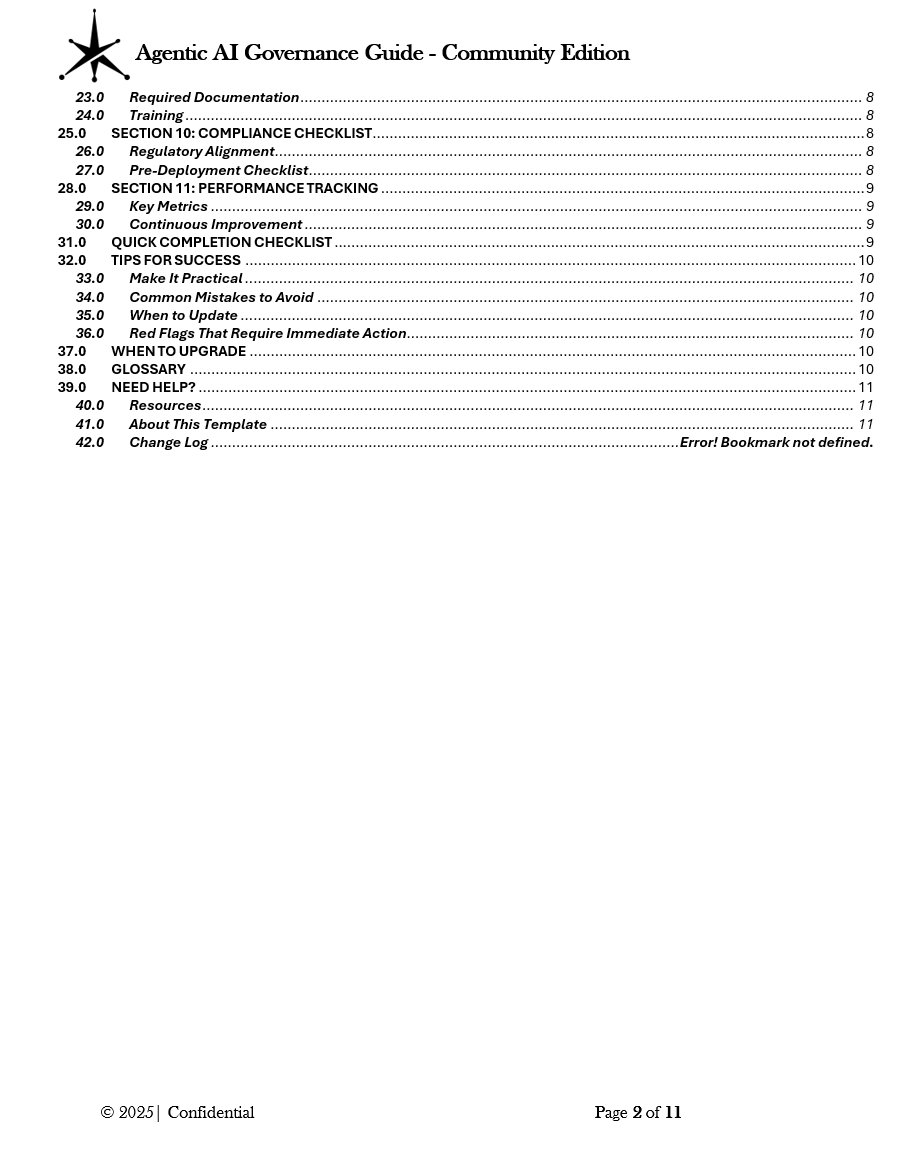
Preview What's Inside: The template contains 11 structured sections with fillable fields, checkbox frameworks, and guidance text. Each section includes specific prompts for documenting capabilities, boundaries, risks, and controls. The appendix provides a glossary of key terms and references to relevant frameworks.
Why Agentic AI Governance Matters
Autonomous AI systems differ fundamentally from traditional software because they make decisions and take actions based on their own reasoning, often without requiring approval for each step. An AI customer service agent that can process refunds, an AI coding assistant that writes and deploys code, or an automated trading system all operate with varying degrees of independence from human oversight.
This autonomy creates governance challenges that traditional IT risk frameworks may not adequately address. Organizations need structured approaches to document what these systems can do, what they cannot do, how decisions are monitored, and what happens when things go wrong. The documentation approach in this template is based on principles found in frameworks including NIST AI RMF, EU AI Act requirements for high-risk AI systems, and GDPR data protection standards.
What Makes AI "Agentic"?
The template defines agentic AI systems as those that exhibit four key characteristics: they make decisions without asking permission each time, take actions automatically based on their own reasoning, interact with other systems or people, and can plan and execute multi-step tasks independently. If your AI system displays these behaviors, this governance framework may be relevant for your documentation needs.
Framework Alignment
This template includes references to multiple governance frameworks:
NIST AI Risk Management Framework: The structure aligns with principles of identifying, assessing, and managing AI system risks through documented processes.
EU AI Act: The autonomy classification system and risk assessment approach are designed to support organizations subject to high-risk AI requirements under EU regulations.
GDPR: Privacy and data compliance sections include prompts for documenting personal data processing, legal basis, and data subject rights.
OWASP Top 10 for LLMs: Security testing checklists reference common vulnerabilities in AI systems including prompt injection and unauthorized access attempts.
Key Features
System Identity & Scope Documentation Structured fields for capturing basic information including system name, version, owner, and a plain-language description of what the agent does. This section provides the foundation for all subsequent documentation.
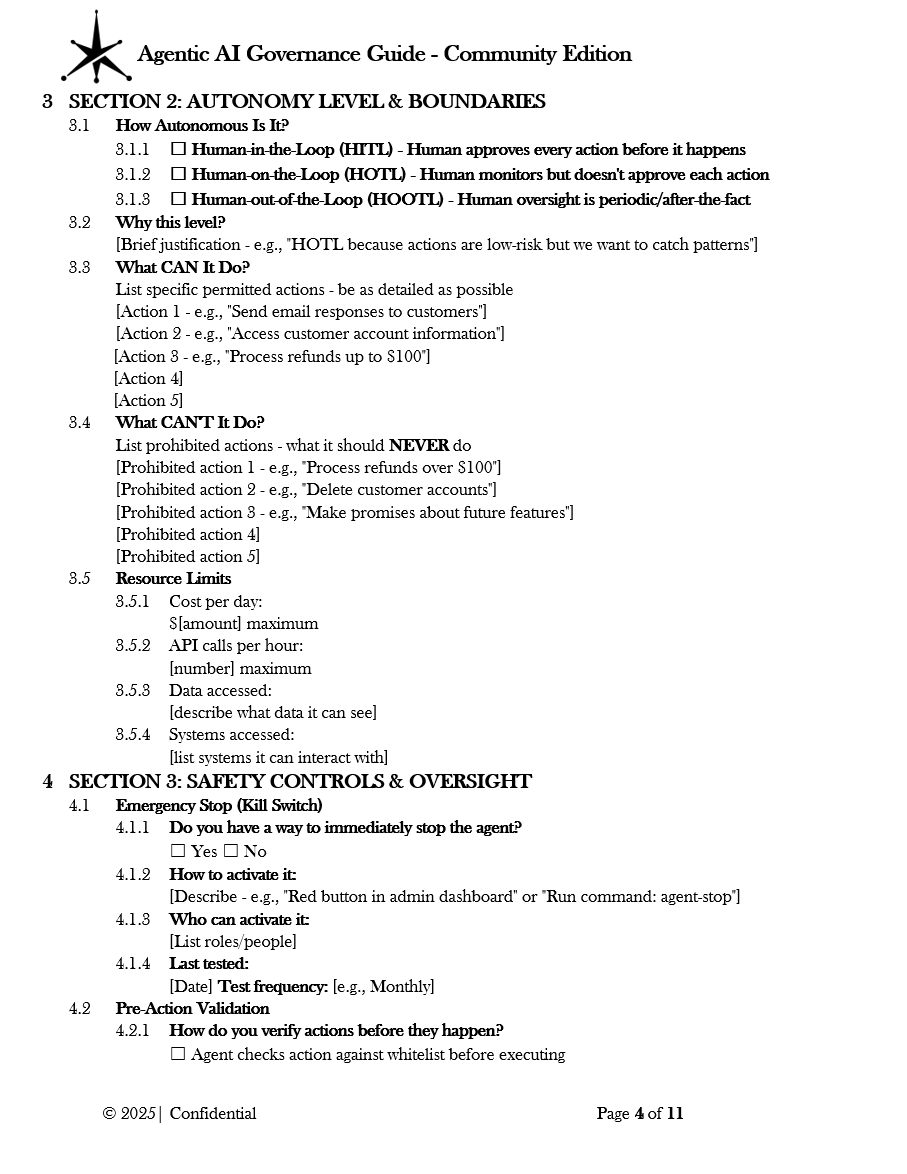
Three-Tier Autonomy Classification The template includes a framework for classifying systems as Human-in-the-Loop (approval required for each action), Human-on-the-Loop (monitoring without per-action approval), or Human-out-of-the-Loop (periodic oversight). Organizations select and justify their autonomy level based on risk tolerance and use case requirements.
Permitted and Prohibited Actions Separate sections for explicitly documenting what the system can do and what it cannot do. This boundary-setting approach helps teams think through edge cases and prevents scope creep.
Safety Control Frameworks Pre-built checklists for emergency stop mechanisms (kill switches), pre-action validation, human override capabilities, and monitoring protocols. Each control includes prompts for documenting implementation details, responsible parties, and testing frequency.
Risk Assessment Matrix A structured table format for identifying risks, rating likelihood and impact, and documenting prevention measures. The template also includes advanced risk considerations like reward hacking, scope creep, and multi-agent interaction issues.
Testing & Security Checklists Verification frameworks covering normal operation testing, edge case scenarios, failure modes, security vulnerabilities, and adversarial testing for prompt injection attempts.
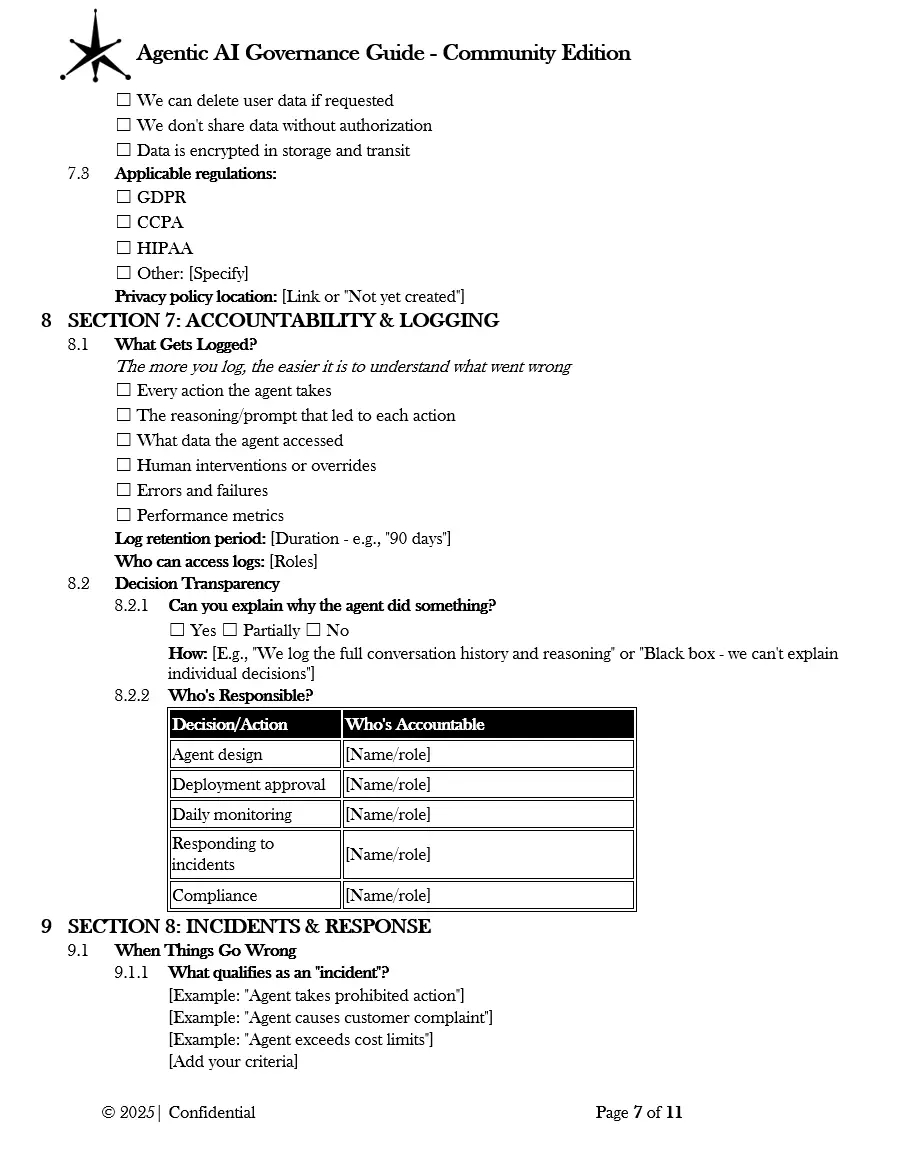
Data & Privacy Compliance Documentation tables for cataloging data types accessed, usage purposes, and personal data flags. Includes checkbox frameworks for common privacy regulations (GDPR, CCPA, HIPAA).
Accountability & Logging Structured sections for defining what gets logged, log retention periods, decision transparency capabilities, and role-based responsibility assignments across design, deployment, monitoring, and incident response.
Incident Response Planning A severity matrix framework (Critical, High, Medium, Low) with corresponding response times, responsible parties, and required actions. Includes prompts for defining what qualifies as an incident.
Performance Tracking Metrics Pre-built metric tables for success rate, human override rate, error rate, unauthorized actions, and cost tracking. Includes trend indicators and review frequency documentation.
Pre-Deployment Verification A comprehensive checklist covering all critical elements that should be in place before production deployment, from documented actions and tested kill switches to completed training and legal reviews.
Comparison Table: Generic Approach vs. Structured Template
| Aspect | Ad Hoc Documentation | Agentic AI Governance Template |
|---|---|---|
| Scope Definition | Informal descriptions of what AI "should do" | Explicit lists of permitted and prohibited actions with resource limits |
| Autonomy Classification | Unclear human oversight expectations | Three-tier framework (HITL/HOTL/HOOTL) with justification requirements |
| Safety Controls | Assumed ability to "turn it off if needed" | Documented kill switch with testing schedule and responsible parties |
| Risk Assessment | General concerns about AI "doing wrong things" | Structured matrix with likelihood, impact, and specific prevention measures |
| Incident Response | Reactive approach when issues arise | Pre-defined severity levels with response times and escalation procedures |
| Compliance Documentation | Scattered information across multiple sources | Centralized framework addressing GDPR, EU AI Act, NIST RMF, and other standards |
FAQ Section
Q: Who should use this Community Edition template? A: This template is designed for organizations deploying autonomous AI systems where the AI makes decisions and takes actions independently. It may be particularly relevant for teams implementing AI customer service agents, automated coding assistants, scheduling systems, or other applications where AI operates with some degree of autonomy. The Community Edition works well for getting started with agentic AI governance, though organizations with high-risk AI systems may need more comprehensive documentation.
Q: What's the difference between this and traditional IT documentation? A: Traditional IT documentation typically covers static systems with predefined logic. Agentic AI systems make dynamic decisions based on reasoning, which requires different governance approaches. This template specifically addresses autonomy levels, decision transparency, behavioral boundaries, and risks unique to systems that can independently plan and execute multi-step tasks.
Q: How long does it take to complete this template? A: Initial completion typically requires 3-5 hours for most systems. However, thorough implementation including testing kill switches, conducting risk assessments, and establishing monitoring protocols may require additional time. The template is designed to be filled out progressively, with organizations able to start with basic information and expand documentation as they learn more about their system's behavior.
Q: Does this template guarantee regulatory compliance? A: No. This template provides a structured framework for documenting agentic AI systems and includes references to common regulatory requirements, but it does not guarantee compliance with any specific regulation. Organizations should work with legal and compliance advisors to ensure their documentation and processes meet applicable requirements for their jurisdiction and industry.
Q: What file format is this template? A: The template is provided as a Microsoft Word document to ensure proper formatting and to enable collaborative editing. Organizations can customize, add sections, or adapt the structure to their specific needs.
Q: Can I modify this template? A: Yes. The Community Edition is provided as a free-to-use and modify resource. Organizations are encouraged to adapt the template to their specific use cases, regulatory requirements, and internal processes.
Ideal For
- AI Product Teams deploying autonomous agents in production environments and needing structured documentation
- Risk & Compliance Officers establishing governance frameworks for AI systems that operate with limited human oversight
- Technology Leaders documenting AI capabilities and controls for board-level reporting and stakeholder communication
- Startups & Scale-ups implementing their first autonomous AI systems and building governance practices
- Enterprise IT Teams supplementing existing AI governance programs with agentic system-specific documentation
- Consultants & Advisors working with clients on responsible AI deployment and risk management
About This Template
Version: Community Edition 1.0
License: Free to use and modify
Format: Microsoft Word (.docx)
Page Count: 13 pages
Created by: Tech Jack Solutions
Disclaimer: This template provides a framework for documenting agentic AI systems but does not constitute legal, compliance, or risk management advice. Organizations should consult with qualified professionals to ensure their AI governance approaches meet applicable regulatory and industry requirements.
Remember: An autonomous AI agent with documented limits is safer than one with unlimited freedom. Start here, deploy carefully, and improve based on what you learn.


| File | Action |
|---|---|
| Agentic-AI-Governance-Guide-Community-Edition.docx | Download |
