AI Governance Committee

AI Governance Committee Hub
Structure, roles, and the TJS 8-stage framework for standing up a committee that actually governs AI. Not one that rubber-stamps it.

Most organizations that fail at AI governance don’t fail because they lacked policies. They fail because no one was accountable for enforcing them. An AI governance committee is the organizational mechanism that bridges strategy and operations. It decides, oversees, and escalates when AI systems behave in ways that create risk.
The TJS AI Governance Committee framework is built on the primary regulatory and standards corpus (ISO 42001, NIST AI RMF, EU AI Act, GAO, CSA) and structured around an 8-stage implementation model with a 120-day rollout target plus a 30% delivery buffer. Few public frameworks map committee implementation across all three regulatory regimes in one staged sequence.
Why an AI Governance Committee?
A governance policy without a committee is a document without an owner. The committee is the enforcement mechanism, the escalation path, and the continuous improvement engine all in one.
Centralized Accountability
Named individuals (not teams) own each AI system. The committee holds RACI accountability at the organizational level, preventing the “everyone owns it, no one owns it” failure mode that kills governance programs.
Cross-Functional Oversight
AI risk cuts across Legal, IT, Compliance, Operations, and the C-Suite. A committee is the structure that brings all five domains into the same room with decision authority and documented minutes to prove it.
Regulatory Defensibility
EU AI Act Article 26(2) requires deployers of high-risk AI to assign human oversight to natural persons with the necessary competence and authority; Article 27 then requires deployers to complete a Fundamental Rights Impact Assessment. ISO 42001 Clause 5.3 mandates documented organizational roles. “We have a policy” will not satisfy an auditor. A committee will.
Risk Proportionality
Not every AI use case requires the same scrutiny. The committee applies risk-tiered review: critical systems get full board-level visibility, low-risk tools get expedited approval tracks. Governance scales with impact.
Shadow AI Detection
Employees adopt AI tools faster than IT can inventory them. The committee establishes the intake process, the exception request workflow, and the amnesty window that surfaces shadow AI before it becomes a breach or a compliance finding.
Incident Authority
When an AI system produces harmful output, who has authority to suspend it? The committee defines escalation thresholds, kill-switch authority, and the documented incident response runbook that satisfies both legal counsel and the board.
What Happens When Governance Fails
These aren’t hypothetical scenarios. Each one is a documented case where missing or inadequate AI governance produced measurable harm.
COMPAS Recidivism Algorithm
ProPublica’s 2016 analysis reported a 45% false-positive rate for Black defendants vs. 23% for white defendants. Northpointe disputed the methodology; the underlying disparity remains a live debate in algorithmic fairness research.
Population Health Risk Scoring
Obermeyer, Powers, Vogeli, and Mullainathan (Science 366(6464), Oct 2019) found the algorithm systematically under-identified Black patients for care management programs.
Air Canada Chatbot
AI chatbot hallucinated bereavement fare policy. The BC Civil Resolution Tribunal ruled against the airline in Moffatt v. Air Canada (Feb 2024), establishing legal liability for AI-generated misinformation.
Pentagon Blast Deepfake
A synthetic image of a Pentagon explosion went viral on May 22, 2023. The S&P 500 dipped roughly 0.3% intraday before recovering within minutes once the image was debunked.
Clearview AI Facial Recognition
Scraped billions of photos from the internet without consent. France’s CNIL fined the company €20M in October 2022, with a further €5M penalty in May 2023; Italy, the UK, and Greece levied separate fines.
EU AI Act Prohibited Practices (Article 5)
The committee’s first screening obligation: ensure no proposed AI system falls into the “unacceptable risk” tier. Violations carry fines up to €35 million or 7% of global annual turnover.
Committee obligation: Every AI use case submitted through the intake process must be screened against this list before risk tiering begins. If a proposed system matches any prohibited category, the committee must reject it. There is no exception workflow. NIST AI RMF adds that if an AI system poses unacceptable negative risk, development and deployment must cease until the risk can be managed.
How a Use Case Moves Through the Committee
Every AI system follows the same path. The risk tier determines the review track, the review track determines the SLA, and the SLA determines who approves it.
Authority Cascade
Policy flows down. Escalations flow up. The committee sits at the operational center, with clear lines to the board above and business units below.
↓ Mandate, veto authority, budget
↓ Approvals, policy, risk tier assignments, AUP
↓ Review decisions, conditions, training reqs
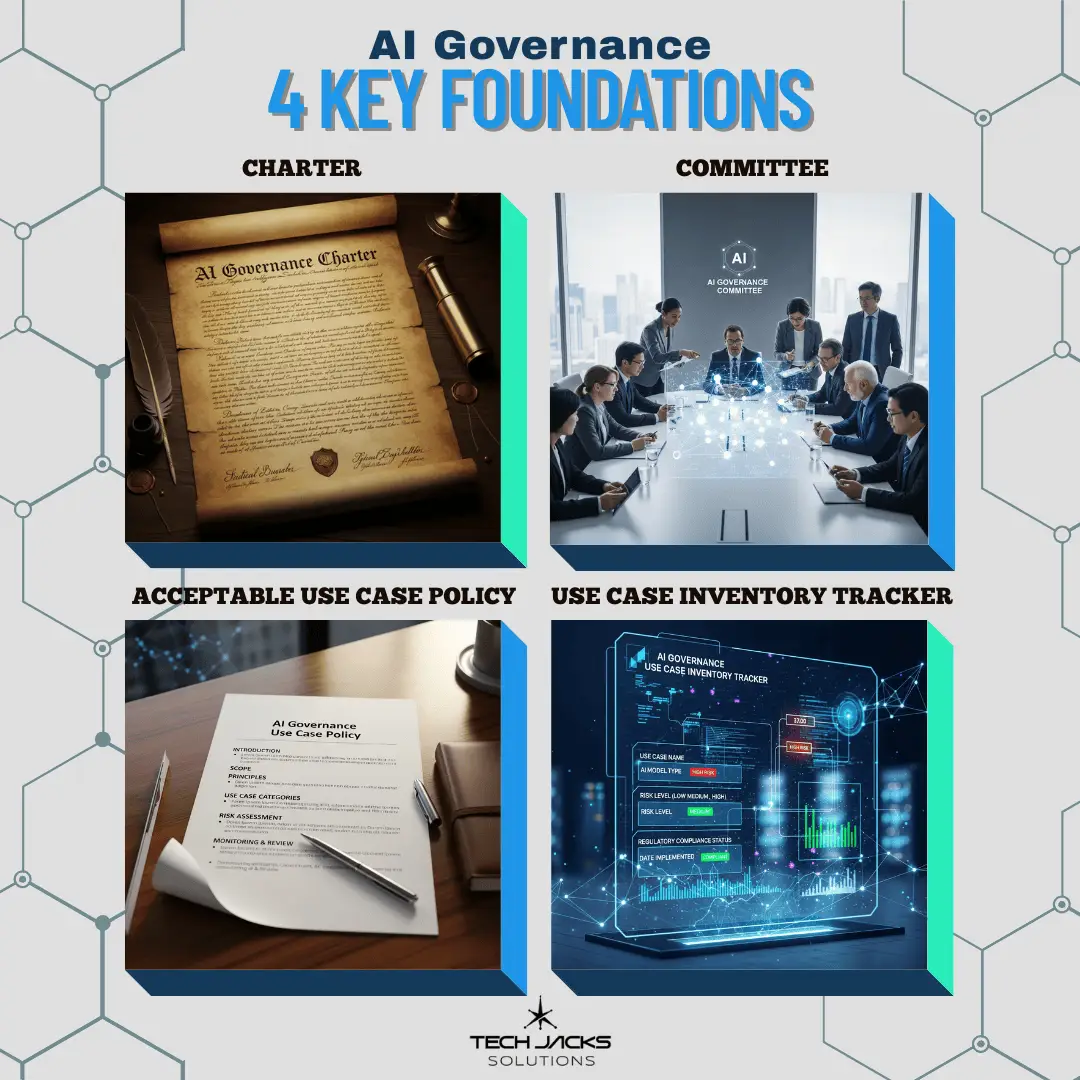
The Four Foundations of AI Governance
A committee without the right foundations underneath it is a discussion group. The four foundations below are what turn the structure into an enforcement function. Each foundation maps to specific stages of the 120-day rollout.
Committee Composition & RACI
Effective committees aren’t large. They’re precise. The TJS framework identifies 8 core roles, each with a defined RACI assignment. Click any role to expand its responsibilities and decision authority.
The 8-Stage Committee Implementation
Standing up an AI governance committee isn’t a kick-off meeting and a terms of reference document. The TJS framework structures implementation across 8 stages with a 120-day timeline, a 30% schedule buffer, and go/no-go tollgates between each stage. Click any stage to expand deliverables and framework references.
Secure executive sponsorship and authorize the committee’s decision rights in writing.
Fill all 8 seats with named individuals and signed time commitments.
Draft the AUP, procurement, intake, and incident response policies the committee will enforce.
Train committee, employees, and BU leads with auditable completion records.
Sweep the organization for AI systems, classify by risk tier, populate the register.
First formal committee meeting and end-to-end review of real intake requests.
Stand up the KPI dashboard and lock the board reporting cadence.
Internal audit against ISO 42001 Cl. 9.2 and TJS maturity-level scoring.
This is the overview. The implementation guide covers each stage in depth: per-stage deliverables, tollgate criteria, RACI assignments, NIST / ISO 42001 / EU AI Act framework mappings, and the downloadable artifact for every stage.
Committee Requirements by Framework
Each major AI governance framework mandates committee-equivalent structures. The TJS 8-stage implementation satisfies all three simultaneously: one implementation, three compliance postures.
| NIST Function / Control | Committee Requirement | TJS Stage |
|---|---|---|
| GOVERN 1.1 | Policies, processes, procedures, and practices across the organization related to the mapping, measuring, and managing of AI risks are in place, transparent, and implemented effectively. | Stage 1: Mandate |
| GOVERN 2.1 | Roles and responsibilities and organizational accountabilities for AI risk management are documented for teams and individuals. | Stage 2: Roles |
| GOVERN 2.1 | The organization’s personnel and partners receive AI risk management training to enable them to perform their duties and responsibilities consistent with related policies, procedures, and agreements. | Stage 4: Training |
| GOVERN 4.1 | Organizational teams are committed to a culture that considers and communicates AI risk. | Stage 4: Training |
| MAP 1.1 | Context is established for the AI risk assessment, framing, and prioritization process, including information about the AI system’s expected use, potential users, and risks. | Stage 5: Inventory |
| MEASURE 4.1 | Feedback processes for continual improvement are in place and functional. | Stage 7: KPIs |
| ISO 42001 Clause | Committee Requirement | TJS Stage |
|---|---|---|
| Cl. 5.1: Leadership & Commitment | Top management shall demonstrate leadership and commitment with respect to the AI management system. | Stage 1: Mandate |
| Cl. 5.3: Roles, Responsibilities, Authorities | Top management shall assign and communicate responsibilities and authorities for relevant roles within the organization. | Stage 2: Roles |
| Cl. 6.1: Actions to Address Risks | The organization shall determine the risks and opportunities that need to be addressed to ensure the AIMS can achieve its intended outcomes. | Stage 3 & 5 |
| Cl. 7.2: Competence | The organization shall determine the necessary competence of persons doing work under its control that affects its AI risk performance. | Stage 4: Training |
| Cl. 8.4: AI System Impact Assessment | The organization shall apply controls to address AI risks, including an AI system impact assessment for high-impact systems. | Stage 5: Inventory |
| Cl. 9.2: Internal Audit | The organization shall conduct internal audits at planned intervals to provide information on whether the AIMS conforms to the organization’s own requirements. | Stage 8: Audit |
| EU AI Act Article | Committee Requirement | TJS Stage |
|---|---|---|
| Art. 9: Risk Management System | A risk management system shall be established, implemented, documented, and maintained for high-risk AI systems throughout their entire lifecycle. | Stage 3 & 5 |
| Art. 13: Transparency | High-risk AI systems shall be designed and developed in such a way as to ensure sufficient transparency to enable users to interpret the system’s output. | Stage 5: Inventory |
| Art. 14: Human Oversight | High-risk AI systems shall be designed and developed in such a way, including with appropriate human-machine interface tools, that they can be effectively overseen by natural persons. | Stage 2 & 6 |
| Art. 27: Fundamental Rights Assessment | Deployers of high-risk AI systems that are bodies governed by public law, or private operators providing public services, shall perform a fundamental rights impact assessment. | Stage 1 & 5 |
| Art. 72: Post-Market Monitoring | Providers shall establish and document a post-market monitoring system proportionate to the nature of the AI technology and its risks. | Stage 7: KPIs |
| Art. 73: Serious-Incident Reporting | Providers report serious incidents to market surveillance authorities. Three timelines apply: 2 days for widespread infringement (Art. 3(49)(b)) or critical-infrastructure disruption (Art. 73(3)); 10 days for incidents resulting in death; 15 days for all other serious incidents. | Stage 3 & 7 |
TJS Framework vs. Generic Committee Guidance
Most “AI governance committee” resources give you a org chart and a list of talking points. The TJS framework provides staged implementation with deliverables, tollgates, and framework mappings per stage.
| Dimension | Generic Guidance | TJS 8-Stage Framework |
|---|---|---|
| Implementation Structure | List of recommended roles with no sequencing | ✓ 8 ordered stages with day ranges |
| Schedule | No timeline; “this takes several months” | ✓ 120 days + 30% buffer per stage |
| Go/No-Go Controls | None (proceed when ready) | ✓ 7 documented tollgate criteria |
| Deliverables | Generic (e.g., “write a policy”) | ✓ Named artifacts per stage (4–5 each) |
| Framework Alignment | Single framework or none | ✓ ISO 42001 + NIST AI RMF + EU AI Act simultaneously |
| RACI Specificity | High-level roles (e.g., “Legal team”) | ✓ 8 named roles with per-activity RACI assignments |
| Shadow AI Coverage | Not mentioned | ✓ Stage 5 shadow AI detection scan with CISO lead |
| Audit Readiness | Not addressed | ✓ Stage 8 internal audit + maturity assessment |
| Source Basis | Opinion / editorial | ✓ 130+ primary source documents (ISO, NIST, EU, GAO, CSA) |
Resources for Your Committee
Every resource your committee needs, from the governance charter that authorizes it to the tools that support its day-to-day work.
AI Governance Committee: 8 Critical Stages
The full implementation guide: every stage, every deliverable, every tollgate. 4,000+ words sourced from ISO, NIST, EU AI Act, and GAO.
Read the full guide →AI Governance Charter
The charter that authorizes your committee. Covers all 6 core components, 5 foundational pillars, 90-day rollout, and three framework alignments.
Read the charter guide →Charter Implementation Checklist
55-item checklist covering the 5 charter phases and 90-day rollout. Use this alongside the committee’s Stage 1–3 work to ensure no governance requirement is missed.
Download free →Board AI Governance Summary Template
Quarterly board reporting template. Pre-built sections for committee activity log, risk register status, open incidents, and six KPI categories. Built for the Executive Sponsor.
Download free →40-Field AI Use Case Tracker
The inventory form the AI Risk Lead uses to capture Stage 5 use cases. 40 fields covering identity, risk classification, data sensitivity, integration depth, and lifecycle stage.
Download free →Risk Tier Decision Tree
7-question decision tree that classifies any AI system as Critical, High, Medium, or Low risk. Use this to standardize the committee’s risk classification process in Stage 5.
Download free →Quick-Start Checklist
3-tier rollout checklist for the committee’s first 90 days: Stages 1–4 essentials, intake validation, and the announcement plan that signals the committee is operational.
Download free →Regulatory Mapping Cheat Sheet
40 controls mapped to ISO 42001, NIST AI RMF, and the EU AI Act in one reference. The fastest way for Legal to validate the committee’s charter against three regulatory regimes.
Download free →All 6 committee tools in one download: Tracker Template, Charter Checklist, Regulatory Mapping, Risk Decision Tree, Board Summary, and Quick-Start Checklist.
Download the Free AI Governance Bundle →Where to Go From Here
The committee is the mechanism, but it still needs policies to enforce, a charter to authorize it, and systems to govern. These three resources complete the picture.
TJS can accelerate your committee build with facilitated workshops, pre-built policy templates, and hands-on implementation support. Engagements are scoped to the organization’s executive commitment and existing maturity.
Looking for AI governance roles, salary ranges, or career paths? Visit the AI Governance Careers hub →