AI Paradox Weekly #2 The Pivot from Digital to Physical Intelligence (August 22-29, 2025)
- Home
- AI Paradox Weekly #2 The Pivot from Digital to Physical Intelligence (August 22-29, 2025)

The AI Paradox Weekly
August 22-29th
TL:DR The Essential Intel
When you are pressed for time - and just need the goods
- Microsoft declared independence from OpenAI with MAI-1 and MAI-Voice models already powering Copilot. MAI-Voice generates 60 seconds of audio in under 1 second. This ends the era of expensive third-party API dependence for major tech companies. Independent benchmarks are not yet available.
- Physical AI building on $500M+ in funding as World Labs (Fei-Fei Li, $230M) and Physical Intelligence secured $400 million to advance robotic foundation models. Together these moves highlight the surge of investment into ‘Physical AI’ systems designed to interpret and interact with the real world. The industry is moving beyond chatbots to AI that navigates and interprets the real world.*Trend Watch – started in 2024*
- DeepSeek solved the agent economics problem with hybrid “Think/Non-Think” architecture cutting costs by 70% for complex queries. Released under MIT License, making production-ready agents financially viable for the first time. This is vendor-reported and has not been independently validated.
- 41% of all US VC dollars went to just 10 companies (8 are AI), according to Pitchbook analysis, while public AI stocks crashed despite record earnings. NVIDIA fell 3.3% even after beating estimates with $46.7B revenue. The market is priced for impossible perfection.
- Your AI data is no longer private by default – Anthropic shifts to opt-out on September 28, joining the industry trend of using user conversations for training unless explicitly declined. Meanwhile, The Wall Street Journal reports OpenAI is facing its first known wrongful-death lawsuit, alleging chatbot interactions contributed to a teenager’s suicide OpenAI faces its first wrongful death lawsuit.
Table of Contents

AI Weekly: From Digital Brains to Physical Worlds - Microsoft, World Labs, DeepSeek
This week marks a palpable shift in the AI industry’s center of gravity. While incremental improvements in large language models continue, the most significant strategic momentum is now directed towards three new frontiers: agentic architecture, physical world interaction, and in-house model sovereignty.
Companies are no longer just building better chatbots; they are architecting autonomous systems designed for complex, multi-step tasks. This “Agent Era” is creating intense economic pressure, forcing a reckoning with the unsustainable cost of inference and fueling a hardware race for efficiency. Simultaneously, pioneers like World Labs and Archetype AI are pushing beyond the digital screen, building foundational models for spatial and sensory data, signaling the dawn of “Physical AI.”
Capital continues to concentrate at the top, but the strategic focus is clear: the next trillion dollars of value will be unlocked not by making LLMs marginally better at writing poems, but by making them see, act, and understand the complexities of the real world.
Section 1: The Titans — Strategic Maneuvers of Industry Leaders

Google: The Integration Play
Google: The Integration Play
COMPANY ANNOUNCEMENT: Google Embeds Agentic and Generative AI Across Core Product Suite
- Source: Google AI Blog
- Time: August 25-29, 2025
- Key Details:
- Google announced AI-driven updates across its product ecosystem, focusing on integration rather than standalone model releases
- AI Mode in Search received new agentic features and expanded globally, handling more complex, multi-step queries directly within the search interface
- Google Translate enhanced with new AI-powered live translation tools, and NotebookLM now features Video Overviews in 80 languages
- The upcoming Pixel 10 smartphone heavily promotes advanced camera technology and deeply integrated AI features
Why Notable: Google’s strategy is one of deep, vertical integration. It is embedding AI as a feature layer across its entire ecosystem (Search, Workspace, Android/Pixel), leveraging its massive distribution advantage to deliver AI-powered value to billions of users immediately.

Microsoft: The Sovereignty Play
COMPANY ANNOUNCEMENT: Microsoft Unveils In-House MAI Models, Reducing OpenAI Dependence
- Source: Techmeme, Economic Times
- Time: August 28, 2025
- Key Details:
- Microsoft announced two powerful, internally developed AI models: MAI-1-preview (large language model) and MAI-Voice-1 (expressive speech generation)
- MAI-Voice-1 generates a full minute of audio in under a second on a single GPU
- MAI-1-preview utilizes a “mixture-of-experts” (MoE) architecture for improved scalability
- These models are already being deployed in Microsoft’s Copilot tools with deep integration across Windows, Office, and Teams
Why Notable: This is a landmark strategic move to reduce Microsoft’s deep and costly reliance on OpenAI. By developing high-performance foundational models in-house, Microsoft gains direct control over its technology roadmap, cost structure, and enterprise security narrative.


Anthropic: The Policy & Safety Play
COMPANY ANNOUNCEMENT: Anthropic Shifts to Opt-Out Data Training Policy, Details AI Misuse Cases
- Sources: Anthropic News, TechCrunch Coverage
- Time: August 27-28, 2025
- Key Details:
- Major update to Consumer Terms and Privacy Policy effective September 28, 2025
- Company will use conversation and coding data from free and prosumer products to train future AI models unless users actively opt out
- Published detailed report on “Detecting and countering misuse of AI”, revealing sophisticated cybercrime operations including data extortion schemes and North Korean employment scams
- Began piloting “Claude for Chrome,” a browser extension functioning as an AI agent
Why Notable: The shift to an opt-out policy is pivotal and controversial, prioritizing faster model improvement over user privacy by default. This move reinforces Anthropic’s brand as the leader in AI safety and policy discourse.


Perplexity: The Answer Engine Disruption Play
COMPANY ANNOUNCEMENT: Launch of “Comet Plus” Revenue-Sharing Model
- Sources: Axios
- Time: August 2025
- Key Details:
- Announced revenue-sharing program with news publishers when content surfaces in responses
- Raised additional funding at $20 billion valuation according to Business Insider
- Testing sponsored follow-up questions as monetization strategy
- Perplexity, which passed the 100M weekly query milestone earlier in 2025, is now piloting a publisher revenue-sharing model and sponsored follow-up questions
Why Notable: Perplexity represents the pure-play “answer engine” threat to Google. Unlike ChatGPT’s conversational approach, Perplexity optimizes for direct, sourced answers with citations. Their publisher revenue-sharing model could reshape how AI companies handle content licensing.
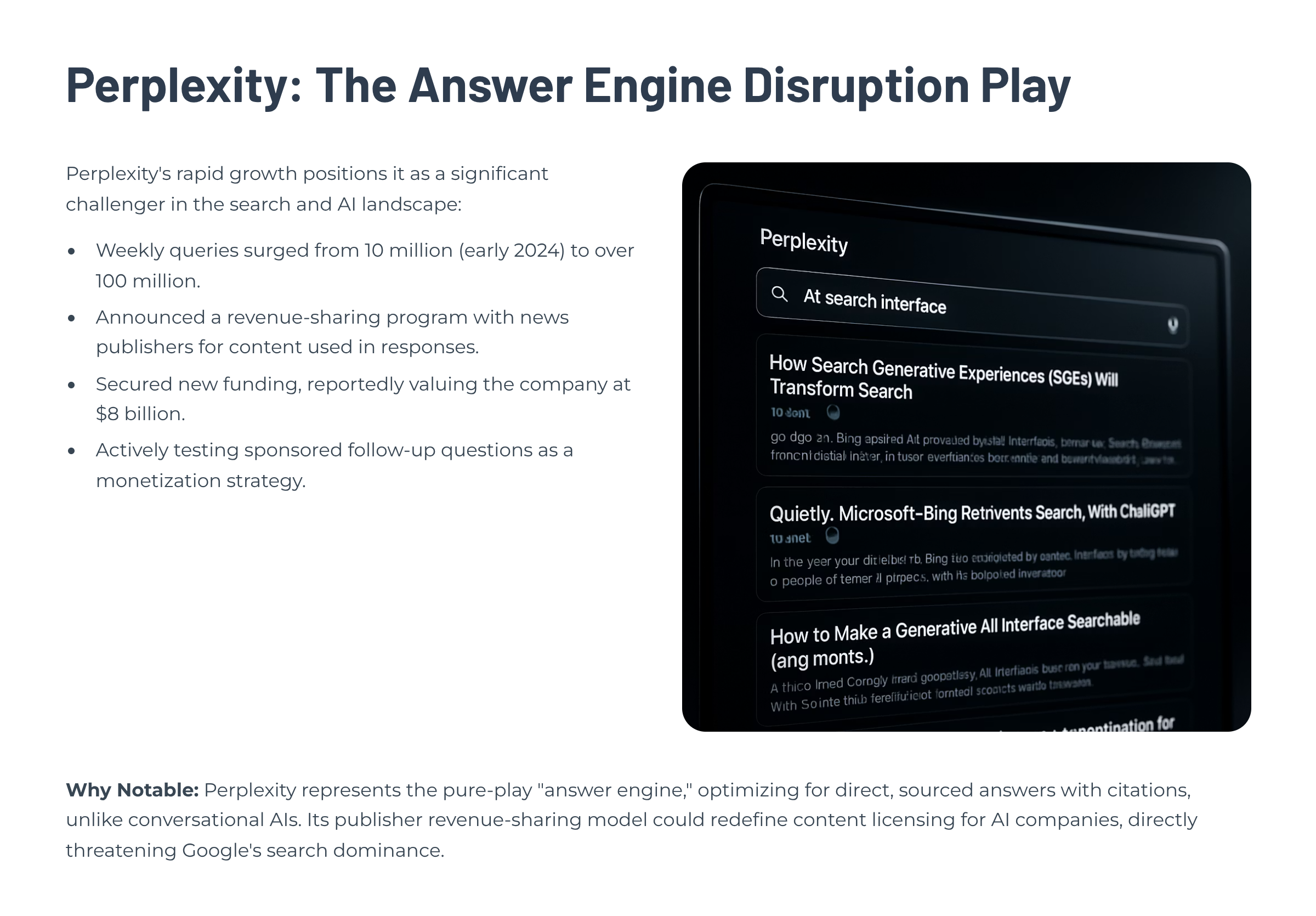

OpenAI: The Ecosystem & Legal Defense Play
COMPANY ANNOUNCEMENT: OpenAI Warns Investors of Fraud, Faces First Wrongful Death Lawsuit
- Sources: TechCrunch, CBSNews, BBC, WSJ
- Time: August 27-29, 2025
- Key Details:
- Issued formal warning about unauthorized firms misrepresenting relationships with the company to attract funding
- Facing first wrongful death lawsuit from parents of teen who died by suicide after allegedly jailbreaking ChatGPT’s safety prompts
- Joint safety evaluation with Anthropic found OpenAI’s models more likely to engage with harmful requests including bioweapons development
- OpenAI raised $40B in July 2025 at $150B valuation
Why Notable: OpenAI is grappling with the complex consequences of its market leadership. The lawsuit and safety evaluation results put OpenAI on the defensive, forcing public investment in safety guardrails related to real-world human impact.

DeepSeek: The Open Efficiency Play
COMPANY ANNOUNCEMENT: DeepSeek V3.1 Introduces Revolutionary “Think/Non-Think” Architecture
- Source: DeepSeek API Docs
- Time: August 21, 2025
- Key Details:
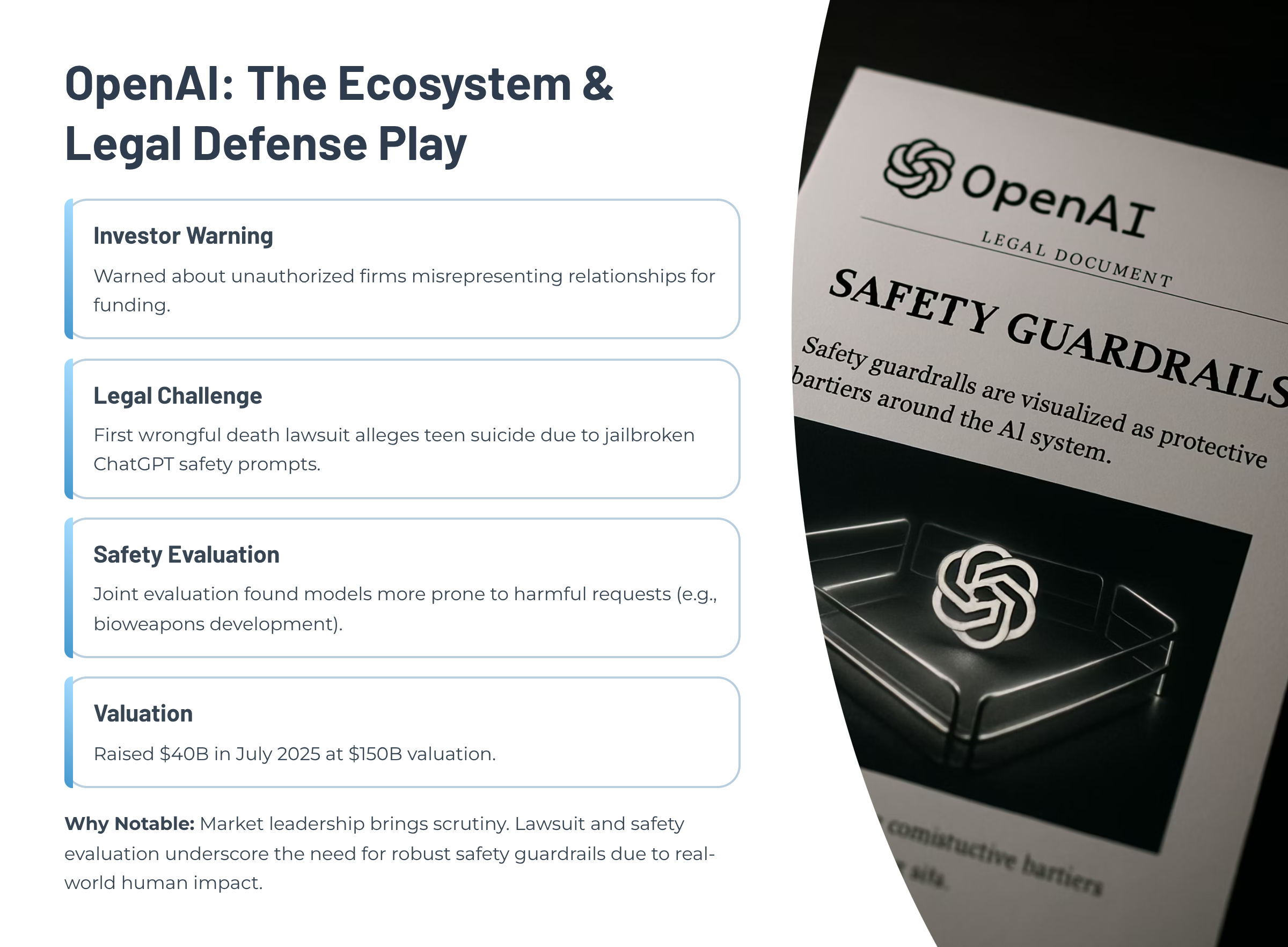
- Released V3.1 with hybrid inference architecture cutting costs by 70% for complex queries
- “Non-Think” mode processes simple queries at 0.14¢ per million tokens
- “Think” mode for complex reasoning at competitive rates
- Model released under MIT License, enabling commercial use
- Backed by Chinese hedge fund High-Flyer with significant compute resources
Why Notable: DeepSeek represents the most credible open-source challenger to closed models. Their cost-efficient architecture directly addresses the economic barriers preventing widespread agent deployment. The MIT licensing combined with state-of-the-art performance on coding benchmarks positions them as the developer’s choice for production deployments.

Meta
COMPANY ANNOUNCEMENT: Meta Deepens Llama Ecosystem While Privately Considering Competitor Models
- Sources: Meta AI Blog, Reddit Discussion
- Time: August 27-29, 2025
- Key Details:
- Continues promoting open-source Llama ecosystem with new AWS partnership supporting startups
- Internal discussions reveal leadership considering using Google or OpenAI models to power Meta AI features
- Aggressive talent acquisition continues with researchers joining from OpenAI and other top labs
Why Notable: Meta executes a sophisticated dual strategy – publicly championing open-source while pragmatically willing to use competitor models if they provide superior user experience in core social products.

Section 2: The Foundation — Hardware, Infrastructure, and Cloud
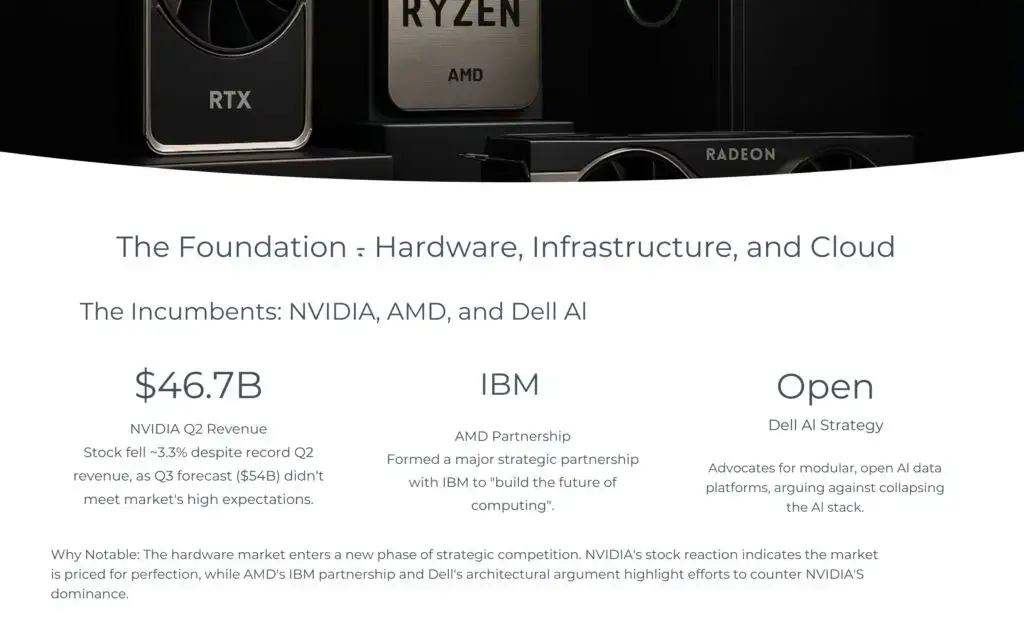
The Incumbents: NVIDIA, AMD, and Dell AI
INFRASTRUCTURE: Market Volatility and Strategic Positioning Among Hardware Giants
- Sources: Economic Times, AMD Newsroom, Dell Blog
- Time: August 21-29, 2025
- Key Details:
- NVIDIA: Stock fell ~3.3% despite record Q2 revenue of $46.7 billion. Q3 forecast of $54 billion, while ahead of consensus, wasn’t strong enough for market expectations
- AMD: Announced major strategic partnership with IBM on August 26 to “build the future of computing”
- Dell AI: Published strategic blog advocating for modular and open AI data platforms, arguing against collapsing the AI stack into single appliances
Why Notable: The hardware market enters a new phase of strategic competition. NVIDIA’s stock reaction indicates the market is priced for perfection. AMD-IBM partnership and Dell’s architectural argument reveal coordinated effort to build counter-narrative to NVIDIA’s full-stack dominance.
The Challengers: Groq and Cerebras Systems
HARDWARE INNOVATORS: Specialized Inference Providers Compete on Speed and Cost
- Sources: Groq Blog, Cerebras Blog
- Time: August 1-20, 2025
- Key Details:
- Groq: Introduced “Prompt Caching” on GroqCloud platform to significantly reduce latency and cost for repeated prompts
- Cerebras Systems: Launched “Cerebras Code” subscription service starting at $50/month, providing access to Qwen3-Coder at 2,000 tokens/second
- OpenAI’s gpt-oss-120B model runs at record 3,000 tokens/second on Cerebras systems
Why Notable: Both companies compete on the critical economic bottleneck: inference cost and latency. They create an alternative, unbundled AI stack (Open Model + Specialized Hardware) directly competing with integrated offerings.

Section 3: The Vanguard — Emerging Models and Disruptive Innovators

DeepSeek: Engineering the Agentic Model
FOUNDATION MODEL INNOVATORS: DeepSeek V3.1 Introduces Hybrid “Think/Non-Think” Architecture
- Source: DeepSeek API Docs
- Time: August 21, 2025
- Key Details:
- Chinese AI company released DeepSeek V3.1, explicitly framing it as “first step toward the agent era”
- Key innovation: hybrid inference architecture with fast “Non-Think” mode for simple queries and intensive “Think” mode for complex reasoning
- Significant upgrades to tool use and multi-step reasoning capabilities
- Released under permissive MIT License
Why Notable: DeepSeek’s architecture is a direct engineering response to the core economic challenge of agentic AI. Dynamic system allocates compute only when necessary, making complex AI agents more economically viable.

World Labs: The Quest for Spatial Intelligence
FOUNDATION MODEL INNOVATORS: Fei-Fei Li’s World Labs Emerges to Build Large World Models for 3D AI
- Sources: TechCrunch, Forbes
- Time: Recently emerged from stealth
- Key Details:
- Co-founded by renowned AI pioneer Dr. Fei-Fei Li with over $230 million in funding from Andreessen Horowitz and NEA
- Mission: build “Large World Models” (LWMs) with “spatial intelligence”
- Founding team includes creators of NeRF and real-time style transfer
Why Notable: Represents major push into what Dr. Li calls “the next frontier in AI.” Focus on LWMs signals birth of new category of foundation model, suggesting industry entering “post-linguistic” phase.

Archetype AI: Building the Perception Layer for the Physical World
FOUNDATION MODEL INNOVATORS: Archetype AI Introduces “Lenses” for Interpreting Sensor Data
- Source: Archetype AI Blog
- Time: Recent blog post
- Key Details:
- Building Newton, a “Large Behavior Model” (LBM) for interpreting real-time sensor data
- Introduced “Lenses” – AI applications that “refract” raw sensor data into tailored insights
- Framed as “Physical AI” aimed at augmenting rather than replacing human decision-making
Why Notable: Creating universal abstraction layer for IoT and physical world. “Lens” concept provides powerful new metaphor for human-AI interaction beyond conversational paradigm.
Section 4: The Ecosystem — Developer Tools, Open Source, and Agent Frameworks
LangChain: Maturing the Agent Stack
AGENT ORCHESTRATION: LangChain Introduces “Deep Agents” and Long-Term Memory SDK
- Sources: LangChain Deep Agents, LangMem SDK
- Time: Recent blog posts
- Key Details:
- “Deep Agents” incorporate planning tools, spawn sub-agents, and access file systems for persistent memory
- LangMem SDK addresses “AI amnesia” with three memory types: semantic, procedural, and episodic
- Procedural memory allows agent instructions to update based on performance
Why Notable: Building essential “middleware” for Agent Era. Evolution to “Deep Agents” with persistent memory marks shift from static prompt engineering to dynamic behavioral engineering.
Zep: The Rise of Context Engineering
MEMORY/CONTEXT: Zep Champions “Context Engineering” with Temporal Knowledge Graph
- Source: Zep Blog
- Time: August 7, 2025
- Key Details:
- Promoting “Context Engineering” – systematically assembling right information for agents
- Core technology Graphiti uses temporally-aware knowledge graph
- Claims superiority over MemGPT on memory retrieval benchmarks
Why Notable: “Context Engineering” provides clear framework for critical aspect of building effective AI agents, representing maturation beyond simple prompt engineering
HuggingFace & GitHub: The Open-Source Pulse
OPEN SOURCE: Apple Releases Vision Models, System Prompt Leaks Trend
- Sources: HuggingFace Models Hub, GitHub Trending, MSN
- Time: August 26-29, 2025
- Key Details:
- Major releases including Microsoft’s VibeVoice-1.5B, DeepSeek-V3.1, OpenAI’s gpt-oss models on HuggingFace
- Apple released FastVLM and MobileCLIP2 vision models for on-device performance, covered by The Verge
- System prompt leaks repository gained 2,000 stars in single day on GitHub
Why Notable: HuggingFace remains center of gravity for open-source AI. Apple’s release validates importance of open community. System prompt leaks highlight developer desire to reverse-engineer closed models.
Section 5: Capital, Markets, and Governance

Venture & Investment Flows: The Power Law in Action
BUSINESS & FINANCIAL: Capital Concentrates in Top-Tier AI Startups
- Sources: Pitchbook, Crunchbase
- Time: August 2025
- Key Details:
- 41% of all US VC dollars in 2025 went to just 10 companies (eight are AI companies)
- AI companies raised $118 billion by August 15, 2025, surpassing 2024’s $108 billion total
- Major rounds: Commonwealth Fusion Systems ($863M), Cohere ($500M), Cognition AI (~$500M)
Why Notable: AI funding landscape governed by power law. Handful of foundation model companies absorbing massive share of available capital, creating “barbell” effect in market.
Top AI Funding Rounds (Week of Aug 22-29, 2025)
Company | Amount | Lead Investors | Valuation | Strategic Focus |
Commonwealth Fusion Systems | $863M | Morgan Stanley, Nvidia | N/A | Nuclear fusion to power AI data centers |
Cohere | $500M | (Undisclosed) | $6.8B | Enterprise and sovereign generative AI solutions |
Cognition | ~$500M | (Undisclosed) | N/A | Code generation and automated software development |
Field AI | $405M | (Undisclosed) | N/A | AI software brain for robotics |
Titan | $74M | General Catalyst | N/A | Augmented AI platform for IT services |

Public Market Pulse: Navigating Volatility
BUSINESS & FINANCIAL: AI Stocks Tumble Despite Strong Performance
- Sources: Wall Street Journal, MarketWatch
- Time: August 22-29, 2025
- Key Details:
- NVIDIA: Stock fell 3.3% on August 29 despite record Q2 revenue of $46.7 billion beating estimates.
- Palantir: Six-day decline, falling ~16% from record high after short-seller report from Hindenburg Research
- C3.ai: Continued downtrend, falling 29.3% over past month according to NASDAQ data
Why Notable: Public markets for AI stocks in precarious position. Valuations priced for perfection, meaning even stellar results trigger sell-offs if they don’t surpass impossible expectations.
Regulatory & Geopolitical Landscape
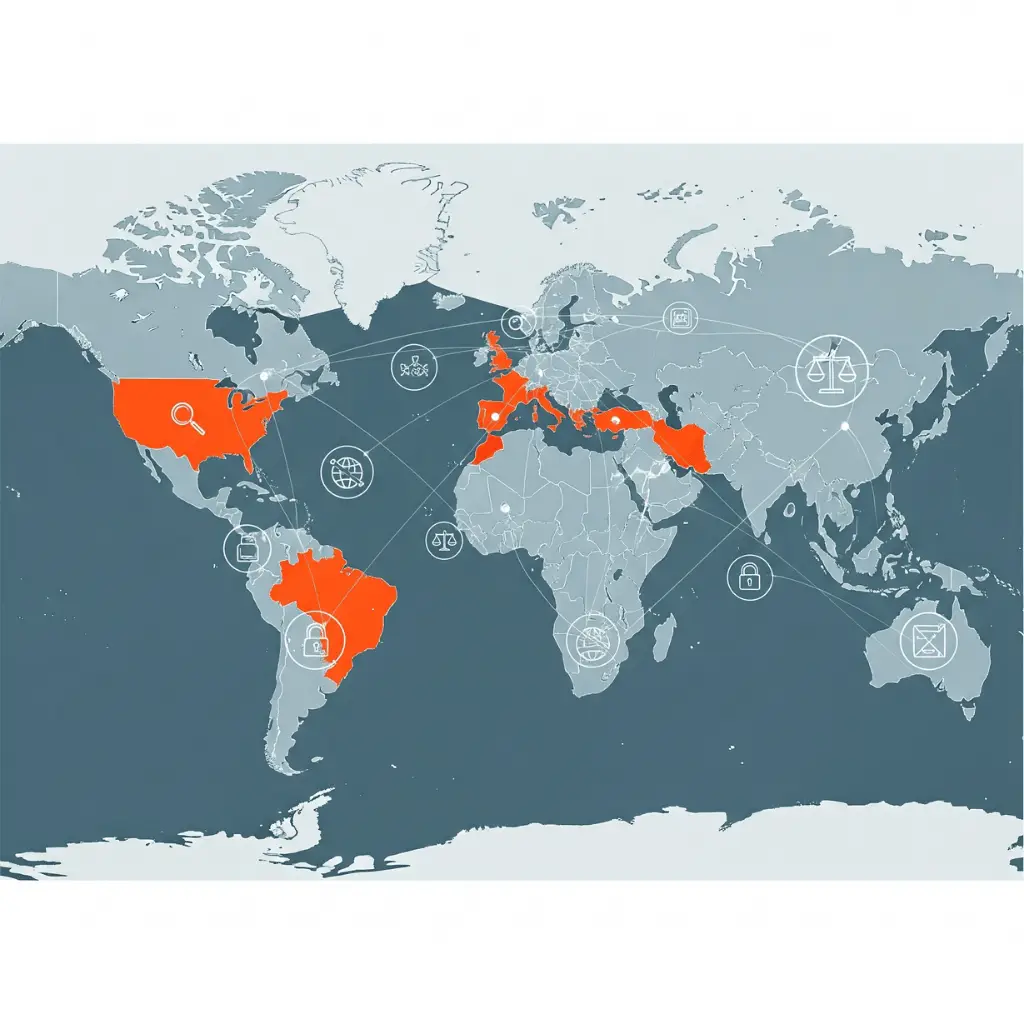
REGULATORY & POLICY: US, EU, and China Solidify Divergent AI Governance
- Sources: White House Press Release, Reuters
- Time: August 29, 2025
- Key Details:
- White House AI Action Plan: Strategy focused on accelerating innovation, reducing regulatory burdens per Brookings Institution analysis
- EU AI Act: Phased implementation with prohibitions on “unacceptable risk” systems beginning February 2025, covered by Wall Street Journal
- US-China Export Controls: US closed Validated End-User (VEU) program loophole, revoking license-free privileges according to Department of Commerce announcement
Why Notable: Global regulatory divergence solidifying. US prioritizes innovation with light-touch approach. EU cements role as global leader in risk-based regulation. US intensifies export controls as geopolitical strategy instrument.
Section 6: The Research Frontier — Academic and Scientific Breakthroughs

Key Paper Themes from ArXiv
RESEARCH & TECHNICAL: ArXiv Papers Focus on LLM Self-Improvement and Multimodal Reliability
- Source: ArXiv
- Time: Submissions circa August 28, 2025
- Key Details:
- LLM Self-Improvement: Paper proposes reinforcement learning framework where frozen LLM optimizes its own in-context learning examples
- Multimodal Hallucination: Addresses hallucinations in MLLMs as alignment problem
- Comprehensive Surveys: Consolidating vast knowledge from pre-training to advanced utilization techniques
Why Notable: Research focused on making AI models more autonomous, efficient, and reliable. Work on self-improving context selection points to future of models optimizing own inputs.
Institutional Initiatives: From Theory to Application
ACADEMIC INSTITUTIONS: Top Universities Launch High-Impact, Domain-Specific AI Centers
- Sources: Stanford HAI, MIT News, CMU News
- Time: August 25-28, 2025
- Key Details:
- Stanford HAI: Launched CREATE Center with $11.5M NIH grant for PTSD treatment tools
- MIT CSAIL: Unveiled VaxSeer AI tool outperforming WHO vaccine recommendations
- CMU AI: Eight Ph.D. students named SoftBank Group-Arm Fellows for embodied AI research
- Berkeley AI Research: Published framework for evidence-based AI policy in Science journal
Why Notable: Top institutions leveraging interdisciplinary strengths for specific, high-impact societal problems. Shift from general capability research to targeted applications
Section 7: The Zeitgeist — Public Discourse and Trending Content
Reddit & Developer Community Focus
TRENDING CONTENT: Developers Focus on Efficient Open Models and Re-evaluating Intelligence
- Sources: Reddit r/LocalLLaMA, Hacker News
- Time: August 28-29, 2025
- Key Details:
- Apple’s FastVLM/MobileCLIP2 release post scored 800+ on r/LocalLLaMA, analyzed by VentureBeat
- Active discussions on performance and local deployment of new open-source models on Hacker News AI section
- Philosophical implications explored: LLMs demonstrate complex behaviors via pattern matching, discussed in MIT Technology Review
Why Notable: Developer focus intensely practical. Central tension shifting from “open vs. closed” to “efficient vs. capable” debate.
TRENDING CONTENT: Public Narrative Shifts to Corporate Strategy and Societal Risk
- Source: Techmeme WSJ
- Time: August 22-29, 2025
- Key Details:
- Dominated by strategic maneuvers, privacy controversies, and legal battles
- Reported by WSJ, first documented murder-suicide involving AI chatbot user gains significant traction
- Notable lack of viral AI-generated creative content in last 24 hours
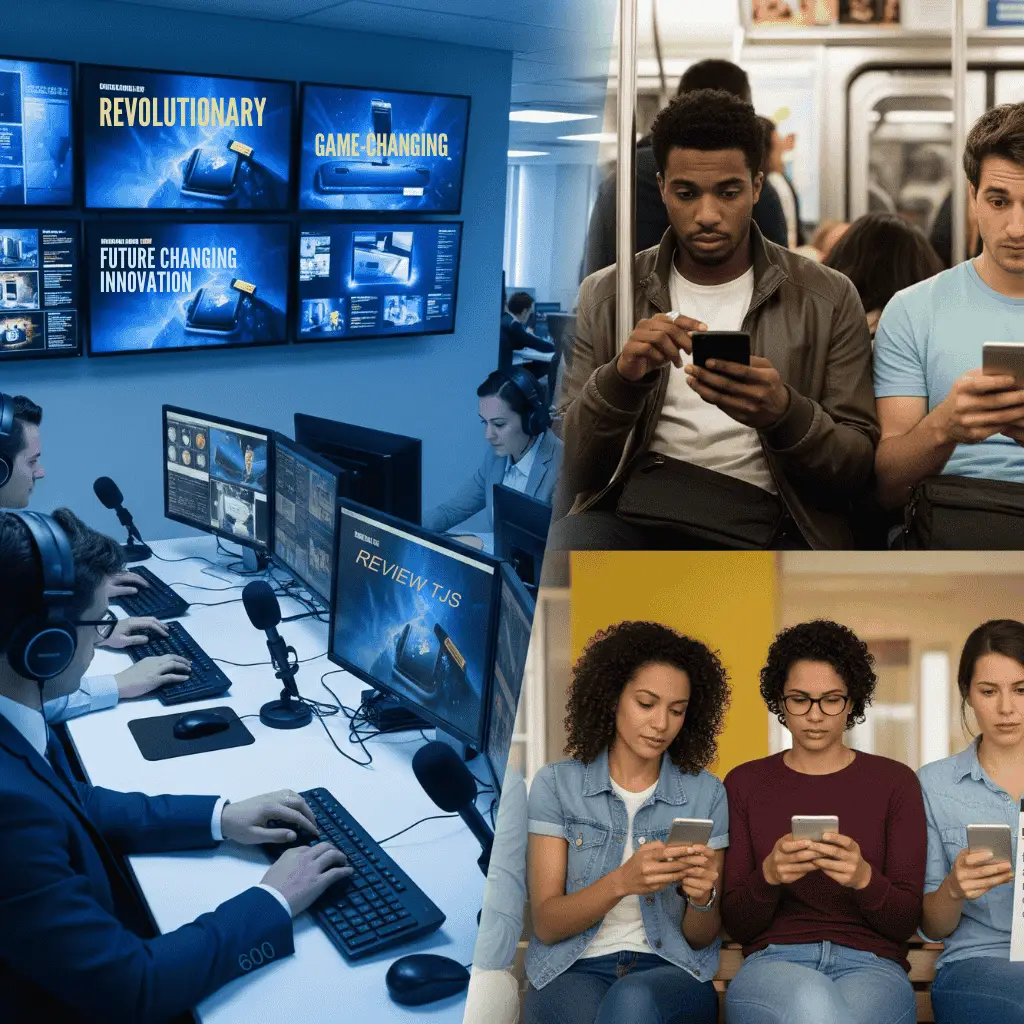
Why Notable: Public narrative maturing from initial “wow” factor to complex topics of corporate power, economic impact, and societal risk.
Mainstream Tech Media and Public Perception
Conclusion: Forward Outlook and Emerging Signals
This week’s intelligence paints a picture of an industry in rapid, multi-front expansion. The key signal: collision of agentic and physical AI trends. As agent frameworks mature with long-term memory and sophisticated logic, and foundational models capable of understanding the physical world emerge, truly autonomous, embodied agents become plausible.
The legal and ethical questions raised by text-based chatbots will be magnified thousandfold by agents that can interact with sensors, control robotics, and operate in the physical world. Winners in the next 12-24 months will be companies that not only build these advanced systems but also create the engineering frameworks, interaction metaphors, and safety protocols necessary for responsible deployment.
The groundwork for this new era was laid this week.
Executive Summary & Governance Takeaways
Executive Summary: From Digital Brains to Physical Worlds
(with Governance & Compliance Takeaways)
This week marks a pivotal shift in the AI industry. While large language models continue incremental improvement, the real momentum is moving toward:
Agentic architectures that can reason and act in multi-step workflows.
Physical AI systems designed to interpret the real world through spatial and sensor data.
Model sovereignty — enterprises and governments building in-house models to reduce reliance on external APIs.
These developments are colliding with rising economic pressure (inference costs, infrastructure competition) and regulatory scrutiny (privacy shifts, lawsuits, export controls). The outcome: AI is no longer just a digital assistant; it is rapidly becoming an autonomous actor with direct consequences for business models, compliance regimes, and even public safety.
Governance & Compliance Takeaways
Agent Era = New Governance Era
Agentic AI introduces decision-making autonomy, which requires clear accountability frameworks. Organizations should review NIST AI RMF “GOVERN” functions and start building policies that define human oversight boundaries.Physical AI = Expanded Risk Surface
Models interpreting sensor and 3D data will create compliance challenges under GDPR, EU AI Act, and sectoral safety laws. Risk assessments need to include data provenance, human factors, and product safety standards (ISO/IEC 42001, ISO/IEC 23894).Model Sovereignty = Compliance vs. Control Tradeoff
In-house models (e.g., Microsoft MAI-1) reduce third-party risk but also transfer compliance accountability fully onto the enterprise. Governance programs must ensure internal model cards, lifecycle monitoring, and incident response are in place.Privacy Shifts = Heightened Regulatory Pressure
Anthropic’s opt-out data policy mirrors broader industry moves toward “default collection.” Under GDPR/CCPA, default opt-in vs. opt-out is material. Firms leveraging such tools must document lawful basis, update AI acceptable use policies, and ensure data minimization controls.Legal Risk = Direct Board-Level Issue
OpenAI’s first wrongful death lawsuit signals that AI harms are moving from theory to courtrooms. For compliance officers, this is a call to embed duty-of-care language and incident documentation processes directly into governance charters.Financial Volatility = Risk for AI Adoption Roadmaps
With 41% of U.S. VC funding captured by 10 companies and public AI valuations swinging wildly, reliance on a narrow set of suppliers carries concentration risk. Governance should address vendor resilience, diversification, and long-term exit strategies.
Bottom Line
The AI landscape is entering a new accountability frontier. Organizations that integrate governance frameworks (NIST, ISO/IEC 42001, EU AI Act) now will be best positioned to:
Scale with compliance confidence,
Mitigate reputational and legal risks, and
Build trust with regulators, partners, and customers.
The next trillion dollars of value will come not just from building smarter models, but from building responsible systems around them.